Development Planned Around Business Workflows, Customer Actions, and Long-Term Ownership

Texas Web Development for Fast, Scalable, Business-Ready Websites

FiliCode provides Texas web development for service companies, professional firms, ecommerce businesses, and growing teams that need more than an attractive homepage. We plan the architecture, content system, integrations, performance, security, and conversion paths required to turn a website into a dependable business platform.

Discuss Your Development Scope

What Is Professional Website Development?

Professional website development is the process of turning business requirements, approved designs, content, and workflows into a secure, responsive, maintainable website. It covers front-end interfaces, back-end logic, content management, forms, integrations, analytics, testing, deployment, and ongoing technical support.

Built Around Operations

The website should support how leads are qualified, appointments are booked, products are managed, content is approved, and customer requests reach the right team.

Designed to Be Maintained

Reusable templates, structured fields, controlled permissions, and documented integrations make future updates safer and more efficient.

Measured by Real Actions

Calls, form submissions, bookings, registrations, purchases, downloads, and qualified inquiries should be trackable after launch.

What Should a Texas Business Website Be Able to Do?

A useful website should explain the offer clearly, load reliably, work across devices, and guide visitors toward the next sensible action. Behind the interface, it may also need to route leads, sync customer data, support staff permissions, publish location content, process payments, connect with booking tools, or provide account features.

FiliCode begins with these operating requirements instead of selecting technology first. We identify who will manage the site, which actions need tracking, what information must move between systems, and where manual work can be reduced. The resulting scope can combine strategy, interface design, development, migration, and launch support through our broader website design and development service.

Map Your Website Requirements
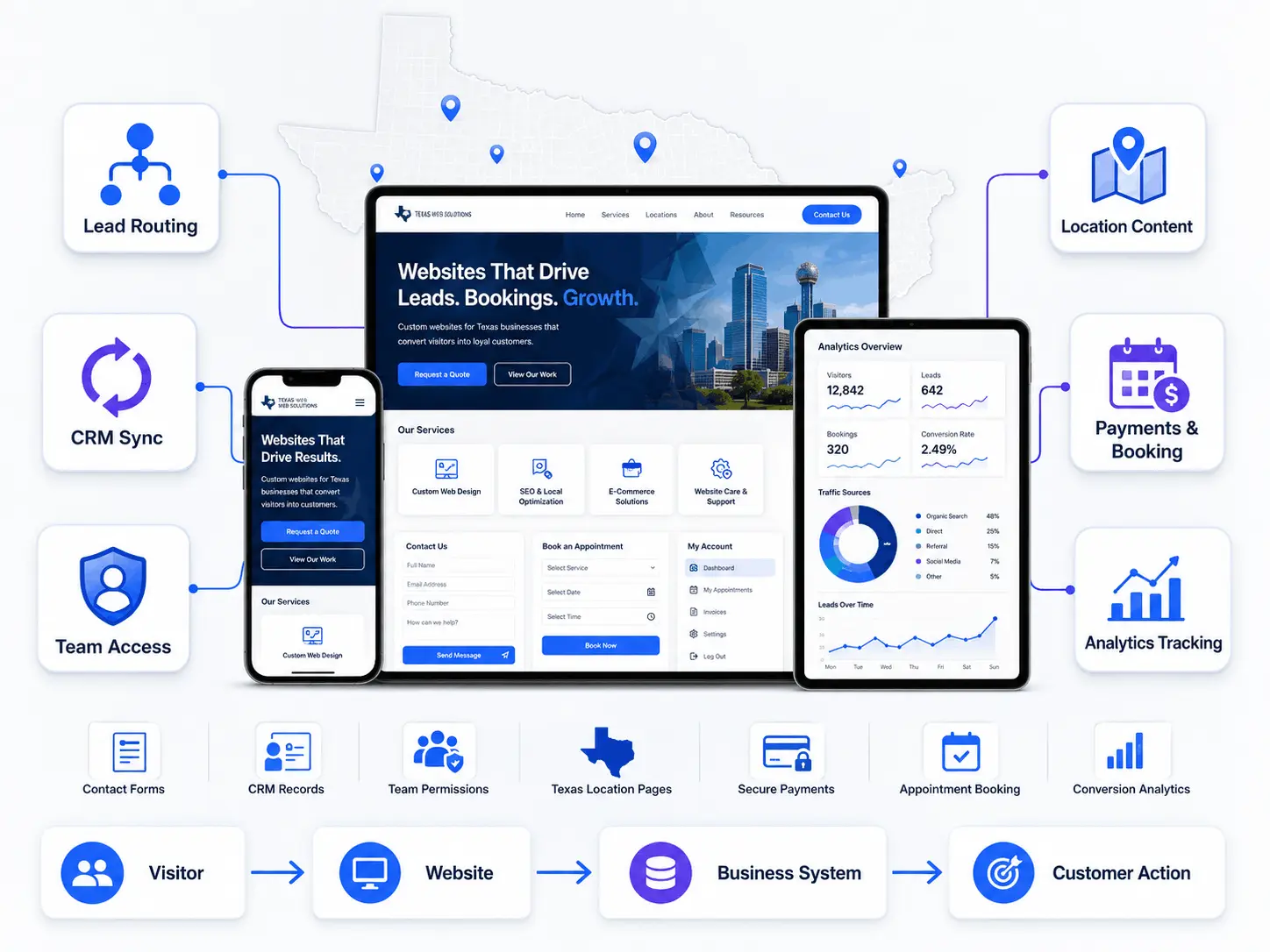
Business website operations dashboard showing responsive screens, lead routing, CRM synchronization, team access, location content, payments, booking, and analytics tracking.

6 Texas Web Development Solutions for Different Business Needs

A focused marketing website, a content-heavy WordPress build, and a custom ecommerce platform should not be scoped the same way. FiliCode selects the development approach according to the required workflows, integrations, editing needs, performance targets, and expected growth.

Custom front-end and back-end development icon

Custom Front-End and Back-End Development

Build responsive interfaces, reusable components, server-side logic, admin controls, database workflows, and application features around defined business requirements.

WordPress content management development icon

WordPress Development

Our WordPress development services cover custom themes, templates, structured content fields, plugin integrations, role-based editing, migrations, and maintainable publishing workflows.

Ecommerce store and payment workflow development icon

Ecommerce Development

Plan product structures, search and filtering, customer accounts, checkout logic, payment connections, order workflows, and business integrations through custom ecommerce development.

Responsive and accessible website interface icon

Responsive and Accessible Interfaces

Develop mobile-responsive layouts with clear navigation, usable forms, readable content hierarchy, keyboard support, practical contrast, and consistent interaction behavior.

API integration and business automation icon

APIs and Business Integrations

Connect forms, CRM platforms, payment providers, email systems, booking tools, analytics, inventory sources, and other approved services while planning validation and error handling.

Website redesign and performance improvement icon

Redesign, Migration, and Performance

Modernize an existing website while reviewing URL preservation, redirects, content migration, page speed, browser behavior, analytics, forms, and launch dependencies. Post-launch support can also cover updates, monitoring, troubleshooting, and planned technical improvements.

Need a build plan that accounts for content, users, integrations, and growth?

Define The Technical Scope

Which Development Approach Fits the Project?

The right approach depends on what the website must do after launch. Choosing a familiar platform is useful only when it supports the required content model, integrations, team permissions, customer journeys, and maintenance responsibilities.

Content and Lead-Generation Websites

  • Structured Service Content

    Reusable templates keep service, industry, team, case study, resource, and location pages consistent without forcing every page into identical copy.

  • Clear Conversion Paths

    Calls, forms, consultation requests, downloads, and booking actions are placed where visitors have enough information to make a decision.

  • Search and Measurement Readiness

    Technical development can support crawlable content, clean heading structure, metadata controls, event tracking, and coordination with our Texas SEO services.

Custom Platforms and Commerce Workflows

  • Business Logic Before Screens

    User roles, permissions, calculations, approvals, notifications, order states, and exceptions are documented before interface development begins.

  • Integration Boundaries

    Each connection needs defined data ownership, authentication, validation, failure handling, rate limits, and responsibility when an external service is unavailable.

  • Scalability With Real Constraints

    Architecture decisions consider expected traffic, content volume, account activity, reporting needs, hosting, maintenance capacity, and the cost of future changes.

How Does the FiliCode Development Process Work?

Our delivery process separates discovery, architecture, interface decisions, development, verification, and release. This makes dependencies visible and helps prevent late surprises caused by missing content, unclear integrations, or undefined approval responsibilities.

Project discovery icon

01. Discover

Technical architecture icon

02. Architect

Interface specification icon

03. Specify

Website build icon

04. Build

Website verification icon

05. Verify

Website release icon

06. Release

Discovery and Technical Scope

We review audiences, actions, content, current systems, user roles, integrations, analytics, hosting constraints, launch expectations, and internal responsibilities.

Architecture and Acceptance Criteria

Page types, data structures, permissions, integration behavior, responsive requirements, and measurable completion criteria are defined before the build expands.

Development and Review

Features are developed in reviewable stages so content, interface behavior, business logic, and integration results can be checked against the agreed scope.

Testing and Launch Readiness

Testing covers key devices, browsers, forms, validation, account flows, integrations, analytics events, redirects, indexability settings, security basics, and critical error states.

Deployment and Stabilization

After release, we verify production behavior, access, forms, tracking, caching, SSL, redirects, and required integrations before moving into the agreed support arrangement.

How Do We Make Website Development Safer to Manage?

Website security is not one plugin or a single launch check. Risk is reduced through appropriate access controls, supported software, careful validation, protected credentials, tested backups, controlled deployments, and clear ownership of updates. The exact controls depend on the platform, data handled, integrations, and hosting environment.

Controlled Access

Administrative roles and credentials are limited according to responsibility rather than shared across every team member.

Validated Inputs

Forms, uploads, account fields, and integration payloads require validation, sanitization, and clear handling of failed requests.

Recoverable Changes

Backups, staging, version control where appropriate, and documented deployment steps reduce the impact of avoidable mistakes.

Visible Responsibility

Hosting, domain, software, content, integrations, monitoring, and maintenance responsibilities are agreed before handover.

What Should a Texas Web Development Company Provide at Handover?

A completed website should not be handed over as an unexplained collection of pages and files. The business should understand what was delivered, who controls each account, which workflows were tested, and what responsibilities continue after launch. FiliCode plans handover around practical ownership, operational clarity, and safer future updates.

Confirmed Deliverables

Completed templates, features, integrations, content responsibilities, and agreed exclusions should be checked against the approved project scope.

Account and Access Ownership

Domain, hosting, CMS, analytics, integration, and administrative access should be assigned clearly so the business is not dependent on shared or undocumented credentials.

Production Verification

Forms, calls to action, analytics events, redirects, responsive layouts, payment flows, account features, and important integrations should be checked in the live environment.

Maintenance Roadmap

The handover should identify software-update needs, backup responsibilities, monitoring requirements, support boundaries, and possible improvements for future development phases.

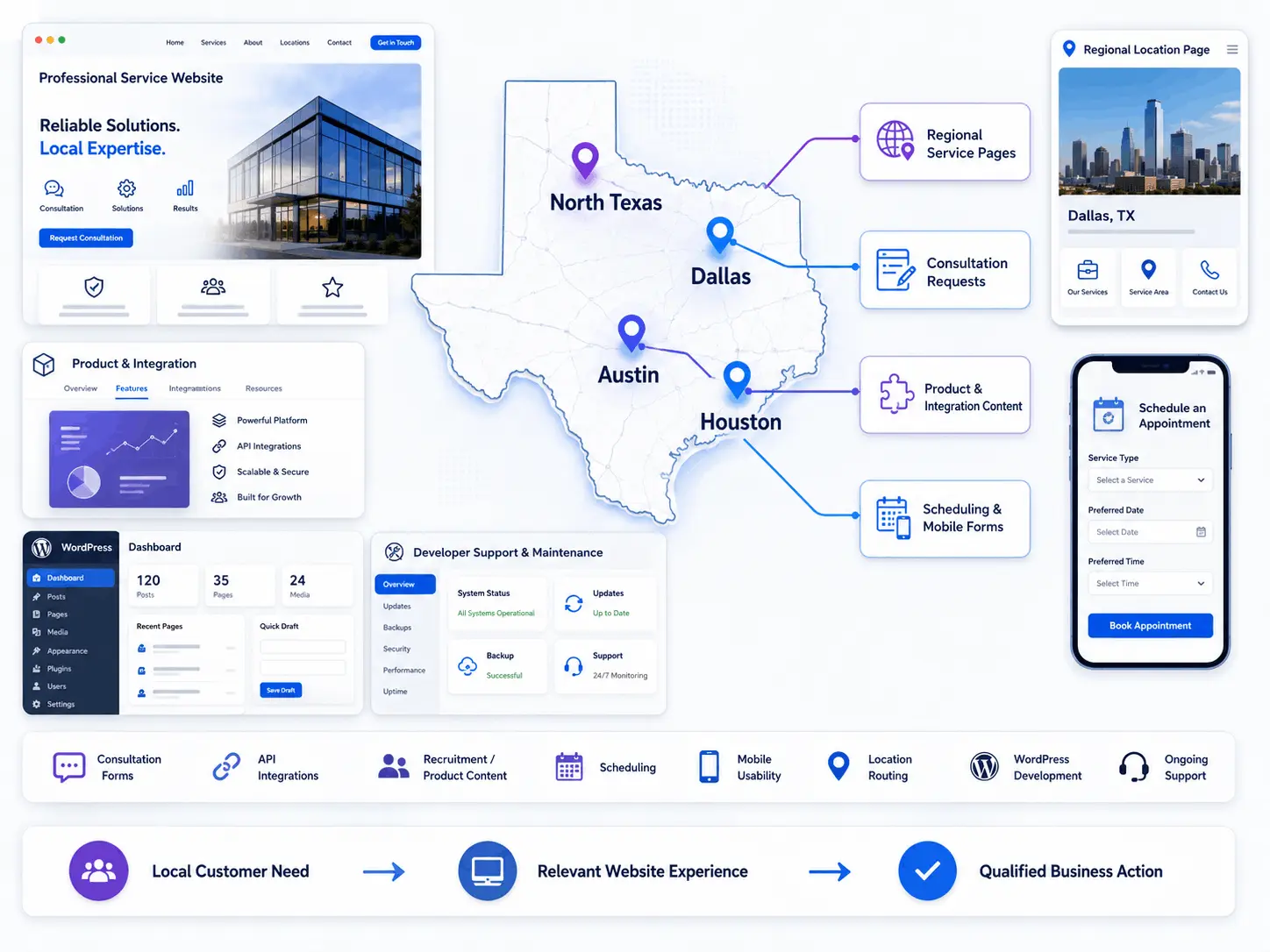
Texas web development map showing Dallas, Austin, Houston, and North Texas connected to consultation forms, integrations, scheduling, regional pages, and WordPress support.

Development Support Across Dallas, Austin, Houston, and North Texas

Texas businesses can have very different sales models even when they operate in the same industry. A North Texas professional firm may depend on consultation requests and regional service pages, while an Austin technology company may need product education, integrations, and recruitment content. A Houston service operation may require location routing, scheduling, and mobile-first forms for customers contacting the business from the field.

FiliCode does not treat city names as a substitute for useful content. Regional relevance comes from real service coverage, customer needs, operating details, and a website structure that helps each audience reach the correct information. Businesses that want to expand internal capacity can also hire a WordPress developer for focused implementation and ongoing platform work.

Review Your Current Platform

Seven Questions to Ask a Texas Web Development Company

A useful comparison should examine how a team defines scope, handles content, selects a technology stack, manages integrations, tests critical workflows, protects ownership, and supports the site after launch. Buyers should also separate visual design decisions from the technical work required to operate, secure, update, and maintain a website.

Website scope question icon

Scope

Content ownership question icon

Content

Technology stack question icon

Stack

Website integration question icon

Integrations

Website testing question icon

Testing

Website ownership question icon

Ownership

Website support question icon

Support

Frequently Asked Questions

Custom website development cost depends on the number of unique templates, content readiness, user roles, integrations, ecommerce requirements, data migration, accessibility work, testing depth, and support scope. FiliCode reviews these factors before proposing a build so the estimate reflects defined deliverables and dependencies rather than a generic package.

The timeline depends on scope, content availability, approval speed, design readiness, integration complexity, migration needs, and testing requirements. A focused business website can move faster than a custom application or ecommerce build. A reliable schedule should show phases, client dependencies, review windows, and launch criteria before development begins.

Post-launch support can include software updates, backups, uptime checks, security reviews, content changes, form testing, performance monitoring, analytics verification, integration troubleshooting, and scoped feature improvements. The exact responsibilities and response expectations should be agreed before handover.

Web developer pay in Texas varies by experience, specialty, city, portfolio, employment model, and whether the role is front-end, back-end, full-stack, or technical leadership. Employers and contractors should use current compensation data for the specific role and metro area instead of relying on one statewide figure.

Website design and development are generally treated as taxable data-processing services in Texas. Texas guidance also identifies website creation, hosting, repair, and maintenance as taxable data-processing activities. Twenty percent of the charge for qualifying data-processing services is exempt, so tax generally applies to the remaining 80%. Because contracts and bundled services can vary, businesses should review the official Texas Comptroller guidance on taxable services or consult a qualified tax professional.

Request a Texas Website Development Consultation

Share your current website, required pages, user roles, integrations, content status, preferred platform, launch goals, and any technical concerns. FiliCode will review the project fit and recommend a practical direction for a new build, migration, redesign, or phased platform improvement.

We hate spam, and we respect your privacy.

Contact FiliCode about a Texas website development project