WordPress Websites Built Around Real Business Workflows
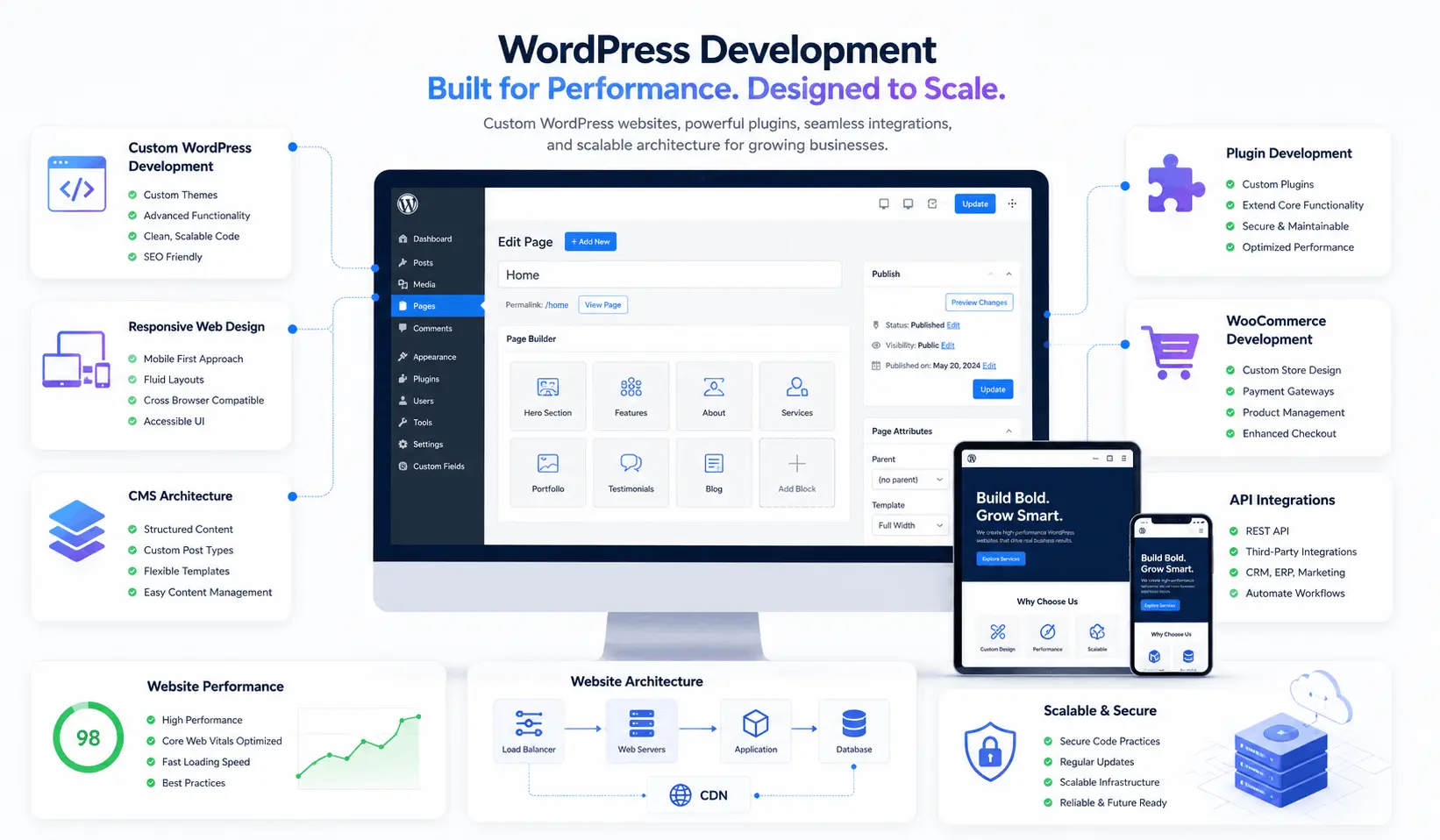
NYC WordPress Development Services help businesses plan, build, integrate, migrate, and maintain WordPress websites that support practical business goals. FiliCode combines custom development, responsive design, WooCommerce, performance optimization, technical SEO awareness, integrations, and long-term support in one structured delivery process.
Discuss Your WordPress ProjectA professional WordPress partner should do more than install a theme and arrange page blocks. The work can include information architecture, custom theme development, plugin planning, CMS configuration, API integrations, WooCommerce workflows, accessibility considerations, performance improvements, migration, deployment, and ongoing technical support.
We clarify users, content responsibilities, integrations, lead paths, ecommerce requirements, and administration needs before development decisions are finalized.
The site structure is planned around current requirements while keeping future pages, features, integrations, and content expansion in mind.
A useful CMS should make routine content updates manageable while keeping sensitive development tasks controlled and maintainable.
Custom development becomes useful when the website must support requirements that are difficult to handle reliably with a generic template. Examples include unusual content relationships, membership workflows, advanced forms, external APIs, customer dashboards, complex product rules, multilingual structures, gated resources, or internal operational processes.
FiliCode evaluates where standard WordPress functionality is sufficient and where custom code provides a practical advantage. The goal is not to custom-build every feature. It is to avoid unnecessary complexity while giving the project enough flexibility to support its actual requirements.
Businesses comparing broader development options can review our
WordPress development services
to understand how custom themes, integrations, migrations, ecommerce, support, and performance improvements can work together.
Different websites need different levels of engineering. FiliCode organizes development around the business model, content structure, user journey, technical dependencies, administration needs, and expected growth of the website.
Build a WordPress front end around approved layouts, reusable components, content requirements, responsive behavior, and manageable editing workflows.
Convert approved designs into responsive WordPress templates while preserving layout hierarchy, content flexibility, reusable sections, and consistent behavior across screen sizes.
Extend WordPress with carefully scoped functionality, third-party APIs, CRM connections, payment workflows, forms, automation tools, and other business systems.
Develop product, cart, checkout, payment, shipping, account, and operational workflows based on the way the store actually sells and manages orders. Projects needing specialized ecommerce support can also hire experienced WooCommerce developers.
Move websites carefully, preserve important URLs where appropriate, review redirects, reduce avoidable front-end weight, and address performance problems affecting real users.
Support updates, bug resolution, compatibility reviews, security-related maintenance, content changes, performance monitoring, and controlled improvements after launch.
Have a WordPress requirement that does not fit a generic package?
Review It With FiliCodeThe answer depends on the quality of the existing codebase, the scale of the requested changes, content migration needs, plugin dependencies, technical debt, and how different the future website is from the current one.
The theme, plugins, database structure, and hosting setup can support the planned improvements without introducing unreasonable development risk.
Performance work, new templates, design refinements, integrations, conversion improvements, and content restructuring can be completed without rebuilding everything.
In some projects, a controlled improvement plan is more practical than replacing stable workflows that already support the business.
A rebuild may make sense when fragile code, abandoned plugins, inflexible templates, or poor architecture block necessary business changes.
New services, customer journeys, ecommerce workflows, integrations, locations, or content models may require a substantially different website structure.
A carefully planned rebuild can replace repeated short-term fixes with clearer components, documentation, workflows, and responsibilities.
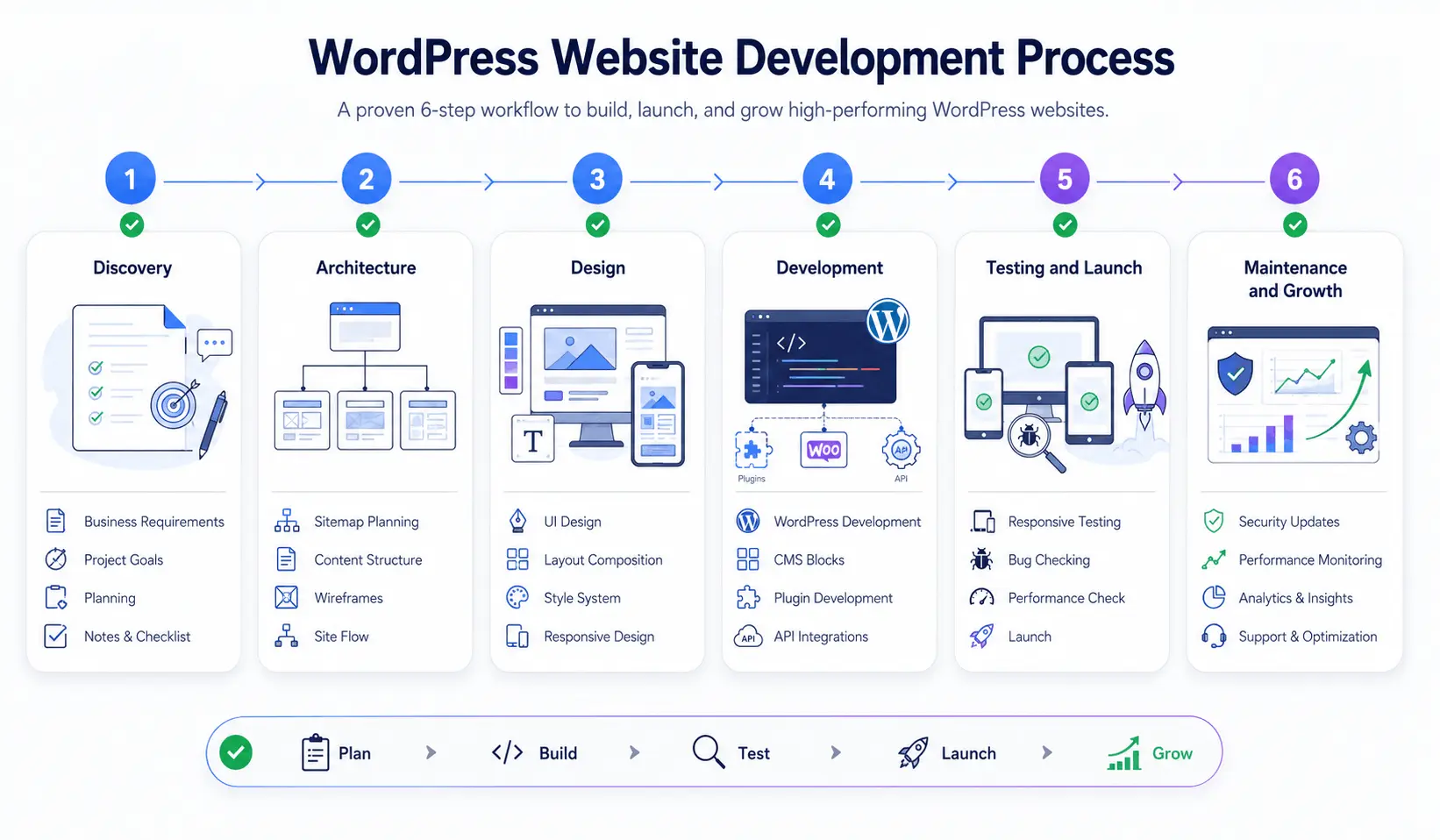
Our delivery process separates discovery, architecture, development, quality assurance, launch, and support. This creates clearer decisions and reduces the confusion that often appears when design, content, development, and business requirements move in different directions.
We clarify who will use the website, what they need to accomplish, and which paths should lead toward inquiries, purchases, bookings, applications, or other business outcomes.
Pages, custom post types, taxonomies, forms, integrations, ecommerce logic, and administrative workflows are reviewed before development begins.
Templates and features are developed with consistency in mind so the website can grow without requiring every new page to become a separate engineering project.
APIs, forms, ecommerce services, CRM systems, tracking tools, payment providers, and other dependencies are integrated according to project scope.
Forms, navigation, checkout paths, responsive behavior, content presentation, account functions, integrations, and other important journeys are reviewed before release.
Launch planning considers backups, DNS or hosting dependencies, redirects where needed, analytics, indexing controls, and post-launch checks.
Ongoing support can cover controlled updates, issue resolution, compatibility work, security-related maintenance, backups, and technical improvements.
After launch, website behavior, content needs, search performance, customer questions, and internal workflows can reveal better priorities for future improvements.
A website can look complete while still being difficult to update, expensive to change, overloaded with plugins, or dependent on undocumented customizations. FiliCode treats maintainability as part of the development work rather than a separate concern discovered after launch.
Scope decisions are connected to specific users, workflows, content needs, integrations, and operational responsibilities instead of vague feature lists.
We consider when established WordPress features are enough, when a trusted plugin is appropriate, and when custom development provides stronger control.
Project communication should make decisions, dependencies, risks, responsibilities, and next steps understandable to both technical and business stakeholders.
Development choices consider future content, feature expansion, support requirements, integrations, performance, and the people responsible for managing the website.
FiliCode can support complete projects or focused development requirements. Businesses with a defined technical backlog can also hire a WordPress developer for scoped implementation and ongoing technical work.
Discuss Your Development NeedsWordPress is an open-source content management system used for many types of websites. Its practical value comes from how the CMS, theme layer, plugins, content model, hosting environment, and integrations are planned together. For general platform background, see the WordPress overview on Wikipedia.
Custom development is most useful when website requirements extend beyond simple publishing. The need may come from integrations, administration workflows, ecommerce logic, content scale, redesign requirements, or the cost of maintaining an unsuitable existing setup.
Business Sites
Commerce
Integrations
Redesigns
Migrations
Performance
Support
Growth
New York businesses do not all need the same type of WordPress website. A professional services firm may need clear lead-generation paths and CRM integration, while an ecommerce company may depend on product management, payments, shipping rules, customer accounts, and reliable checkout workflows.
Businesses serving Manhattan, Brooklyn, Queens, the Bronx, Staten Island, or customers beyond New York may also need different approaches to service pages, location content, navigation, conversion paths, and website expansion. The development structure should support the actual market and customer journey rather than adding location pages or features without a clear purpose.
A capable WordPress development partner should be able to explain how design, CMS architecture, integrations, performance, technical SEO, content publishing, analytics, and maintenance responsibilities will work together. FiliCode connects these decisions early so the website is easier to operate, improve, and expand after launch.
Businesses planning organic growth alongside development can review our
New York SEO optimization services.
Companies still comparing freelancers, specialists, and agency support can also review our guide on how to
find the right WordPress developer
before selecting a development partner.
Tell us about the website you are planning, the current platform if one exists, required integrations, ecommerce needs, content structure, technical concerns, and launch priorities. FiliCode will review the requirements and help identify a practical development direction.