





Contents
- Quick Summary:
- Why Companies Hire Dedicated PHP Developers for Long-Term Support
- Hire PHP Developer for Legacy Code and Architecture
- What Dedicated PHP Developers Actually Handle
- Hire Dedicated PHP Developer for WordPress and WooCommerce Scaling
- Dedicated PHP Development Team and Hiring Models
- Hiring PHP Developers in India, USA, or Remotely
- Hire Dedicated PHP Programmers for APIs and Integrations
- Monolith vs Microservices in PHP Systems
- SaaS Platforms Need Product Architecture Thinking
- AI Automation and PHP Backend Systems
- Performance Optimization Is Continuous
- Security, RBAC, and Maintainability
- Cheap PHP Development vs Maintainable Systems
- When a Dedicated PHP Team Makes Sense
- How to Evaluate Before Hiring
- Frequently Asked Questions
- How much does it cost to hire dedicated PHP developer support?
- Should I hire dedicated PHP developer from India or the USA?
- Can a dedicated PHP developer scale WooCommerce?
- When should businesses hire PHP developers?
- Is PHP still suitable for SaaS development?
- Conclusion
If you need to hire PHP developer for legacy code, long-term maintenance, or platform upgrades, the right support should do more than fix isolated issues. Businesses hire dedicated PHP developer support when they need reliable technical ownership, lower technical debt, and stable workflows across WooCommerce, APIs, and custom PHP systems.
PHP still powers WordPress, WooCommerce, Laravel applications, SaaS dashboards, CRMs, marketplaces, booking systems, and B2B portals. The real question is not whether PHP can scale. It can. The real question is whether the developer understands architecture, integrations, caching, queues, database load, security, and long-term maintainability.
Quick Summary:
- A dedicated PHP developer should improve system reliability, not only complete tasks.
- The right hire depends on architecture, traffic, integrations, and maintenance needs.
- WooCommerce, WordPress, SaaS, and marketplace platforms require different PHP skills.
- Low-cost PHP development can become expensive if code lacks structure, logging, testing, or upgrade planning.
- A good PHP engineer thinks about APIs, caching, queues, database scaling, RBAC, and deployment risk.
Why Companies Hire Dedicated PHP Developers for Long-Term Support
Businesses planning to hire PHP developer long term need continuity. The developer learns the codebase, business rules, workflows, and previous decisions, reducing repeated onboarding and improving delivery speed.
That is when basic support stops being enough.
Companies usually hire dedicated PHP developer resources when they face issues like slow checkout, broken plugins, unstable API sync, poor admin performance, failed webhooks, database delays, and repeated bugs after updates.
Businesses that want to hire a PHP developer long term need continuity. The developer learns the codebase, business rules, workflows, and previous decisions, reducing repeated onboarding and improving delivery speed.
A freelancer may fix a bug. A dedicated PHP developer can improve the system that keeps creating bugs, especially when you need long-term support from someone who understands how to hire a dedicated PHP programmer for ongoing backend ownership.
Hire PHP Developer for Legacy Code and Architecture
The biggest mistake is treating PHP as simple scripting. In production, PHP often manages checkout, authentication, CRM sync, reporting, admin tools, payment states, subscriptions, permissions, and customer portals.
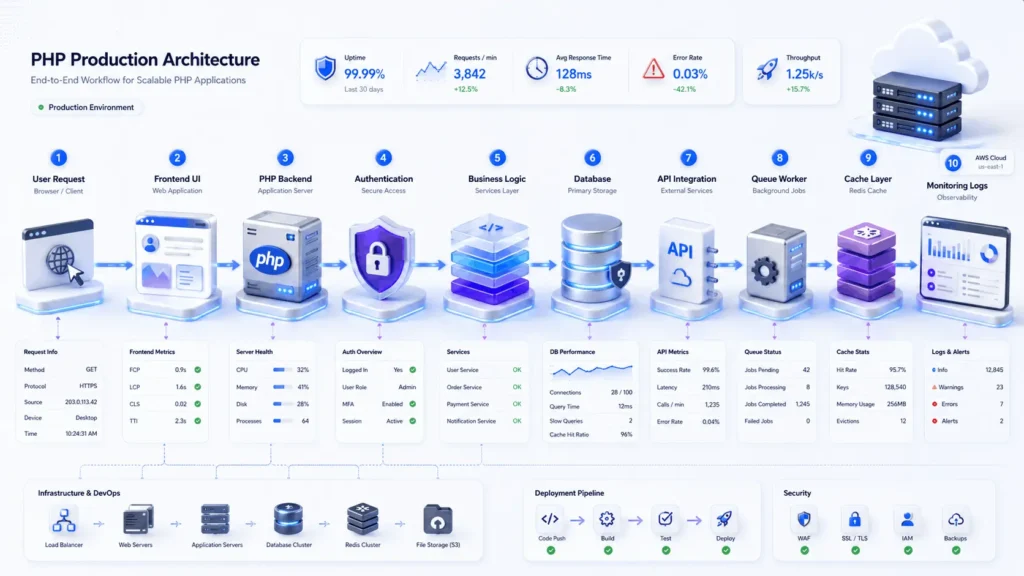
A normal workflow may look simple:
User submits a request. PHP validates the input, checks authentication, loads permissions, queries the database, applies business logic, calls an API, stores records, triggers background jobs, updates cache, logs activity, and returns a response.
Under low traffic, weak architecture may stay hidden. Under real traffic, problems appear quickly. A slow query blocks the page. A payment API delay affects checkout. A missing retry creates failed orders. Poor logging makes support teams blind.
This is why businesses should hire a PHP developer for legacy code with production experience, not only framework knowledge.
What Dedicated PHP Developers Actually Handle
A senior PHP developer works across backend logic, database design, integrations, security, deployment, and performance.
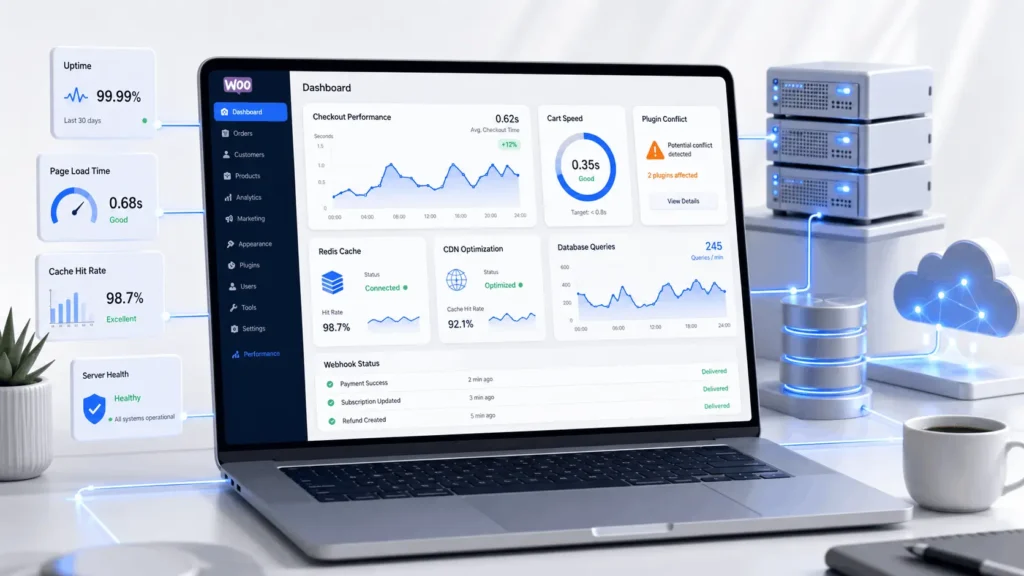
For WordPress and WooCommerce, this may include custom plugin development, hooks, REST API integrations, checkout customization, Redis object caching, cron replacement, payment gateways, CDN optimization, and plugin conflict debugging.
For SaaS products, it may include tenant isolation, subscription workflows, admin panels, RBAC, audit logs, background queues, reporting, and billing logic.
For enterprise software, it often includes CRM integration, ERP sync, webhook handling, secure authentication, custom dashboards, operational reporting, and practical website design and development where users interact with the system daily.
PHP remains a mature server-side language used for business platforms, APIs, and legacy systems. Dedicated PHP developers benefit from its broad ecosystem, framework support, and long-term maintainability. For technical background, review Wikipedia’s overview of PHP.
Hire Dedicated PHP Developer for WordPress and WooCommerce Scaling
WordPress projects fail at scale when every problem is solved with another plugin.
Plugins are useful, but production WordPress development services require knowing when to use hooks, when to build custom architecture, when to optimize queries, when to cache, and when to move heavy work outside normal page requests.
WooCommerce has its own bottlenecks: cart fragments, checkout calculations, payment callbacks, coupon validation, shipping rates, admin order screens, and reporting queries.
A strong WordPress PHP developer should understand:
- Custom WordPress plugin development, hooks, and filters
- WooCommerce checkout lifecycle
- REST API integrations
- Redis object caching
- CDN optimization
- Plugin conflict management
- Database indexing
- Security hardening
- Gutenberg customization
- Server-level cron jobs
WordPress cron is a common issue. It works for small sites, but it depends on traffic. For serious automation, server cron or queue workers are more reliable.
If your store processes daily revenue, long-term PHP developer support can help manage these production limits.
Dedicated PHP Development Team and Hiring Models
Different hiring models solve different problems.
| Hiring Model | Best For | Risk |
|---|---|---|
| Full-time dedicated developer | SaaS, WooCommerce, marketplaces, long-term product work | Higher monthly cost |
| Part-time dedicated developer | Ongoing improvements and maintenance | Limited daily availability |
| Hourly PHP developer | Debugging, audits, small fixes | Less ownership |
| Fixed-price project | Clear scope with stable requirements | Risky when legacy code is unclear |
| Dedicated team | Complex systems, integrations, scaling, support | Needs strong project management |
Fixed-price PHP development works when requirements are stable. It becomes risky when the existing platform has undocumented plugins, legacy code, unstable APIs, or database issues.
For growing platforms, the dedicated hiring model usually gives better control because the developer stays close to the system.
Hiring PHP Developers in India, USA, or Remotely
India has a large PHP engineering market and can be cost-effective for long-term development. USA-based hiring may offer closer timezone alignment for American teams, usually at a higher cost. Remote PHP developers can work well when communication, documentation, version control, and delivery processes are clear.
Location does not guarantee quality.
An experienced PHP developer from India can outperform a local developer who only applies patches. A low-cost developer without system discipline can also create expensive technical debt.
Evaluate candidates based on production experience, code structure, database thinking, API reliability, debugging process, security awareness, and communication clarity.
Hire Dedicated PHP Programmers for APIs and Integrations
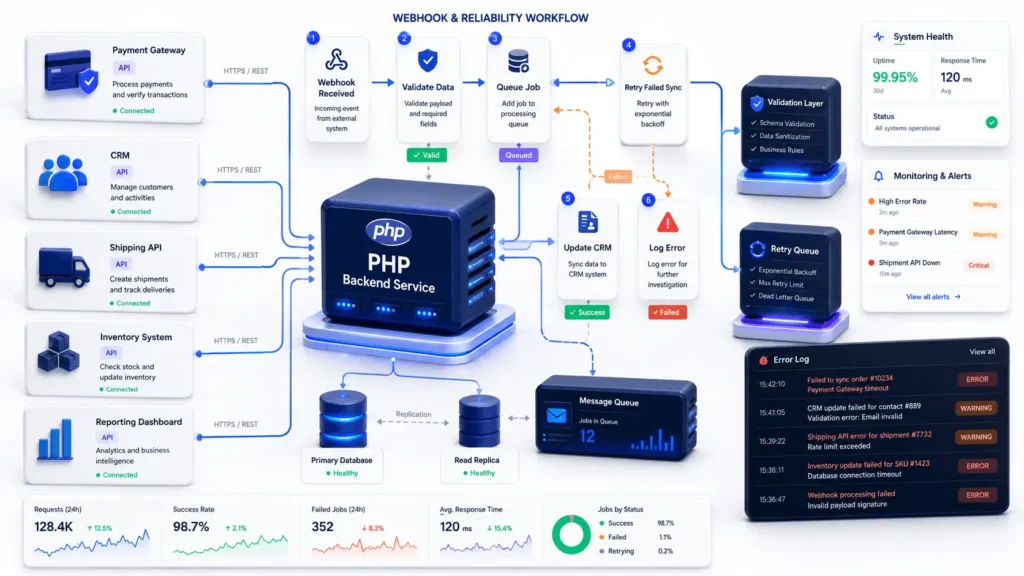
Modern PHP platforms rarely work alone. They connect with CRMs, ERPs, payment gateways, shipping providers, marketing tools, AI services, inventory systems, and reporting platforms.
API integration looks simple until failures happen.
A webhook may arrive twice. A CRM may rate-limit requests. A payment gateway may send delayed status updates. A shipping API may return partial data. A provider may change its response format.
Good PHP architecture handles this through validation, retries, idempotency, queues, logs, and alerts.
For example, checkout should not depend on a live CRM API call. The order should be saved first. Then a background job can sync the data. If the CRM fails, the job retries and logs the issue. The customer experience remains stable.
This is the difference between basic integration and production-grade integration.
Monolith vs Microservices in PHP Systems
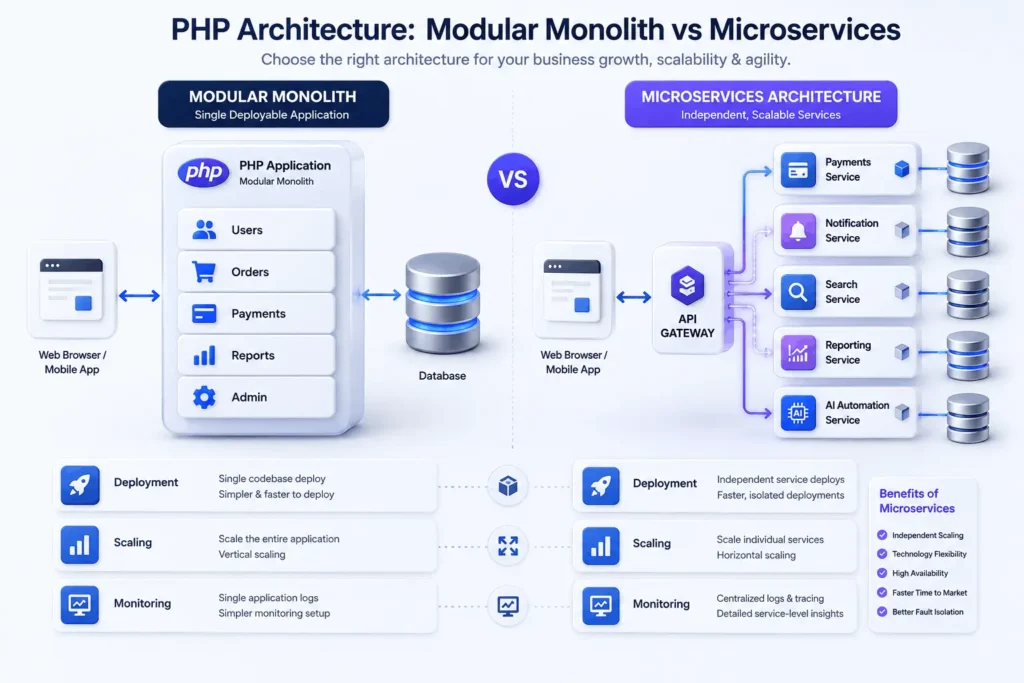
Not every business needs microservices. Many platforms are better served by a clean modular monolith.
A monolith is easier to deploy, test, and manage when the team is small or the business logic is still changing. Laravel, Symfony, and WordPress-based systems can remain stable for years if the code is modular, database access is controlled, and background jobs are separated.
Microservices make sense when parts of the system need independent scaling, separate deployment, or isolated ownership. Payments, notifications, search, reporting, and AI automation may eventually become separate services.
| Approach | Best For | Advantage | Trade-Off |
|---|---|---|---|
| Modular monolith | Startups, WooCommerce, early SaaS | Easier deployment and debugging | Can become heavy if poorly structured |
| Microservices | Large platforms with separate teams | Independent scaling | More DevOps complexity |
| Headless WordPress | Content-heavy platforms needing frontend flexibility | Better frontend performance | More integration work |
| Custom SaaS | Subscription platforms and internal tools | Full workflow control | Higher planning and maintenance needs |
| No-code SaaS tools | Simple automation | Fast launch | Limited customization and ownership |
A senior engineer should not push microservices because they sound advanced. The decision should depend on traffic, team size, deployment needs, data ownership, and maintenance cost.
SaaS Platforms Need Product Architecture Thinking
SaaS systems require more than pages and forms.
They need tenant isolation, subscription billing, onboarding flows, user roles, admin tooling, audit logging, feature permissions, usage limits, reporting, and background processing.
Multi-tenant architecture must be designed carefully. Some platforms use shared databases with tenant IDs. Others use separate databases for high-value clients. Each model affects backups, cost, performance, and data isolation.
Billing also needs careful handling. A subscription may be active, trialing, overdue, cancelled, refunded, disputed, or pending. Webhooks must update internal records safely. Access control, invoices, and notifications should follow the correct transaction state.
Dedicated PHP developers working on SaaS products should understand complete workflows, not only UI development.
AI Automation and PHP Backend Systems
AI automation still depends on strong backend engineering.
A PHP system may trigger AI automation services for support workflows, lead scoring, product tagging, invoice classification, CRM updates, content workflows, or internal reporting.
The AI layer may use LLM APIs, orchestration rules, validation checks, fallback systems, and human review.
The risk is unreliable automation. AI outputs need validation. Sensitive actions need approval. Failed prompts need fallback logic. Logs should track inputs, outputs, status, and review decisions where required.
A PHP backend can control the workflow. It can collect data, call AI services, validate responses, store results, notify humans, and trigger next actions.
This is where many businesses outgrow basic SaaS tools and need custom automation connected directly with WordPress, WooCommerce, CRM, or internal systems.
Performance Optimization Is Continuous
Performance optimization is not one task. It starts with measurement.
A PHP developer should inspect slow queries, memory usage, response time, cache hit rates, API latency, queue backlog, error logs, and server behavior.
Common fixes include database indexing, reducing repeated queries, moving heavy tasks to queues, using Redis object caching, optimizing checkout logic, replacing slow plugin code, tuning PHP-FPM, and using CDN caching for static assets.
Caching needs care. Caching user-specific data can create privacy issues. Caching dynamic checkout data can break orders. A good developer knows where caching helps and where it creates risk.
This is another reason businesses hire dedicated PHP programmers with practical debugging experience.
Security, RBAC, and Maintainability
Secure PHP systems require layered protection at every stage.
Input validation, output escaping, CSRF protection, nonce verification, prepared statements, secure uploads, authentication, and role-based access control matter in WordPress, Laravel, and custom PHP platforms.
RBAC is often underestimated. Admins, managers, vendors, customers, staff, and finance users should not share broad access. Permissions should follow real operational roles.
Audit logging also becomes important as platforms grow. Refunds, role changes, exports, invoice actions, and customer record updates should be traceable.
Maintainability depends on structure. Critical business logic should not live inside random snippets, theme files, or overloaded plugin hooks. Important workflows need clear services, reusable components, version control, documentation, and testing where practical.
Cheap PHP Development vs Maintainable Systems
Low-cost development can work for small tasks. It becomes dangerous when the platform handles payments, customers, subscriptions, automation, or operational workflows.
Cheap code often creates hidden costs:
- Poor structure slows future changes.
- Missing logs increase support time.
- No testing increases deployment risk.
- Weak database design creates scaling issues.
- Hardcoded API logic breaks during provider changes.
- Plugin shortcuts create update conflicts.
A maintainable system may cost more at the start, but it reduces operational drag later.
When a Dedicated PHP Team Makes Sense
After a platform starts supporting revenue or operations, technical decisions become expensive to reverse. That is where architecture-focused development matters.
Filicode works across custom software development, WordPress development, WooCommerce development, AI automation, API integrations, SaaS development, and performance optimization.
The goal is not only to write PHP code. It is to understand where the platform is creating friction and improve the workflows that affect revenue, reliability, growth, and digital marketing services when the website supports campaigns or lead generation.
A WooCommerce store may not need a rebuild. It may need checkout optimization, Redis caching, custom plugin cleanup, and better payment webhook handling.
A SaaS dashboard may not need microservices. It may need RBAC, queue workers, audit logs, billing state management, and database indexing.
A business using disconnected tools may not need another SaaS subscription. It may need custom API integration between CRM, billing, support, website, and reporting systems.
That is why companies choose a dedicated PHP team instead of treating development as a series of isolated tasks.
How to Evaluate Before Hiring
Before hiring, prepare the technical context.
Share the platform type, framework, hosting stack, current bottlenecks, plugins, APIs, database size, traffic level, and roadmap.
Ask how the developer would handle slow checkout, failed webhooks, plugin conflicts, legacy code, large reports, API retries, queue jobs, security roles, and deployment risk.
Good developers explain trade-offs. Weak developers only promise quick delivery.
A strong answer includes logs, staging, backups, rollback planning, version control, testing, monitoring, and maintainability.
Frequently Asked Questions
How much does it cost to hire dedicated PHP developer support?
Cost depends on skill level, location, workload, and responsibility. A simple PHP programmer costs less than a senior engineer who handles architecture, integrations, performance, security, and production support.
Should I hire dedicated PHP developer from India or the USA?
Both can work. India is often cost-effective for long-term development, while USA-based hiring may offer closer timezone alignment. The better choice depends on communication, technical depth, and production experience.
Can a dedicated PHP developer scale WooCommerce?
Yes, if the developer understands WooCommerce internals, checkout flow, object caching, Redis, database optimization, payment webhooks, and plugin conflicts.
When should businesses hire PHP developers?
Businesses should hire PHP developers when legacy code, recurring bugs, slow performance, unstable integrations, or delayed releases begin affecting operations and growth.
Is PHP still suitable for SaaS development?
Yes. PHP works well for SaaS platforms when architecture is planned properly. Laravel, Symfony, and custom PHP systems can support subscriptions, dashboards, tenant logic, queues, and APIs.
Conclusion
You should hire dedicated PHP developer support when your platform starts showing operational stress: slow pages, unstable integrations, checkout problems, plugin conflicts, delayed releases, manual workarounds, or recurring bugs after updates.
These are not only development problems. They are signs that the system needs stronger engineering ownership.
The right PHP developer improves architecture, database performance, API reliability, WooCommerce stability, SaaS workflows, security, and long-term maintainability.
If your business is growing beyond off-the-shelf tools, disconnected plugins, or short-term fixes, custom PHP development becomes a practical next step. Start with a technical review, identify the highest-risk workflows, and improve the areas where reliability directly affects revenue, operations, and customer experience.