


Contents
- Quick Summary:
- Understanding AI Business Automation in Enterprise Context
- Defining AI Business Automation
- Core Operational Workflows
- Architecting AI Automation Systems
- Monolith vs Microservices
- AI Agent Orchestration
- Data Pipelines and Model Training
- AI Automation Implementation for Business Workflows
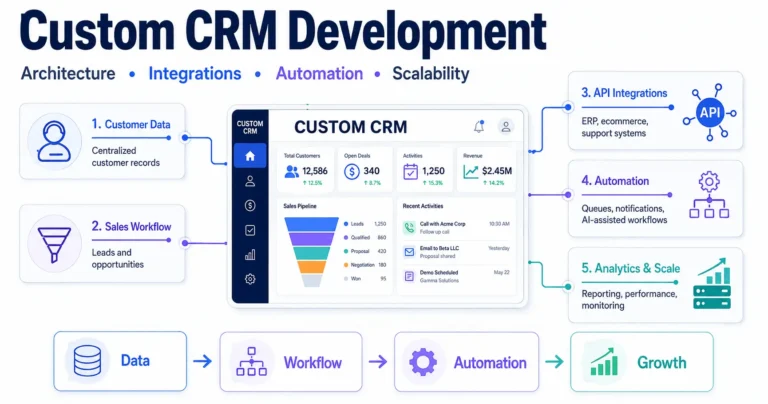
- CRM and Enterprise Systems
- Async Jobs and Queue Management
- Caching and CDN Optimization
- AI Automation Tools and Platforms
- Enterprise Platforms
- Tooling for 2025–2026
- Scaling AI Business Automation for Enterprise Systems
- Multi-Tenant Architecture
- Performance Monitoring
- Operational Trade-Offs
- Comparing SaaS vs Custom AI Automation
- Filicode’s Approach to AI Business Automation
- Real-World Implementation Examples
- AI Business Automation Trends 2025–2026
- Frequently Asked Questions
- How can AI automation scale with business growth?
- How to start an AI automation business?
- What is AI workflow automation for business?
- How to build AI agents for business automation?
- How does agentic AI enhance business automation?
- Conclusion
AI business automation combines intelligent agents, workflow orchestration, and connected enterprise systems to reduce manual work and improve operational efficiency. This guide explains 10 proven strategies for building scalable AI workflows across CRM, data processing, customer support, reporting, and other business operations.
Quick Summary:
- Integrate AI agents into workflow orchestration layers to handle repetitive and decision-heavy tasks.
- Monitor data pipelines and model outputs with real-time observability to prevent operational drift.
- Balance monolithic and microservices architectures based on load, multi-tenant isolation, and deployment complexity.
- Leverage AI-driven CRM automation and intelligent augmentation for process efficiency.
- Prioritize maintainability, audit logging, and fallback systems to reduce long-term operational risk.
Understanding AI Business Automation in Enterprise Context
AI business automation extends traditional business process automation by incorporating predictive modeling, autonomous agents, and continuous learning pipelines.
Defining AI Business Automation
AI business automation encompasses systems that autonomously execute workflows, make context-sensitive decisions, and continuously learn from structured and unstructured data. Unlike traditional RPA, AI automation leverages predictive modeling, reinforcement learning, and agentic decision-making to adapt to operational variations. It integrates with CRM systems, ERP platforms, and SaaS products to drive business outcomes while reducing manual oversight.
Core Operational Workflows
Key enterprise workflows for AI business automation include:
- Frontend interaction: Customer input validation, chatbot triage, and form processing.
- Backend processing: Task queues, asynchronous job handling, API orchestration, and caching strategies.
- Database operations: Optimized queries, Redis caching layers, object caching, and transactional integrity.
- Monitoring and validation: Observability dashboards, anomaly detection, and error handling with retry policies.
- Continuous learning: Feedback loops from real-world outputs, model retraining, and performance auditing.
Architecting AI Automation Systems
Enterprises using WordPress as an operational interface can connect AI agents with custom WordPress solutions for dashboards, approval workflows, data collection, and secure automation triggers.
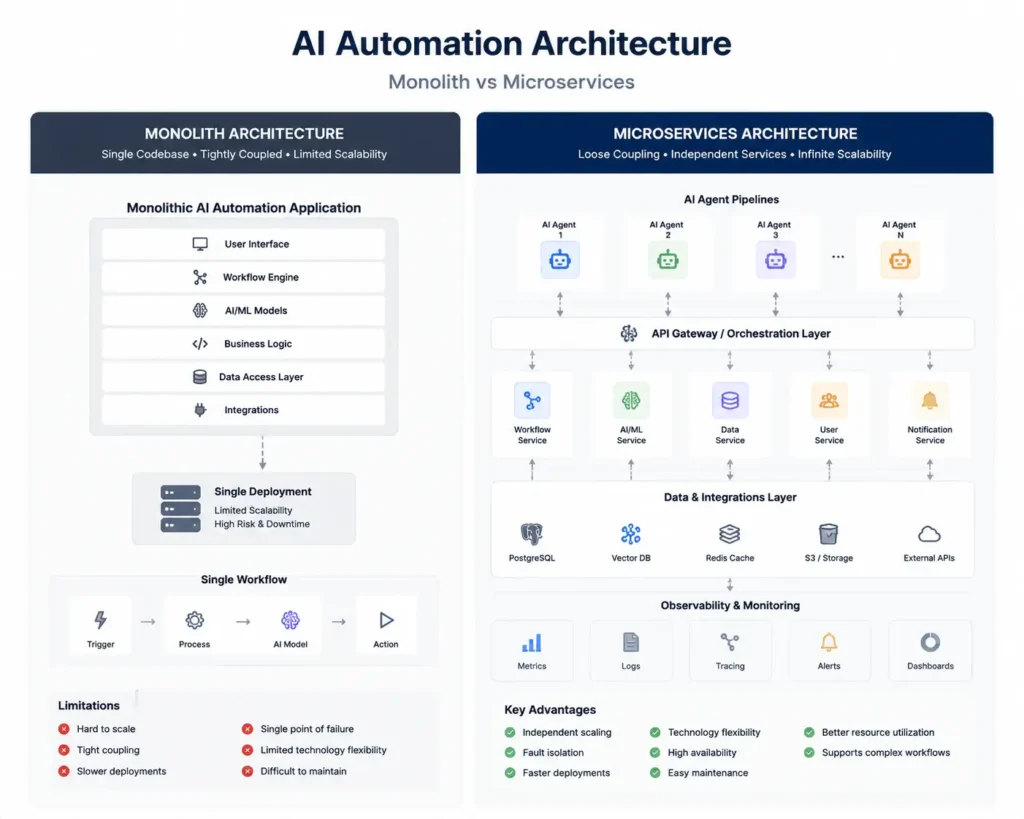
Monolith vs Microservices
- Monoliths: Centralized control but scaling limitations under high transaction volumes.
- Microservices: Decoupled functions AI agents, CRM automation, workflow orchestration require robust API governance, observability, and distributed caching.
- Decision factor: Use microservices when multi-tenant or agentic AI workloads grow complex.
| Aspect | Monolith | Microservices |
|---|---|---|
| Complexity | Simple to deploy initially | More complex, distributed |
| Scaling | Vertical scaling; limited | Horizontal scaling; highly scalable |
| Fault Isolation | Entire app affected by errors | Errors isolated to single service |
| Deployment Speed | Faster for small apps | Slower due to inter-service dependencies |
| Observability & Monitoring | Limited granularity | Detailed, per-service metrics |
| AI Workflow Integration | Harder to extend | Easier to orchestrate multiple AI agents |
| Maintenance | Technical debt accumulates faster | Modular, easier to maintain |
AI Agent Orchestration
Real production systems do not simply “call an LLM” — they implement an orchestration layer that:
- Receives events from sources (CRM, user input, job queue)
- Validates and enriches context
- Passes standardized payloads to agents
- Coordinates multiple agents via event loops
- Handles retries, throttling, timeouts, and human‑in‑the‑loop checkpoints
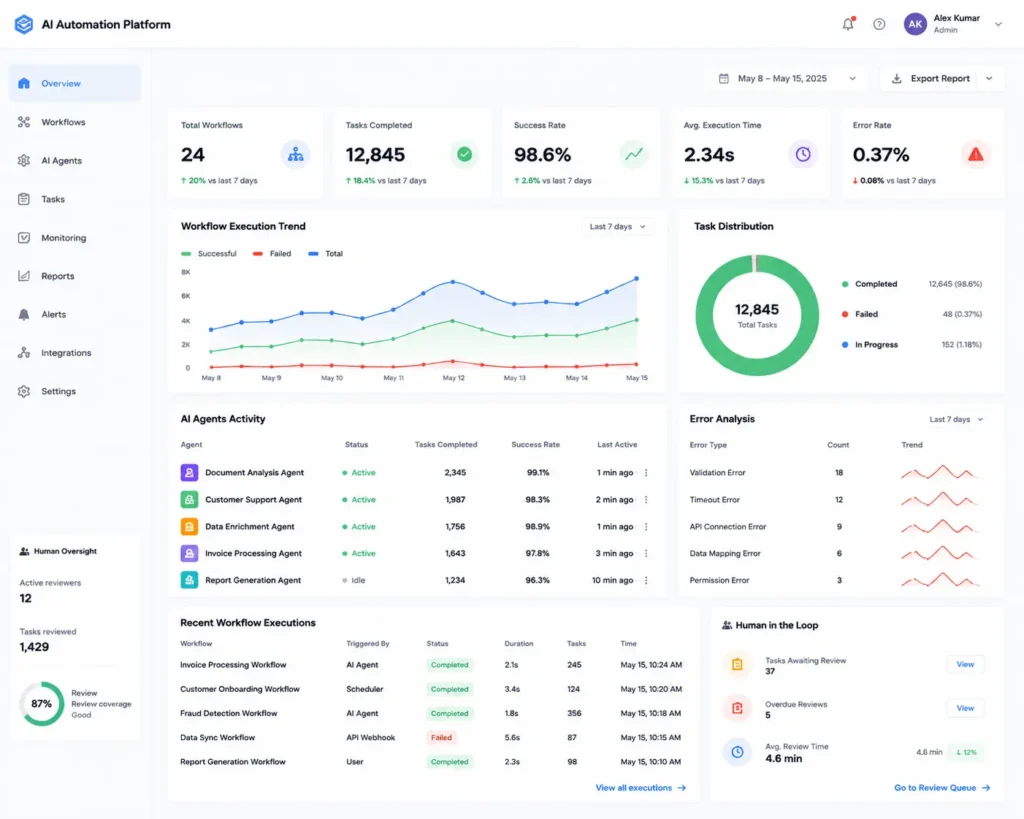
Under heavy load, orchestration layers throttle tasks based on SLA priority, queue lengths, and API rate limits. If an external API fails, fallback handlers redirect work to secondary systems or human operators. Monitoring layers produce streaming metrics (latency, success ratio, drift) to ensure operational reliability.
This forms the backbone of enterprise AI automation workflows.
Advanced orchestration often requires plugin development for automation to extend WordPress and WooCommerce capabilities.
- Deploy autonomous agents orchestrated via a workflow layer.
- Include human-in-the-loop (HITL) for validation in critical decision paths.
- Integrate predictive analytics for task prioritization.
- Maintain fallback logic for failed automation or unavailable APIs.
Data Pipelines and Model Training
- Collect structured (CRM, ERP) and unstructured (emails, documents) data.
- Prepare and normalize datasets for machine learning and NLP models.
- Automate retraining cycles with monitoring for drift.
- Use cloud services for scalable training and inference.
AI Automation Implementation for Business Workflows
In marketing and content workflows, AI automation can coordinate publishing, reporting, lead routing, and optimization tasks. Connecting these processes with SEO optimization for small businesses helps improve search visibility, engagement, and lead generation.
CRM and Enterprise Systems
- AI business automation integrates directly with CRM platforms to streamline lead scoring, ticket routing, and customer insights.
- Monitor throughput to avoid transaction bottlenecks.
- Implement audit logging to ensure compliance.
Async Jobs and Queue Management
- Background job systems handle heavy processing like document parsing or API batch operations.
- Utilize queue prioritization, retries, and dead-letter queues for fault tolerance.
- Monitor queue depth to detect system stress early.
Caching and CDN Optimization
- Redis or in-memory caches reduce latency in high-volume operations.
- CDN layers accelerate static content delivery in multi-region deployments.
- Avoid over-reliance on cache invalidation; ensure consistency with transactional systems.
AI Automation Tools and Platforms
For enterprises looking to implement these workflows, AI automation services provide prebuilt frameworks, monitoring dashboards, and orchestration layers to accelerate deployment.
| Tool / Platform | Use Case | Strengths | Limitations |
|---|---|---|---|
| Palantir AI Business Automation | Enterprise workflow orchestration | Agentic AI, predictive analytics | Licensing cost, learning curve |
| Open-Source ML Pipelines | Custom AI workflow development | Flexible, free | Requires engineering, ops overhead |
| AI Automation SaaS Platforms | Quick automation deployment | Prebuilt connectors, fast setup | Limited customization |
| AI Business Automation Toolkit 2025 | Hybrid pipelines, monitoring dashboards | Continuous learning, closed-loop ops | Requires integration effort |
Enterprise Platforms
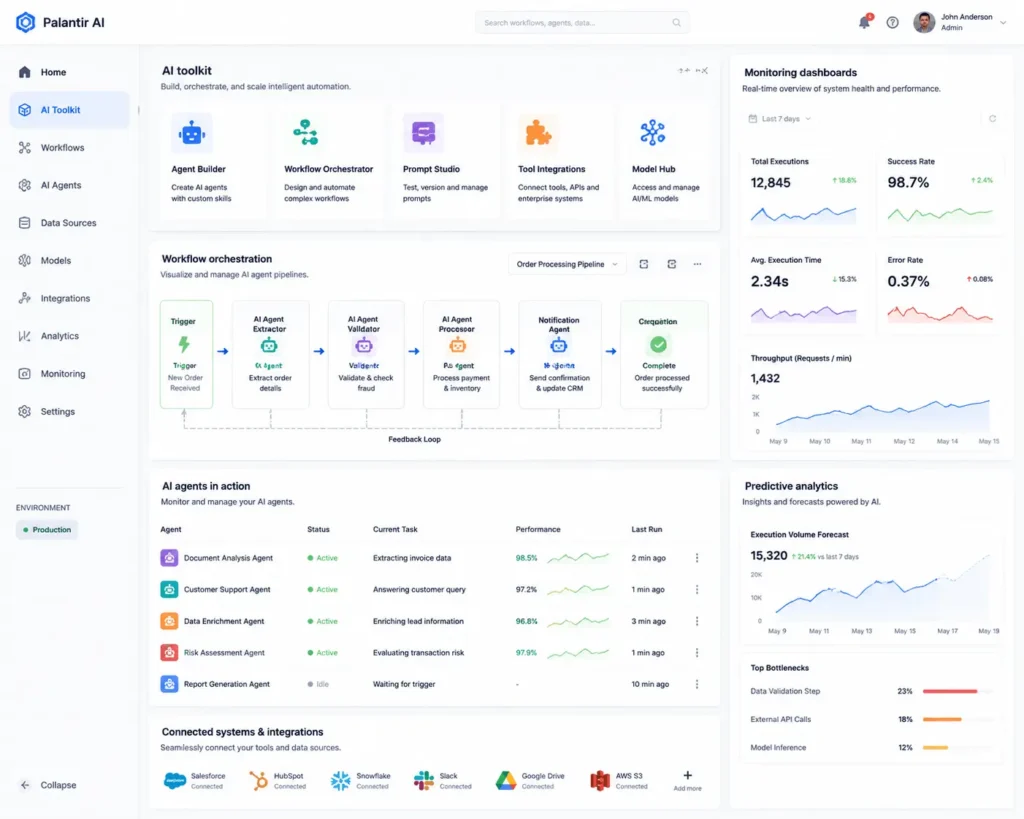
- Platforms like Palantir AI business automation enable integration of agentic AI workflows, predictive analytics, and operational dashboards.
- Support multi-tenant SaaS architecture and role-based access control (RBAC).
Tooling for 2025–2026
- AI business automation toolkit includes model training pipelines, workflow orchestrators, agent simulators, and monitoring dashboards.
- Emerging trends emphasize continuous learning, closed-loop automation, and decision augmentation over simple task execution.
Scaling AI Business Automation for Enterprise Systems
Dashboards and automation panels benefit from UI/UX design services that enhance operator efficiency.
Multi-Tenant Architecture
- Isolate tenants to prevent data leakage and workload interference.
- Separate database schemas or sharding strategies improve performance.
- Observability dashboards track agent performance and task completion per tenant.
Performance Monitoring
- Monitor AI agent decisions with real-time logging, latency tracking, and anomaly detection.
- Include alerting for task failures, API downtime, and workflow drift.
Operational Trade-Offs
- Faster deployment vs maintainable architecture: avoid rushed integration of AI agents into production without observability.
- No-code solutions may accelerate prototyping but limit complex agentic workflows.
- WordPress/WooCommerce integration requires plugin conflict management, cron reliability, and caching strategy.
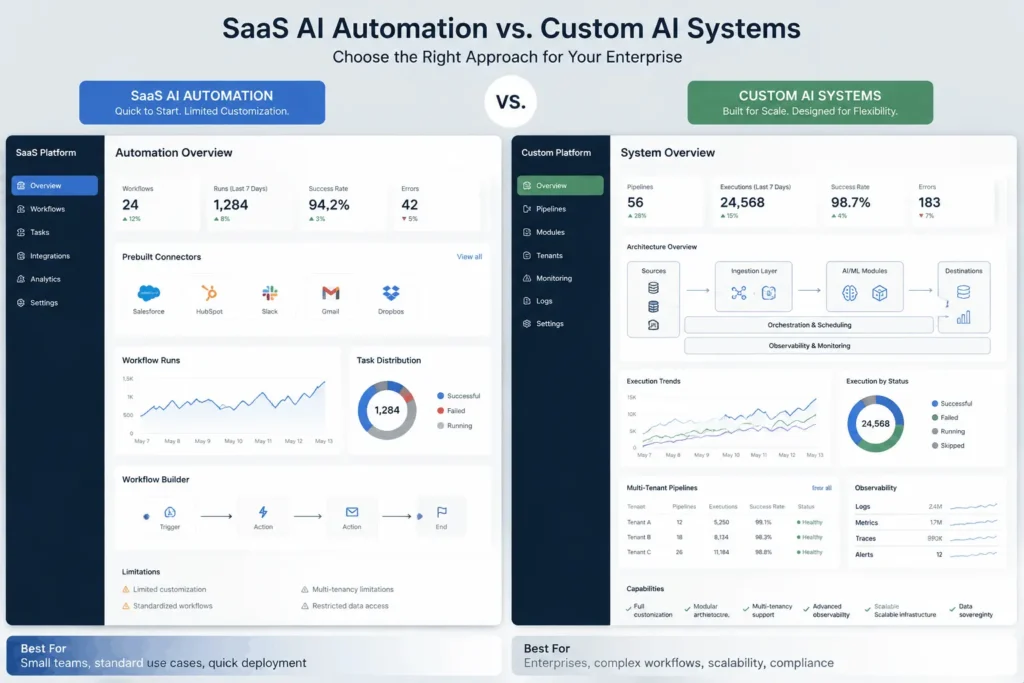
Comparing SaaS vs Custom AI Automation
Robust API integration solutions are essential when combining SaaS tools with custom AI workflows
- SaaS solutions: Quick deployment, prebuilt connectors, limited customization.
- Custom systems: Tailored architecture, scalable AI orchestration, long-term maintainability.
- Decision: Custom systems reduce operational risk for enterprises handling high volumes or complex workflows.
| Feature / Consideration | SaaS Solutions | Custom AI Systems |
|---|---|---|
| Deployment Speed | Fast setup with prebuilt connectors | Longer setup; custom architecture |
| Customization | Limited; depends on vendor | Fully tailored workflows |
| Multi-Tenant Support | Usually built-in | Requires engineering for isolation |
| Scalability | Good for moderate loads | High scalability for complex workloads |
| Observability & Monitoring | Vendor dashboards | Full control; custom observability |
| Integration Flexibility | Limited API support | Extensive API and workflow integration |
| Long-Term Maintainability | Vendor-dependent | Engineering ensures sustainable growth |
Filicode’s Approach to AI Business Automation
- Delivers custom software development, WordPress and WooCommerce optimization, and AI automation integration.
- Engineers resilient workflows with observability, failover, and monitoring systems.
- Aligns AI agent pipelines with operational KPIs, ensuring predictable outcomes.
- Reduces future operational debt by implementing maintainable, scalable automation frameworks.
Real-World Implementation Examples
AI-driven reporting can feed into digital marketing insights for better campaign decisions and ROI tracking.
- Lead Routing Automation: AI agents parse incoming leads, classify urgency, and assign tasks automatically.
- Invoice Processing: Intelligent agents extract data from unstructured documents, reconcile transactions, and flag anomalies.
- Customer Support: Hybrid automation with chatbots and human oversight for escalated cases.
AI Business Automation Trends 2025–2026
- Rise of agentic AI, capable of multi-step decision-making.
- Increased AI integration with operational CRMs for predictive support.
- Continuous learning pipelines for workflow optimization.
- AI platforms offering real-time observability and closed-loop feedback.
Frequently Asked Questions
How can AI automation scale with business growth?
Scale by implementing agent orchestration layers, queue management, and continuous learning pipelines. Multi-tenant isolation ensures growing workloads don’t interfere.
How to start an AI automation business?
Begin with workflow analysis, deploy pilot AI agents, and validate predictive and task augmentation capabilities. Focus on operational reliability over feature quantity.
What is AI workflow automation for business?
Systems combining task orchestration, predictive decision-making, and automated execution across CRM, ERP, and SaaS platforms.
How to build AI agents for business automation?
Define decision tasks, integrate with backend APIs, implement validation loops, and include monitoring for drift and failures.
How does agentic AI enhance business automation?
Agentic AI enables multi-step reasoning, prioritization, and continuous learning, reducing manual oversight while adapting to workflow variability.
Conclusion
When operational bottlenecks emerge slow CRM processing, delayed task queues, failed integrations it indicates the limits of off-the-shelf automation. Enterprises should consider custom AI business automation to implement agentic workflows, scalable data pipelines, and observability systems. Evaluating workflow complexity, integration depth, and growth projections determines whether to augment existing tools or engineer a bespoke system. Prioritizing maintainable architecture and monitoring reduces long-term operational risk and ensures sustainable scaling.