



Contents
- Quick Summary:
- How an AI Agent for Workflow Automation Works
- Core Components of AI Agent Workflows
- Designing Enterprise-Scale AI Agents Workflows
- Monolith vs. Microservices
- API and Webhook Architecture
- AI Agent Operational Workflows and Bottlenecks
- AI Agent Automation Dashboard and Workflow Controls
- Use Cases and Examples
- Best Practices for Reliable Web-Connected AI Agent Workflows
- AI Agents Workflow Automation: Enterprise Considerations
- Comparisons and Trade-offs
- Filicode’s Approach to AI Agents Workflow Automation
- Frequently Asked Questions
- How are AI agents used in workflow automation?
- How to build AI agents for workflow automation?
- What should an AI agent automation dashboard include?
- How do you secure AI agent workflows?
- What is the typical implementation timeline?
- Conclusion
AI agents workflow automation helps enterprises overcome bottlenecks when tasks span multiple systems, APIs, and asynchronous processes. Traditional automation fails to adapt to dynamic environments, resulting in delayed task execution, failed transactions, and operational inefficiencies. AI agents workflow automation addresses these challenges by orchestrating autonomous agents capable of context-aware decision-making, multi-system execution, and iterative problem-solving, ensuring workflows scale without increasing maintenance overhead. Early adoption reduces technical debt and supports sustainable growth across platforms.
Real-world enterprises face challenges like scaling e-commerce operations, reconciling customer data across multiple SaaS platforms, and maintaining real-time updates without overloading databases. AI agents provide automated decision-making, continuous monitoring, and adaptive task execution, enabling teams to reduce human error while maintaining operational efficiency.
Quick Summary:
- AI agents execute cross-system workflows autonomously, adjusting to context and data changes.
- Production-ready workflows include monitoring dashboards, human-in-the-loop checkpoints, and robust fallback mechanisms.
- Enterprise deployment requires role-based access control, multi-tenant isolation, and operational observability.
- Integrating AI agents reduces errors, accelerates task execution, and scales beyond traditional automation limits.
- Consider architectural trade-offs: monolithic systems reduce deployment complexity, while microservices improve scalability and fault isolation.
- Implementation requires alignment with existing APIs, SaaS tools, and CMS platforms, including WordPress workflows.
How an AI Agent for Workflow Automation Works
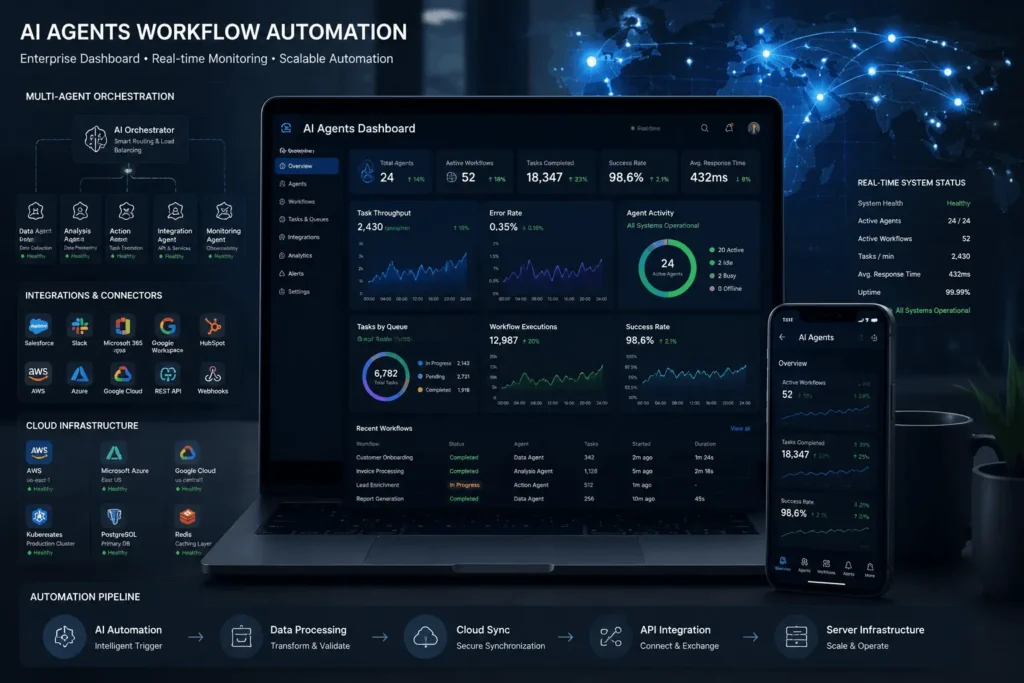
AI agents workflow automation is a system where autonomous agents execute predefined and adaptive tasks across enterprise software platforms. Unlike static automation, AI agents can process data in real time, adapt to new conditions, and make context-aware decisions. They integrate with APIs, databases, queues, front-end interfaces, and SaaS platforms to maintain operational continuity.
In practical deployments, AI agents can manage tasks like automatically updating customer CRM records, validating e-commerce orders, reconciling inventory, and synchronizing analytics reports. Integration with platforms like n8n or Zapier allows non-engineering teams to extend workflows without breaking core systems. Enterprises leveraging these agents achieve faster response times, reduce operational errors, and maintain consistent system states across multiple services. For WordPress-based platforms, custom plugin development ensures agents operate within CMS constraints while maintaining performance.
This approach builds upon principles of workflow automation and robotic process automation, combining them with intelligent decision-making and memory systems to orchestrate tasks that evolve dynamically.
For multi-platform integration, leveraging WordPress development services ensures agents interact reliably with CMS-based workflows.
Core Components of AI Agent Workflows
A production-ready workflow typically includes:
- Orchestration Layer: Schedules tasks, manages dependencies, balances load across agents, and ensures priority handling for critical workflows.
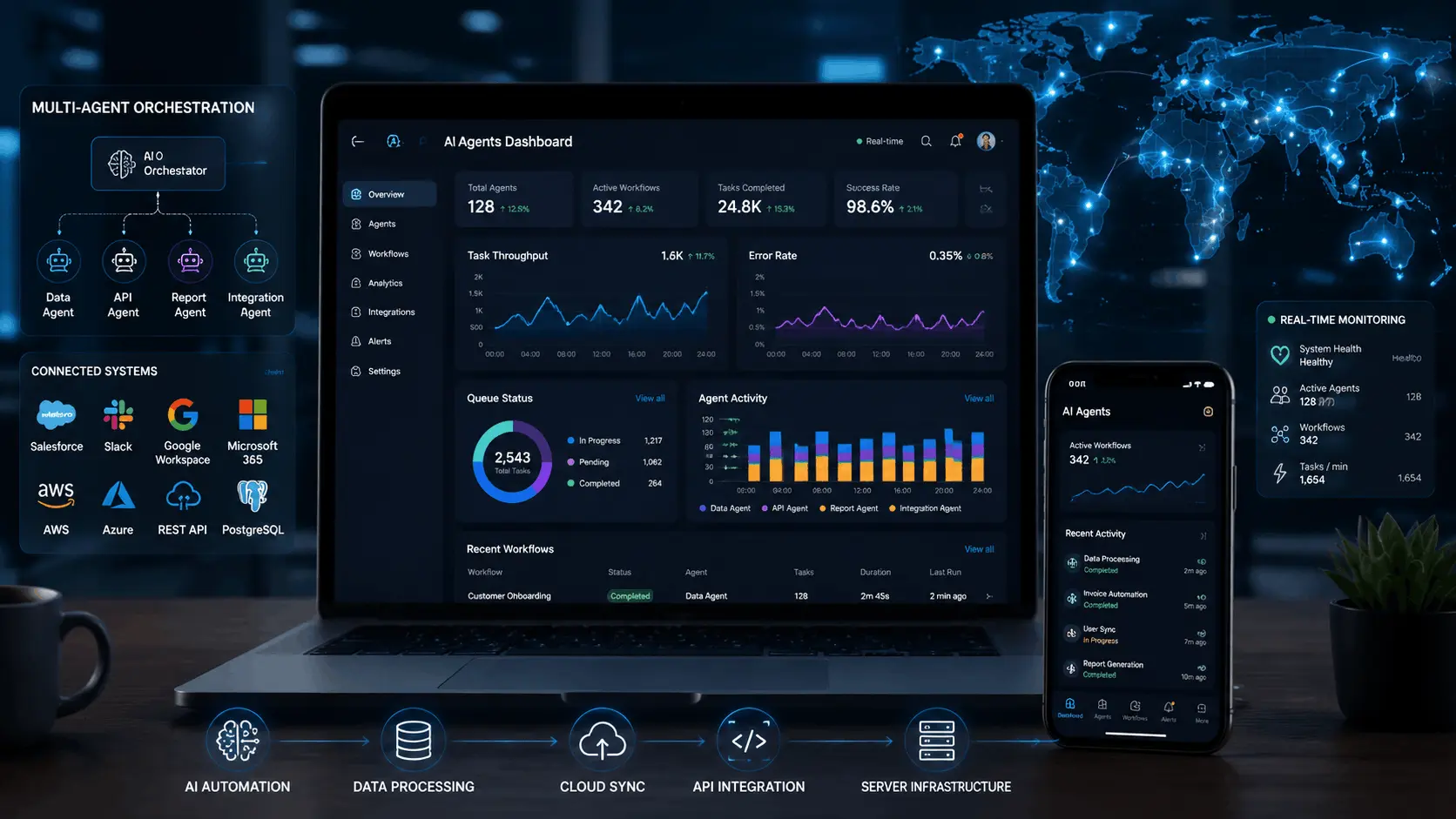
- Agent Interfaces: Dashboards, CLI, or laptop interfaces provide operational visibility, real-time logs, and control over execution.
- Data Pipelines: Intelligent data agent workflows ingest, validate, transform, and route structured and unstructured data for context-aware decision-making.
- Async Job Management: Queues, retries, backpressure handling, and failure recovery mechanisms maintain reliability at scale.
- Observability & Logging: Metrics on task throughput, SLA adherence, and error rates support monitoring and troubleshooting.
- Human-in-the-Loop Checkpoints: Critical actions are validated by operators, ensuring accuracy without slowing workflow.
- Security & RBAC Controls: AI agents for secure workflows require role-based access, tenant isolation, protected credentials, audit logs, and human approval for sensitive actions.
- Caching & Performance Layers: Redis or in-memory caches reduce redundant operations and improve agent responsiveness.
Designing Enterprise-Scale AI Agents Workflows
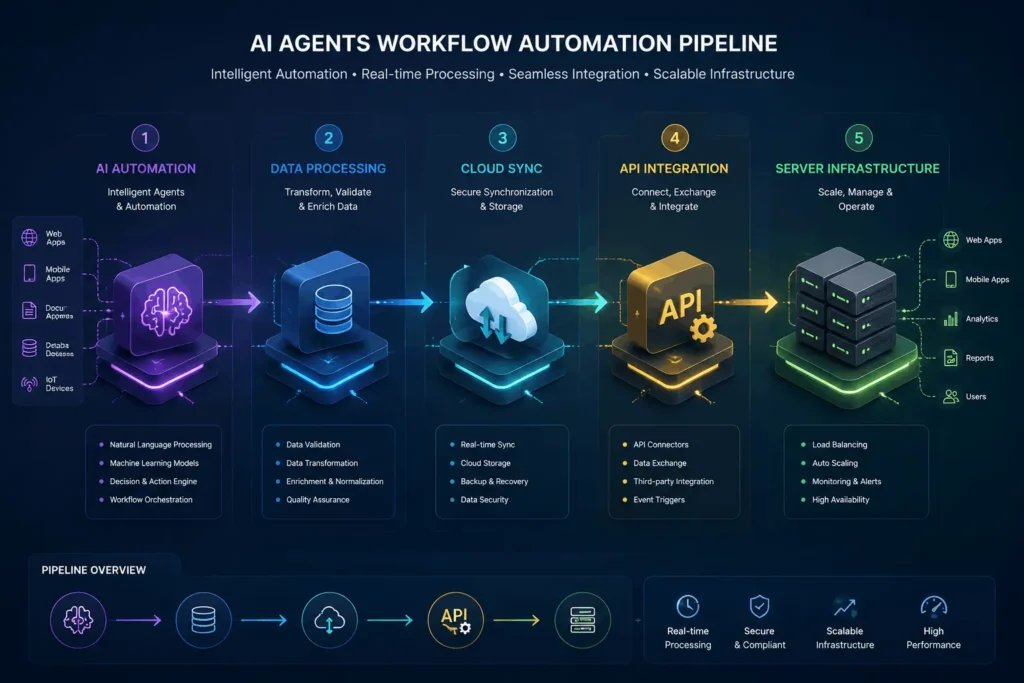
Scaling AI agents requires careful consideration of infrastructure, operational constraints, and integration complexity. In enterprise SaaS environments, agents must interact with multiple tenants, enforce role-based permissions, and maintain system isolation. Key architectural considerations include:
Monolith vs. Microservices
- Monolithic deployments reduce network latency and simplify deployment but introduce single points of failure and hinder scalability.
- Microservices support independent agent scaling, asynchronous execution, and modular updates, although they increase operational complexity and monitoring requirements.
API and Webhook Architecture
Agents interact with external systems using RESTful APIs, GraphQL endpoints, and webhooks. Effective enterprise workflows incorporate:
- Idempotent endpoints to avoid duplicate operations
- Retry logic and backpressure handling
- Event-driven architecture for asynchronous task propagation
These concepts are explained further in multi-agent systems literature.
AI Agent Operational Workflows and Bottlenecks
Real-world deployments often reveal operational challenges:
- Database contention: Multiple agents performing writes or reads on shared tables can cause locks and latency spikes. Sharding, read replicas, and Redis caching help mitigate these issues.
- Queue saturation: High task volume requires dynamic queue scaling, prioritization, and monitoring dashboards.
- Latency in third-party APIs: Fallback logic and asynchronous execution prevent cascading failures.
- Observability gaps: Lack of real-time monitoring can hide failures; dashboards and logging are essential.
Designing these dashboards benefits from UI/UX design services to make complex agent states understandable.
AI Agent Automation Dashboard and Workflow Controls
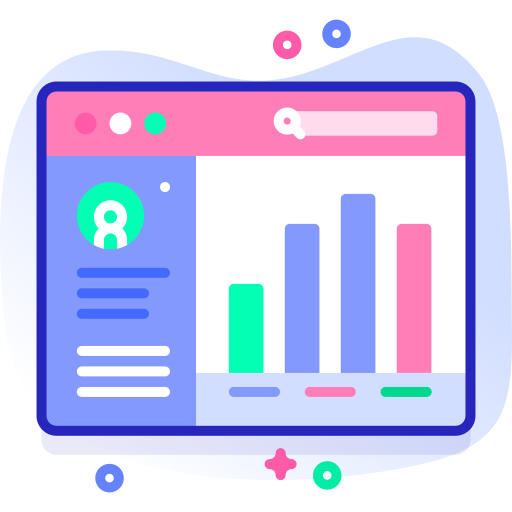
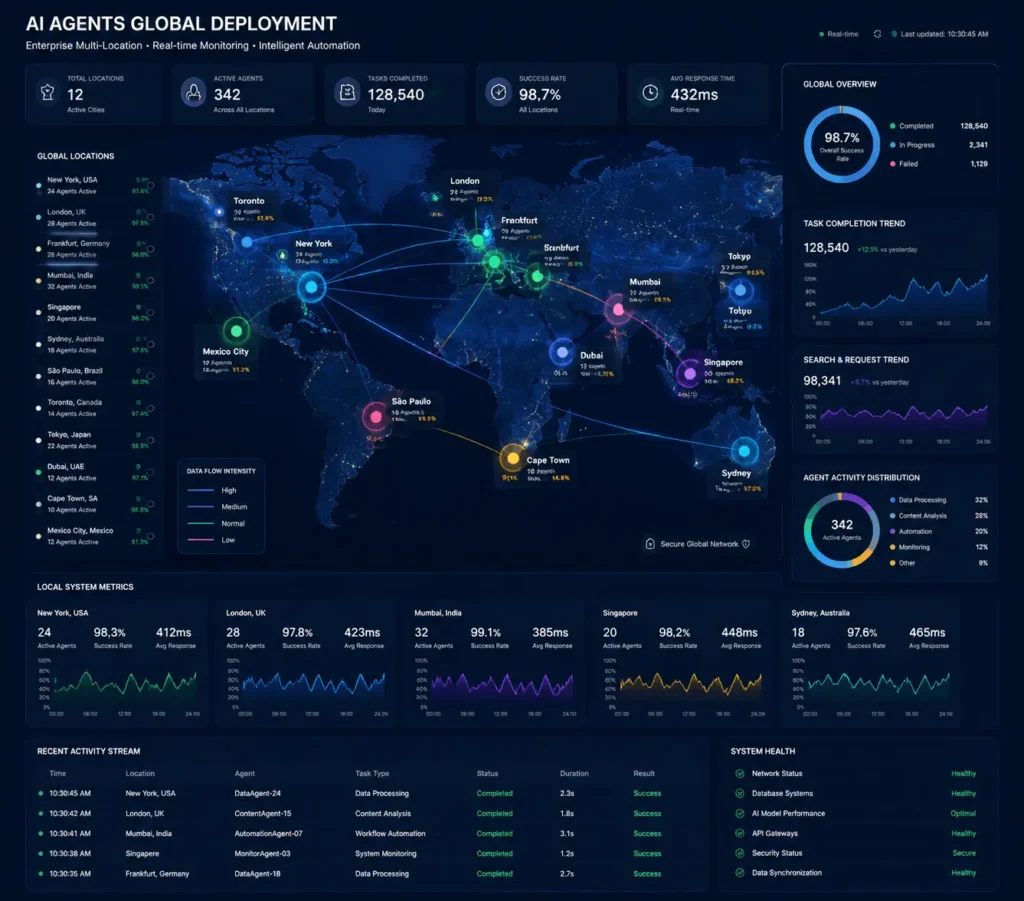
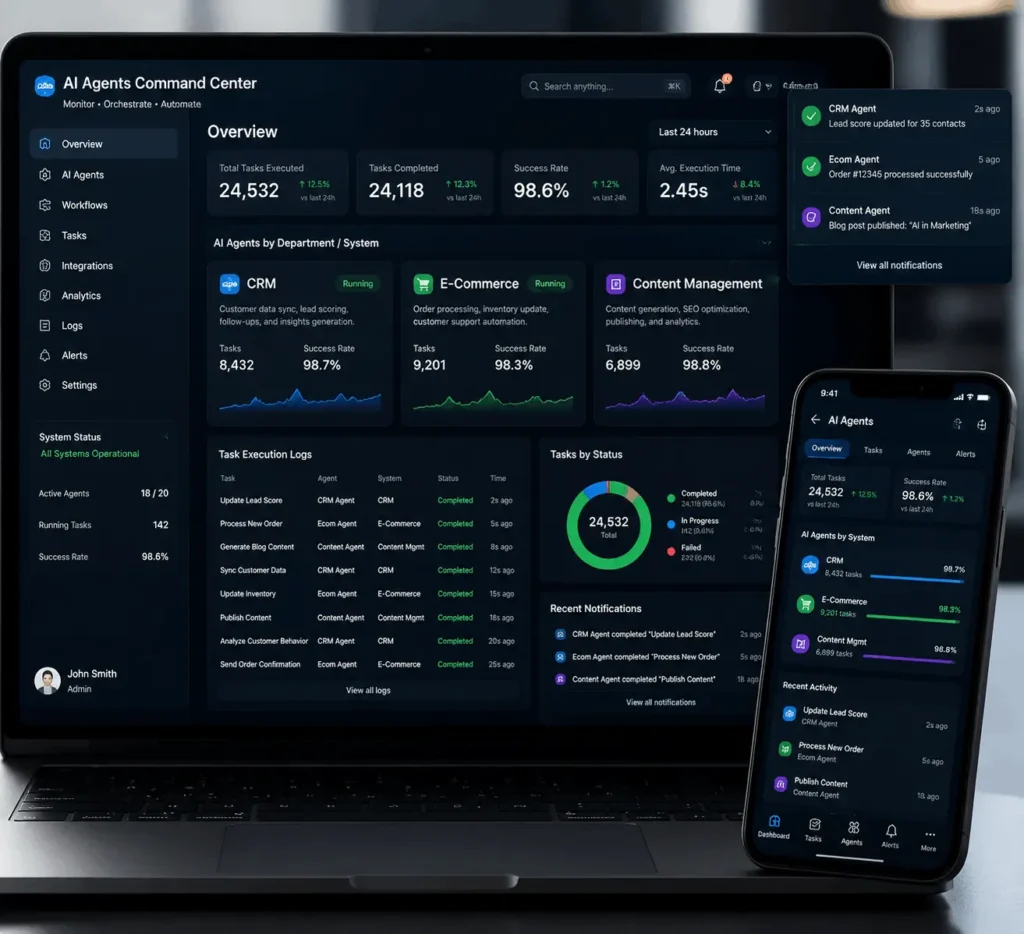
An AI agent automation dashboard helps teams monitor agent status, task queues, retries, failures, API activity, human approvals, and workflow performance from one operational interface.
Enterprise dashboards visualize:
- Agent status, task logs, and throughput metrics
- Failed task queues with retry options
- Multi-system execution flows (AI agents workflow automation diagram)
- Alerts for SLA breaches and operational anomalies
Integration with API integration services ensures consistent cross-platform agent performance.
Use Cases and Examples
- CRM automation: Agents reconcile customer records across multiple SaaS systems, trigger notifications, and maintain compliance logs, reducing human errors.
- E-commerce operations: Agents validate inventory, monitor orders, and manage payment gateway interactions, avoiding checkout failures and delays.
- IT incident management: Multi-agent systems triage alerts, execute remediation scripts, and escalate unresolved issues while tracking historical trends for predictive analysis.
- Content management: Agents schedule posts, verify metadata, and coordinate with analytics dashboards to ensure SEO and content quality standards.
- AI workflow agents for SaaS products: Agents guide tenant setup, configure integrations, validate workflow readiness, and reduce manual IT intervention.
Enterprises use AI automation services to deploy these agent workflows efficiently.
Best Practices for Reliable Web-Connected AI Agent Workflows
- RBAC and multi-tenant isolation for secure operations
- Caching strategies to reduce redundant operations and improve performance
- Audit logging to track agent decisions and ensure compliance
- Human-in-the-loop validation for critical workflows
- Fallback mechanisms for API or external system failures
- Continuous monitoring of execution time, error rates, and throughput
AI Agents Workflow Automation: Enterprise Considerations
When adopting AI agents, enterprises must consider:
- Integration complexity with legacy and SaaS systems
- Migration risk from static workflows
- Platform limitations regarding compute and storage
- Maintenance overhead and update cycles
- Pricing and licensing implications of SaaS vs custom-built agents
Custom WordPress plugin development services enable agent integration without breaking existing functionality.
Comparisons and Trade-offs
| Aspect | Traditional Automation | AI Agents Workflow Automation |
|---|---|---|
| Adaptability | Static, rule-based | Context-aware, adaptive |
| Scalability | Limited by human management | Parallel, autonomous execution |
| Monitoring | Minimal, manual | Integrated dashboards, observability |
| Maintenance | Low technical overhead | Requires architecture planning |
| Decision-making | Predefined | Dynamic, feedback-driven |
Filicode’s Approach to AI Agents Workflow Automation
Filicode applies deep operational expertise to design scalable, maintainable AI agent workflows for enterprise clients. Services include:
- SaaS platform development with multi-agent orchestration
- WordPress and WooCommerce integration with automated workflows
- End-to-end monitoring, logging, and dashboard setup
- API and webhook management to ensure reliability
- AI workflow validation with human-in-the-loop support
- Enterprise AI agent consulting and implementation
Clients often combine these with SEO services for small business to ensure optimized discovery and process efficiency.
Frequently Asked Questions
How are AI agents used in workflow automation?
AI agents workflow automation enables tasks to execute autonomously across multiple systems. Agents adapt to changing data, trigger APIs, maintain logs, and follow defined business rules, reducing operational bottlenecks and scaling enterprise workflows efficiently.
How to build AI agents for workflow automation?
Start with clear workflow definitions, design orchestration layers, implement asynchronous task queues, integrate APIs, and include monitoring and human-in-the-loop validation.
What should an AI agent automation dashboard include?
An AI agent automation dashboard should show agent status, active and failed tasks, retry queues, API activity, execution time, error rates, human approval requests, and workflow performance.
How do you secure AI agent workflows?
Secure AI agent workflows use role-based access control, protected API credentials, tenant isolation, audit logging, data validation, human approval for sensitive actions, and continuous monitoring.
What is the typical implementation timeline?
Initial setup varies by complexity, ranging from 6–16 weeks for enterprise-scale deployment, including orchestration design, integrations, testing, and monitoring dashboards.
Conclusion
AI agents workflow automation solves enterprise scaling bottlenecks by executing adaptive, autonomous tasks across complex systems. Organizations facing repeated failures, delayed integrations, or increasing maintenance costs should evaluate agent deployment. Proper architecture, observability dashboards, and fallback systems ensure operational reliability. Filicode provides technical guidance and implementation services aligning AI agent workflows with enterprise objectives, maximizing maintainability, scalability, and measurable outcomes.
Enterprises hitting repeated system failures, delayed integrations, or rising maintenance overhead should consider custom AI agent workflows. Evaluating the trade-offs between off-the-shelf SaaS automation and engineered solutions ensures scalability and long-term cost efficiency. Monitoring performance metrics, enforcing RBAC, and integrating with existing platforms like WordPress or WooCommerce are crucial operational indicators. Early assessment and structured implementation reduce technical debt and improve ROI.