








Contents
- Quick Summary:
- What Is a B2B Digital Marketing Strategy?
- How Weak Digital Marketing Systems Impact B2B Pipeline Growth
- B2B Digital Marketing Strategy Architecture
- B2B Digital Marketing Strategy Best Practices for Technical Companies
- Build Around the Buying Committee
- Match Content to Buying Stages
- SEO as the Foundation of B2B Demand Generation
- Content Marketing That Supports Sales, Not Just Rankings
- B2B Digital Marketing Strategy Examples
- CRM, Automation, and Sales Handoff
- Paid Media, LinkedIn, and Account-Based Marketing
- Measuring B2B Digital Marketing Strategy Performance
- Platform and Architecture Trade-Offs
- Where Filicode Fits Into This Work
- 7-Step B2B Digital Marketing Strategy Framework
- 1. Define Your Ideal Customer and Buying Committee
- 2. Clarify Positioning and Commercial Value
- 3. Build the Website and SEO Architecture
- 4. Create Content for Each Buying Stage
- 5. Connect CRM and Marketing Automation
- 6. Improve Lead Qualification and Sales Handoff
- 7. Measure Pipeline and Improve the System
- FAQ
- What is a B2B digital marketing strategy?
- How much does a B2B digital marketing strategy cost?
- How long does implementation take?
- Can WordPress support a serious B2B digital marketing strategy?
- What are the biggest implementation risks?
- Conclusion
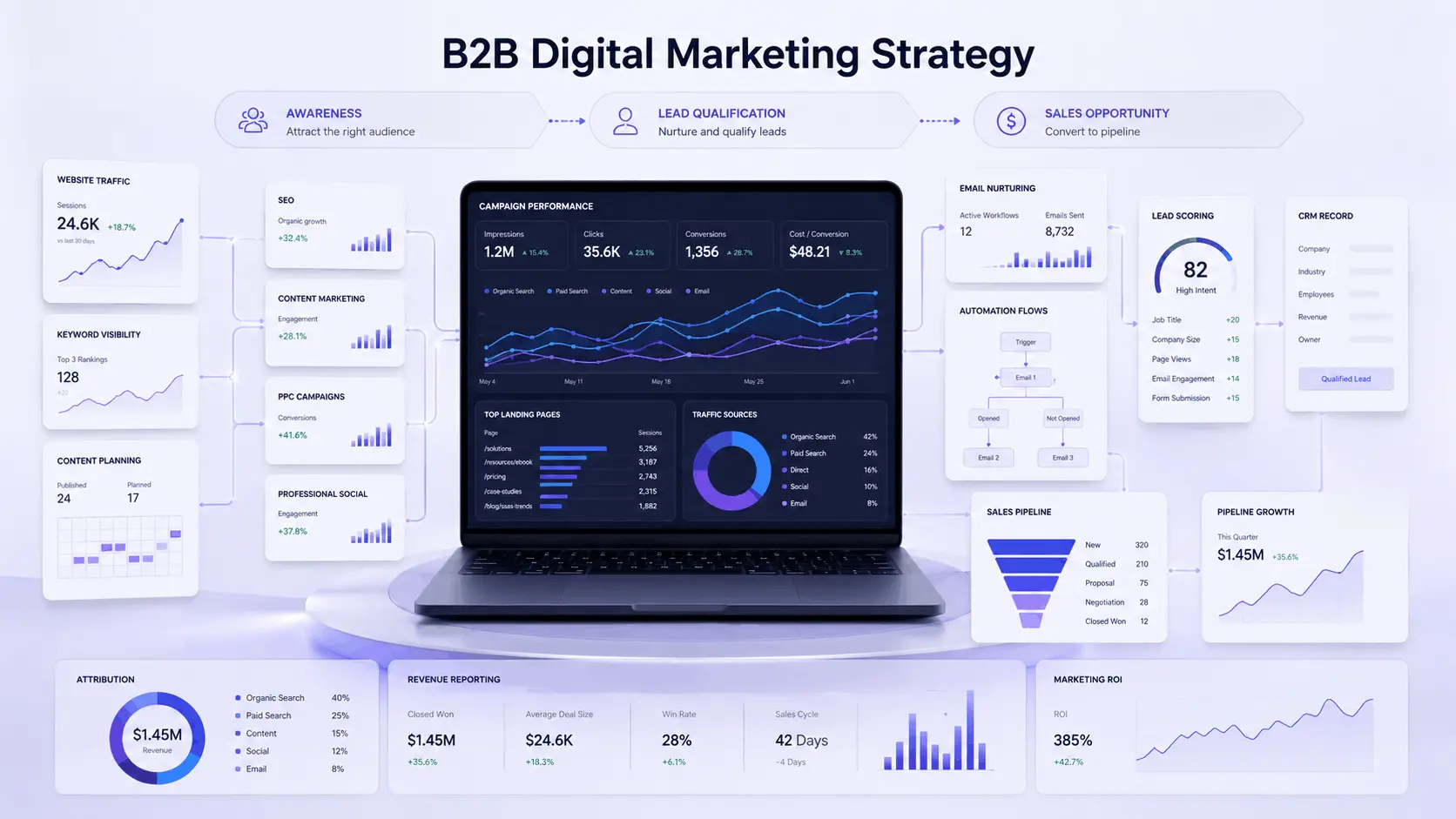
A B2B digital marketing strategy is a coordinated plan for attracting business buyers, supporting their research, qualifying demand, and turning marketing activity into measurable pipeline growth.
This 7-step framework connects SEO, content, website conversion, CRM automation, sales handoff, and performance measurement to help B2B companies generate more qualified opportunities.
Quick Summary:
A practical b2b digital marketing strategy should:
- Build demand around real business problems, not only keywords or ad clicks.
- Align SEO, content, CRM, email, paid media, and sales workflows.
- Support long sales cycles with technical proof, use cases, demos, and ROI logic.
- Track pipeline quality, conversion velocity, revenue influence, and account engagement.
- Use automation carefully, with validation, fallback handling, and clean CRM data.
- Treat the website as a revenue system, not a brochure.
What Is a B2B Digital Marketing Strategy?
A b2b digital marketing strategy is the structured plan a business uses to attract, educate, qualify, nurture, and convert other businesses through digital channels. It usually includes SEO, content marketing, email, paid media, social platforms, CRM automation, analytics, account-based marketing, and sales enablement.
The main difference is complexity. B2C marketing often targets one buyer with a shorter decision cycle. B2B marketing usually deals with a buying committee, budget approval, technical validation, security concerns, integration requirements, and long-term service expectations.
That is why a b2b digital marketing strategy must answer three questions clearly:
- Why should this company trust us?
- Can our solution solve the actual operational problem?
- Can we prove the business value before the sales call?
For general background, the concept of business-to-business helps explain why B2B decisions usually involve organizations, departments, and longer procurement paths rather than individual consumers.
How Weak Digital Marketing Systems Impact B2B Pipeline Growth
Weak digital marketing systems impact B2B pipeline growth when campaigns, content, CRM records, lead qualification, and sales follow-up operate independently.
The reason is usually operational, not creative.
The website may not match search intent. The CRM may not separate marketing qualified leads from sales qualified leads. Paid campaigns may send traffic to thin pages. Email automation may send the same sequence to every lead. Analytics may show form submissions without showing whether those leads became opportunities.
A production-ready b2b digital marketing strategy requires a working system. For companies that need SEO, paid campaigns, email, social, analytics, and conversion planning to work together, B2B digital marketing services can help turn isolated activity into a measurable growth process.
| Weak Marketing Setup | Scalable Marketing System |
|---|---|
| Campaigns run independently | Channels connect to shared pipeline goals |
| Blogs target random keywords | Content maps to buyer intent and funnel stage |
| CRM fields are inconsistent | Lead source, lifecycle stage, and account data are governed |
| Sales receives low-context leads | Sales sees behavior, pain point, use case, and engagement history |
| Reporting focuses on traffic | Reporting tracks pipeline impact and revenue influence |
B2B Digital Marketing Strategy Architecture
A serious b2b digital marketing strategy should be designed like a platform workflow. Each channel has a job, each system passes clean data, and each handoff has validation.
At a high level, the workflow looks like this:
- A buyer searches for a problem, vendor, integration, or comparison.
- The website answers the intent with a relevant page, guide, case study, or tool. If the page experience is weak, conversion-focused user experience improvements can help buyers move from research to action with less friction.
- The visitor engages with content, forms, pricing pages, demos, or downloads.
- Tracking captures source, page journey, campaign, account, and intent signals.
- CRM automation scores and segments the lead.
- Email or sales outreach continues based on behavior.
- Sales validates fit, need, urgency, budget, and technical feasibility.
- Marketing reports which channels influenced qualified pipeline.

If forms do not validate properly, bad leads pollute the CRM. If webhook events fail, attribution becomes incomplete. If automation fires from weak logic, sales teams lose trust. Clean CRM and marketing tool connections help protect data flow between forms, analytics, automation, and sales systems.
Good strategy includes retries, validation rules, duplicate handling, monitoring, and clear ownership.
B2B Digital Marketing Strategy Best Practices for Technical Companies
The best b2b digital marketing strategy for technical companies is not built around broad awareness only. It is built around decision support.
Build Around the Buying Committee
A buying committee may include:
- Economic buyer: budget, ROI, risk.
- Technical evaluator: architecture, security, integration.
- Operations lead: workflow fit and adoption.
- End-user: usability and daily impact.
- Procurement or legal: compliance, contract terms, vendor stability.
Each role needs different content. A founder may read a strategic guide. A CTO may inspect API documentation. An operations manager may review process diagrams. A CFO may need ROI framing.
Match Content to Buying Stages
A practical content journey includes:
| Buyer Stage | Content Type | Purpose |
|---|---|---|
| Problem awareness | Educational blog, checklist, diagnostic guide | Clarify the issue |
| Solution research | Comparison page, use case page, technical guide | Explain available options |
| Vendor evaluation | Case study, architecture overview, pricing logic | Reduce perceived risk |
| Internal justification | ROI framework, implementation roadmap, migration plan | Support approval |
| Post-sale adoption | Documentation, onboarding guide, support workflows | Improve retention |
A b2b digital marketing strategy becomes stronger when content supports internal decision-making, not only traffic growth.
SEO as the Foundation of B2B Demand Generation
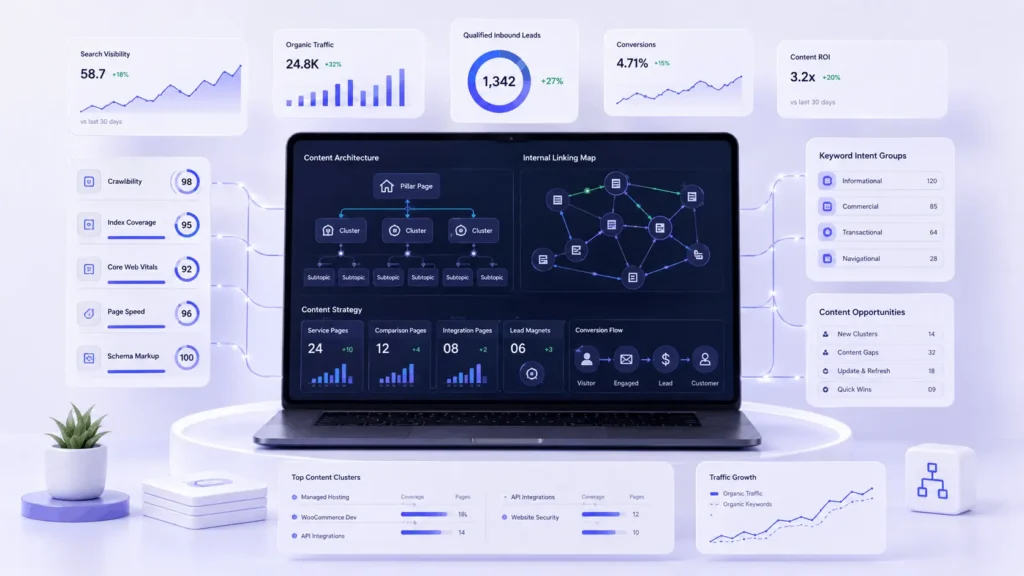
SEO for B2B is not about ranking one page. It is about building category authority across problem, solution, comparison, integration, and commercial queries. For companies that need steady inbound growth, small business SEO support can help connect technical SEO, content planning, and search visibility.
A SaaS company may need pages for use cases, integrations, alternatives, API workflows, and industry solutions. A WordPress or WooCommerce company may need content around performance, plugin architecture, checkout scaling, migrations, and custom development.
Technical SEO matters because B2B websites often become messy over time. Thin service pages, duplicate category URLs, poor internal linking, slow templates, plugin conflicts, broken redirects, and weak schema can limit crawlability and indexation.
For WordPress and WooCommerce websites, the technical layer often includes:
- Clean custom post type architecture.
- Proper internal linking between service and supporting content.
- Object caching with Redis where appropriate.
- CDN optimization for static assets.
- Careful plugin selection to reduce conflicts.
- Structured data for services, FAQs, articles, and organization details.
- Fast landing pages with clear conversion paths.
- Secure forms, spam protection, and CRM field validation.
A b2b digital marketing strategy depends on this foundation because poor technical execution creates invisible growth limits.
Content Marketing That Supports Sales, Not Just Rankings
B2B content should not read like recycled definitions. It should help buyers make decisions.
Strong content explains trade-offs. It shows implementation risks. It clarifies when a simple tool is enough and when custom architecture is necessary. It helps the buyer understand cost, timeline, integration complexity, maintenance, and operational impact.
For example, a company comparing no-code automation with engineered AI workflows may need to understand:
- Where no-code works well.
- Where data validation becomes difficult.
- How API limits affect automation reliability.
- Why human-in-the-loop review may be required.
- How fallback systems reduce operational risk.
- How CRM automation should be monitored.
B2B Digital Marketing Strategy Examples
Here are practical b2b digital marketing strategy examples by business type:
A SaaS company may build SEO pages around use cases, integrations, competitors, API workflows, and role-based pain points. It may support those pages with webinars, product demos, email nurturing, onboarding content, and account-based LinkedIn campaigns.
A WooCommerce service provider may create content around checkout optimization, payment gateway reliability, plugin conflicts, store speed, database performance, subscription billing, and migration risks.
An AI automation consultancy may publish guides on AI agents, orchestration layers, prompt operations, CRM automation, validation systems, human review workflows, and monitoring AI outputs.
A fintech platform may focus on compliance, authentication flows, audit logging, data security, reporting, integrations, and transaction workflows.
The structure changes by industry, but the principle stays the same: match content to operational pain and commercial decision-making.
CRM, Automation, and Sales Handoff
Marketing automation can improve efficiency, but only when the underlying data model is clean.
A weak automation setup creates noise. Leads get wrong emails. Sales teams receive unqualified contacts. Duplicate records appear. Follow-ups happen too early or too late.
A reliable b2b digital marketing strategy should define:
- Lead source rules.
- Lifecycle stages.
- MQL and SQL criteria.
- Account ownership.
- Sales handoff triggers.
- Email segmentation.
- Follow-up timing.
- Disqualification reasons.
- Closed-won and closed-lost feedback loops.
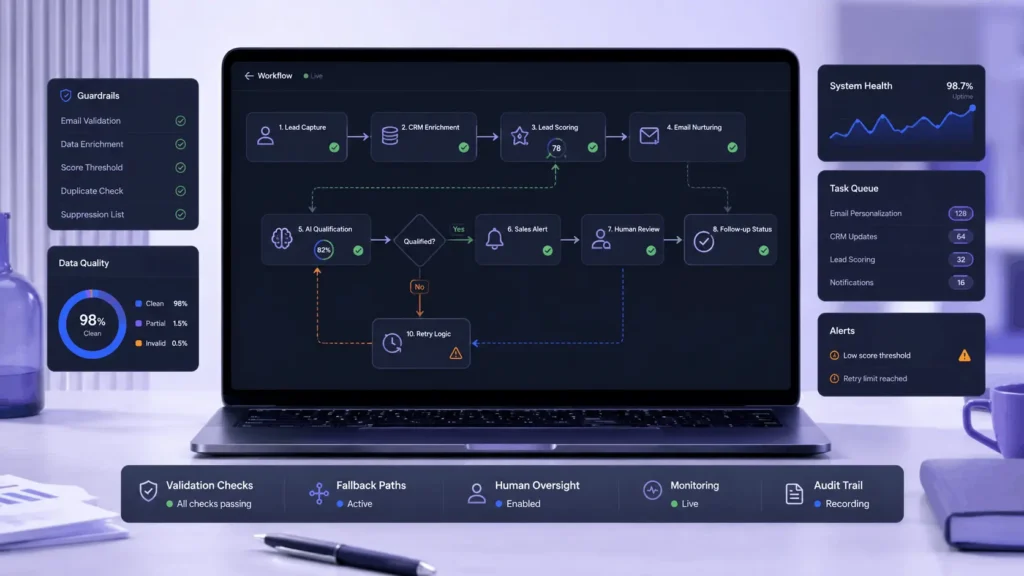
For AI automation, extra care is needed. AI agents can help qualify leads, summarize conversations, route requests, generate sales notes, or support customer service. But they need guardrails. This is where marketing workflow automation can reduce manual follow-up without removing human review.
Production AI workflows should include validation layers, fallback handling, logging, confidence checks, and human review for high-value decisions.
Paid Media, LinkedIn, and Account-Based Marketing
LinkedIn is useful for B2B because decision-makers and technical evaluators spend time there. Strong distribution usually combines expert commentary, case studies, technical breakdowns, and targeted account engagement.
Account-based marketing works best when the target account list is narrow and the message is specific. A company selling enterprise software should not treat every visitor the same. High-value accounts may need personalized landing pages, role-based messaging, sales outreach, retargeting, and tailored proof.
A good b2b digital marketing strategy balances long-term organic authority with focused paid experiments and account-level engagement.
Measuring B2B Digital Marketing Strategy Performance
Traffic alone is not enough. High traffic with poor-fit leads creates sales waste. Low traffic with high-intent buyers can be more valuable.
To measure b2b digital marketing strategy performance, track the full path from channel to revenue.
Useful metrics include:
- Organic qualified leads.
- Marketing qualified leads.
- Sales qualified leads.
- Pipeline created.
- Marketing-sourced revenue.
- Marketing-influenced revenue.
- Conversion rate by landing page.
- Lead-to-opportunity rate.
- Opportunity-to-close rate.
- Customer acquisition cost.
- Customer lifetime value.
- Sales cycle length.
- Account engagement score.
- Content-assisted conversions.

Attribution will never be perfect. The goal is enough trusted data to improve budget allocation, content priorities, sales follow-up, and forecasting.
Platform and Architecture Trade-Offs
| Decision Area | Faster Option | More Scalable Option | Trade-Off |
|---|---|---|---|
| Website | Basic WordPress theme | Custom WordPress or headless architecture | Faster launch vs stronger control |
| Automation | No-code workflows | API-based automation layer | Lower cost vs better reliability |
| Data | Spreadsheet reporting | CRM and analytics data model | Simplicity vs trusted attribution |
| Content | Generic blog publishing | Topic clusters and sales enablement assets | Volume vs decision value |
| Integrations | Plugin-based connectors | Custom API integrations | Quick setup vs maintainability |
| Scaling | Monolithic setup | Modular services where needed | Lower complexity vs future flexibility |
The website, CRM, analytics, automation, and sales tools should exchange reliable data. The right platform is the one that supports clear attribution, maintainable landing pages, accurate lead routing, and measurable pipeline growth without unnecessary complexity.
Where Filicode Fits Into This Work
After a company has validated demand, marketing often exposes deeper system limits. The website cannot support new landing pages quickly. CRM data is inconsistent. Automations break. Integrations rely on fragile plugins. Analytics cannot prove pipeline impact. The sales team needs better technical proof, but the content system is not built for it.
Filicode works at that intersection of marketing, software architecture, WordPress development, WooCommerce development, SaaS systems, API integrations, AI automation, and performance optimization.
For businesses outgrowing off-the-shelf tools, the right technical decisions can reduce future operational cost. A maintainable architecture makes campaigns easier to launch, data easier to trust, and systems easier to scale.
A b2b digital marketing strategy becomes more effective when the website, CRM, integrations, automation, and analytics are engineered as one connected operating system.
7-Step B2B Digital Marketing Strategy Framework
Use this seven-step framework to connect marketing execution with qualified pipeline and revenue goals.
1. Define Your Ideal Customer and Buying Committee
Document the industries, company sizes, business problems, buying triggers, budgets, decision-makers, technical evaluators, users, and procurement concerns that influence a purchase.
2. Clarify Positioning and Commercial Value
Explain the problem you solve, the type of customer you serve, why your approach is different, and what measurable business result the buyer can expect.
3. Build the Website and SEO Architecture
Map core service pages, industry pages, use cases, comparison content, supporting articles, internal links, structured data, and conversion paths around genuine buyer intent.
4. Create Content for Each Buying Stage
Use educational guides for problem awareness, solution pages for research, case studies for vendor evaluation, and ROI or implementation resources for internal approval.
5. Connect CRM and Marketing Automation
Define lead sources, lifecycle stages, scoring rules, segmentation, email workflows, ownership, duplicate handling, and the information that must reach the sales team.
6. Improve Lead Qualification and Sales Handoff
Agree on marketing-qualified and sales-qualified lead criteria. Sales should receive the buyer’s source, company, problem, content activity, requested service, and relevant engagement history.
7. Measure Pipeline and Improve the System
Track qualified leads, opportunities, pipeline created, conversion rates, sales cycle length, revenue influence, acquisition cost, and content-assisted conversions. Use this information to improve campaigns, pages, workflows, and budget allocation.
FAQ
What is a B2B digital marketing strategy?
A b2b digital marketing strategy is a structured plan for attracting, educating, qualifying, and converting business buyers through SEO, content, paid media, email, CRM automation, analytics, and sales workflows.
How much does a B2B digital marketing strategy cost?
Cost depends on scope. A basic strategy may focus on content and SEO. A more advanced plan may include CRM architecture, automation, landing pages, analytics, paid media, integrations, and technical website improvements.
How long does implementation take?
A practical rollout often starts in phases. Positioning, website fixes, tracking, and priority content can start first. CRM automation, technical SEO, integrations, and advanced reporting usually take longer because they affect operational systems.
Can WordPress support a serious B2B digital marketing strategy?
Yes, if it is engineered properly. WordPress can support scalable service pages, Gutenberg templates, custom post types, structured data, CRM integrations, performance optimization, and content operations. Poor plugin architecture is usually the risk, not WordPress itself.
What are the biggest implementation risks?
The common risks are unclear positioning, weak CRM data, poor tracking, slow websites, plugin conflicts, broken automation, low-quality content, and sales teams that do not trust marketing-qualified leads.
Conclusion
A b2b digital marketing strategy should not be treated as a content calendar or ad plan. It is a revenue operating system that connects buyer intent, technical proof, website architecture, CRM workflows, automation, sales enablement, and measurable pipeline impact.
Warning signs usually appear before growth stalls completely. Leads increase but quality drops. Sales ignores form submissions. CRM reports conflict with analytics. Website changes become slow. Automations break silently. Content ranks but does not support deal movement. Paid campaigns get expensive without improving opportunity quality.
Those are operational signals, not just marketing problems.
When the current stack cannot support clean data, reliable integrations, scalable landing pages, technical content, automation, and attribution, custom development should be considered. The next step is not always rebuilding everything. Often, the best move is an architecture review, tracking cleanup, content gap analysis, CRM workflow audit, and a practical implementation roadmap.
A well-built b2b digital marketing strategy gives founders, CTOs, and operations teams a clearer path from visibility to qualified pipeline, without adding unnecessary complexity.