Websites Built Around Clear Decisions, Useful Content, and Reliable Technology

St. Louis Web Design Company for Custom, Scalable, Conversion-Focused Websites

FiliCode is a web design company serving St. Louis businesses, professional teams, retailers, and growing brands with websites that explain their value clearly, work smoothly on every screen, and support inquiries, bookings, purchases, and long-term growth.

Plan Your Website With FiliCode

What Should a St. Louis Business Website Help Customers Do?

A business website should help visitors understand the offer, confirm that the company can meet their needs, and complete the next step without confusion. For St. Louis businesses, that may mean generating qualified inquiries, scheduling appointments, explaining service areas, supporting online purchases, or helping customers compare complex services.

FiliCode connects content strategy, UX/UI design, responsive development, technical SEO, analytics, accessibility, integrations, and post-launch support. The result is not simply a collection of attractive pages, but a maintainable business platform built around customer decisions and measurable actions.

Understand the Offer

Clear service pages, useful navigation, practical explanations, and focused headlines help potential customers quickly understand what the business provides and who it serves.

Verify the Right Fit

Relevant work examples, service areas, team information, process details, policies, credentials, and genuine customer proof can reduce uncertainty before someone contacts the business.

Complete the Next Step

Calls, quote requests, appointment forms, registrations, bookings, and purchases should work reliably and be measurable through properly configured analytics events.

How Should a St. Louis Business Website Be Planned?

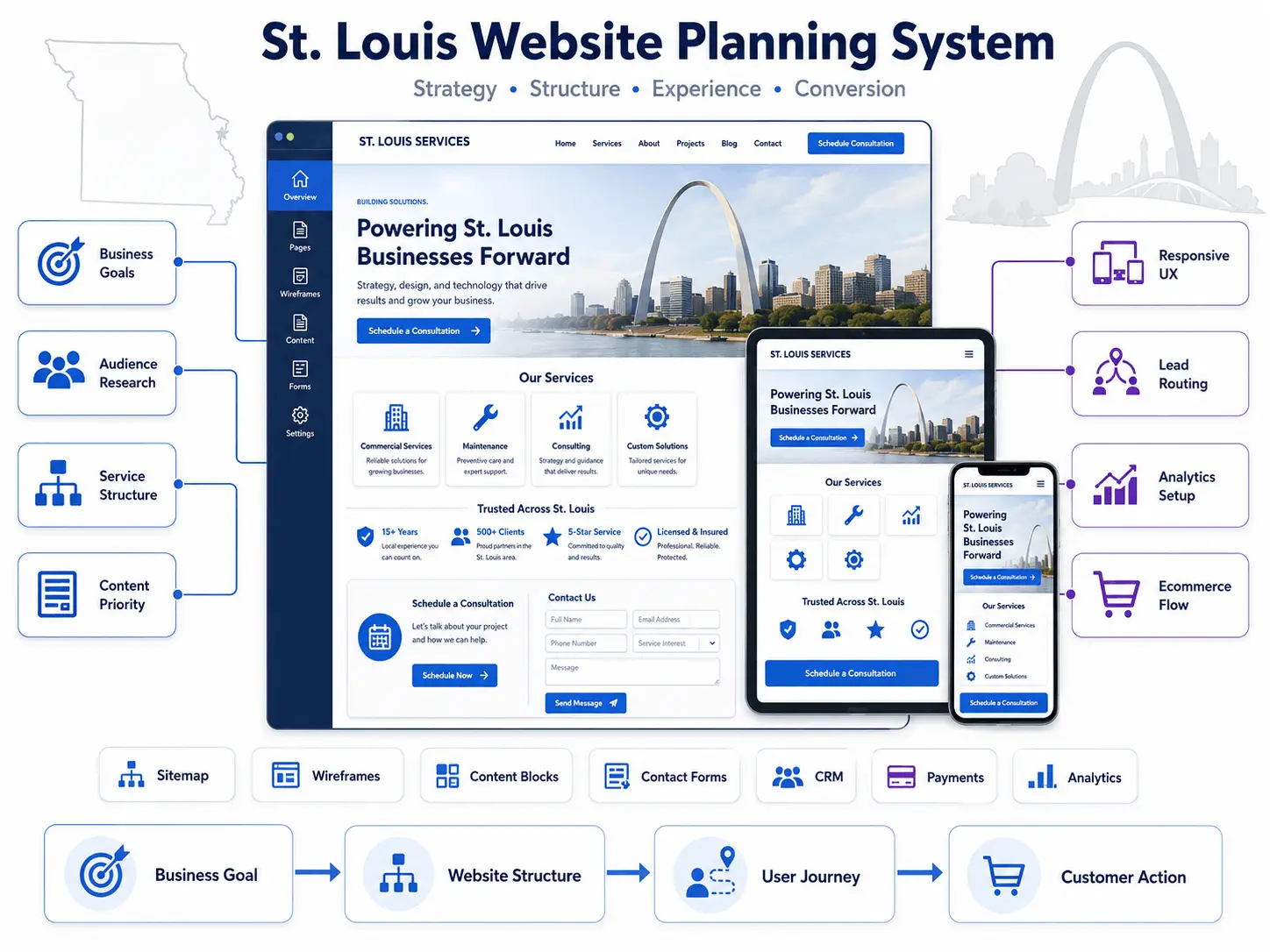
Planning begins with the customer journey, not the home page design. FiliCode reviews the services people compare, the questions they ask before contacting a company, the proof they need, and the steps staff follow after a lead arrives. That information shapes the sitemap, page priorities, content modules, forms, navigation, and technical requirements.

A contractor may need service-area pages, project galleries, and quote qualification. A professional firm may need clear expertise pages, team profiles, appointment requests, and downloadable resources. A retailer may need product architecture, inventory connections, payments, shipping rules, and account workflows. Each website should reflect the way the business actually sells and delivers its services.

FiliCode also considers responsive behavior from the start. Responsive web design allows layouts to adapt to different screen sizes, but useful mobile experiences also require readable content, practical tap targets, short forms, and clear actions.

Review Your Website Requirements
St. Louis business website planning workspace showing sitemap, responsive layouts, content priorities, and conversion paths

Seven Website Services Matched to Real Business Needs

FiliCode scopes design and development around the website's purpose, content volume, internal workflows, integrations, editing responsibilities, and growth plans. The result is a practical build rather than a fixed package with unnecessary features.

Custom website design and user experience icon

Custom Website Design

We create page systems, visual hierarchy, content blocks, navigation, calls to action, and responsive states around the brand and customer journey instead of forcing every business into the same layout.

Custom web development icon

Custom Web Development

Front-end components, CMS templates, forms, dashboards, API connections, and business logic are developed according to documented requirements and tested across common devices and browsers.

WordPress website development icon

WordPress Development

Custom templates, reusable fields, controlled editing, integrations, and role-based workflows give marketing teams flexibility without making every page dependent on a developer.

Responsive and accessible website design icon

Responsive and Accessible UX

Layouts are planned for small screens, keyboard use, readable contrast, clear labels, predictable interactions, and practical ADA-conscious improvements that make the site easier to use.

Landing page and conversion optimization icon

Landing Pages and CRO

Focused landing pages connect campaign intent with concise content, credible proof, suitable forms, and analytics events. Conversion rate optimization then uses observed behavior to guide improvements.

Ecommerce website development and integration icon

Ecommerce Development

Product structures, checkout flows, payment gateways, shipping rules, customer accounts, and operational integrations are planned together. Businesses can also review our ecommerce website design services.

Website maintenance and technical support icon

Redesign, Maintenance, and Support

Website redesign, content updates, technical fixes, backups, software maintenance, performance reviews, and feature improvements can be scoped around the platform and business priorities.

Need a website plan that fits your sales process and internal workflow?

Define The Right Scope

When Does Ecommerce Need More Than a Standard Theme?

Standard themes can support a straightforward catalog, but growing stores often need deeper planning when product data, customer roles, pricing rules, subscriptions, fulfillment, or third-party systems become more complex. For St. Louis businesses, ecommerce web development should connect the storefront with the operational work that happens after an order is placed.

Common Storefront Requirements

  • Product and Category Architecture

    Filters, variants, bundles, attributes, search, and product relationships should help customers find suitable items without creating an unmanageable catalog.

  • Checkout and Payment Logic

    Taxes, shipping, discounts, payment methods, account rules, and confirmation steps need to work together without unexpected gaps.

  • Operational Connections

    CRM, ERP, inventory, email, analytics, and fulfillment connections may require custom ecommerce development rather than isolated plugins.

Platform and Team Decisions

  • Choose the Platform Around the Workflow

    Our e-commerce solution planning considers catalog size, integrations, editing needs, ownership, and future expansion before recommending a build direction.

  • Use Specialist Support Where Needed

    Stores with custom WooCommerce requirements can work with WooCommerce developers for extension work, checkout logic, integrations, and technical troubleshooting.

  • Protect Conversion and Maintainability

    A WooCommerce web design company should consider merchandising, mobile buying behavior, performance, administration, and long-term support together.

How Does FiliCode Move a Website From Idea to Operation?

FiliCode uses a Build-to-Operate Framework that keeps business goals, content, implementation, approval, and launch responsibilities visible. Each phase produces decisions or deliverables that reduce uncertainty in the next phase.

Website discovery and goals icon

01. Align

Website architecture and content planning icon

02. Map

User interface design system icon

03. Design

Website development and integration icon

04. Build

Website testing launch and support icon

05. Operate

Align Goals and Constraints

We review audiences, services, competitors, existing analytics, content readiness, integrations, decision-makers, budget boundaries, and launch dependencies.

Map Pages and Workflows

The sitemap, content responsibilities, forms, conversion routes, CMS fields, integrations, and measurement events are documented before development begins.

Design a Reusable System

Layouts are designed as connected components so headings, cards, forms, proof sections, CTAs, spacing, and responsive behavior remain consistent.

Build, Integrate, and Verify

Development covers templates, content modules, forms, integrations, CMS controls, analytics, device testing, browser checks, redirects where required, and practical performance work.

Launch With Operational Ownership

After approval, we verify critical pages, forms, SSL, analytics, redirects, indexability, and integrations. Training, maintenance, and support responsibilities are agreed according to scope.

How Should You Compare St. Louis Web Design Companies?

Compare agencies by examining their process, relevant work, technical responsibilities, communication, ownership terms, testing standards, and support after launch. A polished portfolio or third-party badge can be useful, but businesses should also confirm what the agency actually delivered, whether the examples are relevant to the proposed project, and who will perform the work.

Ask each company to explain content responsibilities, custom functionality, revision limits, accessibility work, analytics setup, migration risks, hosting arrangements, maintenance, and how unexpected requirements are handled. These details provide a more reliable comparison than broad claims about being the best web developers in St. Louis.

Transparent website scope icon

Scope Transparency

Deliverables, content requirements, integrations, review rounds, exclusions, and support expectations should be visible before work begins.

Technical website ownership icon

Technical Ownership

Ask who owns the design files, code, domain, hosting accounts, analytics access, integrations, licenses, and administrative credentials.

Website quality assurance icon

Quality Verification

A reliable web developer serving St. Louis businesses should explain device testing, browser checks, form verification, performance work, and launch review.

Long-term website support icon

Long-Term Support

Clarify what happens after launch, how requests are prioritized, what maintenance covers, and how future features or content expansions are estimated.

A Practical Recommendation Before Development Starts

FiliCode can review your current website, customer journey, content gaps, technical constraints, ecommerce requirements, and internal workflow before recommending a focused redesign, phased improvement, or complete rebuild.

Request A Website Review
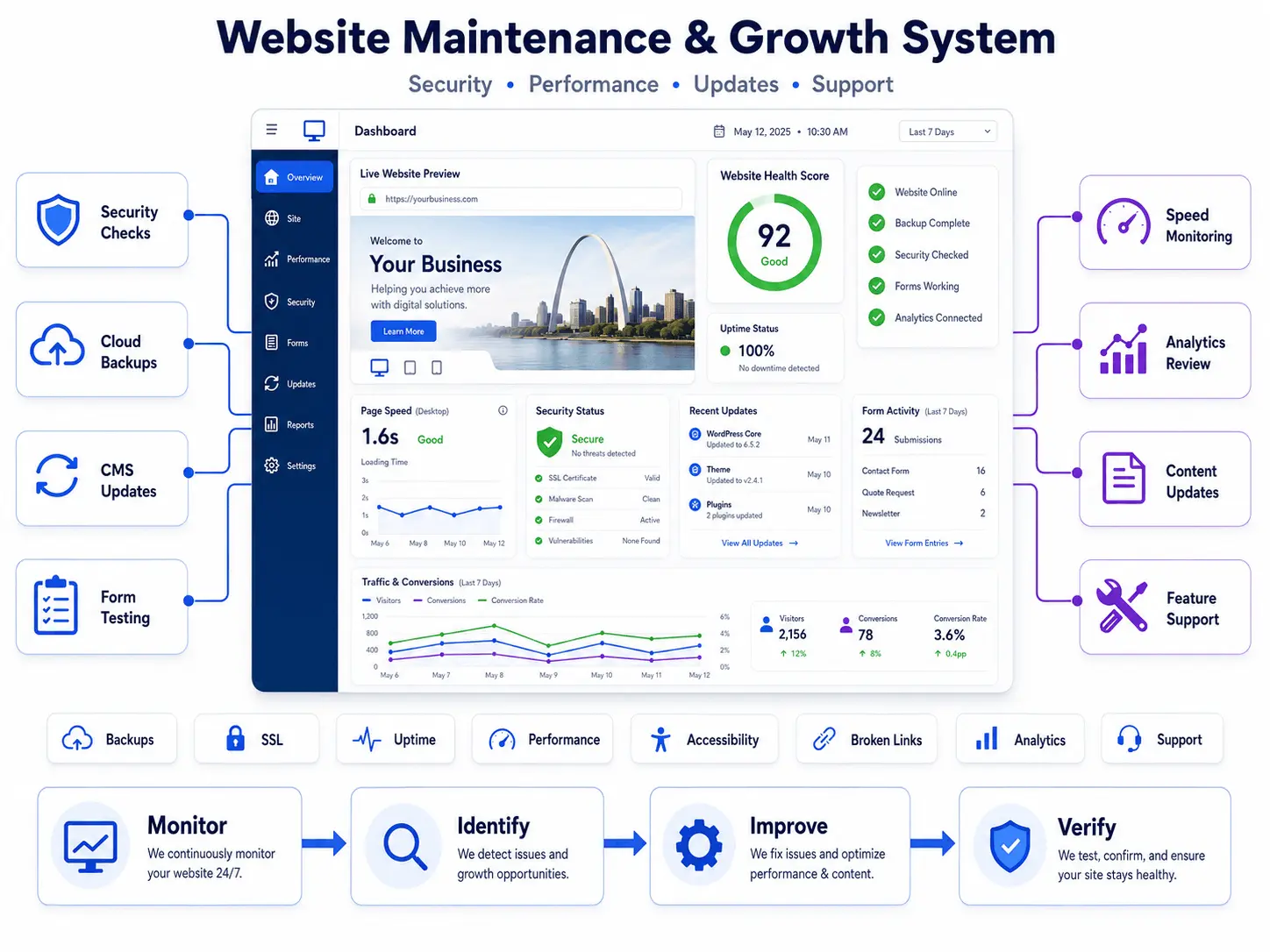
Website maintenance dashboard showing security checks, backups, performance monitoring, analytics, and ongoing support

What Happens After a New Website Goes Live?

Launch moves the website into an operating environment where content, software, customer behavior, integrations, and business priorities continue to change. Ongoing work may include backups, security checks, CMS updates, form testing, performance monitoring, accessibility improvements, analytics verification, landing pages, and carefully scoped feature development.

FiliCode separates maintenance from open-ended promises. The support plan should identify the platform, responsibilities, response process, included tasks, exclusions, and how larger improvements are estimated. This gives the business realistic expectations and helps the website remain useful as services, teams, locations, or product lines expand.

Discuss Ongoing Website Support

Frequently Asked Questions

Review common questions about website pricing, project timelines, custom development, scalability, and long-term support before planning your project.

FiliCode combines business discovery, content architecture, UX/UI design, development, integrations, testing, and post-launch planning within one documented workflow. Unlike a fixed website package, our approach defines responsibilities, technical dependencies, deliverables, and support expectations before development begins. This helps St. Louis businesses understand how their website will be built, managed, and improved over time.

FiliCode can build a fully custom website or use a carefully selected framework when it suits the project's budget, timeline, and technical requirements. The recommended approach depends on branding, page complexity, content management needs, integrations, ecommerce functionality, performance goals, and long-term maintenance rather than a one-size-fits-all preference.

A website can scale more reliably when its content structure, navigation, templates, hosting, integrations, permissions, and performance requirements are considered early. FiliCode develops reusable components and maintainable CMS workflows so businesses can add services, locations, products, landing pages, content, and team members without rebuilding the entire website.

Website pricing depends on the number of pages, content requirements, custom design needs, integrations, ecommerce functionality, migration work, and ongoing support. FiliCode reviews these requirements before providing a defined project scope and estimate instead of applying one fixed price to every St. Louis business website.

The timeline depends on the website's size, content readiness, approval process, integrations, and technical complexity. A focused service-business website may take less time than a custom ecommerce platform or integration-heavy project. FiliCode confirms the project phases, responsibilities, dependencies, and review process before development begins.

Discuss Your St. Louis Website Project

Share your current website, target customers, required pages, content status, preferred platform, ecommerce needs, integrations, launch goals, and any technical concerns. FiliCode will review the fit and recommend a practical direction for design, development, redesign, or phased improvement.

We hate spam, and we respect your privacy.

Contact FiliCode about a St. Louis website design and development project