






Contents
- Ecommerce Website Development Cost Breakdown in 2026
- Quick Summary: Ecommerce Cost Decisions That Matter
- What Actually Drives Ecommerce Website Development Cost?
- Ecommerce Website Development Cost by Platform
- Custom Ecommerce Website Development Cost vs Template Builds
- Workflow Complexity Changes Ecommerce Website Development Cost
- Payment Gateways and Webhook Reliability
- APIs, Automation, and Operational Data
- WooCommerce Development Cost and Scaling Realities
- Ecommerce Website Development Cost in India, Dubai, Pakistan, USA, and Other Regions
- Maintenance, Hosting, and Long-Term Ecommerce Website Development Cost
- Cheap Development vs Maintainable Ecommerce Systems
- FAQs About Ecommerce Website Development Cost
- How much does ecommerce website development cost?
- What affects ecommerce website development cost the most?
- What is the WordPress ecommerce website development cost?
- Is multi vendor ecommerce website development cost higher?
- How long does ecommerce website development take?
- Can ecommerce website development cost be reduced?
- Conclusion: Plan Ecommerce Website Development Cost Around Operations
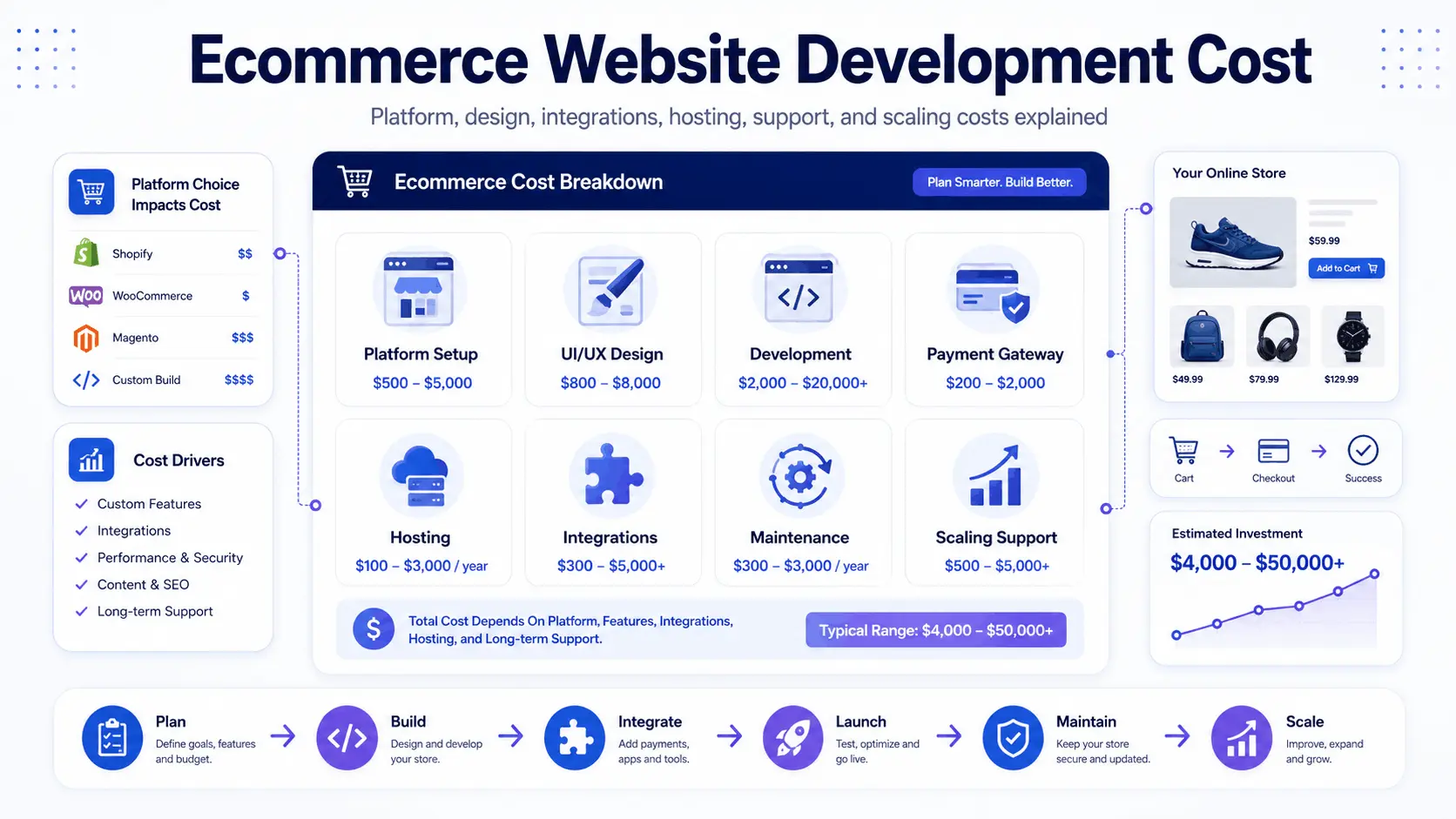
Ecommerce website development cost typically ranges from $1,500–$5,000 for a starter online store to $50,000–$150,000+ for an enterprise ecommerce platform. A custom ecommerce website commonly costs $12,000–$40,000, while a multi-vendor marketplace may cost $25,000–$80,000 or more.
The final cost depends on architecture, platform selection, design, product catalog size, checkout requirements, integrations, payment reliability, hosting, maintenance, and support. A small WooCommerce store with 40 products has a different cost model than a multi-vendor marketplace, B2B portal, subscription store, or high-volume catalog running ERP and warehouse synchronization.
Ecommerce Website Development Cost Breakdown in 2026
Ecommerce website development cost in 2026 usually falls into several layers: planning, UI/UX design, platform setup, theme development, backend logic, product catalog structure, payment gateway setup, integrations, testing, hosting, security, and ongoing support.
A simple store can be built with a theme, standard checkout, payment gateway, shipping rules, and a small catalog. A custom store needs architecture work before development starts. That includes product relationships, customer roles, order states, tax logic, refund workflows, inventory sync, and data ownership.
| Store Type | Typical Scope | Estimated Development Cost |
|---|---|---|
| Starter ecommerce store | Theme setup, basic products, standard checkout, payment gateway | $1,500 – $5,000 |
| Small business WooCommerce store | Custom design, product categories, shipping, tax, plugins, SEO setup | $4,000 – $12,000 |
| Custom ecommerce website | Custom UI, checkout rules, APIs, performance work, reporting | $12,000 – $40,000 |
| Multi-vendor marketplace | Vendor dashboards, commissions, payouts, approvals, disputes | $25,000 – $80,000+ |
| Enterprise ecommerce platform | ERP, CRM, warehouse, automation, audit logs, role permissions | $50,000 – $150,000+ |
These numbers vary by region. Ecommerce website development cost in India, Pakistan, Nepal, and Delhi may be lower than ecommerce website development cost in USA or Dubai because developer rates differ. The risk is not location. The risk is scope clarity. A cheap build with weak architecture can cost more after launch than a properly planned project.
Quick Summary: Ecommerce Cost Decisions That Matter
- A basic ecommerce website can be affordable, but scaling costs depend on catalog size, checkout complexity, integrations, hosting, and support.
- WooCommerce is flexible for WordPress-based stores, but plugin quality, object caching, checkout load, and database structure affect long-term cost.
- SaaS platforms reduce infrastructure work but can become expensive when custom workflows, apps, transaction rules, or enterprise features are needed.
- Custom ecommerce website development cost increases when the store needs APIs, automation, complex pricing, subscriptions, multi-vendor workflows, or ERP integration.
- The cheapest quote usually excludes testing, monitoring, security, performance optimization, and post-launch maintenance.
What Actually Drives Ecommerce Website Development Cost?
The largest cost driver is not the homepage design. It is the amount of business logic behind the store.
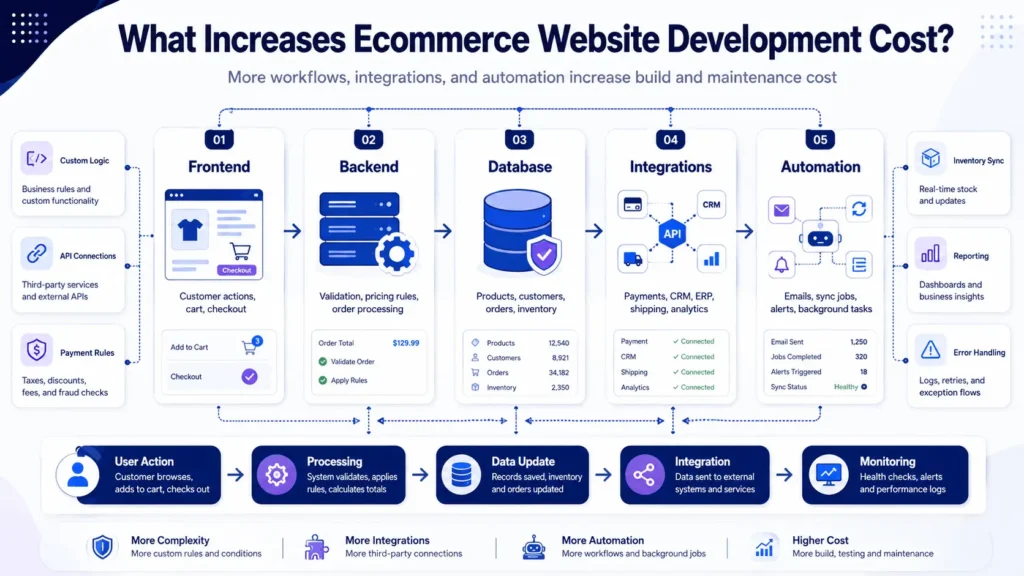
A production ecommerce system handles more than product pages. A customer adds items to cart, applies a coupon, selects shipping, pays through a gateway, receives email notifications, and expects the order to appear correctly in the admin panel. Behind that flow, the system updates stock, stores transaction states, triggers webhooks, creates invoices, sends events to analytics, and may push data to CRM or fulfillment software.
When traffic increases, small mistakes become expensive. Slow database queries delay checkout. Poor plugin choices create conflicts. Missing webhook retries cause payment and order mismatches. Manual refunds create accounting gaps. Weak logging makes failures hard to trace.
That is why ecommerce website development cost should be viewed as total cost of ownership, not only first build price.
Ecommerce Website Development Cost by Platform
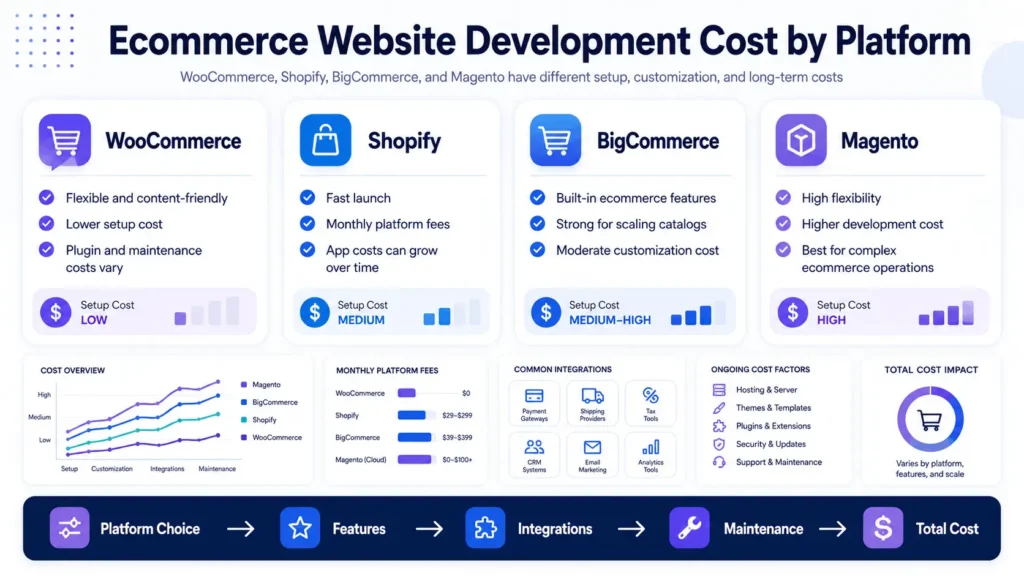
Platform selection changes both upfront and ongoing cost.
WooCommerce is a strong option when a business already uses WordPress, needs content control, wants flexible plugin architecture, or requires custom hooks around checkout, product logic, or user roles. WordPress ecommerce website development cost can stay reasonable for small and mid-sized stores, but performance depends on hosting, plugin discipline, database health, and caching.
Shopify reduces hosting and maintenance work. It works well for standard retail operations, but custom checkout logic, B2B workflows, complex subscriptions, or deep backend control may require higher-tier plans, apps, or custom development. If you need Shopify architecture support, FiliCode provides custom Shopify development services for stores that need more than theme adjustments.
BigCommerce fits teams that want SaaS infrastructure with stronger built-in ecommerce features. For larger catalogs or API-driven builds, BigCommerce development services can reduce operational friction compared with heavily patched plugin stacks.
Magento and Adobe Commerce are better suited for complex catalogs, B2B pricing, multi-store structures, and enterprise workflows. The platform has deeper architecture requirements and usually higher development and maintenance cost. For technical background, the Magento open-source ecommerce platform history explains why it is often considered for more complex commerce builds.
Custom Ecommerce Website Development Cost vs Template Builds
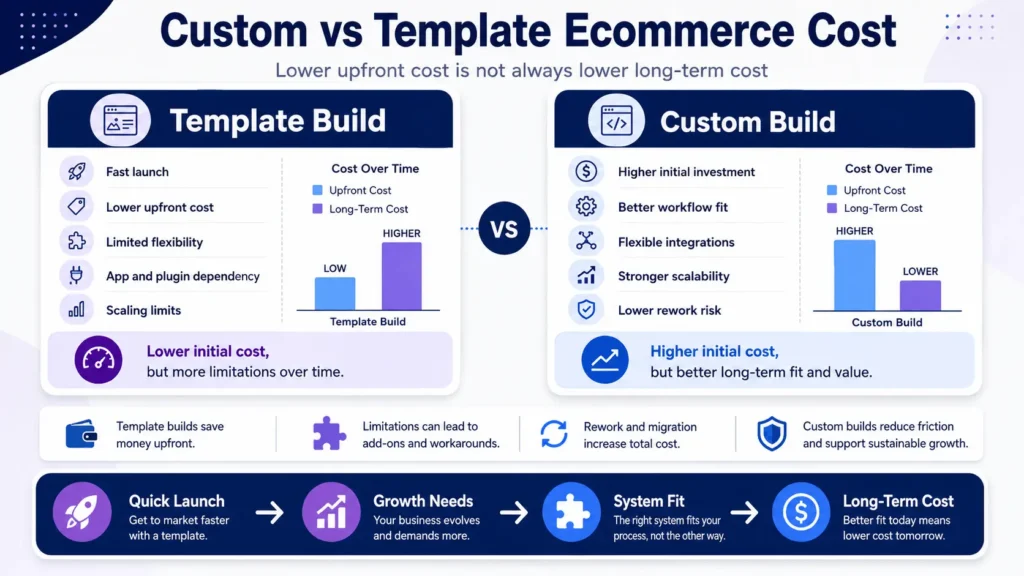
A template build is faster. It works when the business has standard products, simple checkout, limited integrations, and a team that can operate inside existing platform rules.
Custom development becomes necessary when the business model does not fit default behavior. Examples include customer-specific pricing, wholesale portals, multi-currency rules, conditional shipping, quote-based checkout, digital licensing, marketplace commissions, booking logic, or ERP-driven inventory.
| Approach | Best For | Main Cost Risk |
|---|---|---|
| No-code or template store | Simple catalogs, fast launch, limited customization | Outgrowing platform limits quickly |
| WooCommerce custom build | WordPress content, flexible catalog logic, custom plugins | Plugin conflicts and database load if unmanaged |
| SaaS ecommerce platform | Standard retail workflows, lower infrastructure burden | App subscriptions and restricted backend control |
| Headless ecommerce | Custom frontend, API-first teams, performance-focused brands | Higher engineering and maintenance responsibility |
| Enterprise custom system | Complex operations, integrations, multi-region workflows | Architecture mistakes become expensive at scale |
The practical question is not “Which platform is cheapest?” It is “Which platform will still support the business when orders, traffic, integrations, and team workflows become harder?”
For businesses already facing operational limits, custom ecommerce solutions can reduce future rework by planning platform architecture, checkout logic, integrations, automation, and support requirements before development starts.
Workflow Complexity Changes Ecommerce Website Development Cost
A real ecommerce workflow has several moving parts.
The frontend collects product selections, customer data, shipping preferences, and payment intent. The backend validates the cart, checks stock, calculates tax, applies discounts, and creates an order record. The database stores users, products, orders, inventory, payments, refunds, and activity logs. External APIs may handle payments, shipping labels, CRM updates, accounting entries, SMS messages, or email automation.
Under load, these actions cannot all depend on one slow request. Good systems move non-critical work into queues. Order confirmation emails, CRM sync, warehouse notifications, invoice generation, and AI-based recommendations can run asynchronously. If an API fails, the system should retry, log the failure, and alert the team instead of silently losing data.
This is where ecommerce website development cost increases for serious stores. You are not only paying for screens. You are paying for reliability.
Payment Gateways and Webhook Reliability
Payment systems are a common source of hidden cost.
A payment may be authorized, captured, failed, refunded, disputed, or partially refunded. The ecommerce platform must handle these states correctly. Webhooks from Stripe, PayPal, or regional payment gateways should be verified, logged, retried, and matched against internal orders.
A weak implementation creates support problems. Customers are charged but orders do not appear. Refunds are issued manually but reporting stays wrong. Finance teams cannot reconcile revenue. These issues are expensive because they combine technical, customer service, and accounting work.
APIs, Automation, and Operational Data
Integrations can make or break the budget.
A store may need inventory management, CRM, ERP, accounting, fulfillment, analytics, email marketing, support desk, or vendor systems. Basic API integration is straightforward when both systems are clean. Cost rises when APIs are inconsistent, undocumented, rate-limited, or missing key fields.
For stores with disconnected tools, API integration services help connect ecommerce data with operational systems instead of forcing teams to copy information manually.
AI automation can also reduce repetitive work, but only when guardrails exist. Product description generation, support triage, customer segmentation, and CRM updates need validation systems, fallback logic, human review, and monitoring. Without that, automation creates another failure point.
WooCommerce Development Cost and Scaling Realities
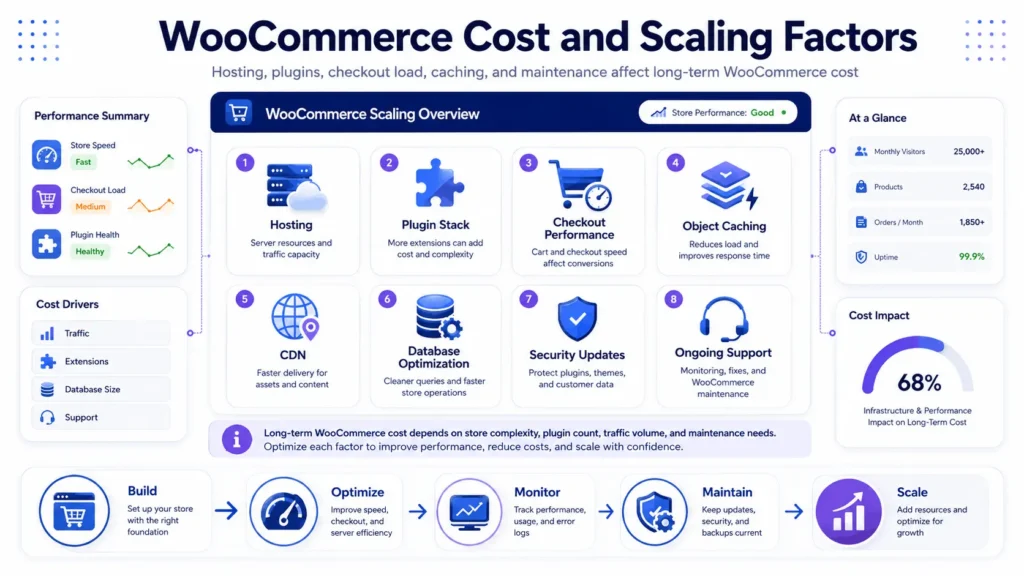
WooCommerce is powerful because it sits inside WordPress and can be extended through plugins, hooks, filters, custom post types, REST APIs, and custom tables. That flexibility is useful, but it must be managed carefully.
Common WooCommerce bottlenecks include overloaded checkout pages, too many plugins, slow admin screens, unoptimized product queries, weak hosting, missing object caching, and heavy theme builders. Redis object caching, CDN optimization, image compression, database cleanup, and careful plugin selection can improve performance.
Cron jobs are another issue. WordPress cron depends on site traffic by default. For stores with subscriptions, abandoned cart workflows, stock sync, or scheduled imports, server-level cron is safer. High-volume stores may also need queue workers for background jobs.
Headless WordPress can help when the frontend requires stronger performance or a custom user experience, but it adds engineering overhead. You now maintain the WordPress backend, API layer, frontend app, hosting pipeline, authentication flow, and preview system.
If your store needs stronger UI planning, product page structure, and conversion-focused layouts, FiliCode’s ecommerce website design agency team can support design and development decisions together instead of treating them as separate problems.
Ecommerce Website Development Cost in India, Dubai, Pakistan, USA, and Other Regions
Regional pricing matters, but it should not be the only filter.
Ecommerce website development cost in India and Pakistan may be lower for development hours. Ecommerce website development cost in Dubai or the USA may be higher because of agency overhead, compliance expectations, project management, and local market rates. Ecommerce website development cost in Nepal or Delhi can also vary widely depending on whether you hire a freelancer, small team, or specialized ecommerce agency.
The stronger comparison is delivery maturity. Ask how the team handles scope documents, staging environments, backups, QA, payment testing, deployment, security hardening, rollback plans, and support after launch.
A low quote that excludes these items is not really cheaper. It is incomplete.
Maintenance, Hosting, and Long-Term Ecommerce Website Development Cost
Ongoing cost starts after launch.
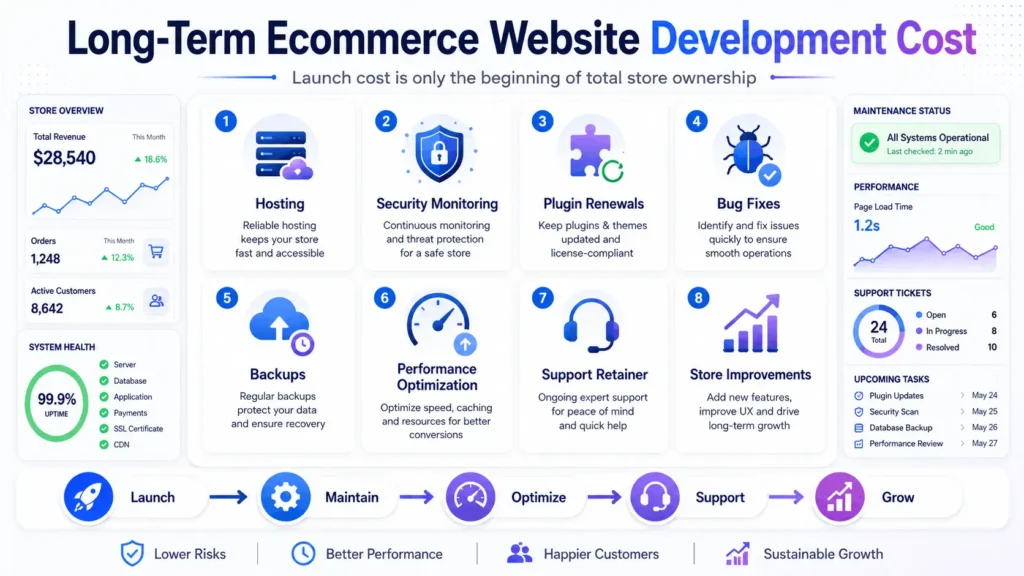
Stores need software updates, plugin renewals, theme maintenance, security monitoring, backups, uptime checks, performance reviews, analytics validation, bug fixes, and conversion improvements. For WooCommerce, maintenance also includes plugin conflict management, PHP version compatibility, database optimization, and checkout testing after updates.
Hosting cost depends on traffic, catalog size, media volume, admin usage, and checkout load. Shared hosting may work for a very small store. Growing stores usually need managed WordPress hosting, VPS, cloud hosting, or dedicated infrastructure with CDN support.
For businesses without internal technical teams, website support services can reduce the operational burden of keeping the store stable after launch.
Cheap Development vs Maintainable Ecommerce Systems
Cheap development usually removes the invisible work.
No staging setup. No test cases. No load testing. No structured deployment process. No logging. No documentation. No rollback plan. No monitoring. No clear ownership after launch.
That may be acceptable for a temporary MVP. It is dangerous for a store that handles real revenue.
Maintainable systems cost more because they include architecture thinking. They define how data moves, how failures are handled, who can access what, how integrations retry, where logs are stored, how backups are restored, and how the platform can evolve without breaking checkout.
This is the difference between a website and a commerce system.
FAQs About Ecommerce Website Development Cost
How much does ecommerce website development cost?
Ecommerce website development cost can range from $1,500 for a basic store to $50,000+ for custom systems with integrations, automation, multi-vendor workflows, or enterprise architecture. The final price depends on platform, design, catalog size, checkout logic, APIs, hosting, and support.
What affects ecommerce website development cost the most?
The biggest factors are custom functionality, product catalog complexity, payment rules, third-party integrations, performance requirements, and maintenance expectations. Design matters, but backend workflows usually create the larger cost.
What is the WordPress ecommerce website development cost?
WordPress ecommerce website development cost commonly depends on WooCommerce setup, custom theme work, plugin licensing, checkout customization, hosting, caching, security, and ongoing support. A simple WooCommerce store costs far less than a custom B2B or high-volume store.
Is multi vendor ecommerce website development cost higher?
Yes. Multi vendor ecommerce website development cost is usually higher because marketplace stores need vendor onboarding, commissions, payout workflows, product approval, dashboards, disputes, permissions, reporting, and stronger security.
How long does ecommerce website development take?
A basic store can take a few weeks. A custom ecommerce platform may take several months, especially if it includes ERP integration, complex checkout rules, marketplace features, migration, or automation workflows.
Can ecommerce website development cost be reduced?
Yes, but not by removing critical engineering work. Start with essential features, use a stable platform, avoid unnecessary plugins, document workflows clearly, and delay advanced automation until the core store is stable.
Conclusion: Plan Ecommerce Website Development Cost Around Operations
Ecommerce website development cost should be planned around how the store will operate after launch, not only how it will look on launch day.
Warning signs are easy to spot. Orders require manual fixes. Inventory does not match. Checkout slows during campaigns. Staff copy data between systems. Plugins break after updates. Reports are unreliable. Payment issues are hard to trace. Support tickets increase because the platform does not match the workflow.
That is when custom development should be considered. Not for complexity by default, but because the business has outgrown generic tools.
FiliCode works on WordPress development, WooCommerce development, custom software development, AI automation, API integrations, SaaS architecture, and performance optimization for businesses that need maintainable ecommerce systems. To review your current platform, scope a new build, or discuss scaling problems, you can discuss your project with FiliCode before committing to a development direction.