





Contents
- Quick Summary: What Decision-Makers Should Prioritize
- 1. How to Compare a Washington DC Web Design Company
- 2. Architecture Standards for a Washington DC Web Design Company
- How a Washington DC Web Design Company Should Map the Request Lifecycle
- 3. WordPress, WooCommerce, and Content Operations
- Common Production Bottlenecks
- 4. How a Washington DC Web Design Company Handles Integrations
- 5. WordPress, Headless, SaaS, or Custom: Real Trade-Offs
- 6. Accessibility, SEO, and Washington Operating Context
- 7. How a Washington DC Web Design Company Should Deliver the Project
- Where Filicode Fits
- Frequently Asked Questions
- How much does a Washington DC Web Design Company cost?
- How long does implementation usually take?
- Can a Washington DC Web Design Company scale WordPress?
- How should CRM and payment integrations be protected?
- Can a redesign preserve existing search rankings?
- What maintenance is required after launch?
- When to Engage a Washington DC Web Design Company
A website can look polished and still fail under pressure: forms stop routing, CRM records duplicate, editors break layouts, and checkout slows during campaigns. A capable Washington DC Web Design Company should solve those operational problems before choosing colors or animations. The right partner designs a maintainable business system with reliable integrations, controlled publishing, measurable conversion paths, and a realistic growth plan.
A Washington DC Web Design Company plans, builds, and supports websites for organizations in the District and wider DMV market. Its value is measured by how well the platform supports users, internal teams, security, accessibility, integrations, performance, and future change—not visual style alone.
Quick Summary: What Decision-Makers Should Prioritize
- A scalable website starts with content models, user journeys, permissions, integrations, and ownership rules before visual design begins.
- WordPress is often the practical choice for content-led organizations, but custom plugins, object caching, controlled updates, and disciplined hosting determine whether it remains reliable.
- Headless architecture can improve frontend flexibility, yet it adds deployment, preview, caching, authentication, and support complexity that smaller teams may not need.
- CRM, payment, email, and analytics integrations require validation, idempotency, retries, logging, and failure alerts; a successful API response is not enough.
- The strongest web design services Washington DC buyers can select are those that define post-launch maintenance, security, accessibility, and measurement before development starts.
1. How to Compare a Washington DC Web Design Company
When comparing a Washington DC web design agency with larger Washington DC web design firms, evaluate delivery models, not portfolios alone. Portfolios show presentation quality but rarely reveal content migration, role-based access control, failed webhooks, traffic spikes, redirect mapping, or months of regression-free plugin updates.
Ask each Washington DC Web Design Company to explain who owns requirements, how scope changes are managed, what testing occurs before launch, and how incidents are handled afterward. Vague answers usually become expensive during migration or stabilization.
| Feature | Weak Approach | Production-Ready Approach |
|---|---|---|
| Discovery | Page count and visual references | User journeys, content inventory, integrations, permissions, risks, and success metrics |
| Development | Theme assembly with many plugins | Reusable components, documented custom code, controlled dependencies, and code review |
| Launch | DNS switch and basic browser check | Redirects, analytics, forms, backups, security, performance, accessibility, and rollback validation |
| Support | Ad hoc fixes after failure | Monitoring, update windows, incident ownership, recovery procedures, and improvement backlog |
Cheap development can suit a temporary campaign. It becomes risky when the website supports lead generation, member services, ecommerce, recruitment, or public information. Maintainable systems cost more because architecture, QA, documentation, and operational safeguards require real work.
2. Architecture Standards for a Washington DC Web Design Company
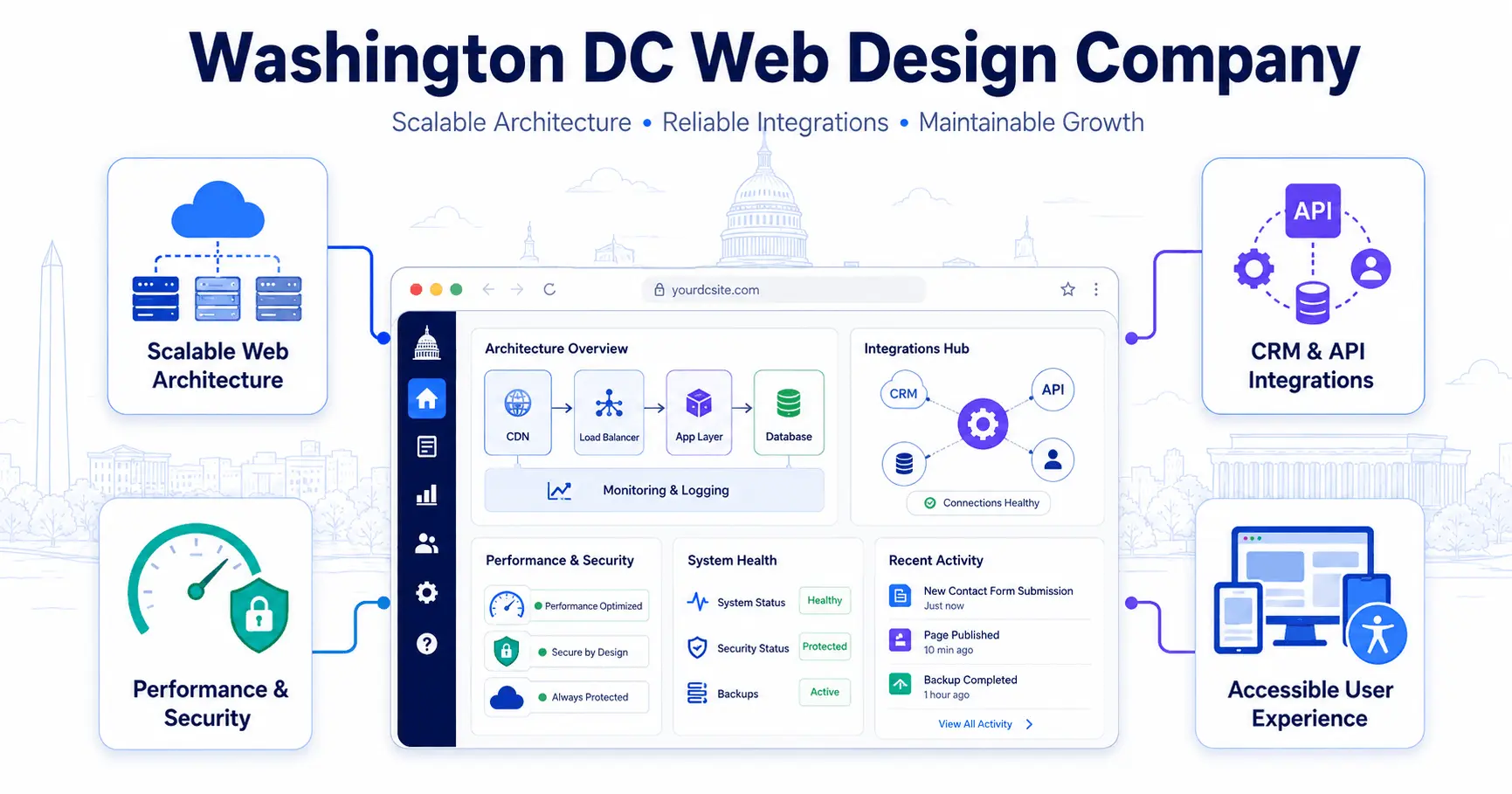
The architecture should match the organization’s operating model. A conventional CMS monolith keeps content management, rendering, authentication, and plugins in one deployable system. This reduces infrastructure complexity and often suits associations, professional services, nonprofits, and content-heavy B2B websites.
A headless CMS separates content from the frontend through REST or GraphQL APIs. It supports multiple channels and independent frontend releases. The trade-off is more hosting, preview tooling, cache invalidation, API security, deployment coordination, and developer dependence.
A complete website design and development framework should connect architecture to content operations, UX, integrations, accessibility, testing, and post-launch ownership. The organization must be able to operate it reliably.
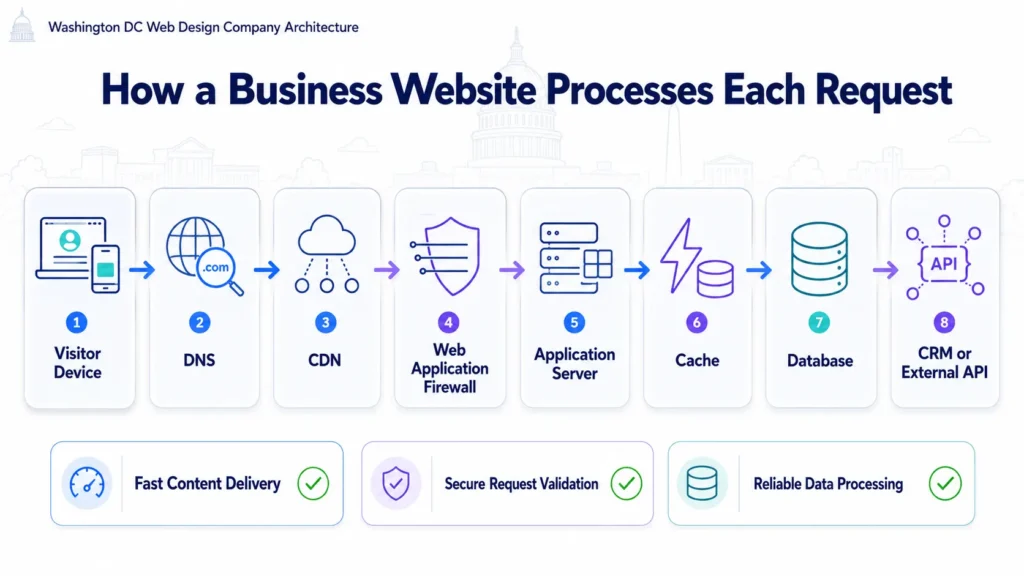
How a Washington DC Web Design Company Should Map the Request Lifecycle
A production request passes through DNS, a CDN, a web application firewall, the application server, cache, business logic, and the database. A form may then call a CRM, send email, enqueue a job, and record an analytics event.
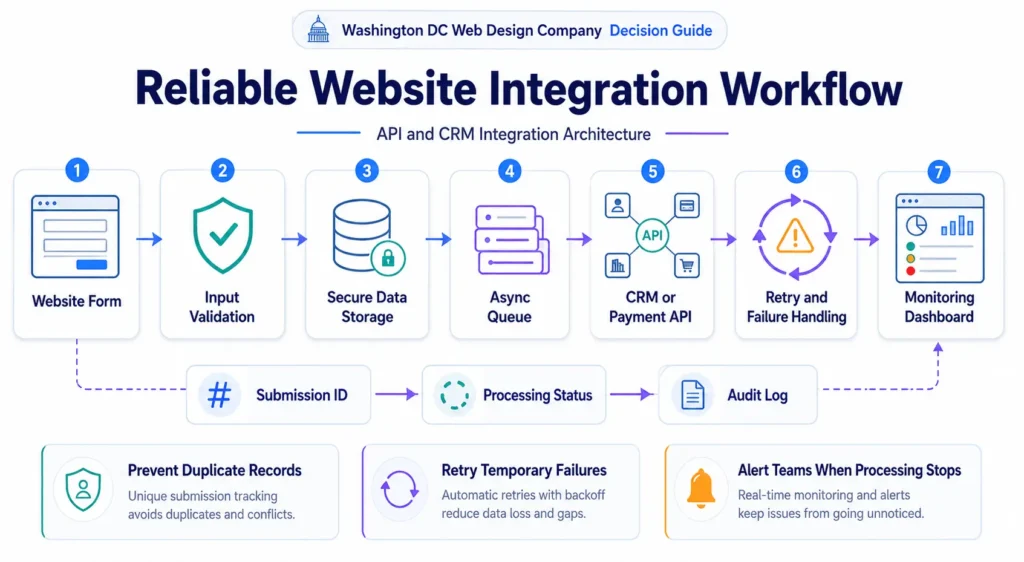
In production, failures often occur after the visitor sees a success message. The CRM may time out, the email provider may reject the payload, or a duplicate retry may create two opportunities. Reliable workflows validate inputs, assign a correlation ID, persist the submission, process external calls asynchronously, retry transient failures, and alert staff when a job reaches a dead-letter state.
A mature Washington DC Web Design Company defines authentication and authorization early. Administrators, editors, members, customers, and integration accounts should receive minimum required permissions. RBAC, two-factor authentication, audit logs, session controls, and protected API credentials reduce security exposure and support burden.
3. WordPress, WooCommerce, and Content Operations
WordPress remains effective when editorial control matters and the implementation is disciplined. The core decision is not “WordPress or custom.” It is whether the content model, theme architecture, plugin strategy, hosting, and release process fit the organization.
For teams evaluating a Washington DC Web Design Company, ask how it uses custom post types, fields, Gutenberg blocks, hooks, and deployment environments. Reusable blocks should protect layout consistency without locking editors into rigid templates. Filicode’s WordPress development services describe this type of controlled CMS implementation.
Common Production Bottlenecks
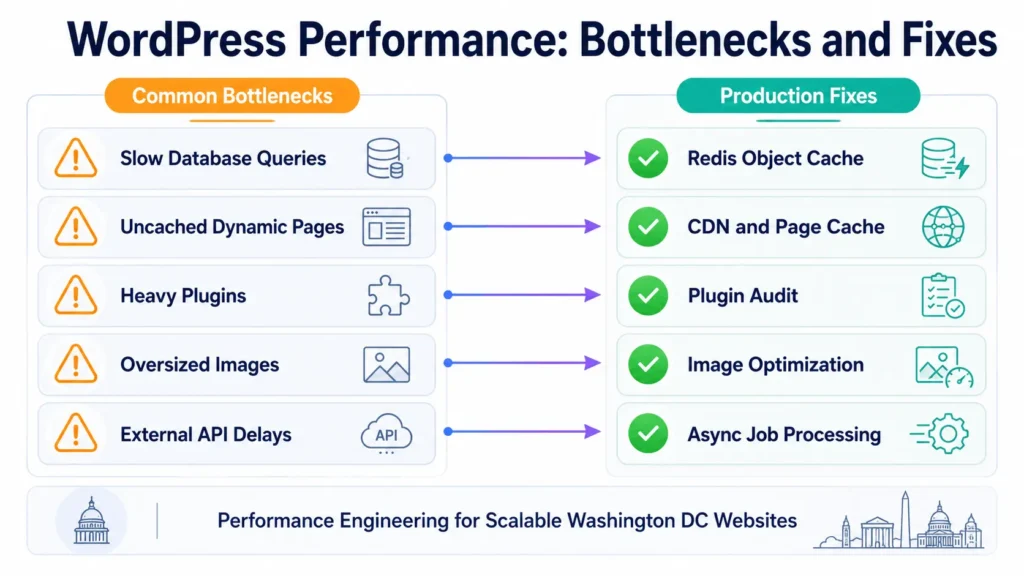
Plugin count alone does not determine performance. Repeated database queries, autoloaded options, slow external calls, uncached personalized pages, oversized assets, and background tasks do. We have seen acceptable staging sites degrade when real content, crawlers, campaign traffic, and scheduled jobs arrive together.
Redis object caching can reduce repeated database work, while page caching and a CDN reduce origin traffic. These layers must exclude carts, accounts, dashboards, and other dynamic routes. Aggressive rules can expose stale data; cautious rules may provide little benefit.
WooCommerce requires particular care around checkout, stock, coupons, payment webhooks, subscriptions, and order reporting. The checkout path should minimize synchronous third-party calls. Payment states must be reconciled from signed gateway webhooks, not only the browser redirect, because customers close tabs and networks fail.
WordPress cron depends on site traffic by default, making timing inconsistent. High-value jobs should use a server scheduler or managed queue. A competent Washington DC Web Design Company documents plugin ownership, update testing, rollback procedures, and conflict resolution instead of treating maintenance as a monthly button click.
4. How a Washington DC Web Design Company Handles Integrations
Most business websites are integration hubs. They exchange data with Salesforce, HubSpot, Mailchimp, Stripe, PayPal, booking systems, identity providers, analytics platforms, and internal databases. The difficult part is not connecting an endpoint. It is preserving data integrity when systems disagree or become unavailable.
Each integration should define validation, authentication, rate limits, timeouts, retries, idempotency keys, field mapping, ownership, and monitoring. Webhooks need signature verification and replay protection. Encrypt sensitive data in transit, keep credentials outside the codebase, and prevent logs from exposing personal or payment information.
AI automation can assist with lead classification, support triage, content tagging, and CRM enrichment, but outputs need boundaries. Reliable workflows use orchestration, structured prompts, field validation, confidence thresholds, human review for consequential actions, and deterministic fallbacks when a provider fails.
A Washington DC Web Design Company should not hide automation inside an undocumented plugin. Operational teams need visible queues, error states, audit logs, and replay tools. Otherwise, staff discover failures through customer complaints instead of monitoring.
5. WordPress, Headless, SaaS, or Custom: Real Trade-Offs
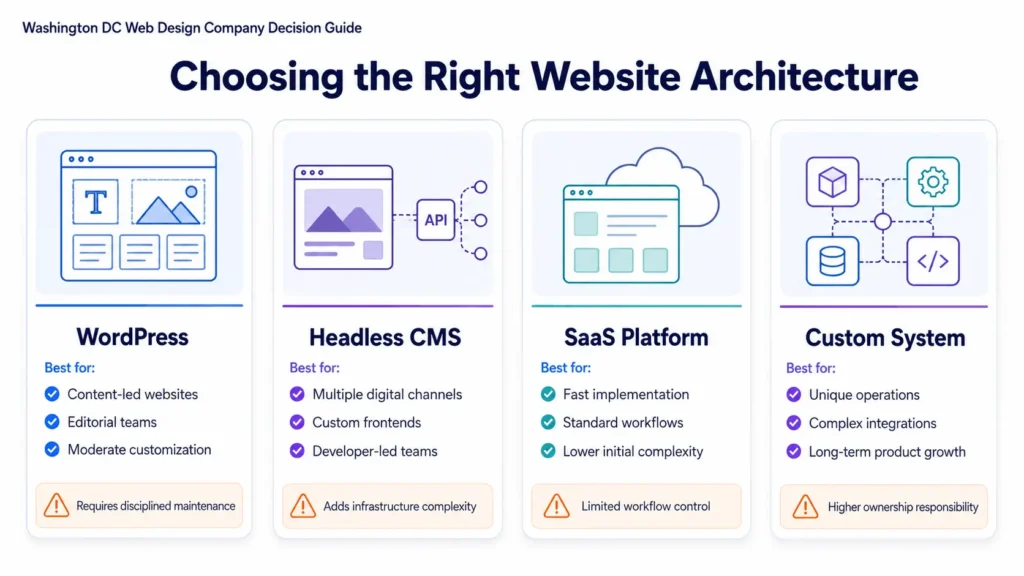
Architecture should reflect transaction volume, content velocity, team capability, compliance, and expected change. Microservices are not automatically more scalable. They distribute deployment but add network failures, tracing, versioning, and infrastructure overhead.
| Feature | Option A | Option B |
|---|---|---|
| WordPress vs headless | WordPress is simpler for integrated publishing and moderate customization | Headless offers frontend freedom but adds API, preview, deployment, and caching complexity |
| SaaS vs custom | SaaS launches faster within predefined workflows | Custom software fits unique operations but requires product ownership and ongoing engineering |
| Monolith vs microservices | A modular monolith reduces operational overhead | Microservices help independent teams scale components but increase observability and coordination needs |
| No-code vs engineered | No-code works for low-risk, stable workflows | Engineered systems provide control when logic, scale, security, or integrations become complex |
Filicode often favors the least complex architecture that satisfies known requirements. That approach has a limitation: a modular monolith may need deliberate decomposition later if one workload grows independently. Premature microservices, however, can impose years of operational cost before the business receives any scaling benefit.
6. Accessibility, SEO, and Washington Operating Context
Government contractors, nonprofits, associations, healthcare organizations, and public institutions often require stronger accessibility and governance. A Washington DC Web Design Company should understand keyboard navigation, semantic headings, labels, focus states, contrast, error messaging, and document accessibility. The Web Content Accessibility Guidelines provide the recognized technical framework.
ADA and Section 508 work cannot be reduced to an overlay. Automated scans catch only part of the problem. Manual keyboard testing, screen-reader review, content practices, and regression checks are needed, especially when editors publish new pages after launch.
Technical SEO belongs in architecture. URLs, canonical rules, sitemaps, redirects, structured data, indexability, internal links, and Core Web Vitals should be planned before migration. Filicode’s UI and UX design services connect journeys with interface decisions, while these scalable website design practices explain content and conversion structure.
Local SEO Washington DC strategies should use real service coverage, case evidence, accurate organization data, and useful location context. Copying one page across Washington, Maryland, and Northern Virginia weakens usefulness. Regional organizations can review Filicode’s Virginia web design approach for related DMV planning.
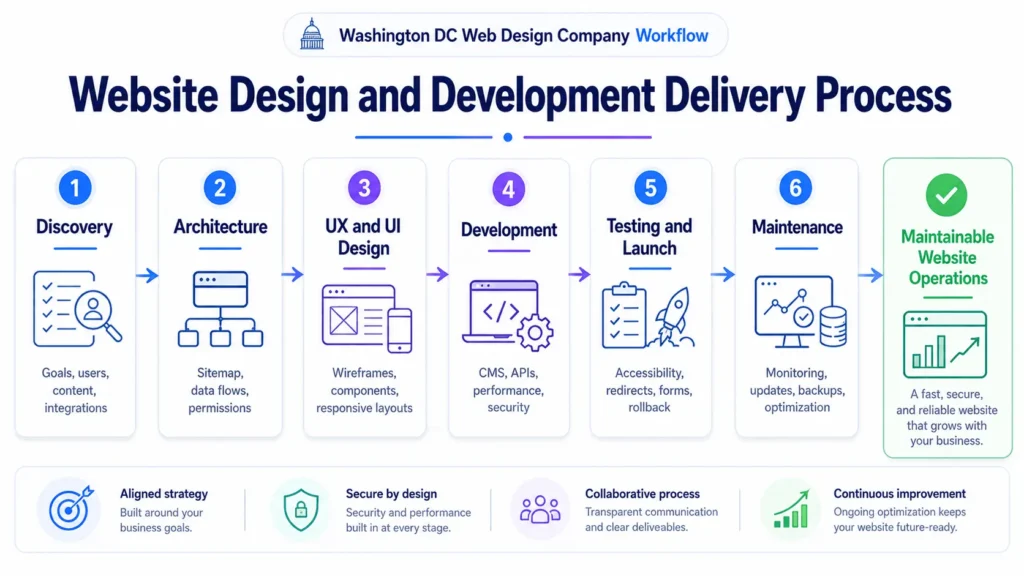
7. How a Washington DC Web Design Company Should Deliver the Project
Discovery should produce decisions, not a generic workshop summary. Required outputs include business goals, audiences, content inventory, sitemap, wireframes, functional requirements, integration map, analytics plan, accessibility target, migration scope, acceptance criteria, and responsible owners.
Design converts those decisions into reusable components and responsive behavior. Development should use version control, separate environments, peer review, practical automated checks, and realistic test data. Cross-device testing must include long content, validation errors, logged-in states, and slow networks.
Before launch, the Washington DC Web Design Company should check backups, DNS, SSL, redirects, forms, payments, analytics, robots directives, sitemaps, accessibility, performance, security headers, and rollback. Stabilization should monitor logs, queue failures, uptime, indexing, conversion events, and support requests.
Ongoing support is part of architecture because every dependency changes. WordPress core, plugins, APIs, browser behavior, payment gateways, and security threats evolve. A defined website maintenance and support plan reduces emergency work and preserves institutional knowledge.
Where Filicode Fits
Filicode works across custom software development, WordPress and WooCommerce, API integrations, SaaS development, AI automation, system architecture, and performance optimization. The practical advantage is not using every technology. It is selecting a stack that the client can operate and extending it only where off-the-shelf tools create measurable constraints.
A business has usually outgrown packaged tools when staff re-enter the same data across systems, reporting cannot reconcile transactions, permissions are too broad, integrations fail silently, or every workflow exception requires manual intervention. At that point, custom services, middleware, admin tooling, or a focused application may reduce recurring operational cost.
For organizations assessing a Washington DC Web Design Company, Filicode’s website design and development capabilities provide a relevant starting point for discovery, UI implementation, CMS engineering, integrations, testing, and launch planning.
Frequently Asked Questions
How much does a Washington DC Web Design Company cost?
A professional project commonly ranges from a focused five-figure website to a larger six-figure platform, depending on content, templates, integrations, ecommerce, accessibility, migration, and custom workflows. Pricing should separate discovery, design, development, content, testing, launch, and support so decision-makers can see what drives cost.
How long does implementation usually take?
A focused business website may take 8 to 14 weeks, while a custom portal, ecommerce build, or complex migration can take 4 to 9 months. Content readiness, stakeholder approvals, integration access, and data cleanup often affect the schedule more than coding speed.
Can a Washington DC Web Design Company scale WordPress?
A Washington DC Web Design Company can scale WordPress when templates, queries, plugins, caching, CDN delivery, database usage, background jobs, and hosting are engineered correctly. Redis object caching and full-page caching can reduce origin load, but personalized pages and WooCommerce checkout require careful exclusions and load testing.
How should CRM and payment integrations be protected?
Use authenticated APIs, signed webhooks, idempotency keys, input validation, timeouts, retries, encrypted transport, restricted credentials, audit logs, and reconciliation reports. Payment confirmation should rely on verified gateway events rather than the customer’s browser redirect alone.
Can a redesign preserve existing search rankings?
A redesign can reduce migration risk through a complete URL inventory, one-to-one redirects, metadata preservation, internal-link updates, canonical checks, sitemap validation, analytics annotations, and post-launch crawl monitoring. No agency can guarantee unchanged rankings, especially when content and architecture change substantially.
What maintenance is required after launch?
At minimum, schedule monthly software updates, daily backups, uptime monitoring, security review, form testing, and quarterly performance and accessibility checks. High-transaction or regulated websites may require more frequent release windows, logging review, vulnerability management, and recovery testing.
When to Engage a Washington DC Web Design Company
Warning signs are operational: page changes require workarounds, forms fail without alerts, reporting disagrees across systems, checkout performance drops under campaigns, editors lack safe publishing controls, or support tickets keep returning after temporary fixes. These indicate that the website has become a constraint rather than an asset.
Custom development should be considered when the cost of manual work, integration failure, lost conversions, compliance risk, or maintenance debt exceeds the cost of a better platform. The next step is a technical discovery that documents workflows, dependencies, traffic, data, permissions, failure modes, and measurable outcomes.
The right Washington DC Web Design Company will recommend the simplest architecture that can meet those requirements, explain the trade-offs, and leave the organization with a system it can understand, monitor, and improve.