



Contents
- Quick Summary: The Decision Criteria That Matter
- How to Choose a Web Design Company: Compare Delivery Models First
- How to Choose a Web Design Company Beyond the Portfolio
- How to Choose a Web Design Company by Reviewing Architecture
- How to Choose a Web Design Company for Production Workflows
- Platform Expertise: WordPress, WooCommerce, Headless, or Custom
- How to Choose a Web Design Company by Comparing Proposals
- Red Flags When Evaluating a Web Design Agency
- Local vs Remote and Full-Service vs Specialist
- What Does a Strong Discovery and Delivery Process Look Like?
- When Filicode Is a Relevant Technical Partner
- Frequently Asked Questions
- What should I look for when deciding how to choose a web design company?
- How to choose a web design company when proposals differ?
- How long should agency selection and implementation take?
- How do I evaluate whether an agency can scale the website?
- What migration risks should be included in the proposal?
- Does how to choose a web design company in Ireland require different checks?
- Choose for Operational Fit, Not Presentation Quality Alone
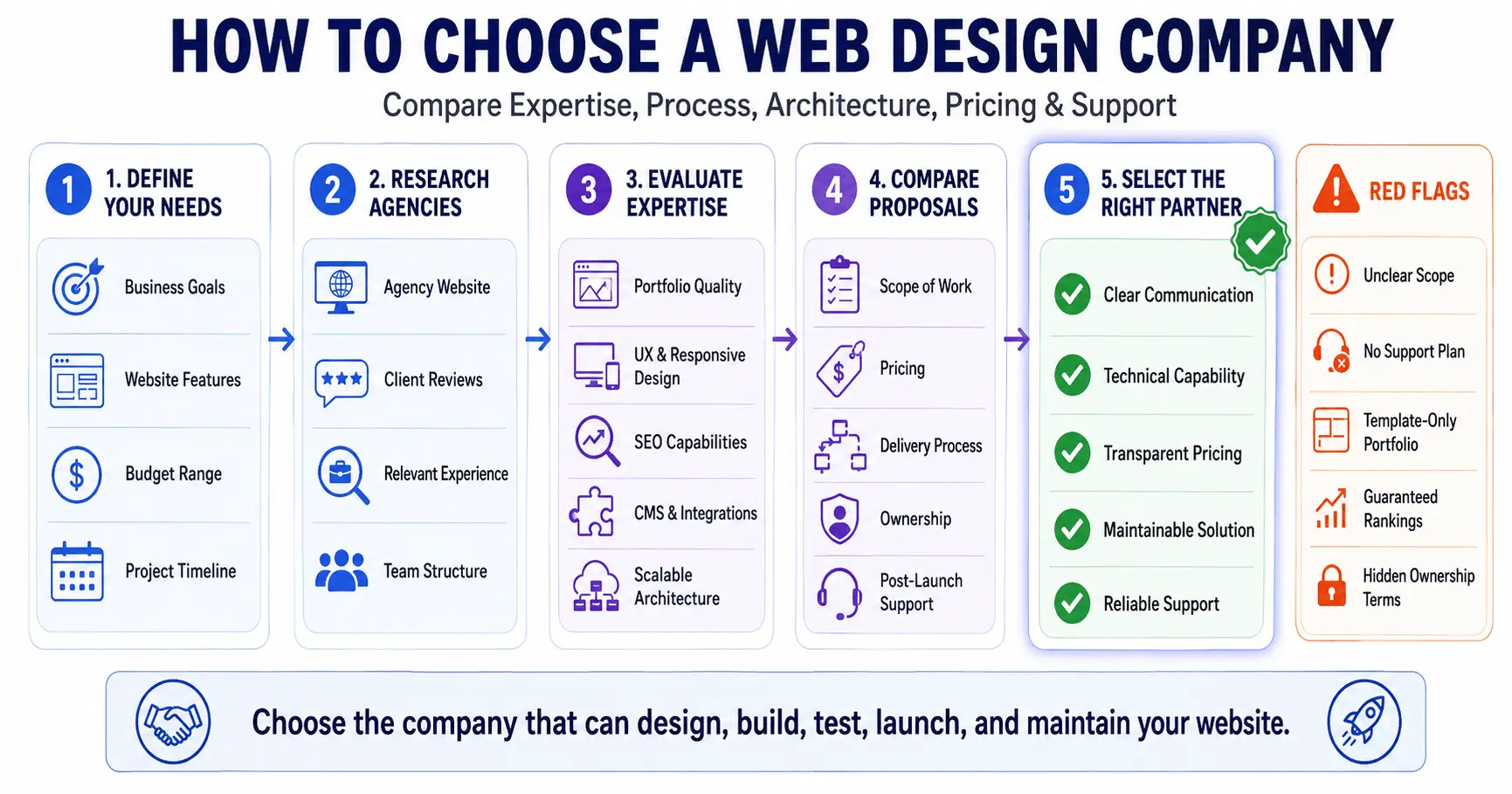
The wrong web design partner rarely fails at the visual stage. Failure appears when checkout slows, plugins conflict, CRM data stops synchronizing, or nobody owns deployment. How to choose a web design company comes down to four checks: architecture, production failure handling, post-launch ownership, and evidence of measurable outcomes.
To decide how to choose a web design company, evaluate architecture, delivery, support, and commercial transparency. Choose the partner that can explain how the site will be built, tested, deployed, monitored, and maintained not only how it will look.
Quick Summary: The Decision Criteria That Matter
- A polished portfolio proves visual capability, but case studies should also show performance, conversion, integration, or maintenance outcomes.
- The right agency documents frontend, backend, database, API, caching, security, and deployment responsibilities before development begins.
- Low initial cost becomes expensive when the proposal excludes content migration, quality assurance, analytics, training, monitoring, or post-launch fixes.
- WordPress, Webflow, headless, SaaS, and custom stacks are tools; the correct choice depends on workflow complexity, ownership needs, and expected scale.
- How to choose a web design company is ultimately a risk decision: select the team that exposes assumptions, trade-offs, and failure-handling plans early.
How to Choose a Web Design Company: Compare Delivery Models First
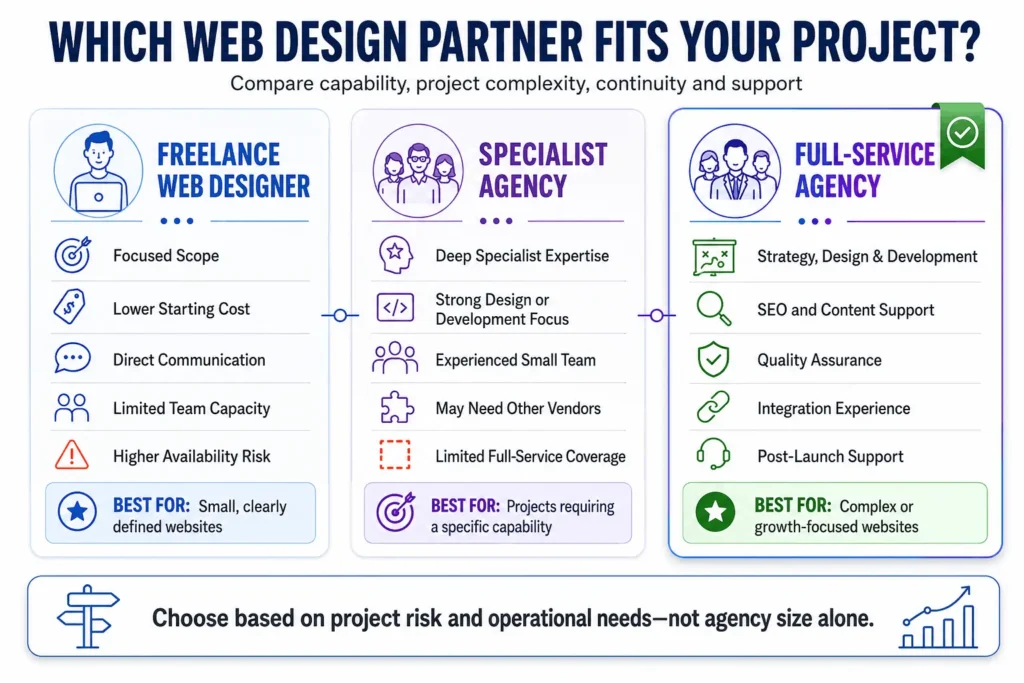
Start with the type of partner. A freelance web designer can suit a focused marketing site. A specialist studio may be better for branding or conversion design. A full-service web design agency fits projects combining strategy, content, SEO, custom development, integrations, migration, and support.
Two proposals may both say “custom website.” One may mean a modified theme; the other may include reusable components, custom data models, automated testing, deployment controls, and documented ownership.
| Feature | Freelancer or small specialist | Full-service web design agency |
|---|---|---|
| Best fit | Defined scope and low integration complexity | Projects needing strategy, engineering, SEO, and support |
| Delivery capacity | Depends heavily on one or two people | Design, engineering, QA, and project management |
| Technical depth | Can be excellent within a narrow specialty | Broader architecture, integration, and migration coverage |
| Continuity risk | Higher if availability changes | Lower when processes, documentation, and role coverage are established |
| Cost structure | Lower overhead, often lower starting price | Higher price with wider operational coverage |
Neither model is automatically better. How to choose a web design company depends on the cost of failure. A brochure site can tolerate a simpler delivery model. A WooCommerce store, subscription platform, marketplace, or lead-generation system connected to business operations usually cannot.
How to Choose a Web Design Company Beyond the Portfolio
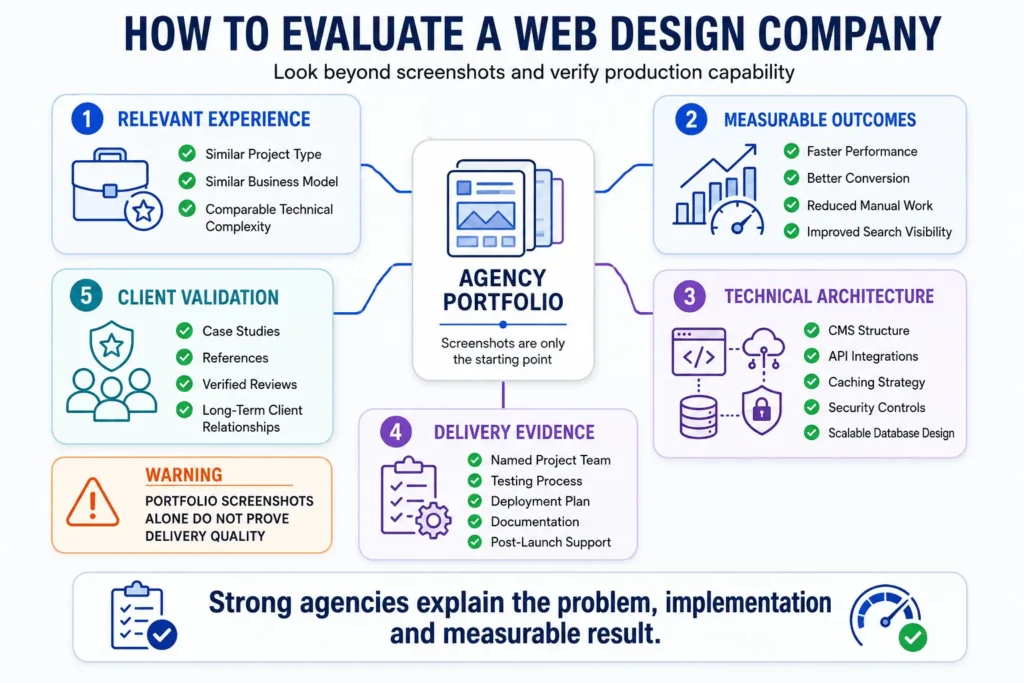
Portfolio evaluation should answer three questions: what problem existed, what changed, and what improved. Screenshots reveal taste, not delivery quality. Ask for evidence such as Core Web Vitals, conversion, checkout completion, organic visibility, or reduced manual work.
Review the agency’s own website as a working sample: mobile behavior, speed, accessibility, forms, broken states, and technical SEO. Ask how templates support crawlability, structured data, internal links, and concise answers for SEO and AI Overviews. Clutch profiles and awards help, but references better reveal delivery behavior.
Location is a secondary factor unless regulation, market knowledge, workshops, or stakeholder access makes it operationally relevant. A business comparing a web design company in Florida should still apply the same architecture, process, and support criteria it would use for a remote team.
How to Choose a Web Design Company by Reviewing Architecture
Ask the agency to describe the proposed system in plain language: how requests reach the CDN, application, database, and third-party services; what is cached; which jobs use queues; and what happens when a dependency fails.
A credible answer distinguishes a modular monolith from microservices. Most content and commerce projects are easier to operate as a structured monolith. Microservices help when domains need independent scaling, deployment, or fault isolation, but they add network failures, observability overhead, and data consistency problems. Event-driven queues isolate slow work, while indexes, query plans, object caching, and read replicas address different causes of database contention.
The review should cover authentication, role-based access control, API permissions, webhook validation, audit logs, backups, and environment separation. For accounts, payments, or private data, ask how the team applies guidance such as the OWASP Application Security Verification Standard.
How to Choose a Web Design Company for Production Workflows
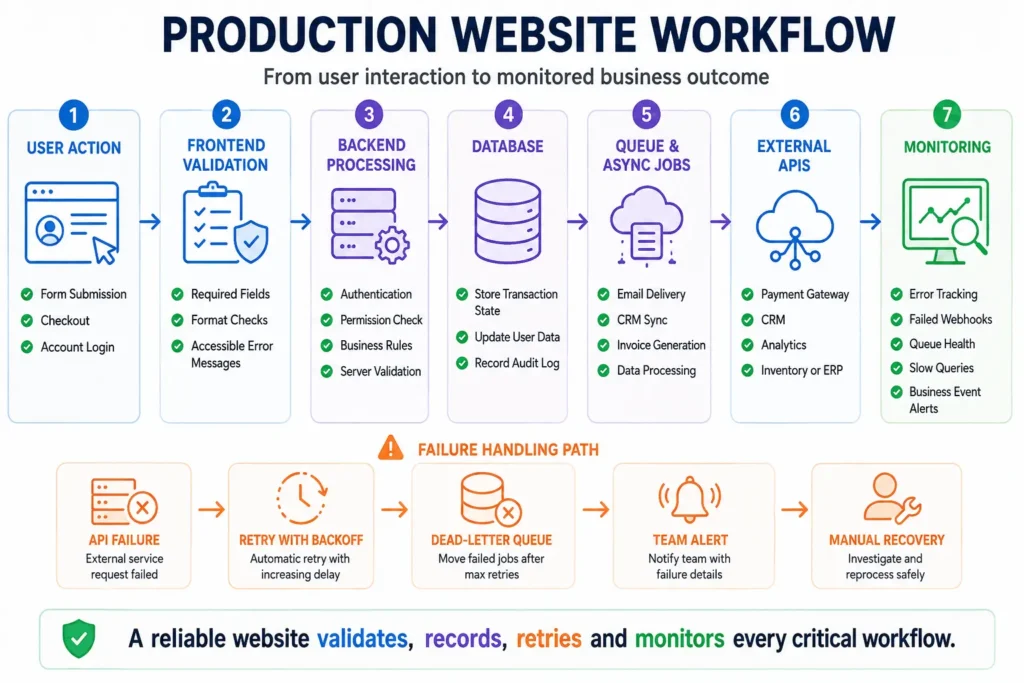
A production website is a workflow, not a collection of pages. The frontend validates input; the backend revalidates it; the database records state; APIs update CRM, payment, inventory, or email systems; and background jobs complete non-critical work.
In production, this fails when teams assume every API responds immediately and exactly once. Webhooks can arrive late, arrive twice, or arrive out of order. Queue workers can stop. A payment can succeed while the browser times out. A capable agency designs idempotency, retries with backoff, transaction states, reconciliation jobs, dead-letter handling, and alerts instead of relying on a success page.
Monitoring must cover more than uptime. Ask for error tracking, slow-query visibility, queue health, failed webhooks, cache hit rates, deployment records, and business events such as failed lead delivery. Without observability, customers become the monitoring system.
This is why how to choose a web design company should include a workflow review before design approval. Useful business website design decisions connect interface choices to content operations, lead routing, analytics, and future maintenance.
Platform Expertise: WordPress, WooCommerce, Headless, or Custom
Platform expertise matters only when tied to the operating model. WordPress works well for structured content, landing pages, multilingual publishing, and integration-led sites. Gutenberg customization can give internal teams reusable blocks without fragile page-builder settings.
For WordPress, ask how the agency evaluates plugin architecture, custom hooks, update safety, object caching, Redis, CDN behavior, cron limitations, REST API integrations, and security hardening. A strong WordPress developer should know when to configure an existing plugin, extend it safely, or replace it with focused custom code.
WooCommerce adds order states, inventory, taxes, shipping, payment webhooks, refunds, and scheduled actions. Bottlenecks often come from uncached queries, slow extensions, or external APIs. Under load, moving email and ERP synchronization into asynchronous queues can protect checkout response time.
Headless WordPress can improve frontend flexibility and independent deployment, but it introduces preview, caching, authentication, search, redirect, and content-propagation complexity. A traditional WordPress agency approach is often more maintainable unless there is a clear product reason for decoupling.
For SaaS or AI-enabled projects, ask about tenant isolation, subscriptions, RBAC, audit logs, real-time synchronization, and admin tooling. AI workflows also need orchestration, validation, human review for high-impact actions, fallback behavior, and output monitoring; a working prompt is not a production control system.
How to Choose a Web Design Company by Comparing Proposals
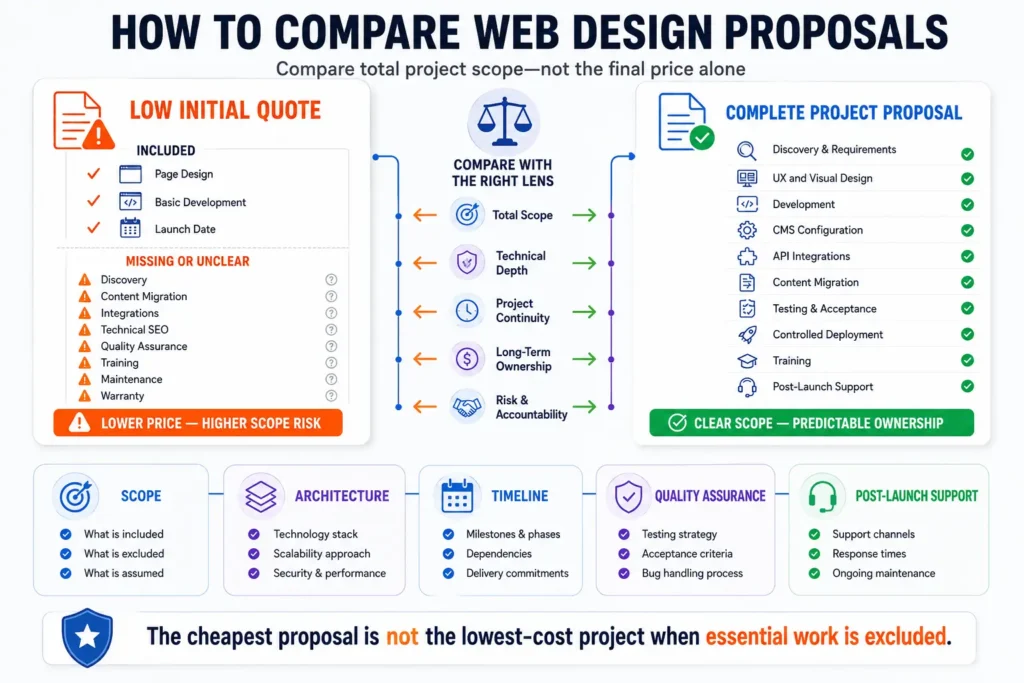
Do not compare totals until scope is normalized. One agency may include discovery, content modeling, migration, redirects, technical SEO, accessibility, analytics, training, and a warranty period. Another may quote only design and page assembly.
| Feature | Weak proposal | Decision-ready proposal |
|---|---|---|
| Scope | Lists pages and visual deliverables | Defines workflows, integrations, roles, content, data, and exclusions |
| Architecture | Names a platform without rationale | Explains stack choice, hosting, caching, security, and scaling trade-offs |
| Timeline | Provides one launch date | Shows discovery, design, development, migration, QA, acceptance, and deployment stages |
| Quality assurance | Promises testing | Specifies devices, browsers, accessibility, performance, security, and regression checks |
| Post-launch | Unclear or hourly support only | Defines warranty, monitoring, maintenance, response targets, and ownership |
Web design agency cost should be evaluated against lifetime ownership. A low-cost build can suit a small, validated scope. It becomes a false economy when the business later rebuilds content models, untangles plugins, or recreates undocumented integrations. An affordable website design company should remove unnecessary complexity, not engineering discipline.
Timelines depend on decision speed, content readiness, migration volume, integrations, and stakeholder availability. A focused site may take six to ten weeks; custom commerce or SaaS work can require three to six months. How to choose a web design company includes checking whether the schedule reflects these dependencies.
Red Flags When Evaluating a Web Design Agency
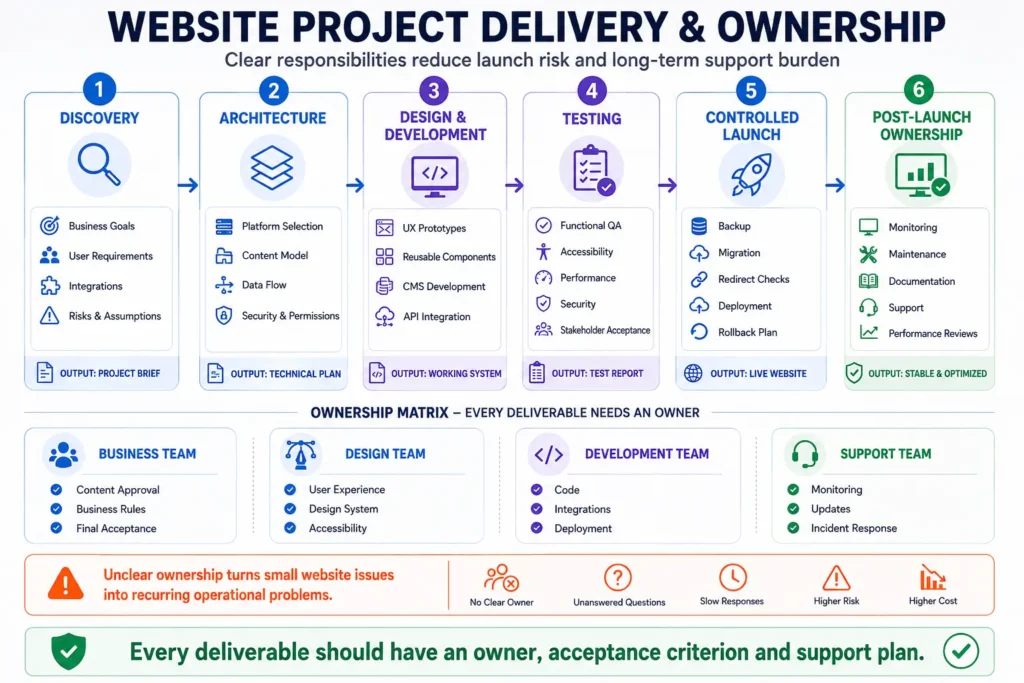
- The team cannot explain who owns discovery, UX, development, QA, deployment, and support.
- The proposal guarantees rankings, exact performance scores, or complex delivery dates before technical discovery.
- The agency recommends many plugins or SaaS tools without discussing data ownership, recurring cost, conflicts, or exit risk.
- There is no staging environment, rollback plan, backup verification, acceptance process, or post-launch warranty.
- Source code, design files, domains, analytics, hosting, and third-party accounts remain under the agency’s ownership.
Ask what happens when a deployment breaks a form, a webhook is duplicated, Redis fails, or an API hits its rate limit. Experienced teams do not deny failure; they explain containment, recovery, and communication.
Local vs Remote and Full-Service vs Specialist
A local agency helps when regulation, regional content, workshops, or stakeholder access matter. Remote teams can offer wider specialist access. In either model, how to choose a web design company depends on documented communication, overlap hours, decision logs, issue tracking, and escalation.
For example, choosing a WordPress development agency in Chicago should not be based on proximity alone. Review the same evidence you would request from an international vendor: relevant systems, named team members, delivery process, references, and support terms.
A full-service agency reduces coordination across design, engineering, SEO, and content, but it can cost more and may not provide the deepest specialist in every discipline. A specialist can deliver exceptional depth, yet your team may need to coordinate other vendors. Honest proposal comparison should acknowledge both trade-offs.
What Does a Strong Discovery and Delivery Process Look Like?
When teams ask how to choose a web design development company, a serious discovery call is one of the clearest tests. It does not begin with colors. It maps users, business goals, content ownership, permissions, integrations, reporting, compliance, migration, traffic expectations, and support responsibilities. The output should include agreed requirements, risks, assumptions, priorities, and measurable acceptance criteria.
Delivery should move through architecture, content modeling, UX, visual design, component development, integration, migration, QA, stakeholder acceptance, and controlled launch. Production and staging environments should be separated. Releases need backups, rollback steps, change records, and post-deployment checks.
In production, small omissions create recurring support burden. A form without ownership rules becomes lost leads. A CMS without permissions creates publishing risk. An integration without audit logs creates reconciliation work. How to choose a web design company means testing whether the proposed process identifies these operational details before they become tickets.
When Filicode Is a Relevant Technical Partner
Filicode is relevant when a website sits inside a wider operating system. That may include custom software, WordPress or WooCommerce engineering, SaaS workflows, AI automation, API integrations, performance optimization, and system architecture.
Off-the-shelf tools remain right for standard workflows. Custom development becomes reasonable when teams duplicate data, reconcile systems manually, or fight platform restrictions. Its honest trade-off is higher demand for discovery, testing, documentation, monitoring, and maintenance.
Filicode’s approach focuses on maintainability and operational fit. Not every project needs microservices, headless delivery, or custom code. Each choice should be justified by workflow, scale, internal capability, and the cost of change.
Frequently Asked Questions
What should I look for when deciding how to choose a web design company?
Look for relevant production work, a named team, clear architecture, measurable acceptance criteria, transparent exclusions, and defined support. How to choose a web design company should be based on evidence that the team can build, deploy, monitor, and maintain the system.
How to choose a web design company when proposals differ?
Normalize the scope before comparing price. Check discovery, UX, development, migration, integrations, QA, launch, warranty, and maintenance as separate line items so missing work is visible.
How long should agency selection and implementation take?
A practical shortlist and proposal process often takes one to three weeks. A focused marketing site may require six to ten weeks, while integration-heavy commerce or SaaS work commonly takes three to six months or longer.
How do I evaluate whether an agency can scale the website?
Ask for a plan covering CDN delivery, caching, database queries, queues, API rate limits, load testing, logging, and rollback. Scalability is credible only when the expected bottleneck and measurement method are clear.
What migration risks should be included in the proposal?
The proposal should cover content mapping, URL inventories, 301 redirects, metadata, analytics, backups, DNS changes, form testing, and rollback. Pre-launch crawl comparisons reduce traffic loss and broken journeys.
Does how to choose a web design company in Ireland require different checks?
The core evaluation is the same, but Irish projects may need closer review of GDPR responsibilities, local content, tax or commerce integrations, accessibility expectations, and support hours. Local presence matters only when it improves delivery or compliance.
Choose for Operational Fit, Not Presentation Quality Alone
The warning signs are usually operational: publishing requires developer help, checkout performance drops during campaigns, integrations fail silently, reporting does not reconcile, plugin updates feel dangerous, or every feature takes longer because nobody understands the original build.
How to choose a web design company is a question of architecture, process, ownership, and support. Shortlist teams that explain workflows, show comparable production work, document trade-offs, and define post-launch responsibility. If system limits are increasing manual work or slowing growth, begin with technical discovery before requesting another visual redesign.