








Contents
- Quick Summary: for Founders, CTOs, and Technical Teams
- How long does seo take to start working in real projects?
- Why SEO takes time even after implementation
- The production workflow behind SEO movement
- How technical architecture changes the SEO timeline
- How long does seo take to start working after technical fixes?
- How long does seo take to start working with content and links?
- What delays SEO results in SaaS, WordPress, and WooCommerce sites
- Measuring progress before top rankings arrive
- Where engineering changes accelerate SEO progress
- SEO, AI automation, and operational systems
- FAQ
- How long does it take for seo to start working?
- Does a bigger SEO budget make results faster?
- Can SEO work faster after a website migration?
- Do WordPress plugins slow down SEO progress?
- When should a company consider custom development for SEO?
- Conclusion: how long does seo take to start working?
Slow SEO progress usually has less to do with publishing frequency and more to do with how a website is built, crawled, understood, and trusted. When founders ask how long does seo take to start working, they are often asking a business question: when will organic search begin producing visible movement, qualified traffic, and measurable leads?
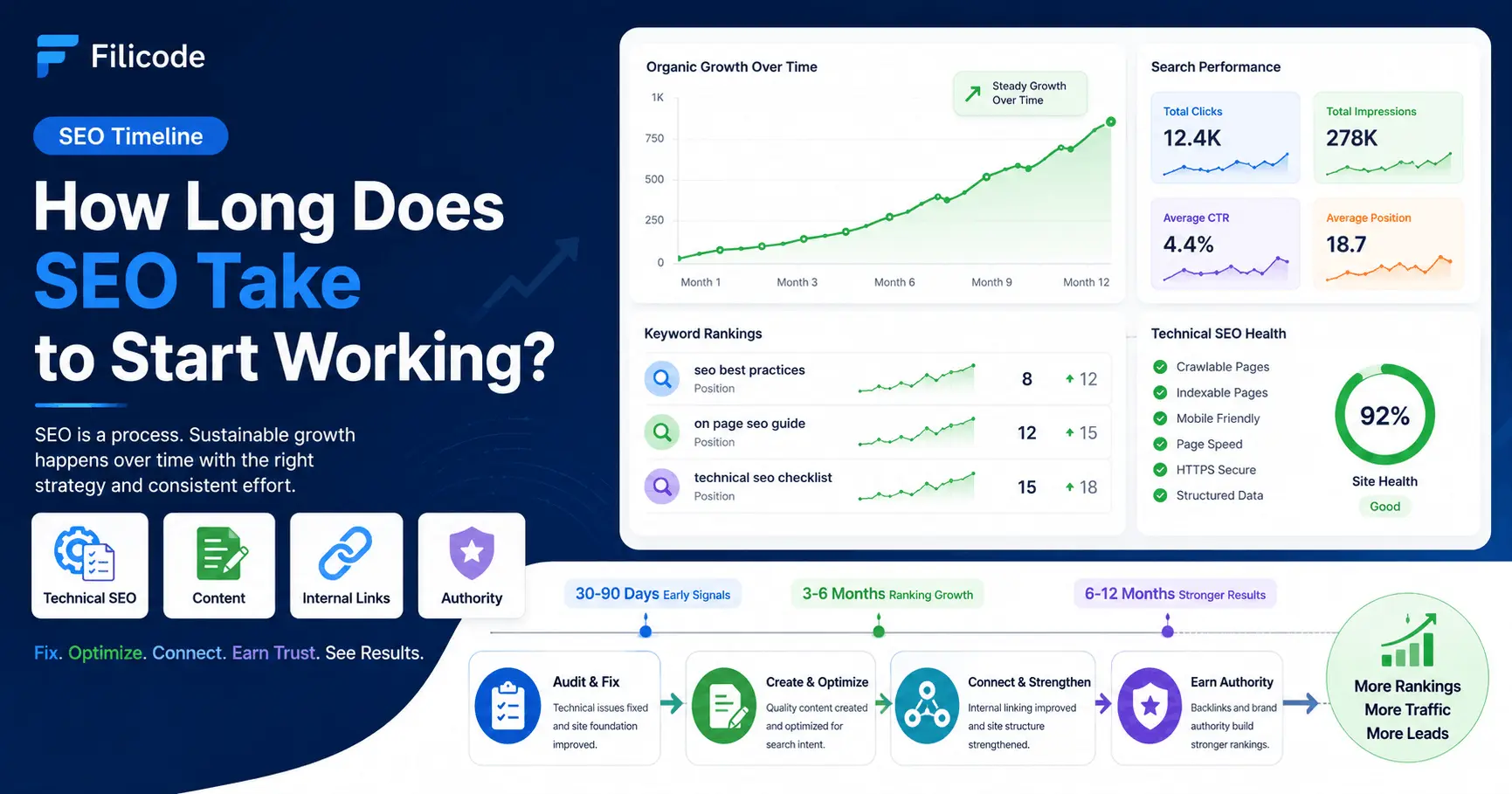
For most serious websites, early movement can appear within 30 to 90 days, but reliable growth usually takes 3 to 6 months. Competitive SaaS, WordPress, WooCommerce, marketplace, and B2B technology sites often need 6 to 12 months before SEO becomes a dependable acquisition channel. The timeline depends on technical health, site architecture, content quality, internal linking, authority, implementation speed, and search competition.
Quick Summary: for Founders, CTOs, and Technical Teams
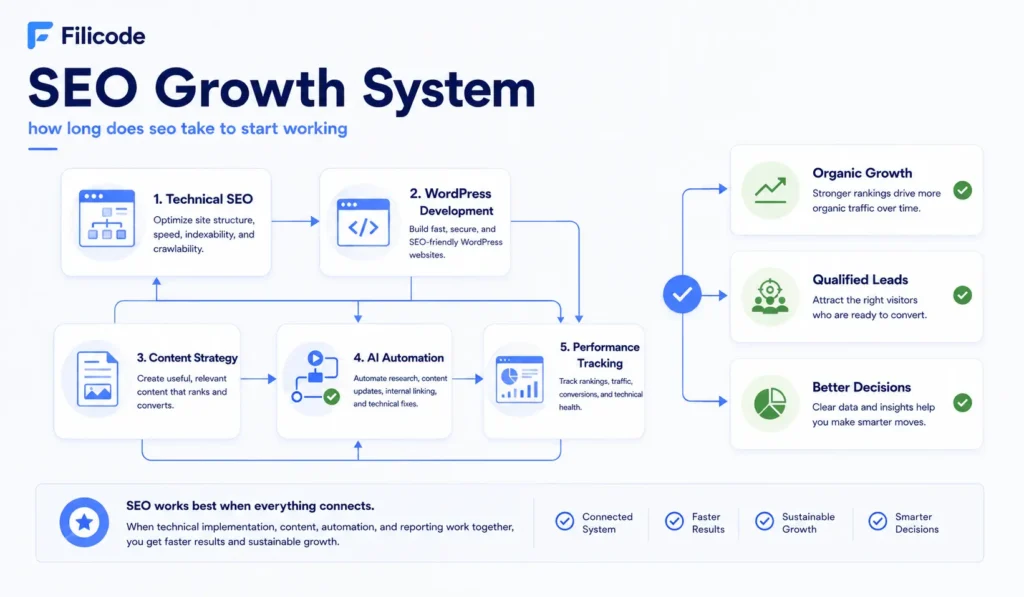
- SEO starts working faster when crawling, indexing, rendering, and site architecture are clean before content scaling begins.
- Technical SEO fixes may show early signals in weeks, but competitive keyword rankings usually need multiple crawl and ranking cycles.
- WordPress and WooCommerce sites with plugin bloat, slow queries, weak caching, or broken templates often need engineering work before SEO gains compound.
- Internal linking, topical authority, and clean keyword mapping reduce wasted crawl budget and help Google understand page priority.
- SEO reporting should track impressions, crawl coverage, CTR, conversions, and revenue impact, not only keyword positions.
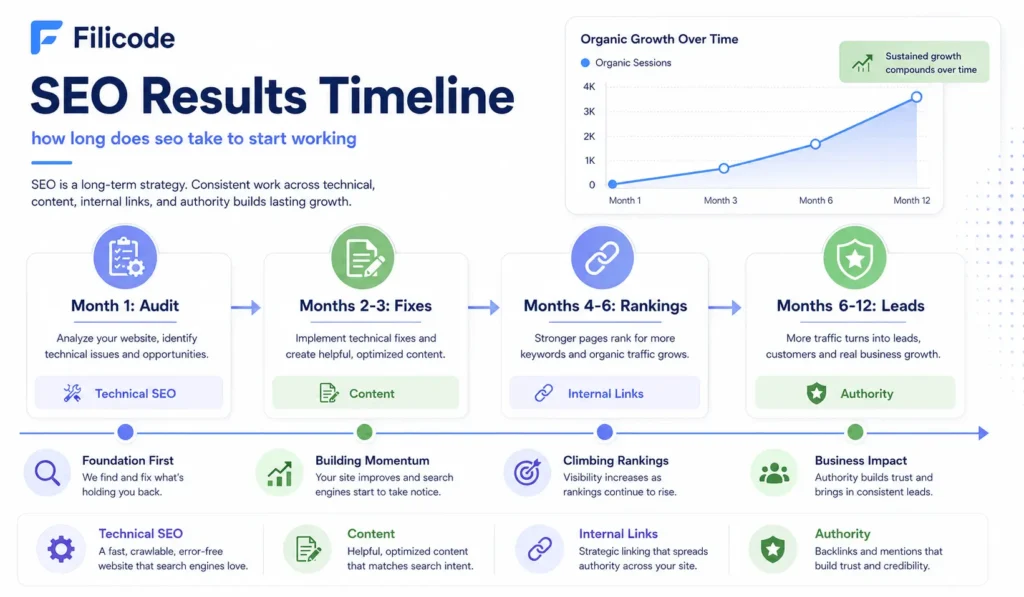
How long does seo take to start working in real projects?
A practical answer is this: how long does seo take to start working depends on the starting condition of the system. A new site with thin content, weak authority, and technical issues is not on the same timeline as an established WordPress site with crawlable templates, clean internal links, and a strong backlink profile.
In the first month, the main work is usually diagnostic. Teams audit crawlability, index coverage, Core Web Vitals, URL structure, duplicate content, title tags, headings, schema, internal links, and conversion tracking. Without that baseline, SEO becomes guesswork.
Months two and three often show early SEO progress through better impressions, improved indexing, and movement on long tail keywords. Months four to six are where content ecosystems, internal link equity, and authority signals begin to create more stable ranking movement. For competitive keywords, months six to twelve are more realistic.
| Timeline | What usually happens | Business interpretation |
|---|---|---|
| 0 to 30 days | Audit, keyword mapping, technical fixes, analytics cleanup, index review | The foundation is being repaired, not fully monetized yet |
| 30 to 90 days | Early impressions, crawl improvements, low competition keyword movement | SEO is starting to send measurable signals |
| 3 to 6 months | Ranking distribution improves, internal links pass more value, content clusters mature | Organic traffic can become more visible and useful |
| 6 to 12 months | Competitive pages gain authority, conversions stabilize, topical authority improves | SEO starts behaving like a repeatable growth channel |
Why SEO takes time even after implementation
Search engines do not instantly reward a page because it was edited. Google has to crawl the page, process the HTML, render JavaScript where required, understand the content, compare it against competing results, evaluate links, and reassess whether the page deserves better SERP visibility.
This is why how long does seo take to start working is partly an engineering question. A clean update on a fast, crawlable site can be processed faster than a content change buried inside a slow theme, blocked resource, duplicate URL cluster, or client-side rendered layout that search engines struggle to interpret.
Google’s own documentation on search engine optimization fundamentals is a useful reference because it reinforces the basics that still affect real-world performance: crawlable pages, descriptive titles, helpful content, organized structure, and accessible links.
The production workflow behind SEO movement
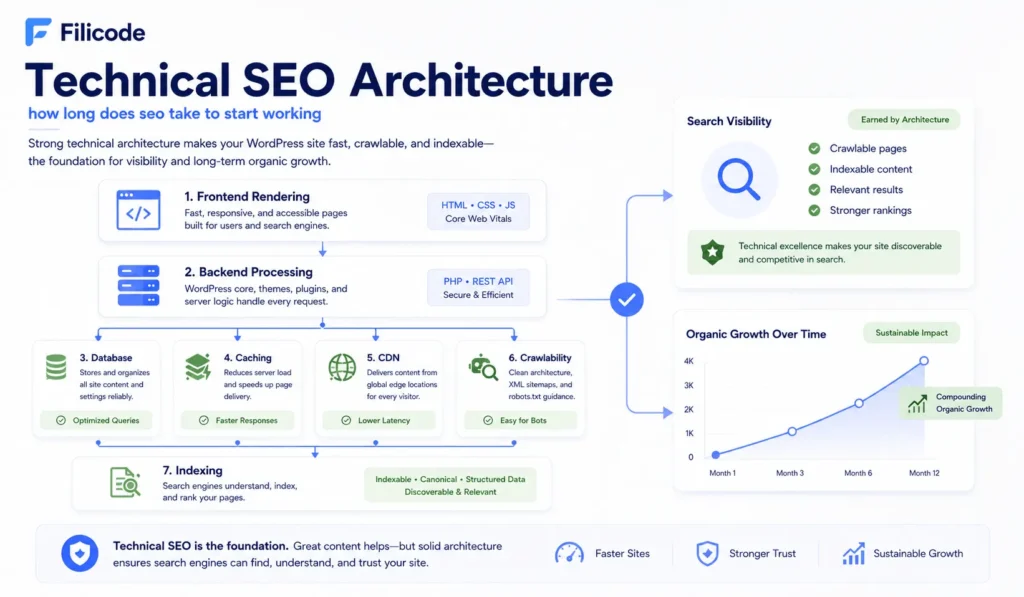
In production, SEO is not a single task. A page passes through several technical layers before it can rank well.
- The frontend must render content, links, headings, images, and structured data in a way crawlers can access.
- The backend must deliver pages quickly without database bottlenecks, plugin conflicts, or excessive server response time.
- The database must avoid slow queries, bloated postmeta, duplicate records, and unnecessary joins that hurt performance.
- Caching must reduce repeated processing without serving stale canonical tags, outdated schema, or broken dynamic content.
- Monitoring must catch 404 errors, 5xx errors, redirect chains, indexing drops, and unexpected template changes.
Under load, weak systems show their limits. A WooCommerce store with heavy checkout plugins, uncached product archives, and poor object caching may rank slower because the site is unstable, slow, and difficult to crawl consistently.
How technical architecture changes the SEO timeline
Architecture affects how long does seo take to start working because search performance depends on how efficiently the site exposes useful content. A small brochure site can often be improved with template cleanup, internal links, and content updates. A SaaS platform or marketplace needs stronger planning.
Monoliths are easier to manage early because templates, content, and routing sit in one system. WordPress often works well here, especially when theme code is clean and plugins are controlled. The trade-off appears when the site grows into complex user dashboards, subscriptions, integrations, or multi-tenant workflows.
Microservices and headless systems give teams more flexibility, but they also add SEO risk. API latency, client-side rendering, authentication rules, and dynamic content loading can hide valuable pages from crawlers if the architecture is not planned correctly.
For WordPress and WooCommerce, common timeline blockers include plugin bloat, weak hosting, missing Redis object caching, slow admin-ajax calls, poor CDN configuration, duplicate category archives, broken canonicalization, and cron jobs that fail under traffic. These issues do not just affect page speed. They affect crawl reliability, user experience, and conversion rates.
How long does seo take to start working after technical fixes?
After technical fixes, how long does seo take to start working usually depends on crawl frequency and severity of the original problems. Fixing a noindex mistake or blocked robots.txt rule can produce faster recovery. Rebuilding a large content architecture, resolving cannibalization, and improving authority takes longer.
Teams should not expect every fix to produce a visible ranking jump. Some fixes remove friction. Others create growth. A faster site, better internal linking, cleaner structured data, and stronger content clusters work together over time.
How long does seo take to start working with content and links?
Content and links are where many teams misread the timeline. Publishing more pages does not automatically improve organic rankings. Search engines need to understand whether the site has topical authority, whether the content satisfies search intent, and whether other trusted sources validate the brand.
A strong content system starts with keyword mapping. Each page should have a clear role: commercial landing page, comparison article, technical guide, product page, local page, or supporting blog. Without mapping, teams create duplicate clusters and content cannibalization.
Internal links then decide how authority flows. A hub and spoke model helps important pages receive PageRank flow from supporting assets. This is why a blog targeting how long does seo take to start working can support a commercial page like SEO services for Omaha businesses when the link is contextually relevant and useful to the reader.
Backlinks still matter, but quality matters more than volume. Natural links, brand mentions, third-party validation, testimonials, and expert references help search engines reassess trust. Spammy backlinks and link schemes can delay progress or create risk.
What delays SEO results in SaaS, WordPress, and WooCommerce sites
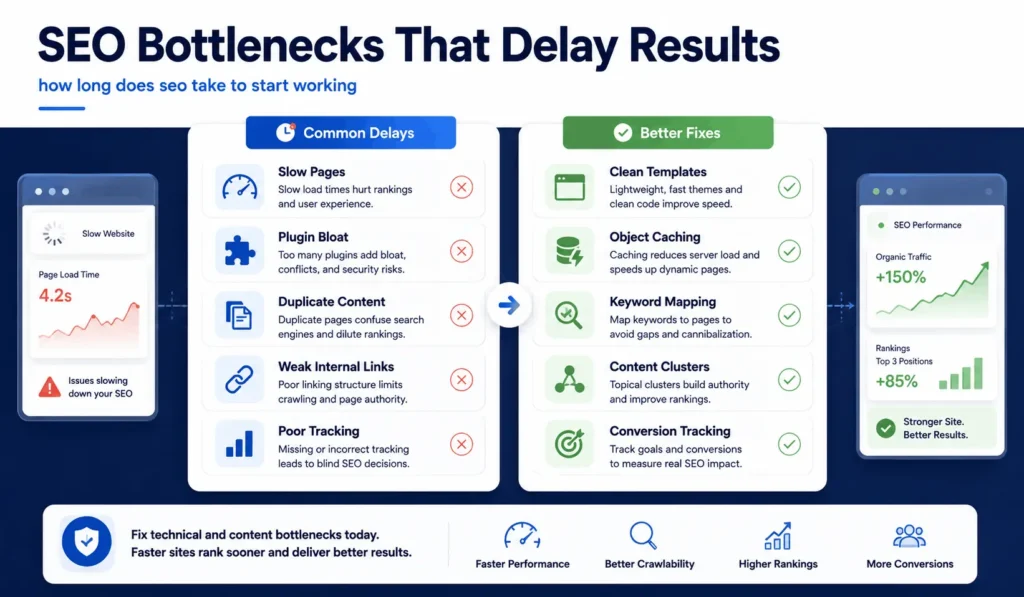
The factors that extend an SEO timeline are usually visible before rankings move. They show up in development workflows, content operations, database design, and decision-making habits.
| Common approach | Production problem | Better operating model |
|---|---|---|
| Publishing pages without keyword mapping | Duplicate intent and cannibalization | Map every URL to a primary intent and supporting query set |
| Copying competitor headings | Weak differentiation and thin expertise signals | Add operational examples, technical depth, and real decision criteria |
| Ignoring site structure | Important pages receive weak internal link equity | Use hub pages, supporting blogs, breadcrumbs, and contextual links |
| Using too many plugins | Slow templates, conflicts, security risk, and maintenance overhead | Use custom hooks, controlled plugins, object caching, and code reviews |
| Reporting only rankings | Teams miss crawl, CTR, conversion, and revenue signals | Track Google Search Console, GA4 events, leads, and business outcomes |
Internal pressure can also damage SEO. When leadership expects page-one rankings in a few weeks, teams often produce low-quality content, overuse keywords, buy poor links, or publish pages before the technical base is ready. That usually slows the result instead of accelerating it.
Another mistake is treating SEO as a one-time project. SEO is closer to product maintenance. Search behavior changes, competitors update pages, AI Overviews alter visibility, SERP layouts shift, and old content loses accuracy. The system needs ongoing optimization.
Measuring progress before top rankings arrive
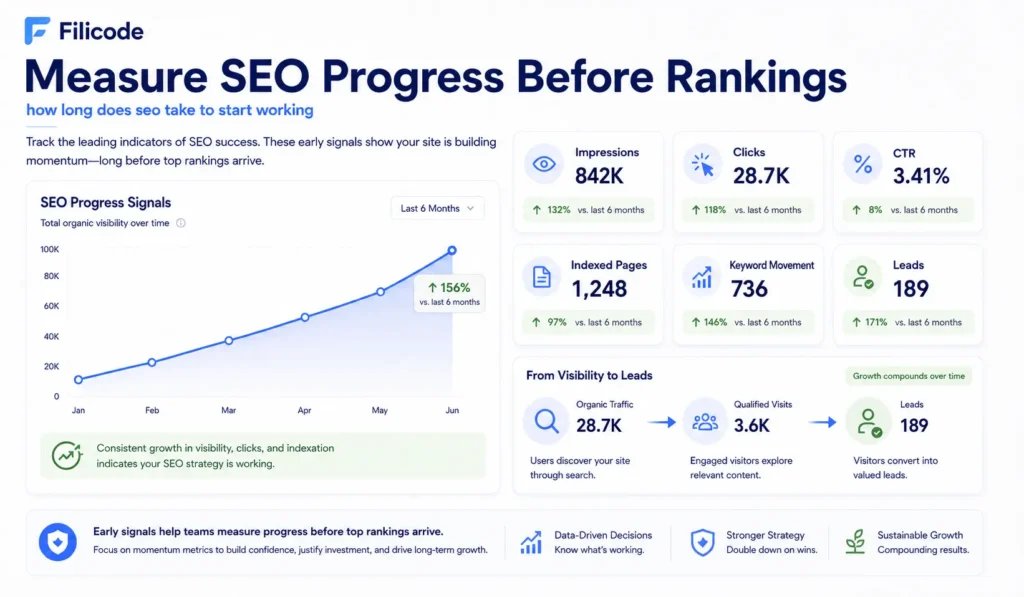
When people ask how long does seo take to start working, rankings are only one part of the answer. Early SEO gains often appear in operational data before they appear in revenue.
- Google Search Console impressions increase across priority keywords.
- More pages move from discovered or crawled to indexed.
- Average position improves across keyword groups, not just one phrase.
- CTR improves after meta titles and descriptions are rewritten.
- Organic users begin reaching service pages, contact forms, product pages, and booking flows.
- Conversions start appearing from informational and commercial-intent pages.
For SaaS and marketplace systems, measurement should include CRM source tracking, assisted conversions, demo requests, trial signups, subscription events, and lead quality. For WooCommerce, connect SEO reporting to product revenue, checkout completion, refunds, and repeat customer behavior.
Image alt text should also be practical. A useful example is “how long does seo take to start working technical SEO timeline dashboard” because it describes the visual and supports the page topic without stuffing unrelated terms.
Where engineering changes accelerate SEO progress
SEO gets faster when implementation friction is removed. Many teams have the right recommendations but cannot ship them cleanly. Title templates need development changes. Schema needs custom logic. Internal links need reusable components. Page speed requires theme cleanup. Tracking needs backend events, not only frontend scripts.
This is where technical execution matters. A WordPress site may need custom Gutenberg blocks, template refactoring, REST API integrations, plugin conflict management, Redis object caching, CDN optimization, and security hardening. A SaaS platform may need event-driven logging, queue systems, role-based permissions, audit trails, and better admin tooling before content and SEO data can scale reliably.
Filicode usually enters the conversation when the SEO issue is connected to the system itself: slow WordPress templates, fragile WooCommerce checkout flows, weak landing page architecture, poor API workflows, or missing automation. The work can include custom WordPress development, WooCommerce engineering, API integrations, SaaS architecture, AI automation, and performance optimization.
For smaller teams, a structured SEO foundation can be enough. A practical place to start is SEO support for small business growth, especially when the main problem is visibility, local search, content structure, and lead tracking rather than deep platform complexity.
Location pages also need a controlled architecture. A page like SEO company Columbus should not compete with other local pages unless the keyword map, internal links, and service intent are clearly separated.
SEO, AI automation, and operational systems
AI automation can speed up research, clustering, reporting, content briefs, support workflows, and CRM updates. It cannot replace validation. LLM workflows still need review logic, data boundaries, fallback systems, prompt operations, and monitoring. Bad automation can scale bad SEO faster.
For technical teams, useful automation connects systems. Search Console data can feed dashboards. CRM events can show lead quality. Support tickets can reveal content gaps. Internal search logs can expose buyer questions. AI agents can help organize those signals, but humans still need to validate search intent, technical accuracy, and commercial value.
If organic visibility is part of a broader acquisition system, SEO should connect with digital marketing strategy, analytics, conversion tracking, and sales operations. Otherwise, traffic increases but the business cannot explain which pages create qualified demand.
FAQ
How long does it take for seo to start working?
Early signals can appear in 30 to 90 days, especially for technical fixes and low competition keywords. Stronger rankings, organic traffic, and leads usually take 3 to 6 months. Competitive markets can take 6 to 12 months.
Does a bigger SEO budget make results faster?
A bigger budget helps only when it improves execution quality. More content, links, or tools will not help if the site has crawl issues, poor keyword targeting, slow templates, or weak conversion tracking.
Can SEO work faster after a website migration?
It can, but migration risk is high. Redirects, canonical tags, internal links, XML sitemaps, analytics, structured data, and URL mapping must be handled carefully. A bad migration can reset months of SEO progress.
Do WordPress plugins slow down SEO progress?
Plugins are not automatically bad. The problem is uncontrolled plugin usage. Heavy plugins can add slow queries, JavaScript bloat, duplicate schema, broken redirects, and security issues. Custom hooks and lean theme code often perform better.
When should a company consider custom development for SEO?
Custom development becomes useful when SEO problems come from architecture, performance, integrations, automation gaps, checkout bottlenecks, or reporting limitations. At that point, content edits alone will not fix the growth constraint.
Conclusion: how long does seo take to start working?
how long does seo take to start working is not answered by a fixed calendar. A realistic timeline comes from the condition of the website, the quality of implementation, the strength of content architecture, and the level of competition. Early signs may appear in weeks. Reliable business impact usually takes months.
The warning signs are easy to recognize: slow pages, duplicate content, weak internal links, plugin conflicts, missing conversion tracking, unstable rankings, poor CTR, and organic traffic that does not produce leads. These are not only SEO issues. They are system issues.
If the site has outgrown basic SEO tasks, the next step is a technical review of architecture, performance, content structure, analytics, and implementation workflow. Filicode can help evaluate whether the right move is SEO cleanup, WordPress development, WooCommerce optimization, API integration, automation, or a more scalable custom system. To discuss the practical route, use the contact page and start with the current bottleneck, not a generic package.