








Contents
- Quick Summary: What Decision-Makers Need to Know
- Why a Multi-Location SEO Strategy Fails as Locations Scale
- System 1: Architecture for a Multi-Location SEO Strategy
- System 2: Building the Multi-Location SEO Strategy Data Layer
- System 3: How Location Landing Pages Should Work
- System 4: The Production Workflow Behind Local Search Visibility
- System 5: Corporate vs Local Content Ownership
- System 6: Entity Optimization, Structured Data, and AI Discovery
- System 7: Measuring a Multi-Location SEO Strategy Beyond Rankings
- Where the Strategy Breaks Down
- When Custom Engineering Becomes Necessary
- Frequently Asked Questions
- How much does a multi-location SEO strategy cost?
- How long does implementation take?
- Can one SEO system scale to hundreds of locations?
- What integrations matter most for multi-location SEO?
- What is the biggest migration risk for a franchise website?
- How should a franchise maintain local SEO after launch?
- Conclusion: Build for Controlled Growth, Not Page Volume
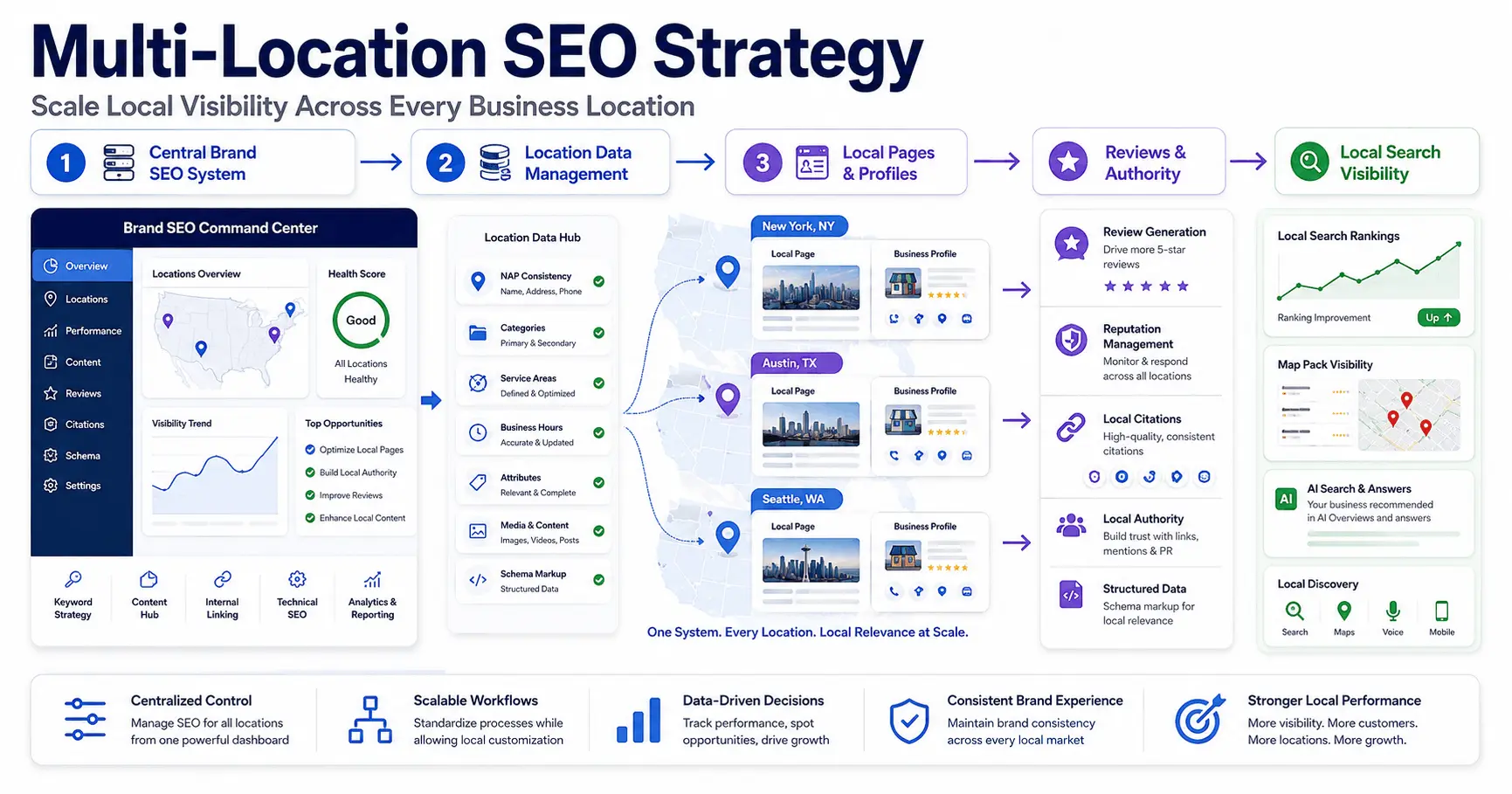
A Multi-Location SEO Strategy is an operating system for managing search visibility across many branches without creating duplicate pages, inconsistent business data, or competing local content. The core challenge is not publishing more city pages. It is coordinating website architecture, Google Business Profiles, location data, reviews, internal links, structured data, and reporting so every location can build local relevance while the parent brand retains technical control.
A multi-location SEO strategy for franchises often breaks when expansion outpaces governance.f Teams update hours, pages, directories, and profiles independently. The result is stale NAP data, crawl waste, content cannibalization, weak attribution, and no reliable way to identify which location needs intervention first.
Quick Summary: What Decision-Makers Need to Know
- A scalable Multi-Location SEO Strategy needs a central data model, controlled publishing workflows, and location-level flexibility rather than unrestricted page creation.
- Subfolder architecture is usually the simplest model for consolidating domain authority and internal link equity across franchise locations.
- Location landing pages should differ through useful local evidence, services, staff, operating details, FAQs, and market context, not token city-name swaps.
- Google Business Profile operations require ownership rules, validation, change logging, and monitoring because profile data is part of a live operational workflow.
- AI-powered discovery increases the value of clear entity relationships, factual consistency, third-party validation, and answerable content structures.
- Reporting should connect visibility to calls, forms, bookings, and qualified leads at location level, not stop at aggregate ranking averages.
Why a Multi-Location SEO Strategy Fails as Locations Scale
A small company can manage local SEO with spreadsheets and occasional manual checks. A franchise with 30, 100, or 500 locations cannot. Every branch adds a profile, landing page, citations, reviews, tracking, and an ownership boundary.
The failure point is coordination. Corporate owns standards, developers own templates, agencies manage search work, and local teams know operational reality. Without franchise SEO governance, each group optimizes a different version of the business.
Google states that local results are mainly based on relevance, distance, and popularity. That makes complete and accurate profile information, review signals, and web visibility practical inputs into a location program rather than cosmetic tasks. Google’s local ranking guidance is a useful baseline for the operating model.
The same governance principles apply to franchises, healthcare groups, professional-services firms, and retailers. Our Georgia SEO strategy approach follows this architecture-first view: local relevance must be built on a system that can be maintained.
System 1: Architecture for a Multi-Location SEO Strategy
A Multi-Location SEO Strategy starts with website structure because it controls authority flow, crawl paths, templates, analytics, and publishing. The main decision is whether locations use separate domains, subdomains, or subfolders.
| Structure | Operational Strength | Main Risk | Best Fit |
|---|---|---|---|
| Separate domains | High local independence | Authority, maintenance, analytics, and security are fragmented | Legally or commercially separate brands |
| Subdomains | Technical separation | Governance and deployment complexity increase | Distinct platforms or business units |
| Subfolders | Central authority, templates, analytics, and deployment | Poor CMS design can create template duplication at scale | Most franchise and branch networks |
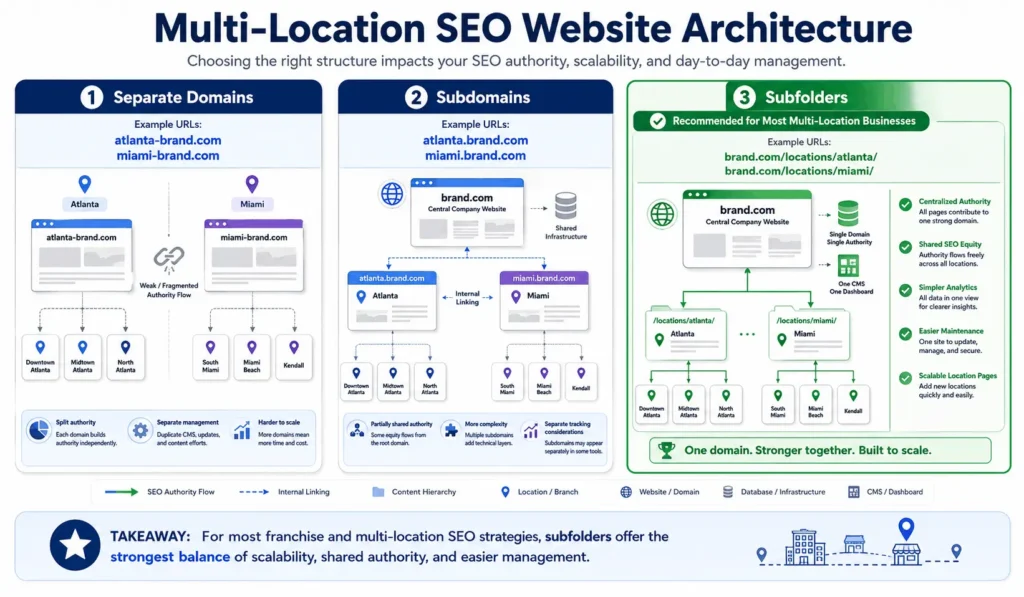
For most organizations, a structure such as /locations/atlanta/ is easier to govern than dozens of independent websites. Engineering teams can deploy one template system, schema model, analytics layer, and quality-control pipeline.
The CMS needs a shared content model with mandatory fields and controlled local modules, not rigid text duplication. WordPress can support this through custom post types, custom fields, reusable Gutenberg patterns, role-based permissions, and validation hooks.
System 2: Building the Multi-Location SEO Strategy Data Layer
The cleanest implementation treats each location as a structured entity. Store the canonical name, address, phone number, coordinates, hours, services, service areas, profile URL, booking URL, manager ownership, and status in a controlled data source.
The source may be the CMS for a smaller network or a data management platform for a larger one. The website, schema, directory feeds, support tools, and reporting should resolve facts from a defined source of truth.
For WordPress networks, scheduled imports should not depend entirely on low-traffic WP-Cron behavior. Use a real scheduler, queue long-running synchronization jobs, log failures, and make updates idempotent so a retry does not create duplicate records or overwrite newer data.
System 3: How Location Landing Pages Should Work
Within a Multi-Location SEO Strategy, a location landing page is not a doorway page with a city name inserted into generic service copy. Its job is to resolve local intent and prove that a specific business entity can serve the searcher.
A useful page combines structured data with local evidence: contact details, hours, directions, services actually offered, staff information where appropriate, customer questions, accessibility details, neighborhood context, and location-specific conversion paths.
The Multi-Location SEO Strategy should also control page creation thresholds. Not every nearby town needs its own page. Service area pages should only exist when the business genuinely serves the area and can provide distinct, useful information. Volume without differentiation creates content cannibalization and maintenance debt.
Use this local SEO checklist as a recurring control baseline. Larger networks should convert repeatable checks into automated validation rules.
System 4: The Production Workflow Behind Local Search Visibility
A scalable franchise Multi-Location SEO Strategy behaves more like a software workflow than a publishing calendar. A location update starts with a trusted user or source system, passes validation, updates the canonical record, triggers dependent systems, and produces an audit trail.
- Input: Corporate operations or an approved local manager submits a location change.
- Validation: Required fields, phone formats, coordinates, URLs, and conflicting hours are checked.
- Processing: The backend updates the canonical record and creates synchronization jobs.
- Distribution: Website content, schema, profile-management tools, and reporting datasets receive the change.
- Monitoring: Failed jobs are retried with limits, logged, and escalated when human review is required.
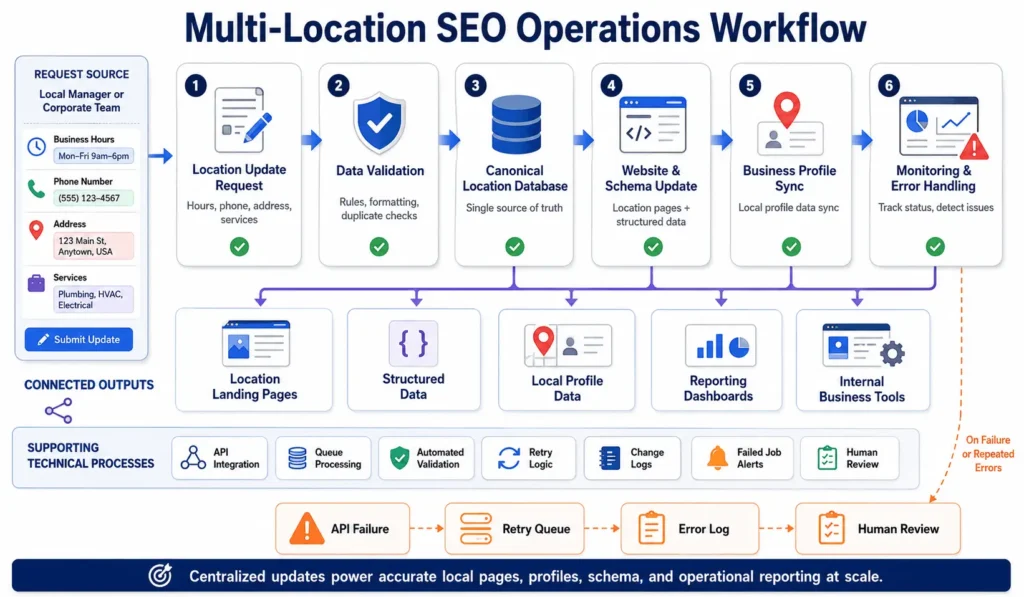
APIs and webhooks do not remove failure handling. External platforms can throttle requests, reject fields, or apply updates later. Reliable integrations need retry policies, request logging, dead-letter handling for repeated failures, and reconciliation jobs that compare expected data with live data.
At the website layer, a CDN can serve location pages efficiently, while Redis object caching can reduce repeated database work for navigation, location finders, and taxonomy queries. Cache invalidation should be scoped so one branch update does not flush the entire network.
Service territories create different constraints. This service-area business SEO framework explains geographic relevance without pretending every city has a physical office.
System 5: Corporate vs Local Content Ownership
A Multi-Location SEO Strategy should separate policy from evidence. Corporate should own brand claims, legal language, templates, service taxonomy, analytics standards, and schema rules. Local teams should contribute facts that headquarters cannot reliably manufacture.
| Content Type | Corporate Ownership | Local Contribution |
|---|---|---|
| Core services | Approved definitions and claims | Availability and local delivery details |
| Location facts | Field schema and validation rules | Hours, staff, access, local contacts |
| Reviews and reputation | Response policy and escalation | Timely context and issue resolution |
| Local content | Quality standard and approval workflow | Events, partnerships, case evidence, local FAQs |
| Technical SEO | Templates, canonicals, schema, monitoring | Issue reporting and factual verification |
This model reduces two common risks: corporate pages that sound generic and local pages that create legal, brand, or SEO problems. A mature Multi-Location SEO Strategy uses RBAC so contributors can edit the fields they own without gaining unrestricted control over templates or technical settings.
This guide to local SEO for small business growth adds a practical operating layer for branch-level activity under central controls.
System 6: Entity Optimization, Structured Data, and AI Discovery
For a multi-location brand, the entity model should make clear that the parent organization and each physical branch are related but distinct.
LocalBusiness structured data can describe details such as business hours and branch information. Google also uses structured data to better understand page content and the entities described on it. Schema should match visible page content and canonical business data rather than becoming a second, manually maintained version of the truth.
For the Multi-Location SEO Strategy, this creates a practical trust triangle: first-party website facts, Business Profile data, and third-party validation such as reputable directories, local coverage, associations, and genuine brand mentions. NAP consistency matters because contradictory facts make automated interpretation and human decision-making harder.
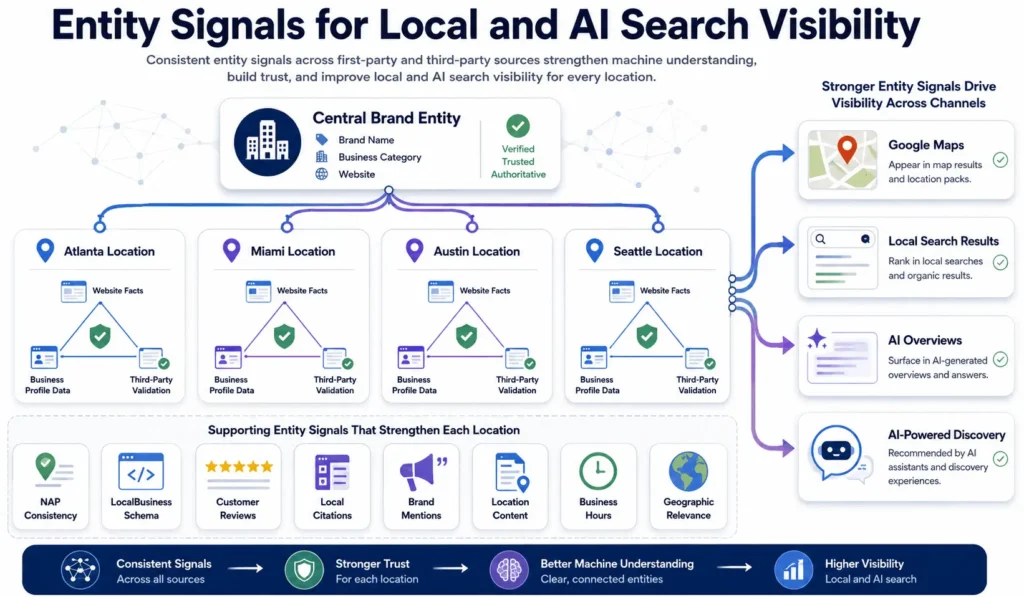
AI Overviews and other AI-powered discovery interfaces do not remove foundational SEO requirements. Google’s guidance says pages still need to be indexed and eligible to appear in Search, while content quality, technical access, and accurate business information remain relevant. Generative engine optimization and answer engine optimization should therefore focus on making useful facts clear, specific, attributable, and easy to extract, not on creating a separate layer of gimmicks.
System 7: Measuring a Multi-Location SEO Strategy Beyond Rankings
Average position across an entire franchise hides more than it reveals. A network can show stable aggregate visibility while ten high-value branches are losing discovery traffic. Measurement needs location-level segmentation.
A Multi-Location SEO Strategy should track local search visibility alongside Business Profile actions, calls, form submissions, bookings, direction requests, assisted conversions, review velocity, and landing-page engagement. Use consistent UTM conventions and call-tracking governance so attribution remains comparable between locations.
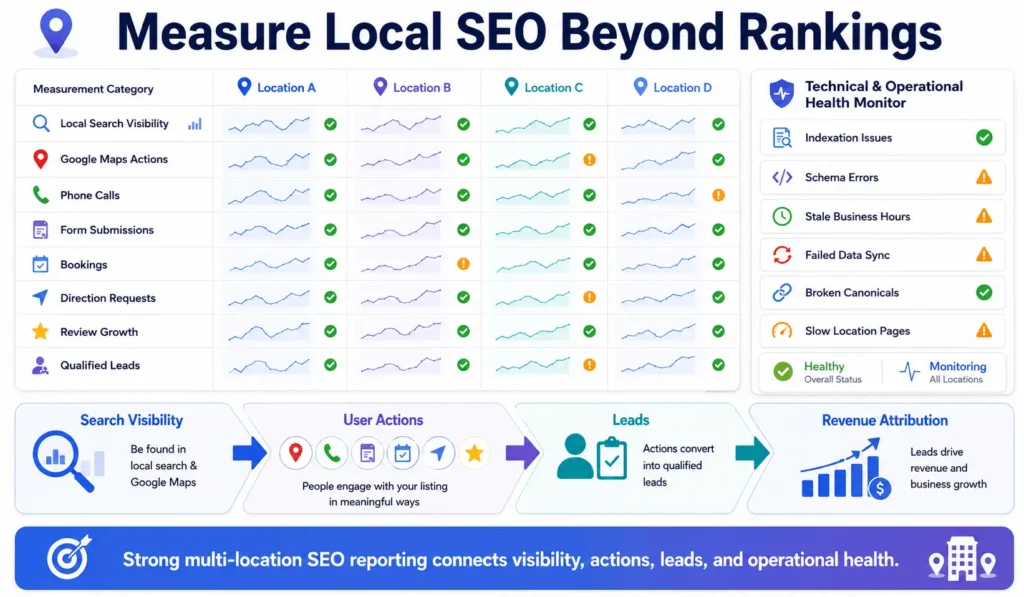
A local SEO audit should monitor operational health: pages returning non-200 responses, broken canonicals, missing schema fields, duplicate titles, stale hours, indexation gaps, slow templates, failed location imports, and unassigned profile ownership.
Dashboards matter only when they drive action. A data mismatch can create an operations ticket, ranking loss paired with conversion decline can trigger market review, and indexation failure can enter a technical investigation queue.
This Columbus local SEO growth systems guide shows how local competition changes execution even when the underlying architecture stays consistent.
Where the Strategy Breaks Down
Failure patterns include unrestricted franchisee CMS access, pages generated before local data exists, uncontrolled tracking configurations, duplicated city service pages, and disconnected review management.
A franchise does not need microservices simply because it has many locations. A modular monolith can often handle the CMS, directory, APIs, and administration with lower overhead. Separate services become useful when independent scaling, deployment boundaries, or ownership justify the complexity.
Cheap page generation can appear fast, but maintenance cost arrives later through duplicate content cleanup, plugin conflicts, schema inconsistency, and manual reconciliation. A maintainable Multi-Location SEO Strategy optimizes for controlled change, not just publishing speed.
When Custom Engineering Becomes Necessary
Off-the-shelf tools work well until the organization needs workflows they cannot model cleanly. Warning signs include hundreds of recurring manual corrections, conflicting location databases, fragile imports, slow admin screens, uncontrolled permissions, unreliable integrations, or reporting that cannot connect local visibility to revenue outcomes.
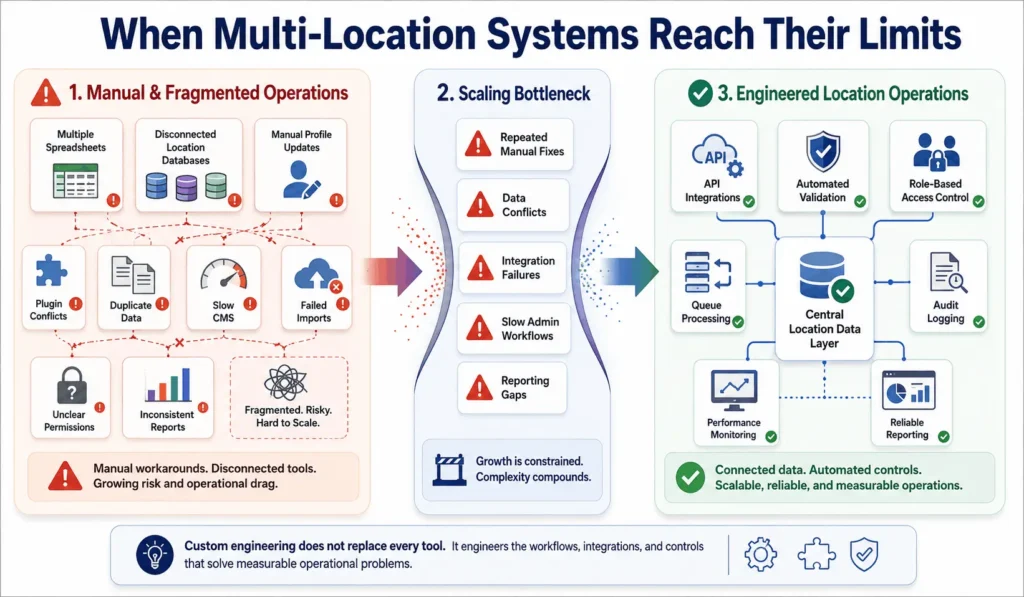
At that stage, Filicode approaches the problem as systems work: custom software where workflows require it, WordPress or WooCommerce engineering where the platform remains appropriate, API integrations for reliable data movement, AI automation for bounded tasks, and performance optimization around measurable bottlenecks.
The goal is not to replace every tool. It is to define architecture, ownership boundaries, validation rules, and observability. A custom location management layer may be more valuable than rebuilding the public website.
This scalable search growth framework for Virginia markets provides a reference for balancing central technical control with regional demand.
Frequently Asked Questions
How much does a multi-location SEO strategy cost?
The cost of a multi-location SEO strategy depends on location count, website condition, profile ownership, citation cleanup, content requirements, integrations, and reporting complexity. A 20-location network with clean data is a different project from a 200-location franchise with duplicate profiles and disconnected systems.
How long does implementation take?
Implementation runs in phases: audit and data cleanup, architecture and template work, profile governance, content rollout, and measurement. Smaller networks may establish the foundation in weeks, while large franchises can take several months because reconciliation and approvals often move slowly.
Can one SEO system scale to hundreds of locations?
Yes, one system can scale to hundreds of locations when location data is structured, publishing is template-driven but locally differentiated, permissions are controlled, and synchronization jobs are monitored. Scaling fails when each branch becomes an independent technical stack.
What integrations matter most for multi-location SEO?
The most useful integrations connect canonical location data with the CMS, profile management, analytics, call tracking, CRM, review workflows, and reporting. Their value comes from reducing conflicts and manual reconciliation.
What is the biggest migration risk for a franchise website?
The biggest migration risk is losing the relationship between old URLs, indexed local pages, profile landing links, analytics data, and the new location structure. A migration needs URL mapping, redirects, canonical checks, profile link updates, tracking validation, and post-launch monitoring.
How should a franchise maintain local SEO after launch?
A franchise should maintain local SEO through recurring data validation, profile monitoring, review workflows, technical checks, content refreshes, local contribution processes, and location-level performance reviews. Maintenance should be assigned to named owners with clear escalation paths.
Conclusion: Build for Controlled Growth, Not Page Volume
A durable Multi-Location SEO Strategy connects architecture, data governance, location content, profile operations, entity clarity, reputation signals, and measurement. The technical objective is controlled scale: every new location should enter an established workflow instead of creating a new exception.
The warning signs are visible: local teams fixing the same data repeatedly, pages competing with one another, profile ownership disputes, untraceable lead sources, slow CMS operations, and reporting that cannot explain why one market is declining.
When those problems become recurring, custom development should be considered selectively. Start by mapping the location data flow, ownership model, publishing process, integrations, and failure points. Then engineer only the parts where off-the-shelf tools are creating measurable operational cost or blocking growth.