








Contents
- Quick Summary: What Local Decision-Makers Should Know
- Why Content Marketing for Local Business Often Fails
- How Should Content Marketing for Local Business Be Structured?
- Content Marketing for Local Business as a Production Workflow
- Build the Strategy Around Local Demand, Not Content Volume
- Which Content Formats Produce Useful Local Outcomes?
- WordPress Architecture, Performance, and Maintenance
- Automation and AI Without Losing Editorial Control
- Measure Content Through the Lead and Revenue Workflow
- Choose Between DIY, No-Code, Agency, and Custom Systems
- When Does Filicode Fit the Operating Model?
- Frequently Asked Questions
- How much does content marketing for local business cost?
- How long does a local content strategy take to produce results?
- Can WordPress scale for a multi-location content program?
- Should content tools connect to a CRM?
- What are the main migration risks when replacing a content platform?
- How often should local business content be maintained?
- Conclusion: Treat Content as an Operating System
Local businesses rarely struggle because they have no ideas. They struggle because content is produced without a system for ownership, distribution, lead capture, and measurement. Effective content marketing for local business connects customer questions to search visibility, local proof, and a repeatable follow-up process. The goal is to create assets that help nearby customers discover, evaluate, and contact the business with less friction.
Content marketing for a local company is the structured creation and distribution of useful information that answers customer questions, builds credibility, and supports calls, bookings, visits, or quote requests. A workable system combines audience research, search intent, editorial planning, distribution, and performance analysis.
Quick Summary: What Local Decision-Makers Should Know
- Local content performs best when each asset is tied to a specific audience question, location, service, and conversion action.
- A content calendar is useful only when ownership, approval, publishing, distribution, and measurement are defined.
- Search traffic without call tracking, form attribution, or CRM validation creates misleading performance reports.
- WordPress can support a scalable local content operation, but plugin sprawl, weak taxonomy, and inconsistent templates increase maintenance risk.
- Automation should remove repetitive work while preserving human review for claims, local accuracy, brand tone, and customer-facing advice.
Why Content Marketing for Local Business Often Fails
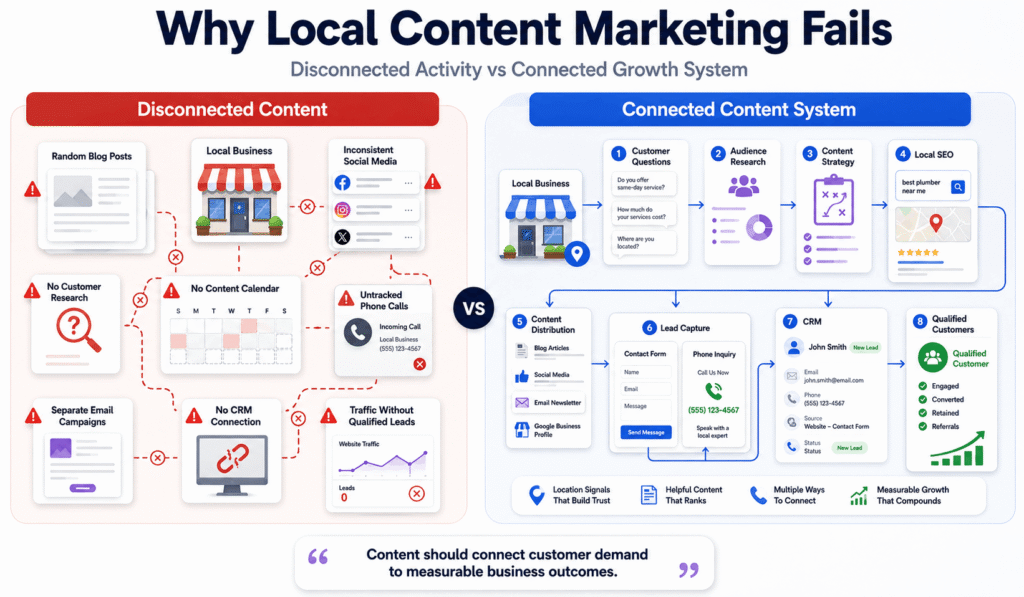
The common failure is not poor writing. It is a disconnected operating model. A blog post is published, a social caption is added later, email is handled separately, and no one knows whether the content influenced a real inquiry.
Local businesses also create broad pages while ignoring questions that influence purchase decisions: availability, pricing factors, response times, coverage areas, qualifications, risks, and what happens after contact. Those questions are commercially useful because they reduce uncertainty.
A practical content strategy starts with four entities: the customer problem, service, location, and desired action. Every topic should map to at least three. A broad home-maintenance article may attract traffic, but a guide about preparing an older Kansas City home for a seasonal roof inspection is more likely to attract a relevant customer.
Businesses comparing internal execution with agency support can review how a digital marketing agency in Kansas approaches channel coordination. The useful question is who can connect content creation to local search, lead quality, and operational capacity.
How Should Content Marketing for Local Business Be Structured?
A reliable content system resembles a small publishing platform. The frontend includes service pages, location pages, articles, FAQs, videos, forms, and conversion elements. The backend includes the CMS, editorial permissions, media storage, analytics, CRM records, and automation rules.
The workflow should be explicit: research creates a topic brief; the brief moves through drafting, subject review, editing, publishing, distribution, and performance review. Each stage needs an owner and a definition of done. Otherwise, a content calendar becomes a list of overdue ideas.
Content Marketing for Local Business as a Production Workflow
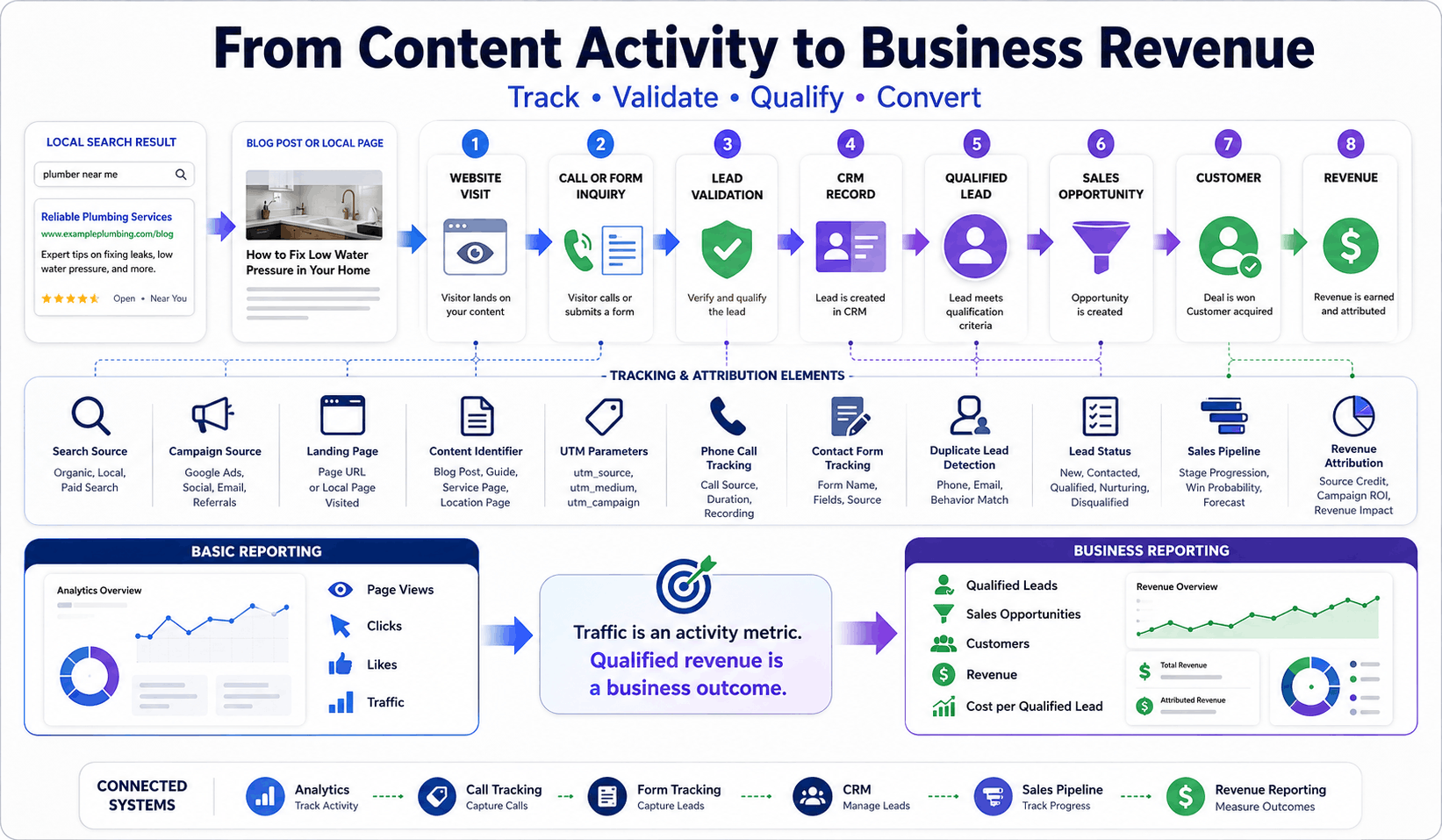
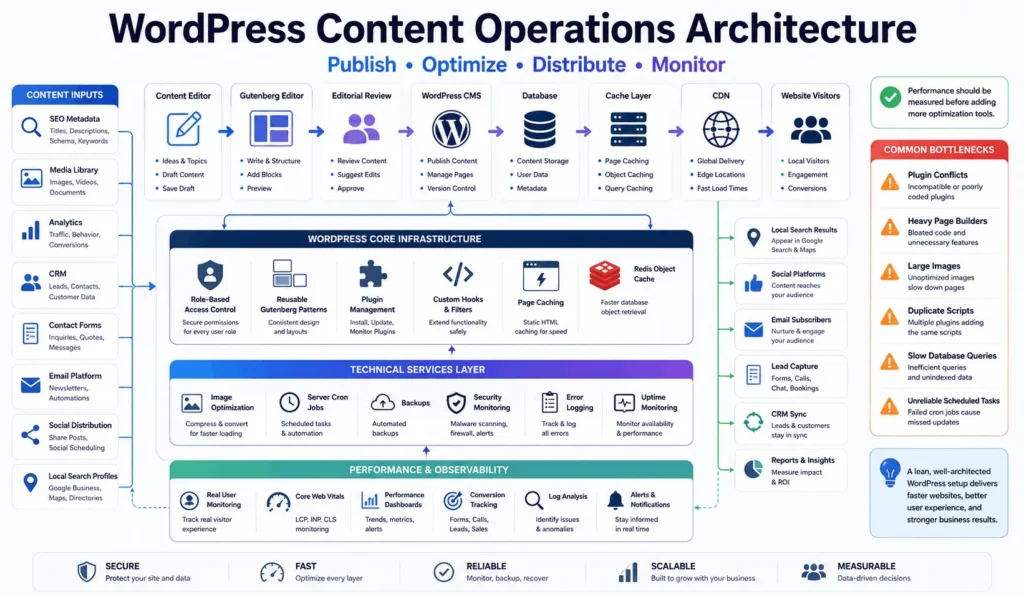
When a page is published, WordPress stores the post and metadata, cache layers refresh the public page, a CDN serves static assets, and analytics records visits. A form submission may trigger validation, spam filtering, a CRM API request, an email notification, and an attribution event.
Under production load, CRM APIs can fail, webhooks can time out, and email services can reject malformed data. Strong implementations use queues for non-critical tasks, limited retries, error logs, and preserved source records. A customer inquiry should not disappear because a downstream integration was briefly unavailable.
Small businesses do not need a microservices architecture for basic publishing. A well-maintained WordPress monolith is usually faster to operate. Separate services become useful when content, customer data, subscriptions, multi-location publishing, or integrations create independent scaling and security requirements.
| Feature | Ad Hoc Publishing | Engineered Content System |
|---|---|---|
| Topic selection | Based on ideas and trends | Based on customer questions, search intent, location, and commercial relevance |
| Workflow | Informal handoffs | Defined owners, approvals, deadlines, and publishing checks |
| Distribution | Manual and inconsistent | Planned website, email, social, and local profile distribution |
| Measurement | Traffic and likes | Qualified leads, calls, bookings, assisted conversions, and revenue |
| Maintenance | Old content accumulates | Scheduled reviews, redirects, updates, and consolidation |
Build the Strategy Around Local Demand, Not Content Volume
Audience research should combine customer interviews, sales calls, support questions, reviews, local search results, competitor analysis, and keyword research. Keyword tools reveal demand, but customer language reveals decision friction. Both are needed.
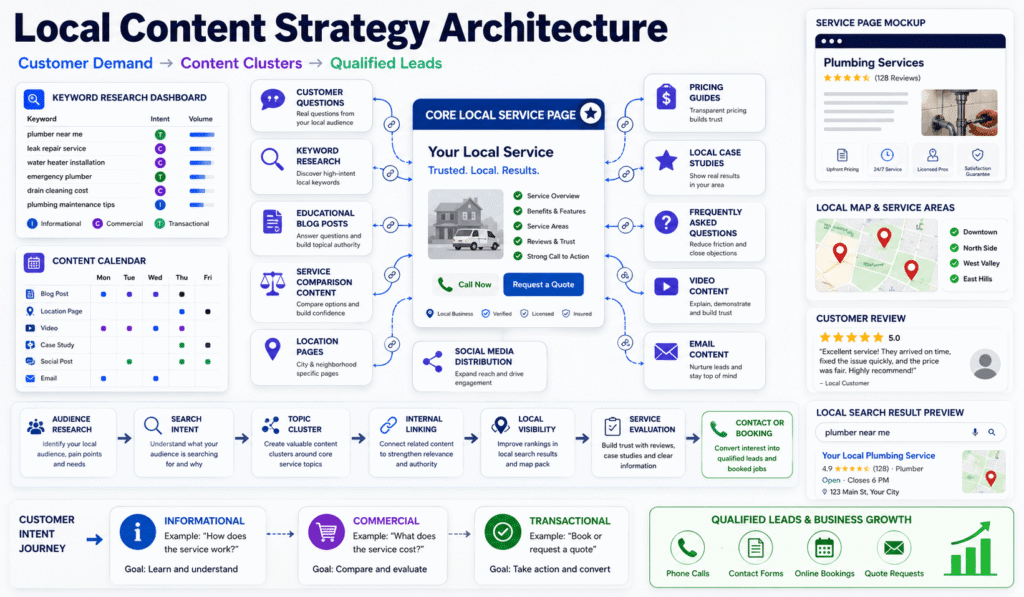
Group topics by intent. Informational topics explain a problem. Commercial topics compare options, costs, risks, and providers. Transactional topics support booking, calling, visiting, or requesting a quote. A healthy content plan covers all three instead of publishing only broad educational posts.
Local SEO also depends on business information, service relevance, page quality, internal links, reviews, and location signals. A useful starting point is this local SEO checklist for small business rankings, which helps connect publishing work to the wider local search system.
A broader local SEO strategy for small business growth connects content planning with location relevance, customer reviews, technical quality, and conversion paths.
Use a topic cluster rather than isolated posts. A core service page explains the offer. Supporting articles answer detailed questions. Location pages clarify service coverage. Case studies provide proof. FAQs address objections. Internal links then guide the reader from education to evaluation.
Which Content Formats Produce Useful Local Outcomes?
Blog posts are useful for detailed questions, but local buyers may prefer a short video, checklist, pricing guide, email reminder, or case study. Format should follow the decision being supported.
Service businesses often benefit from process content. Show what happens before, during, and after delivery. Explain preparation requirements, typical delays, quality checks, and common mistakes. This creates trust because it exposes operational knowledge rather than repeating promotional claims.
Social media should distribute and adapt useful material, not replace the website. The website remains the business-owned repository where service context, search visibility, lead capture, and long-term updates can be managed.
Email newsletters work best when segmented. CRM tags, service interests, location, and lifecycle stage help separate past customers, active leads, and new subscribers so each group receives relevant content.
WordPress Architecture, Performance, and Maintenance
WordPress is a practical platform for local content because editors can publish without developer involvement. The risk appears when every requirement is solved with another plugin. Overlapping SEO, form, caching, security, and page-builder plugins can create conflicts, duplicate scripts, slow queries, and unclear ownership.
A maintainable setup uses controlled plugin selection, a consistent block system, reusable Gutenberg patterns, limited custom hooks, and documented integrations. Role-based access control should separate administrators, editors, authors, and external contributors. Security hardening should include updates, backups, least-privilege access, login protection, and monitoring.
Performance work should start with measurement. Large images, third-party scripts, heavy page builders, uncached queries, and poor hosting are common bottlenecks. Page caching, Redis object caching where justified, CDN delivery, optimized media, and script reduction can help, but each layer adds maintenance responsibility.
WordPress cron is request-driven by default, so scheduled publishing and automation may become unreliable on low-traffic sites. Production setups can use a real server cron to trigger scheduled tasks consistently. This matters when content distribution, imports, report generation, or CRM synchronization depends on timing.
Automation and AI Without Losing Editorial Control
Automation is useful for repetitive transitions: creating briefs from approved topic records, routing drafts for review, generating social variants, attaching UTM parameters, notifying editors, and sending performance summaries. The orchestration layer can use APIs, webhooks, queues, and scheduled jobs.
AI-assisted workflows need validation. Local facts, prices, regulations, addresses, service limitations, and claims should be checked by an authorized person. Human review protects accuracy when source data is incomplete or the output affects a customer decision.
Reliable automation stores the source input, generated output, approval status, model or tool version, and publishing result. Failed steps need fallback paths. Monitoring should detect missing approvals, repeated API errors, duplicated posts, and content published without required metadata.
Search engines consistently emphasize useful, people-first information rather than content created mainly to manipulate rankings. The helpful content guidance from Google Search Central is a useful reference when defining editorial quality checks.
Measure Content Through the Lead and Revenue Workflow
Page views are an activity metric. They do not confirm business value. A useful measurement model connects the original content interaction to form submissions, phone calls, bookings, CRM records, qualified opportunities, and completed sales.
Call tracking and form attribution should preserve the landing page, campaign source, content identifier, and consent state. The CRM should record whether an inquiry was relevant, duplicated, unreachable, qualified, or converted. Without validation, spam can make a weak campaign look successful.
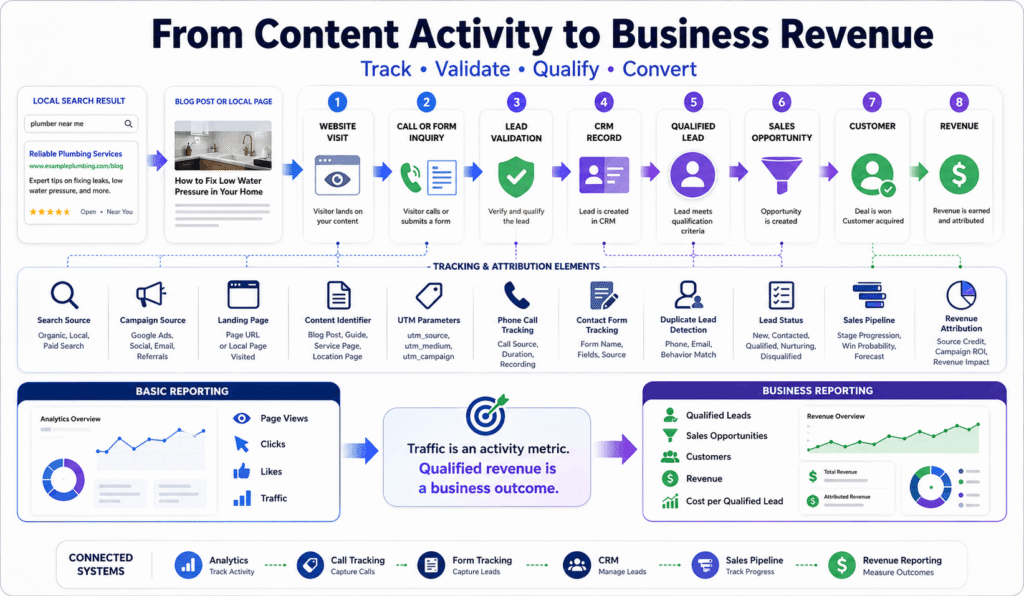
Review performance by topic cluster and customer journey stage. A pricing article may create direct leads. A technical guide may assist a later conversion. A local case study may improve sales confidence without attracting large traffic. These assets should not be judged by the same metric.
For businesses strengthening the full search foundation, this small business SEO checklist helps identify technical, on-page, and local gaps that content alone cannot solve.
Choose Between DIY, No-Code, Agency, and Custom Systems
No delivery model is always correct. A single-location team may operate effectively with WordPress, a spreadsheet calendar, a form plugin, and basic email automation. Complexity should be earned by real operational needs.
| Feature | Off-the-Shelf Stack | Custom or Integrated System |
|---|---|---|
| Initial cost | Lower and faster to launch | Higher due to discovery, engineering, and testing |
| Workflow fit | Business adapts to tool limitations | System can reflect business rules and approvals |
| Integrations | Limited to available connectors | APIs, webhooks, validation, retries, and custom mappings |
| Scalability | Suitable for straightforward operations | Better for multi-location, multi-team, or high-volume workflows |
| Maintenance | Vendor updates and plugin dependencies | Requires documented ownership, monitoring, and technical support |
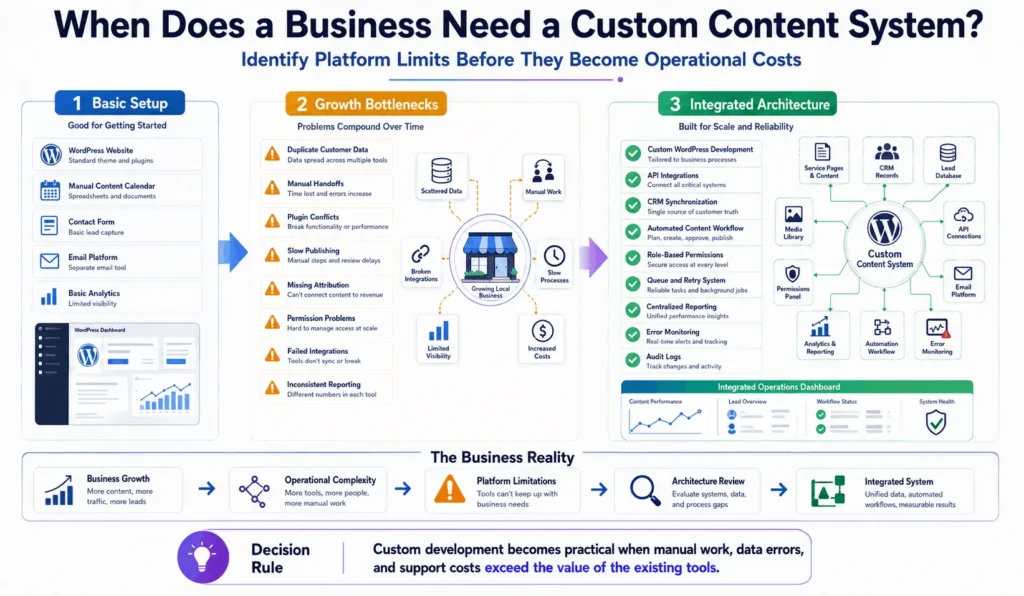
No-code tools work well for prototypes and low-risk workflows. They become fragile when multiple teams edit automations, mappings change, or errors need transaction-level recovery. Custom development becomes reasonable when manual work, data inconsistency, missed leads, or platform limits cost more than engineering.
Budget-sensitive businesses should first remove waste, consolidate tools, and fix measurement. This guide to affordable SEO services for small business growth explains how to prioritize work without reducing the strategy to the cheapest monthly package.
When Does Filicode Fit the Operating Model?
Filicode works with businesses that need more than isolated content production. The work may involve custom software development, WordPress development, WooCommerce development, AI automation, API integrations, SaaS development, performance optimization, or a review of the system architecture supporting marketing and operations.
The strongest fit appears when off-the-shelf tools create duplicate data, manual handoffs, unreliable reporting, permission problems, slow publishing, or integration failures. Architecture-focused decisions can reduce future support costs by clarifying data ownership, failure handling, deployment, monitoring, and maintenance before more tools are added.
Service-area companies also face a specific content challenge: they must explain geographic relevance without publishing thin or duplicated city pages. This guide to service-area business SEO and local growth covers a more maintainable approach to coverage pages and local visibility.
Frequently Asked Questions
How much does content marketing for local business cost?
Content marketing for local business can range from a low-cost internal workflow to a managed program with strategy, writing, design, SEO, video, CRM integration, and reporting. Cost should be evaluated against publishing volume, review complexity, distribution channels, and the value of qualified leads rather than article count alone.
How long does a local content strategy take to produce results?
Early engagement and lead-quality signals may appear within weeks, but durable search visibility usually requires several months of consistent publishing, internal linking, technical quality, and content updates. Competitive locations and services generally take longer than narrow local niches.
Can WordPress scale for a multi-location content program?
WordPress can scale for multi-location publishing when taxonomy, templates, permissions, caching, hosting, and editorial governance are designed correctly. Multisite or headless architecture may help in specific cases, but many businesses can scale with a well-structured single installation.
Should content tools connect to a CRM?
A CRM connection is useful when the business needs to trace content interactions to qualified leads, sales opportunities, and revenue. The integration should validate data, handle API failures, prevent duplicates, and preserve attribution fields.
What are the main migration risks when replacing a content platform?
The main risks are lost URLs, broken redirects, missing metadata, damaged internal links, form failures, analytics gaps, permission errors, and lost media. A migration needs a URL inventory, backups, staging tests, redirect mapping, content validation, and post-launch monitoring.
How often should local business content be maintained?
High-value service, location, pricing, legal, and process content should be reviewed on a defined schedule and whenever operations change. Performance reviews should identify outdated facts, declining rankings, duplicate topics, broken links, and pages that should be improved or consolidated.
Conclusion: Treat Content as an Operating System
Content marketing for local business starts failing when publishing slows, topics overlap, leads cannot be attributed, integrations break silently, or staff spend more time moving data than serving customers. Those are system limitations, not writing problems.
Custom development should be considered when platform constraints create support burden, data loss, reporting gaps, permission risk, or repeated manual work. Map the workflow from topic selection to revenue, identify failure points, and decide whether each problem needs process changes, better configuration, integration work, or new architecture.