








Contents
- Quick Summary:
- What Is Local SEO for Small Business?
- Why Local SEO for Small Business Matters Operationally
- Local SEO for Small Business Websites Starts With Architecture
- Google Business Profile Is a Data System, Not Just a Listing
- Local SEO Workflow: From Search to Lead
- Local Content Should Match Real Buying Questions
- Technical SEO Still Matters in Local Search
- Local SEO for Small Business and Automation
- Average Cost of Local SEO for Small Business
- Benefits of Local SEO for Small Business
- Common Mistakes That Hurt Local SEO for Small Business Growth
- When Local SEO Needs Engineering Support
- Local SEO for Small Business Example
- How to Improve Local SEO for Small Business
- FAQ
- What is local SEO for small business?
- Why local SEO is important for small business?
- How much does local SEO cost for small business?
- How long does local SEO take to work?
- Can local SEO work without a website?
- How to improve local SEO for small business websites?
- Conclusion
A small business can have a clean website, good service pages, and real customer demand, but still lose leads because search visibility is fragmented. The Google Business Profile says one thing, the website says another, citations are inconsistent, reviews are unmanaged, tracking is missing, and no one knows which search terms actually generate calls.
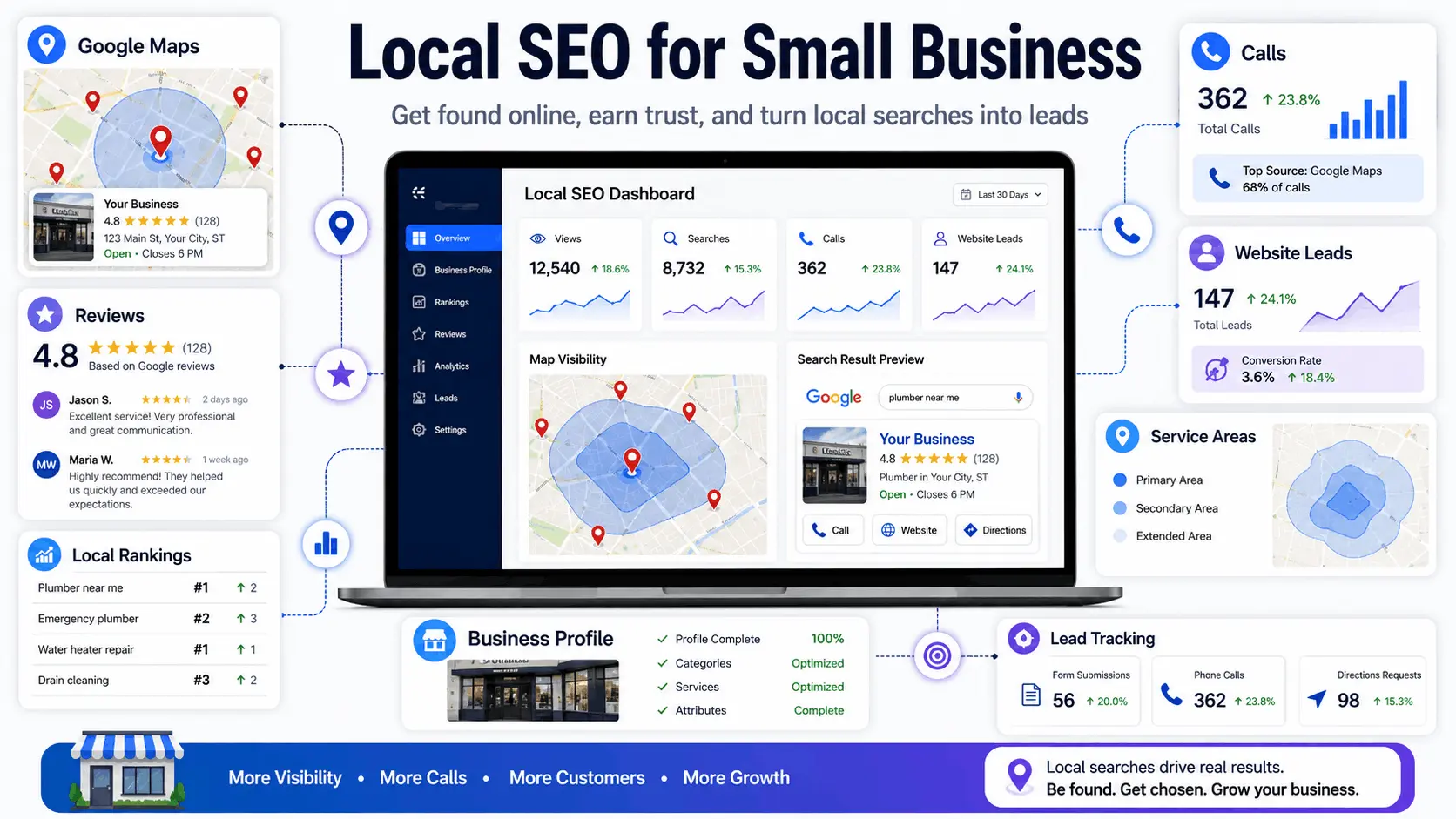
That is where local SEO for small business becomes more than a marketing checklist. It becomes an operational visibility system. It connects search intent, location signals, website structure, reviews, business data, analytics, and conversion tracking so local customers can find the business when they are ready to call, visit, book, or request a quote.
Quick Summary:
- Local SEO works best when business data, website pages, reviews, and tracking are managed as one system.
- A Google Business Profile is not enough if service pages, metadata, internal links, and location signals are weak.
- The average cost of local SEO for small business depends on competition, website quality, number of locations, and how much technical cleanup is needed.
- Local SEO should be measured through calls, form submissions, direction requests, appointment bookings, and qualified leads, not only rankings.
What Is Local SEO for Small Business?
Local SEO for small business is the process of improving how a business appears in location-based search results, Google Maps, local pack results, organic website rankings, and directory listings.
It helps search engines understand:
- what the business offers
- where it operates
- which customers it serves
- whether its information is accurate
- whether customers trust it
- whether its website supports local intent
For example, a contractor in Cleveland, a dental clinic in Houston, a law office in Cincinnati, or a home service company in Denver does not need random global traffic. It needs visibility for people searching with local intent.
Search terms like “roof repair near me,” “small business accountant in Dayton,” “local SEO for small business Cleveland,” or “emergency plumber Houston” show commercial intent. The user is not casually browsing. They are comparing providers.
Search engine optimization itself covers how websites improve visibility in search engines, and this overview of search engine optimization is useful for basic context. Local SEO narrows that work around geographic relevance, proximity, reputation, and local conversion behavior.
Why Local SEO for Small Business Matters Operationally
Many small businesses think local SEO means adding a few city keywords to a page. That is too shallow.
The deeper value of local SEO for small business is operational. It reduces dependency on paid ads, improves discovery, supports reputation, and turns the website into a lead-generation asset instead of a static brochure. For companies planning local search growth around Fairfax and nearby service areas, this Fairfax SEO service page explains how FiliCode connects visibility, website structure, and lead generation.
Local search usually sits close to revenue. Users want pricing, availability, service areas, reviews, directions, phone numbers, and proof that the business can solve their problem.
A weak local SEO system creates practical issues:
- service pages do not rank
- calls are not tracked
- reviews are not requested consistently
- map rankings move without explanation
- duplicate listings confuse search engines
- location pages compete with each other
- technical website issues block performance
Local SEO for Small Business Websites Starts With Architecture
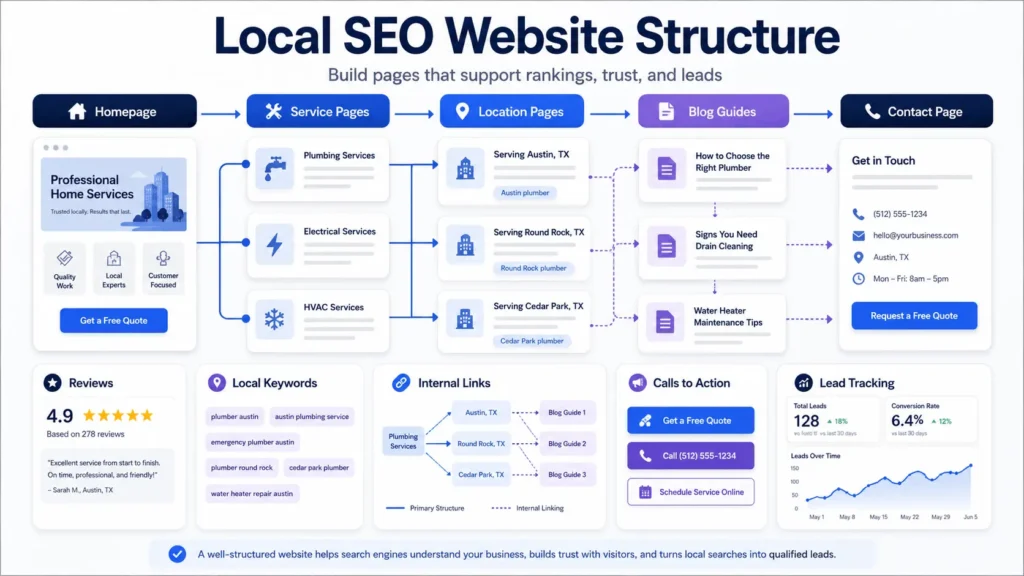
A website built without local search structure usually becomes hard to optimize later. The homepage tries to rank for everything. Service pages are thin. Location pages repeat the same content. Internal links are random. Metadata is written after launch instead of planned during architecture.
Strong local SEO for small business websites starts with a simple structure:
| Website Area | Poor Setup | Better Local SEO Setup |
|---|---|---|
| Homepage | Generic company introduction | Clear primary service, location, trust signals, CTA |
| Service pages | One page listing all services | Dedicated pages for high-value services |
| Location pages | Duplicated city text | Unique local proof, service context, FAQs, reviews |
| Blog content | Random topics | Search-intent articles supporting service pages |
| Internal links | Footer-only links | Contextual links between services, locations, and guides |
| Tracking | Basic page views | Calls, forms, GBP actions, conversions, lead quality |
This structure helps users and search engines. It also helps operations teams maintain the website without guessing where content should go.
In WordPress, this often means building clean templates for service pages, location pages, FAQs, reviews, and calls to action. Gutenberg blocks can be customized so teams can update content without breaking layout consistency. Custom fields can store reusable data such as service areas, phone numbers, review snippets, and schema details.
Google Business Profile Is a Data System, Not Just a Listing
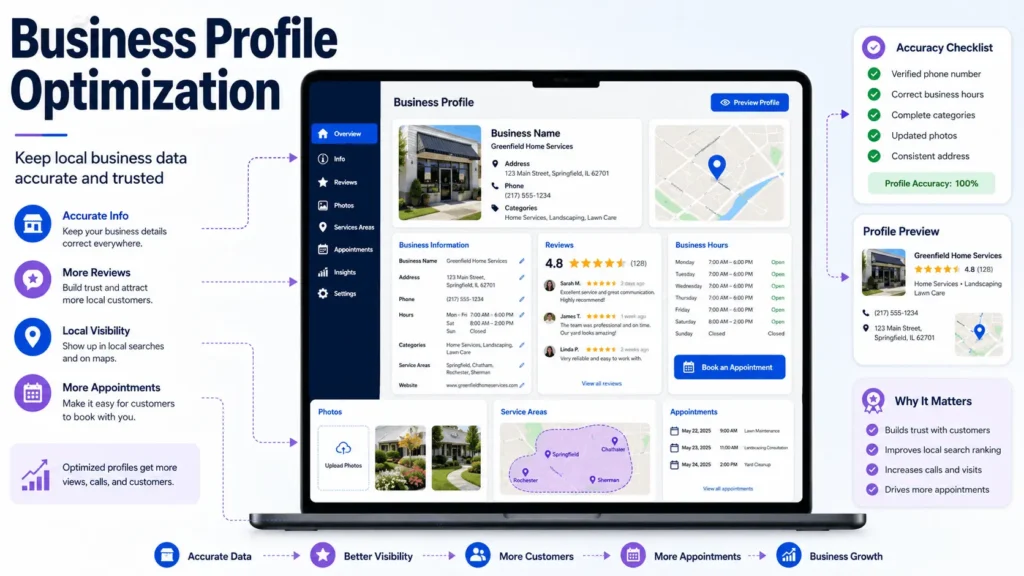
For many businesses, the Google Business Profile is the highest-value local SEO asset. It affects Google Maps visibility, map pack rankings, calls, direction requests, reviews, business hours, photos, and trust.
But it must be treated like a structured data source.
A good profile should include accurate NAP information, categories, services, service areas, hours, photos, appointment links, and regular updates.
The issue is consistency. If the business name, address, phone number, or service area differs across the website, Google Business Profile, Bing, Yelp, Facebook, Apple Maps, and local directories, trust signals weaken.
That is why local SEO for small business should include a source-of-truth workflow. One person or system should own business data changes. When hours, addresses, phone numbers, or service areas change, updates should flow across the website and major listings.
For multi-location businesses, this becomes more technical. Each location may need unique pages, unique tracking numbers, separate business profiles, review management, and local content. Without rules, the site becomes messy and rankings become unpredictable.
Local SEO Workflow: From Search to Lead
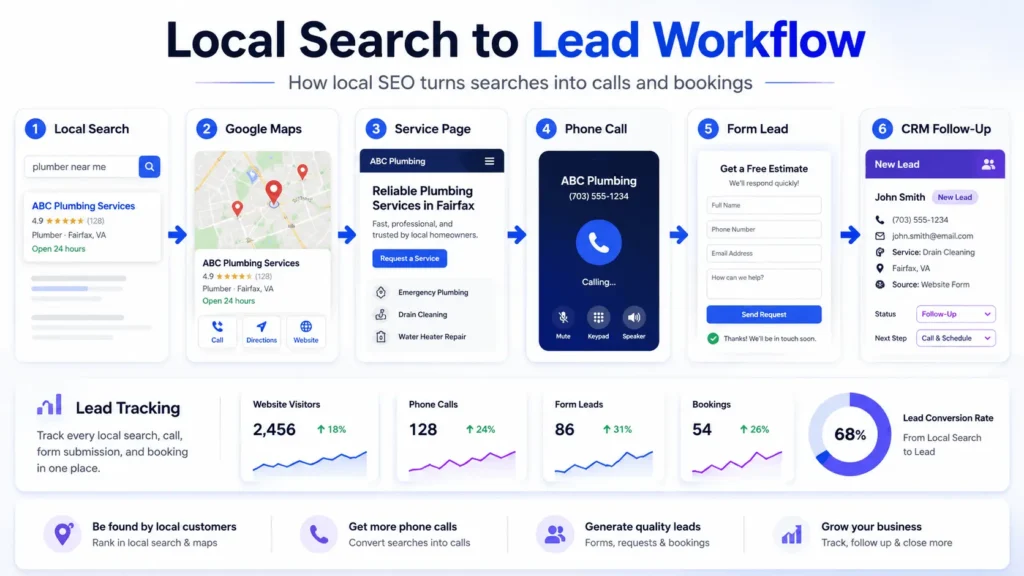
A real local SEO workflow is not only keyword research. It is a chain of events.
A customer searches. Google evaluates relevance, distance, prominence, website quality, profile completeness, reviews, local content, and user behavior. The customer clicks a map result or organic result. The website loads. The page answers intent. The user calls, books, asks for directions, or submits a form.
That workflow has several technical layers:
| Workflow Step | System Requirement | Risk If Ignored |
|---|---|---|
| Search result | Accurate title, description, GBP data | Low CTR |
| Landing page | Fast mobile page with local content | Bounce and lost leads |
| Conversion | Phone, form, booking, chat tracking | No revenue attribution |
| Backend | CRM or email routing | Missed follow-ups |
| Reporting | Analytics, call tracking, rank tracking | Poor decision making |
| Maintenance | Reviews, content updates, listing audits | Rankings decay |
This is where technical SEO, WordPress development, CRM automation, and reporting systems intersect.
For example, a form submission may trigger CRM creation, email notification, Slack alert, quote workflow, and follow-up automation. If that automation breaks, SEO still brings traffic, but operations lose the lead.
Local Content Should Match Real Buying Questions
Local content fails when it is written only for keywords. A page titled “local SEO for small business Chino CA” may rank poorly if it offers no useful local context, no service proof, and no clear reason for the location page to exist.
Good local content answers practical questions:
- What services are available in this area?
- What problems do local customers usually have?
- What neighborhoods or nearby cities are served?
- What makes the business credible?
- What should a customer expect before booking?
- What does the process cost?
- What happens after contact?
A local SEO checklist local SEO for small business teams can follow should include service pages, location pages, internal links, metadata, reviews, schema, Google Business Profile updates, image alt text, and conversion tracking. For a deeper regional example, this guide on building local visibility in Virginia shows how location signals support sustainable search growth.
Technical SEO Still Matters in Local Search
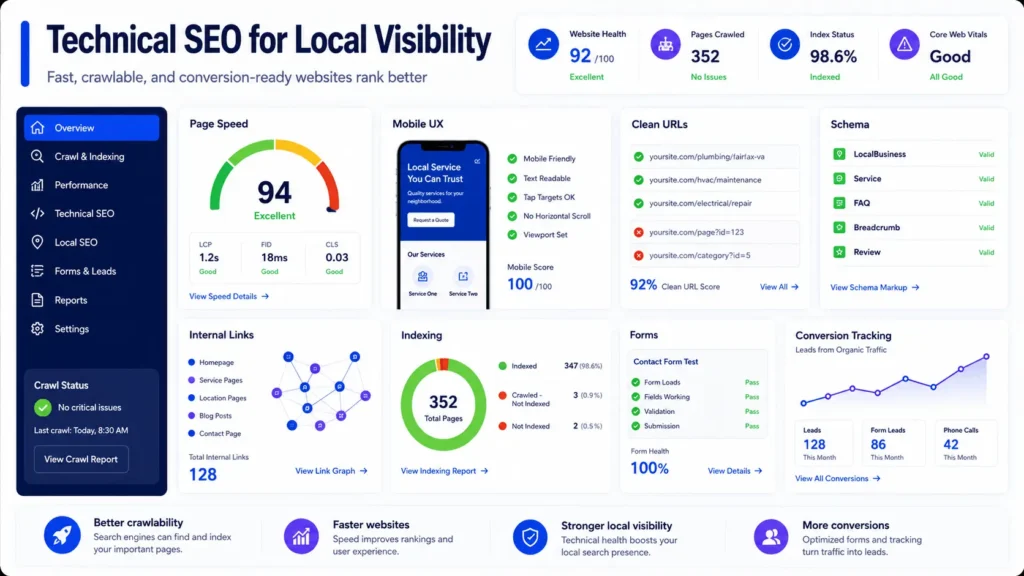
Local intent does not excuse poor technical execution. Search engines still need crawlable pages, fast loading, clean URLs, structured content, internal links, indexable pages, and reliable rendering. When the layout, UX, or page structure is holding the campaign back, website design support for Fairfax businesses can help improve the foundation behind local SEO.
On WordPress sites, common problems include:
- bloated themes
- too many plugins
- unused JavaScript
- slow hosting
- unoptimized images
- poor mobile layout
- plugin conflicts
- missing redirects
- duplicate location pages
- weak schema implementation
- broken forms after updates
Object caching, Redis, CDN configuration, optimized database tables, lazy loading, and careful plugin selection can improve performance. But technical improvements should support measurable business outcomes: faster calls, more form completions, better mobile usability, and stronger local rankings.
Local SEO for Small Business and Automation
Automation can help local SEO, but only when it is controlled.
Useful automation includes review request workflows, CRM follow-ups, missed-call alerts, lead source tagging, reporting dashboards, listing audit reminders, and content update workflows.
AI automation can assist with categorizing leads, summarizing call notes, routing support requests, identifying content gaps, and monitoring review sentiment. But AI should not publish local content blindly or respond to reviews without human review.
A reliable automation setup needs validation. For example:
- form data should be checked before entering the CRM
- phone leads should be tagged by source
- failed webhook events should retry
- reports should flag tracking gaps
- AI-generated outputs should pass human review
- sensitive customer data should not be sent into unsafe workflows
Average Cost of Local SEO for Small Business
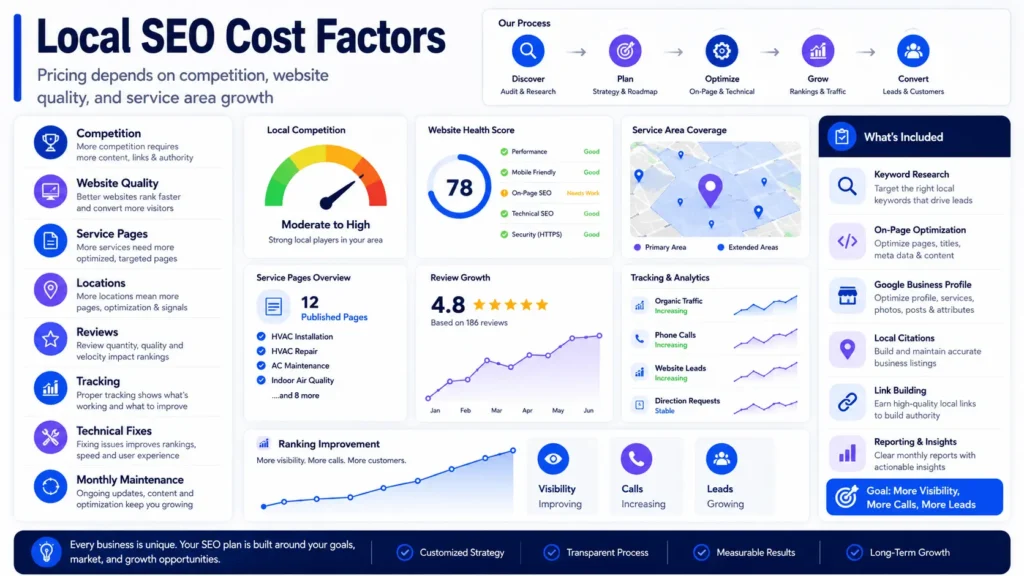
The average cost of local SEO for small business depends on market difficulty, website condition, number of services, number of locations, and how much technical work is required.
A single-location service business with a clean WordPress website may need profile optimization, citation cleanup, service page improvements, review strategy, and tracking setup.
A multi-location business with duplicated pages, slow performance, CRM issues, poor analytics, and inconsistent listings needs deeper work.
| Local SEO Level | Typical Scope | Best Fit |
|---|---|---|
| Basic setup | GBP cleanup, metadata, citations, simple reporting | New or very small local businesses |
| Growth-focused | Service pages, local content, reviews, tracking, technical fixes | Competitive service businesses |
| Advanced | Multi-location architecture, automation, CRM, schema, analytics | Scaling regional businesses |
| Custom system | APIs, dashboards, lead routing, automation, integrations | Businesses outgrowing manual workflows |
Benefits of Local SEO for Small Business
Local SEO for small business creates value because it connects visibility with real customer actions. Better map visibility can increase calls. Strong reviews can improve trust. Clear service pages can convert visitors who already know what they need.
The main benefits are practical:
- more qualified local traffic
- more phone calls and form submissions
- better Google Maps visibility
- stronger customer trust through reviews
- reduced dependency on paid ads
- clearer reporting around local lead sources
Common Mistakes That Hurt Local SEO for Small Business Growth
The most common mistake is treating local SEO for small business as a one-time project. It performs better when search work is connected with content planning, reporting, reputation management, and a wider growth strategy.
Local rankings change because competitors update content, reviews grow, Google changes result layouts, customers search differently, and business information becomes outdated.
Other mistakes include:
- building location pages with copied content
- ignoring call tracking
- choosing keywords without commercial intent
- using fake city targeting
- buying poor-quality backlinks
- ignoring website speed
- hiding phone numbers on mobile
- failing to respond to reviews
- using no CRM follow-up process
- measuring rankings but not leads
A local SEO campaign should be reviewed monthly. Not every page needs constant updates, but the system needs maintenance.
When Local SEO Needs Engineering Support
Basic SEO tools can handle audits, keyword tracking, and reporting. But growing businesses often hit system limitations.
Engineering support becomes useful when the website needs custom page templates, structured location data, API integrations, CRM workflows, booking systems, analytics cleanup, performance optimization, WooCommerce fixes, or automation.
This is where Filicode fits naturally. Filicode works across custom software development, WordPress development, WooCommerce development, API integrations, AI automation, SaaS development, system architecture, and performance optimization.
For a small business, this matters when SEO recommendations require actual implementation. A strategy document does not fix slow templates, broken forms, weak schema, plugin conflicts, poor checkout performance, or missing CRM workflows.
Good architecture reduces future operating costs. Bad architecture turns every SEO improvement into manual developer work.
Local SEO for Small Business Example
A practical local SEO for small business example would be a home service company with one main city and five nearby service areas.
The setup may include:
- homepage optimized for the main business category
- dedicated service pages
- unique service area pages
- Google Business Profile optimization
- review request workflow after completed jobs
- call tracking and form tracking
- internal links from blogs to service pages
- schema for local business and FAQs
- monthly reporting by leads, not only traffic
If the business later expands from Dayton to Cincinnati, Cleveland, or Columbus, the website should not require a rebuild. The location architecture should support expansion without duplicated content or messy navigation.
How to Improve Local SEO for Small Business
Start with the assets closest to revenue. If the business needs a more structured plan, this small business SEO service overview explains the core work behind rankings, local visibility, and lead generation.
A practical order looks like this:
- Verify business data accuracy.
- Improve the Google Business Profile.
- Build or improve service pages.
- Add location-specific proof.
- Fix mobile and speed issues.
- Set up call and form tracking.
- Request and respond to reviews.
- Publish useful local content.
- Monitor rankings and leads.
- Maintain listings and website health.
This creates a system instead of scattered SEO tasks.
FAQ
What is local SEO for small business?
Local SEO for small business is the process of improving visibility in local search results, Google Maps, business listings, and location-based website searches so nearby customers can find and contact the business.
Why local SEO is important for small business?
Local SEO connects the business with high-intent customers who are ready to call, visit, book, or buy. It also improves trust through reviews, accurate listings, and better local visibility.
How much does local SEO cost for small business?
Costs vary based on competition, website quality, number of locations, and technical needs. A simple local setup costs less than a multi-location strategy with content, tracking, automation, and performance fixes.
How long does local SEO take to work?
Small improvements can appear within weeks, especially from profile cleanup and technical fixes. Stronger ranking and lead growth usually require consistent work over several months.
Can local SEO work without a website?
A Google Business Profile can generate visibility, but a website gives the business more control. Service pages, location pages, FAQs, reviews, and tracking make local SEO more scalable.
How to improve local SEO for small business websites?
Improve page speed, service page structure, local keywords, internal links, metadata, schema, mobile usability, reviews, and conversion tracking. The website should support search intent and lead generation.
Conclusion
Local SEO for small business works when it is treated as a maintained system, not a checklist. The strongest results come from accurate business data, useful service pages, strong local signals, review activity, technical website health, and clean lead tracking.
Warning signs are easy to spot: rankings move but leads do not improve, calls are not tracked, location pages are duplicated, reviews are unmanaged, the website is slow, forms break after updates, or the team cannot explain which pages generate revenue.
At that point, the issue is not only SEO. It is architecture, workflow, and maintainability.
Businesses that are outgrowing basic tools should consider custom development, better WordPress architecture, API integrations, CRM automation, performance optimization, and more reliable reporting. A practical next step is to audit the current local search system from profile to website to lead handling, then fix the bottlenecks that directly affect visibility and revenue. If your website, listings, tracking, or lead workflow needs a practical review, you can discuss your local SEO goals with FiliCode.