








Contents
- Quick Summary:
- What Is Local SEO and Why It Matters in Virginia
- How Google Determines Local Rankings
- Relevance
- Distance
- Prominence
- How Local SEO Differs Across Virginia Markets
- Northern Virginia Local SEO
- Richmond Local Search
- Norfolk and Virginia Beach
- Multi-Location Virginia Businesses
- Why Local SEO Matters for Virginia Businesses
- Higher Intent Traffic
- Better Conversion Rates
- Long-Term Ranking Stability
- Lower Paid Advertising Dependency
- How Google Maps and Mobile Search Affect Local Rankings
- Mobile Performance Matters
- Long-Term Return on Investment
- Core Local SEO Strategies for Virginia Businesses
- Local Presence Audit
- Google Business Profile Optimization
- Local Citation Building & Cleanup
- Location-Focused Website Optimization
- Technical Website Foundations for Local SEO Virginia
- WordPress Performance and Maintenance
- Scalable Virginia Location Pages
- Local Structured Data
- Content, Authority, and Local Search Measurement
- Earn Relevant Virginia Backlinks
- Create Useful Virginia-Focused Content
- Research Local Search Intent
- Analyze Local Search Competitors
- Measure Qualified Local Leads
- 12 Local SEO Virginia Strategies for 2026
- Common Local SEO Mistakes in Virginia
- Overusing Exact Match Keywords
- Duplicate City Pages
- Ignoring Mobile Performance
- Weak Review Management
- Plugin Overload in WordPress
- Example Virginia Local SEO Improvement Plan
- Results You Should Measure
- Strengthen Your Virginia Local Search Visibility
- Frequently Asked Questions
- How long does local SEO take in Virginia?
- What affects Google Maps rankings?
- Is Northern Virginia local SEO more competitive?
- Is WordPress good for local SEO?
- Can local SEO reduce dependence on Google Ads?
- What is the biggest local SEO mistake businesses make?
- Should multi-location businesses create separate pages?
- Conclusion
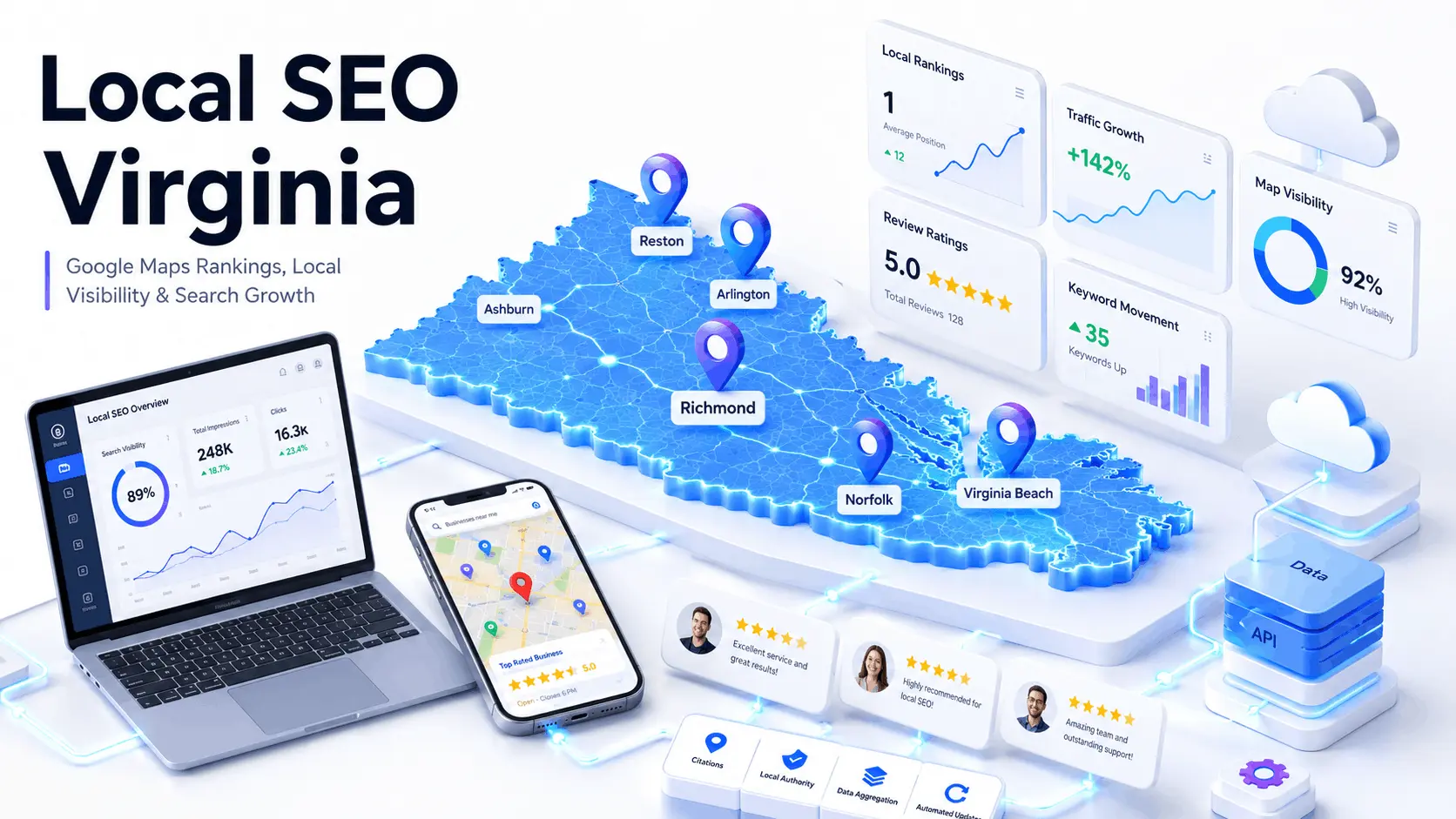
Local SEO Virginia strategies help businesses appear more consistently in Google Maps and location-based organic search results. This guide explains 12 practical improvements covering Google Business Profile optimization, local citations, reviews, location pages, technical SEO, internal linking, and conversion tracking.
For Northern Virginia local SEO campaigns, competition and proximity patterns differ from Richmond, Norfolk, and Virginia Beach. Strong performance depends on accurate business information, useful regional content, trusted local authority signals, and a fast website that turns nearby searches into qualified inquiries.
Quick Summary:
- Local SEO Virginia performance depends on Google Business Profile relevance, citations, reviews, website quality, and local authority.
- Northern Virginia local SEO campaigns often require more detailed service-area and location-page strategies because of stronger competition.
- Google needs clear differences between informational guides, commercial service pages, and individual city pages.
- Duplicate or lightly modified Virginia location pages can create indexing and keyword-cannibalization problems.
- Strong local SEO should be measured through calls, forms, qualified leads, map visibility, and local keyword movement.
What Is Local SEO and Why It Matters in Virginia
Local SEO is a location-focused branch of search engine optimization that improves visibility in geographically targeted Google Search and Google Maps results. For Virginia businesses, it helps connect services with nearby customers who already show local buying intent.
When users search:
- “HVAC repair Richmond”
- “Virginia SEO company”
- “SEO agency near me”
- “emergency plumber Virginia Beach”
Google interprets local intent immediately.
The search engine prioritizes businesses with:
- strong geographic relevance
- verified location signals
- trusted directories
- high review quality
- active customer engagement
- authoritative backlinks
- localized content architecture
Virginia markets are particularly competitive because many industries overlap densely across regional markets.
A law firm in Arlington competes differently from a contractor in Norfolk or a SaaS consultancy targeting Northern Virginia enterprises. Search demand, proximity, and authority signals vary significantly between regions.
That means local SEO services Virginia strategies cannot rely on generic templates.
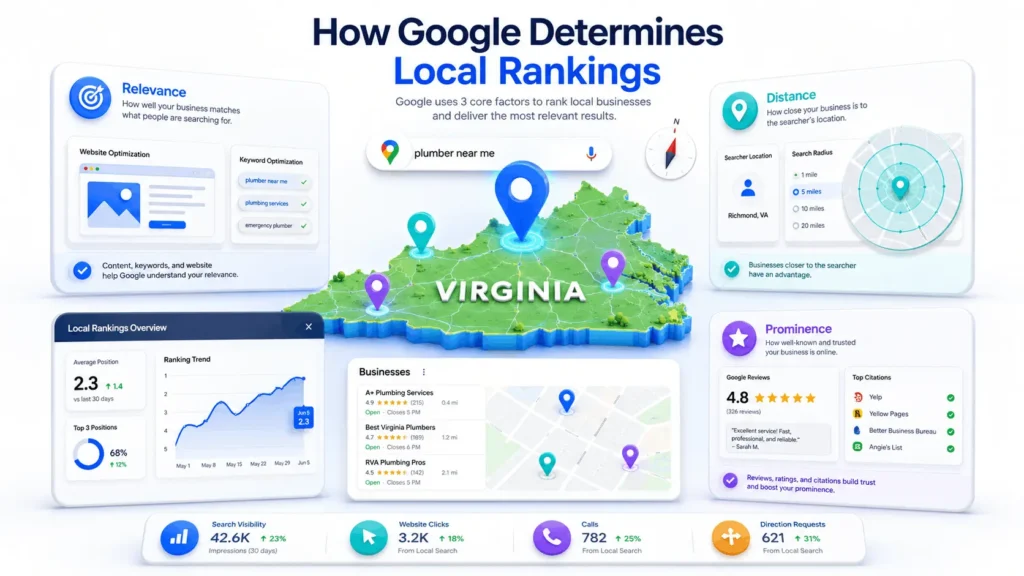
How Google Determines Local Rankings
Google still publicly references three primary ranking signals:
Relevance
How closely a business matches search intent.
This includes:
- category selection
- service descriptions
- local keyword research
- website content
- schema markup
- service pages
- title tag optimization
- Google Business Profile completeness
Poor relevance usually appears when businesses optimize broadly instead of aligning content with actual services and locations.
Distance
Physical proximity between the searcher and business location.
Distance cannot be manipulated directly, but businesses can improve geographic targeting through:
- local landing pages
- service area configuration
- embedded Google Maps
- localized backlinks
- geographic content signals
For multi-location businesses, location architecture becomes critical.
Weak location hierarchy causes internal competition between branches.
Prominence
Prominence reflects authority and trust.
This includes:
- backlinks
- citations
- review quantity
- average rating
- response activity
- online mentions
- branded search demand
- local authority signals
Prominence is where most local SEO campaigns fail long term.
Buying low-quality backlinks or mass-producing citations creates unstable ranking behavior.
Google increasingly evaluates legitimacy through engagement consistency and entity trust.
How Local SEO Differs Across Virginia Markets
Local SEO competition is not identical across every Virginia market. Search demand, proximity, review strength, local authority, and service-area competition change from one region to another.
Northern Virginia Local SEO
Northern Virginia local SEO campaigns often compete across Fairfax, Arlington, Alexandria, Reston, Ashburn, and nearby service areas. Businesses should create useful location content, strengthen professional authority signals, maintain accurate service areas, and avoid publishing nearly identical pages for every nearby city.
Richmond Local Search
Richmond businesses can improve local visibility through city-relevant service content, customer reviews, local organization mentions, consistent citations, and backlinks from trusted regional sources.
Norfolk and Virginia Beach
Businesses targeting Norfolk and Virginia Beach should clearly explain their service coverage, customer needs, examples, and geographic relevance. Changing only a city name across multiple pages is not enough to create useful local content.
Multi-Location Virginia Businesses
Separate location pages should be created only when each location has unique business information, services, staff, customer examples, contact details, or geographic value. This helps Google distinguish legitimate location pages from duplicate doorway content.
Why Local SEO Matters for Virginia Businesses
Paid ads stop generating leads the moment spend pauses.
Strong local rankings continue generating:
- calls
- visits
- inquiries
- form submissions
- ready-to-buy traffic
The operational advantage is compounding visibility.
Businesses appearing consistently in map pack results reduce customer acquisition costs over time.
This becomes especially valuable in service industries where conversion intent is high.
Examples include:
- legal
- healthcare
- home services
- B2B consulting
- SaaS implementation
- IT support
- local agencies
Higher Intent Traffic
Users searching with geographic intent usually have immediate purchasing intent.
Traffic quality improves significantly compared to broad informational SEO.
Better Conversion Rates
Local search visitors convert at higher rates because intent is already narrowed operationally and geographically.
Long-Term Ranking Stability
Ethical SEO practices produce durable visibility.
Shortcuts typically create volatility during algorithm updates.
Lower Paid Advertising Dependency
Strong local presence reduces pressure on Google Ads budgets.
Businesses with stable local rankings can allocate paid budgets strategically instead of defensively.
How Google Maps and Mobile Search Affect Local Rankings
Google Maps visibility depends on more than adding keywords to a business profile. Google evaluates relevance, proximity, prominence, business information, reviews, website authority, and user engagement signals.
Important Google Business Profile actions can include calls, website visits, direction requests, review interactions, photo engagement, and searches for the business name. An incomplete or inactive profile may struggle to compete against better-maintained local businesses.
Mobile Performance Matters
Many local searches happen on mobile devices, especially when users need an immediate service. Virginia businesses should provide fast page loading, clear contact information, clickable phone numbers, usable forms, simple navigation, and location details that are easy to understand.
WordPress websites can lose performance through oversized images, excessive plugins, render-blocking scripts, weak caching, and unnecessarily heavy page builders. These issues can reduce engagement and make local landing pages harder to crawl and use.
Long-Term Return on Investment
Local SEO can reduce long-term dependence on paid advertising by generating visibility for high-intent location searches. The strongest results come from consistent optimization, review management, useful content, accurate citations, and reliable conversion tracking.
Core Local SEO Strategies for Virginia Businesses
Effective local SEO campaigns in Virginia combine technical infrastructure, authority building, and operational trust signals.
Local Presence Audit
A proper local SEO audit should evaluate:
- NAP data consistency
- citation fragmentation
- indexing issues
- schema implementation
- Google Maps rankings
- crawl inefficiencies
- local keyword movement
- duplicate location pages
- backlink quality
- review distribution
Surface-level audits miss operational failures that suppress rankings over time.
Google Business Profile Optimization
Google Business Profile optimization remains foundational.
This includes:
- category tuning
- service optimization
- localized descriptions
- review workflows
- Q&A management
- image optimization
- posting cadence
- map relevance improvements
Businesses frequently overlook operational ownership here.
Multiple employees editing listings inconsistently often create ranking instability.
Local Citation Building & Cleanup
Citation building still matters because consistency reinforces trust signals.
Critical directories include:
- Bing
- Apple Maps
- Yelp
- industry-specific directories
- local business listings
Inconsistent business name, address, and phone number formatting weakens authority signals.
Automated citation tools often introduce formatting conflicts at scale.
Manual validation remains necessary.
Location-Focused Website Optimization
Local SEO website design requires architecture decisions beyond aesthetics.
Important elements include:
- city-based landing pages
- internal linking structures
- schema markup
- location-focused metadata
- embedded maps
- crawl hierarchy
- service-area targeting
Poorly structured local pages create duplicate content risks.
Strong implementations differentiate pages operationally, not just geographically.
Technical Website Foundations for Local SEO Virginia
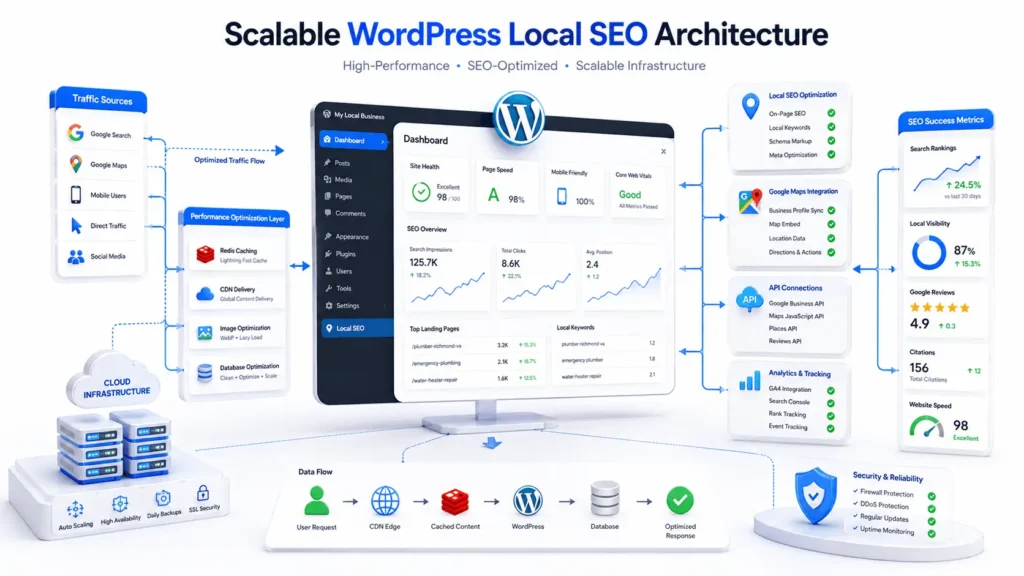
A local business website must support crawlability, mobile usability, geographic relevance, and a clear conversion path. A visual redesign alone will not improve local rankings if the website remains slow, difficult to crawl, or poorly organized.
WordPress Performance and Maintenance
WordPress development can support strong local SEO when the site uses reliable caching, compressed images, clean structured data, a limited plugin footprint, and efficient database management.
Common problems include plugin conflicts, duplicate schema output, heavy themes, oversized images, unnecessary scripts, and slow mobile rendering. These issues can reduce user engagement and make important location pages harder to crawl.
Scalable Virginia Location Pages
Businesses serving multiple Virginia markets need a clear relationship between their main service pages and individual location pages. Each page should contain unique services, customer needs, local examples, FAQs, geographic details, and relevant internal links.
Publishing the same content repeatedly with Richmond, Fairfax, Arlington, Norfolk, or Virginia Beach inserted into the text can create duplication and indexing problems.
Local Structured Data
Local business structured data should accurately reflect the business name, address, telephone number, website, opening hours, service area, and business type. Multiple plugins should not produce conflicting LocalBusiness or Organization schema.
Content, Authority, and Local Search Measurement
Earn Relevant Virginia Backlinks
Useful local backlinks can come from chambers of commerce, regional publications, professional organizations, business partnerships, local events, sponsorships, and industry associations. Relevance and legitimacy matter more than purchasing a large quantity of unrelated links.
Create Useful Virginia-Focused Content
Local content should answer real customer questions and reflect actual services, locations, industries, regulations, or regional conditions. Useful formats include service guides, localized FAQs, regional case studies, project examples, and area-specific problem-solving content.
Thin city pages generated from the same template usually fail because they provide little unique value for users or search engines.
Research Local Search Intent
Keyword research should separate informational searches from commercial and location-based searches. For example, “local SEO Virginia” can support an educational guide, while a query for a Virginia SEO provider usually has stronger commercial intent.
This distinction helps prevent an informational article from competing directly with a service page.
Analyze Local Search Competitors
Competitor analysis should examine Google Business Profiles, reviews, citations, local pages, backlinks, schema, website performance, internal linking, and content usefulness. The goal is to identify missing opportunities rather than copy tactics blindly.
Measure Qualified Local Leads
Track calls, contact-form submissions, booked appointments, direction requests, lead quality, local rankings, Google Business Profile activity, and conversion rates. Traffic and impressions alone do not show whether a local SEO campaign produces business value.
12 Local SEO Virginia Strategies for 2026
- Audit your current local visibility: Review rankings, indexed pages, Google Business Profile performance, citations, reviews, backlinks, and technical issues.
- Complete your Google Business Profile: Use accurate categories, services, business information, hours, images, and service areas.
- Correct inconsistent citations: Keep the business name, address, telephone number, and website consistent across trusted directories.
- Improve review management: Create a consistent process for requesting, monitoring, and responding to legitimate customer reviews.
- Strengthen location relevance: Clearly explain which Virginia areas you serve and how your services apply to customers in those locations.
- Create useful location pages: Give every legitimate location page unique information, examples, FAQs, services, and customer value.
- Improve mobile performance: Compress images, reduce unnecessary scripts, improve caching, and make calls and forms easy to complete.
- Implement accurate local schema: Ensure structured data matches real business details and does not conflict across plugins.
- Strengthen internal linking: Connect service pages, Virginia location pages, related guides, and relevant case studies with descriptive anchor text.
- Earn relevant local authority: Build relationships with Virginia organizations, publications, associations, partners, and communities.
- Track leads instead of traffic alone: Measure phone calls, forms, appointments, qualified leads, and local conversion rates.
- Avoid duplicate city pages: Do not create multiple pages that differ only by changing the city name or a few sentences.
Common Local SEO Mistakes in Virginia
Overusing Exact Match Keywords
Keyword stuffing weakens readability and trust signals.
Duplicate City Pages
Mass-produced Virginia city pages can create indexing problems when they repeat the same services, structure, examples, and wording. Every location page should provide unique and verifiable local value.
Ignoring Mobile Performance
Slow mobile rendering directly affects local engagement.
Weak Review Management
Review quantity without response activity limits trust growth.
Plugin Overload in WordPress
Too many plugins increase operational instability and performance degradation.
Example Virginia Local SEO Improvement Plan
Consider a regional service provider operating across Norfolk and Virginia Beach with inconsistent Google Maps visibility.
An initial audit could identify:
- duplicate or inconsistent citations
- weak service-page and location-page architecture
- conflicting or incomplete schema markup
- slow mobile performance
- fragmented review management
- limited tracking for calls and qualified leads
The improvement plan should first correct business information, strengthen the Google Business Profile, separate Norfolk and Virginia Beach content by genuine customer needs, improve mobile performance, and connect relevant service and location pages through internal links.
AI automation services may support internal review-request reminders and response workflows, but they should never generate, alter, or manipulate customer reviews.
Progress should be measured through local rankings, map visibility, calls, form submissions, direction requests, and qualified leads. The strongest improvements usually come from operational consistency rather than aggressive or temporary SEO tactics.
Results You Should Measure
Reliable Virginia local SEO reporting should connect visibility metrics with real business outcomes.
- local organic rankings and map-pack visibility
- Google Business Profile calls, website visits, and direction requests
- contact-form submissions and booked appointments
- conversion rates and qualified lead volume
- indexed location and service pages
- citation accuracy and review activity
Impressions and traffic are useful diagnostic metrics, but they do not prove that a campaign generates valuable customers.
Strengthen Your Virginia Local Search Visibility
Warning signs such as unstable rankings, inconsistent lead quality, slow mobile performance, fragmented citations, duplicate location pages, and unreliable tracking often point to a structural problem rather than a missing keyword.
At FiliCode, local SEO is approached through website architecture, technical performance, structured data, regional content, authority signals, and measurement working together. The goal is maintainable visibility that can support growth across Virginia markets without relying on duplicate city pages or short-term ranking tactics.
Frequently Asked Questions
How long does local SEO take in Virginia?
Timelines vary by competition, website condition, location, authority, and the strength of the Google Business Profile. Businesses should evaluate progress through indexing, visibility, calls, forms, and qualified leads rather than expecting an immediate ranking change.
What affects Google Maps rankings?
Google considers relevance, distance, and prominence. Accurate business information, suitable categories, reviews, citations, local website relevance, backlinks, and profile activity can support those signals.
Is Northern Virginia local SEO more competitive?
It can be highly competitive because businesses often target overlapping areas such as Fairfax, Arlington, Alexandria, Reston, and Ashburn. Clear service-area relevance, strong reviews, useful location content, technical performance, and trusted authority signals are especially important.
Is WordPress good for local SEO?
Yes. WordPress can support local SEO when the site is fast, mobile-friendly, crawlable, secure, and free from conflicting plugins or duplicate schema output.
Can local SEO reduce dependence on Google Ads?
Strong local organic visibility can reduce dependence on paid acquisition for some high-intent searches. Paid and organic channels can still work together when performance is measured accurately.
What is the biggest local SEO mistake businesses make?
A common mistake is treating local SEO as a one-time keyword task instead of coordinating business information, website quality, reviews, technical SEO, content, authority, and measurement.
Should multi-location businesses create separate pages?
Yes, when each location is legitimate and each page provides unique business information, services, examples, customer needs, contact details, FAQs, or geographic value. Duplicate city pages can create indexing and ranking problems.
Conclusion
Successful local SEO Virginia campaigns combine accurate business information, useful regional content, strong website performance, trusted authority signals, and consistent measurement.
Businesses serving Northern Virginia, Richmond, Norfolk, Virginia Beach, and other regional markets should avoid generic city-page templates. Each page must help users understand the service, location, business value, and next step.
When these elements work together, a business can improve its visibility across Google Maps and local organic results without relying on keyword stuffing, duplicate content, or temporary ranking tactics.