








Contents
- Quick Summary:
- Magento 2 Development Starts With Store Architecture
- Magento 2 Development Services That Matter in Production
- What Happens Inside a Magento 2 Checkout Workflow
- Custom Magento 2 Development vs Extension-Heavy Builds
- Magento 1 vs Magento 2 Development
- Performance Bottlenecks in Magento 2 Development
- API Integrations, Webhooks, and Data Reliability
- Monolith, Headless, and Microservices Trade-Offs
- Security, Permissions, and Operational Control
- Magento 2 Development Cost and Timeline
- Where Filicode Fits for Complex Ecommerce Builds
- AI Automation Around Magento Operations
- FAQs
- What should be standardized before Magento-to-ERP order automation?
- How to speed up Magento 2 development?
- What affects Magento 2 development cost most?
- Should I hire a Magento 2 development company or one developer?
- Is Magento better than WooCommerce for complex stores?
- Can Magento 2 handle high traffic?
- Conclusion
A Magento store usually becomes difficult before it becomes visibly broken. Checkout slows during campaigns. Product imports block indexing. Third-party modules conflict after an update. ERP stock levels arrive late. Customer service teams start correcting orders manually because the system logic does not match real operations.
Magento 2 development is the process of configuring, extending, integrating, and maintaining Magento Open Source or Adobe Commerce. It should be treated as architecture work, not just theme edits or extension installation. A store under growth pressure needs clean module structure, reliable integrations, caching discipline, deployment control, and observability around the workflows that generate revenue. If the project needs a dedicated implementation team, this guide supports our main resource on hiring Magento developers for production ecommerce work.
Quick Summary:
Magento is strong when product catalogs, pricing rules, customer groups, and integrations are too complex for basic ecommerce platforms.
Poor development usually shows up as slow checkout, failed syncs, admin delays, broken extensions, and expensive maintenance.
Performance depends on caching, indexing, database health, frontend decisions, hosting, and deployment quality.
A good Magento 2 development company should understand operations, not only code.
Cheap builds often become costly when custom modules, APIs, security, and upgrades are not planned properly.
Magento 2 Development Starts With Store Architecture
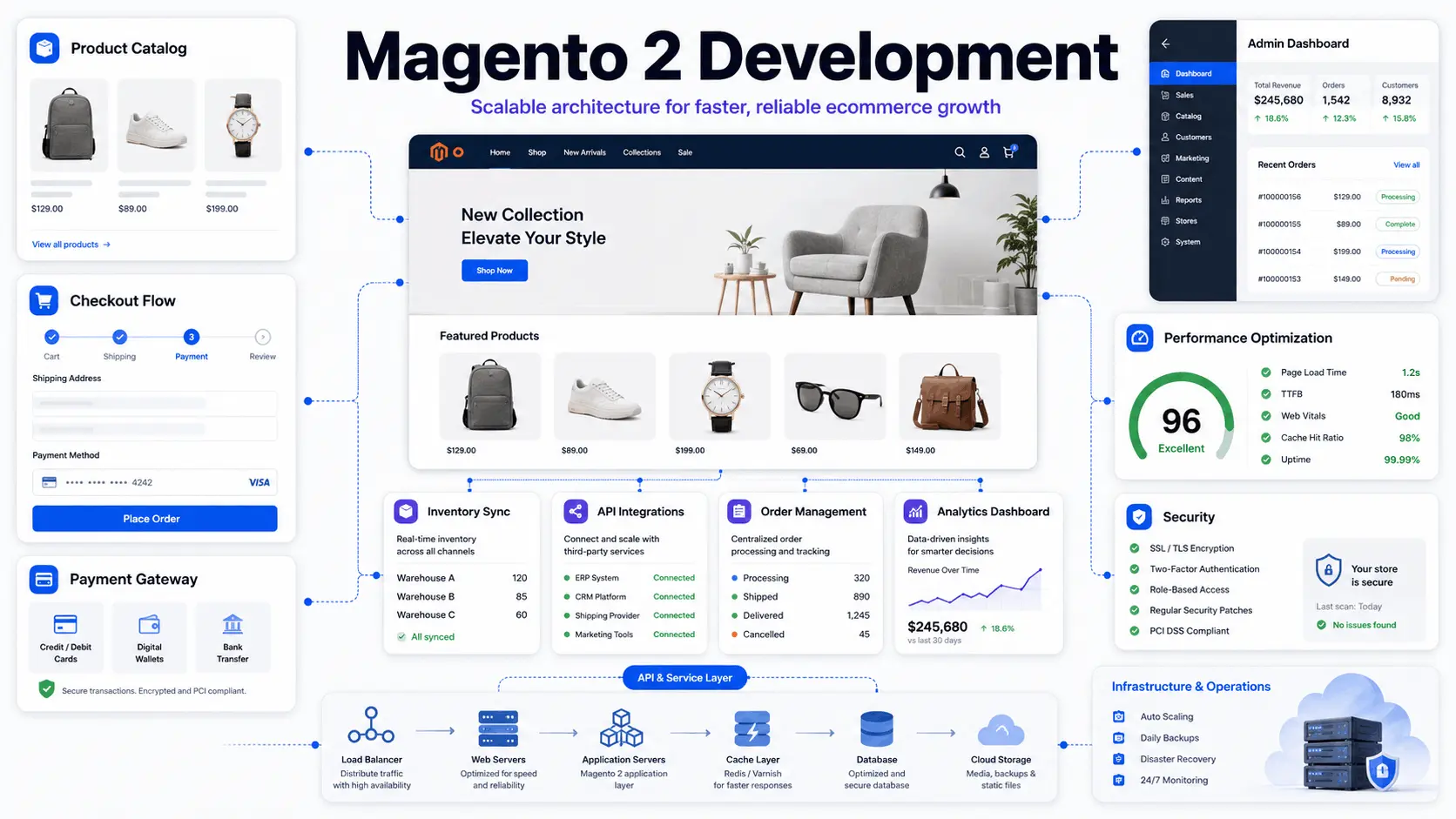
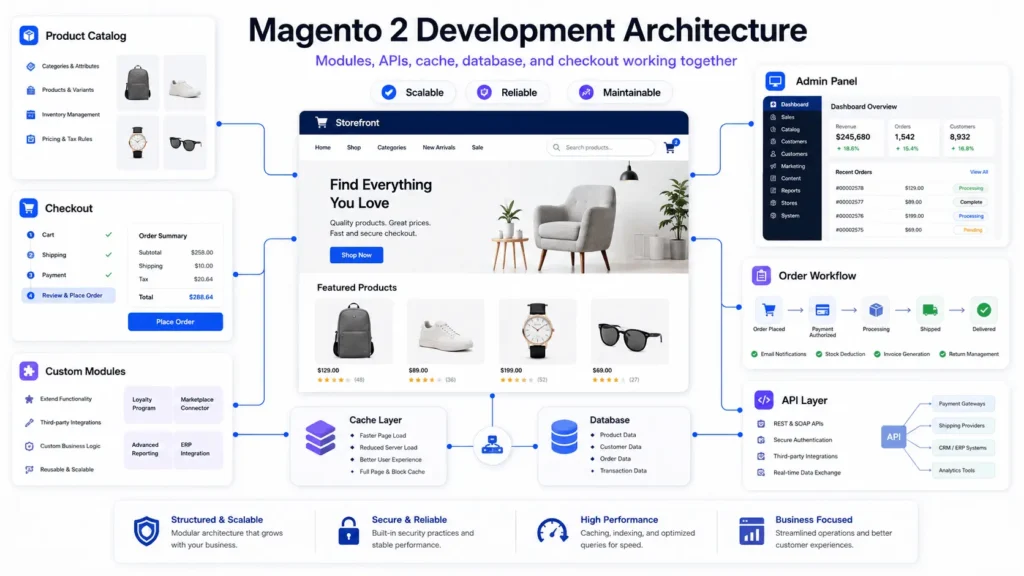
Magento has a modular architecture. That is one reason it works well for complex ecommerce. Catalog, checkout, customer, order, inventory, shipping, tax, CMS, and promotional features can be extended without rewriting the whole platform. For platform background and current technical guidance, use the official Adobe Commerce documentation.
But modular does not automatically mean maintainable.
A weak build often mixes business logic into templates, overrides core behavior unnecessarily, installs too many extensions, and creates hidden dependency chains. The result is a store that works during launch but becomes risky every time the business wants a new feature.
Good Magento architecture usually starts with a few practical questions. When a business already knows it needs hands-on coding support rather than only strategy, working with a specialized Magento programming resource can make smaller fixes, module work, and technical backlog delivery easier to manage.
- Which workflows must be customized?
- Which should remain native Magento?
- Which systems are the source of truth?
- Which jobs should run synchronously?
- Which jobs should move into queues?
- Which customizations will create upgrade risk?
Magento can behave like a powerful ecommerce monolith. That is not a bad thing. The problem starts when businesses expect it to behave like a lightweight SaaS tool while also demanding enterprise-level customization.
Magento 2 Development Services That Matter in Production
A serious Magento 2 development services plan should cover more than frontend design. Design matters, but production ecommerce depends on what happens behind the interface. For stores that need both technical build quality and conversion-focused structure, an ecommerce website design partner can help connect UX, catalog planning, checkout flow, and backend development decisions.
Typical high-value work includes custom Magento 2 development, theme development, checkout customization, Magento API development, ERP integration, payment gateway integration, shipping method development, B2B pricing rules, multi-store setup, performance optimization, security hardening, and migration planning.
The development team should also understand Adobe Commerce concepts, service contracts, dependency injection, layout XML, UI components, events, observers, message queues, indexers, cron jobs, and cache layers.
Magento’s official technical documentation is useful for understanding platform structure and extension practices, especially when teams need to align custom work with Adobe Commerce standards.
What Happens Inside a Magento 2 Checkout Workflow
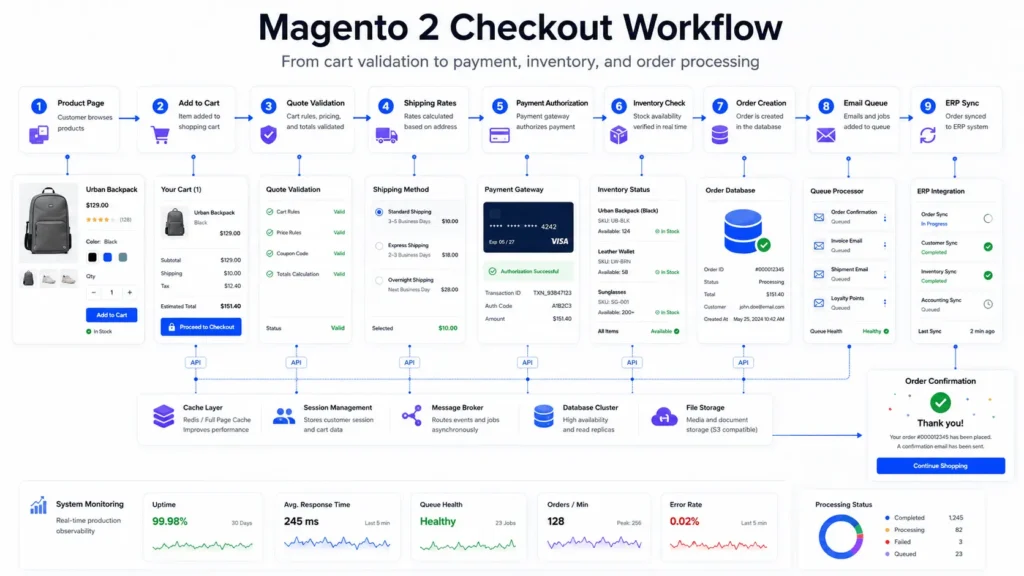
A customer clicks a product page. The frontend loads cached content where possible. Dynamic blocks such as cart state, price rules, customer-specific data, and inventory availability may still need fresh processing.
When the customer adds a product to cart, Magento validates product status, stock rules, customer group pricing, tax configuration, shipping options, quote totals, and promotional logic. During checkout, payment authorization, address validation, shipping rate calls, fraud checks, order placement, invoice generation, and email events may all happen close together.
Slow API calls can delay checkout. Heavy observers can block order placement. Poor database queries can lock important tables. Badly configured indexers can make catalog updates invisible. Cron delays can interrupt inventory sync. Payment webhook failures can leave orders in unclear states.
Magento 2 development should separate urgent checkout logic from background work where possible. Order confirmation must be reliable. Non-critical jobs such as CRM updates, review requests, analytics enrichment, ERP export, and customer segmentation can often run asynchronously.
Custom Magento 2 Development vs Extension-Heavy Builds
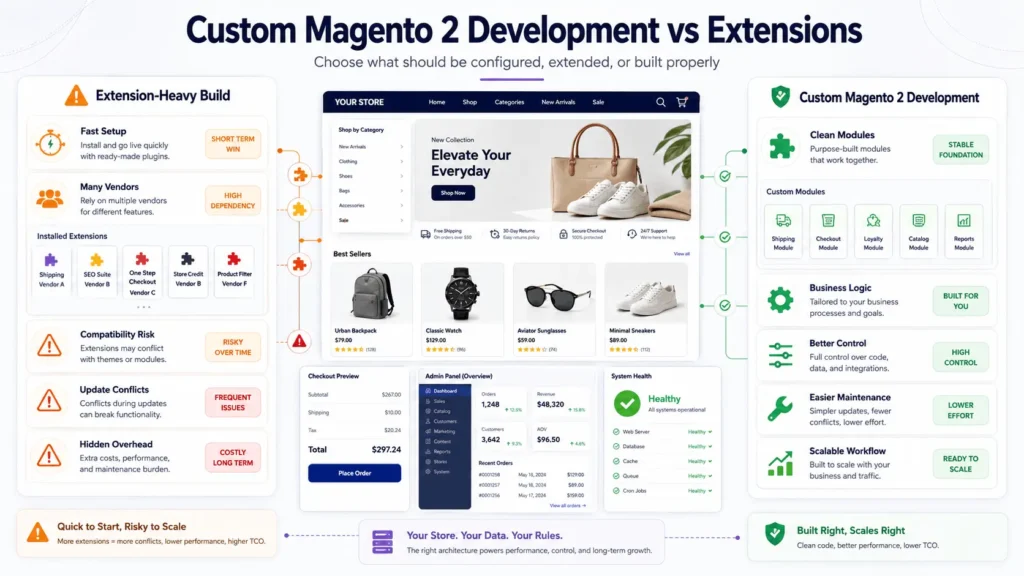
Extensions are useful. They save time and solve common requirements. The problem is depending on extensions for everything.
A store with 40 third-party modules may look fast to build, but every module adds upgrade risk, performance overhead, security responsibility, and possible conflict with another module.
| Approach | Best Use Case | Production Risk | Maintenance Impact |
|---|---|---|---|
| Native Magento feature | Standard catalog, checkout, tax, pricing, inventory | Low | Easier upgrades |
| Trusted extension | Common requirement with mature vendor support | Medium | Needs compatibility checks |
| Custom module | Unique workflow, integration, or business rule | Medium to high | Cleaner if coded properly |
| Core override | Rare emergency use only | High | Upgrade risk increases |
A good Magento 2 development agency does not write custom code for everything. It decides what should be native, what can be configured, what deserves an extension, and what must be built as a custom module.
Magento 1 vs Magento 2 Development
Magento 1 vs Magento 2 development is not just a version comparison. Magento 2 changed architecture, frontend structure, dependency injection, module organization, APIs, performance features, testing approach, and admin experience.
Magento 1 projects often relied on older customization patterns. Magento 2 expects better module isolation, Composer dependency management, service contracts, generated classes, deployment modes, and stronger environment control.
For businesses still carrying legacy Magento 1 logic, migration should not be treated as a copy-and-paste project. Product data, customer data, order history, URL structure, SEO metadata, payment flows, custom modules, and integrations all need review.
A migration is also a chance to remove technical debt. Moving broken workflows into a new platform only makes the new platform expensive from day one.
Performance Bottlenecks in Magento 2 Development
Performance problems usually come from several small issues, not one obvious defect.
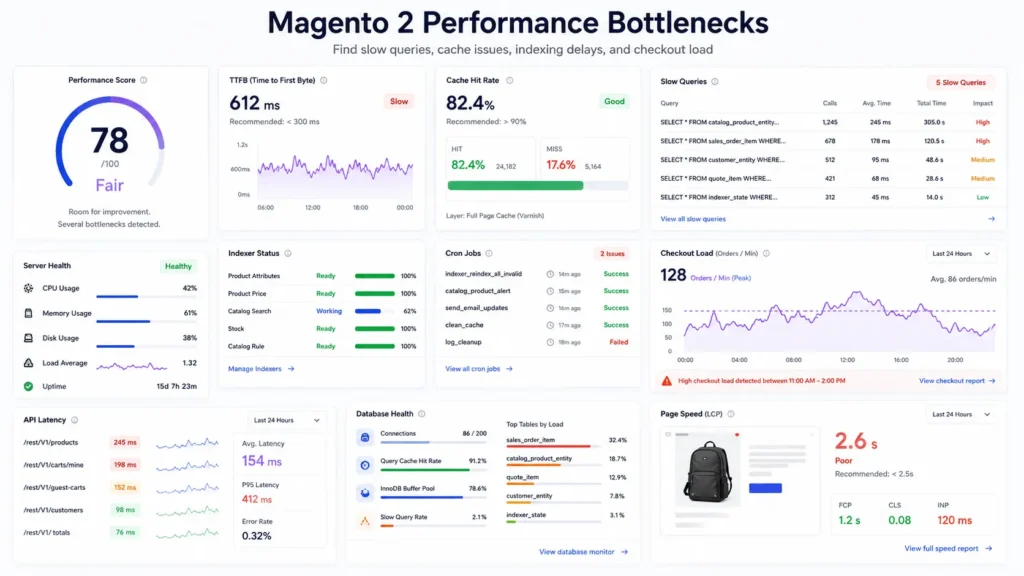
Magento performance depends on PHP version, server resources, MySQL or MariaDB tuning, Redis, Varnish cache, Elasticsearch or OpenSearch configuration, CDN usage, frontend assets, database queries, catalog size, custom modules, and cron/indexing health.
Common bottlenecks include:
- Heavy product attributes in layered navigation
- Uncached custom blocks
- Poorly written collection queries
- Slow third-party API calls during checkout
- Bloated JavaScript bundles
- Misconfigured Redis or Varnish
- Too many synchronous admin operations
- Large catalogs with weak indexing strategy
Magento 2 development should include profiling, not guesswork. Teams should inspect TTFB, slow queries, cache hit ratio, PHP errors, indexer status, queue delays, failed cron jobs, and checkout transaction timing.
A store can have a beautiful frontend and still lose revenue because backend processing is overloaded.
API Integrations, Webhooks, and Data Reliability
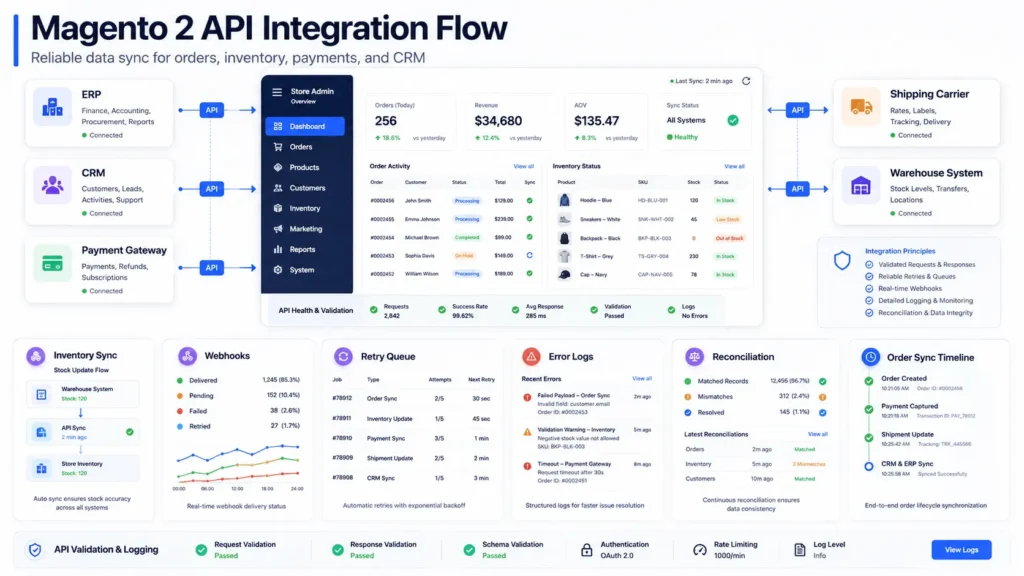
Most growing Magento stores connect to other systems: ERP, CRM, accounting, shipping carriers, tax engines, marketplaces, payment gateways, email automation, warehouse software, and analytics platforms. When those connections affect orders, stock, payments, or customer data, reliable API integration planning becomes part of the core ecommerce architecture, not a side task.
The integration question is not “Can Magento connect?” Usually, it can.
The better question is: what happens when the connection fails?
Reliable Magento integration work includes validation, logging, retry handling, idempotency, webhook verification, rate-limit handling, and reconciliation reports. Without those controls, teams discover issues only after customers complain.
For example, a payment gateway webhook may confirm payment after Magento has created an order. If that webhook fails, the system needs a safe recovery path. If an ERP rejects an order export because of invalid SKU mapping, the admin team needs a visible error, not a silent failure.
API architecture should define source-of-truth ownership. Magento may own storefront orders. ERP may own inventory. CRM may own lifecycle communication. Accounting may own invoices. Confusion here creates duplicate data and support burden.
Before automating Magento orders into an ERP, standardize SKU and customer identifiers, units of measure, tax and shipping codes, payment terms, status mappings, and system ownership. Define idempotency, retry rules, exception queues, and daily reconciliation before enabling end-to-end automation. This reduces duplicate orders, rejected exports, and manual corrections.
Monolith, Headless, and Microservices Trade-Offs
Magento can run as a traditional monolith, a headless commerce backend, or part of a larger service-oriented architecture.
| Architecture | When It Works | Main Trade-Off |
|---|---|---|
| Traditional Magento | Standard ecommerce with manageable customization | Faster to operate, less frontend freedom |
| Headless Magento | Custom frontend, PWA, mobile-first experience | More integration and deployment complexity |
| Magento plus microservices | Complex operations, multiple systems, high scale | Requires stronger DevOps and observability |
| SaaS ecommerce | Simpler stores with limited custom workflows | Lower control over deep business logic |
Headless is not automatically better. React or Next.js can improve frontend flexibility, but it also adds API dependency, preview complexity, deployment pipelines, caching strategy, and debugging overhead. For many businesses, the better starting point is defining the right ecommerce system structure before choosing a frontend architecture.
Microservices can help when separate systems need independent scaling. They can also create operational chaos if the team lacks monitoring, ownership, and deployment discipline.
The architecture should match business maturity. Over-engineering is as dangerous as under-engineering.
Security, Permissions, and Operational Control
Magento stores process customer data, payment-related workflows, admin activity, promotional rules, and order operations. Security cannot be left until launch week.
Important areas include admin URL protection, two-factor authentication, role-based access control, secure API tokens, least-privilege integrations, file permissions, patch management, dependency scanning, WAF configuration, SSL, backup testing, and audit logging.
RBAC matters in larger teams. A support agent should not have the same access as a developer. A warehouse user should not edit payment settings. A marketing user may need CMS access without catalog structure permissions.
Operational control also means knowing who changed what. Without logs, rollback plans, and staging discipline, small admin changes can create production incidents.
Magento 2 Development Cost and Timeline
Magento project cost depends on scope, not only developer rate. A simple theme adjustment is different from a multi-store B2B build with ERP, custom pricing, warehouse sync, and payment reconciliation. Cost also changes with catalog size, data migration, integrations, testing depth, deployment requirements, and post-launch support.
Lower-cost teams can be useful for controlled tasks. The risk appears when cheap development is used for architecture-heavy work without technical review.
A practical cost discussion should separate:
- Discovery and architecture planning
- Theme and frontend work
- Custom module development
- Third-party integrations
- Data migration
- Performance optimization
- QA testing
- Deployment and post-launch support
A US-based Magento team or offshore Magento development company may both deliver good work if the process is mature. Location is less important than architecture quality, communication, documentation, testing, and accountability.
Where Filicode Fits for Complex Ecommerce Builds
After a store reaches a certain level of complexity, off-the-shelf tools stop solving the real problem. The issue is no longer “install a feature.” The issue becomes system behavior.
Filicode supports complex ecommerce work involving custom modules, API integrations, performance optimization, system architecture, workflow automation, and long-term maintenance planning.
For Magento projects, the same engineering thinking matters. A business may need a custom checkout rule, a reliable inventory sync, a migration plan, a support automation workflow, or an integration layer between ecommerce, CRM, and internal operations.
The goal is not to add complexity. The goal is to reduce future operational cost by making the system easier to maintain, monitor, and extend.
AI Automation Around Magento Operations
AI does not replace core ecommerce engineering, but it can support carefully controlled operations such as support ticket classification, catalog cleanup, internal admin search, order risk flagging, and CRM workflow automation.
AI outputs should not directly update critical pricing, inventory, refunds, or order states without human review or strong rule-based controls. Reliable automation also needs fallback logic, output monitoring, and audit trails.
FAQs
What should be standardized before Magento-to-ERP order automation?
Standardize SKU and customer IDs, units of measure, tax and shipping codes, payment terms, order statuses, system ownership, retry rules, duplicate prevention, exception handling, and reconciliation before enabling end-to-end automation.
How to speed up Magento 2 development?
Use a clean local Docker environment, reusable module patterns, version control, staging workflows, coding standards, automated deployment, and a clear backlog. Speed improves when architecture decisions are made before coding starts.
What affects Magento 2 development cost most?
Custom integrations, migration complexity, checkout changes, third-party extension conflicts, catalog size, performance issues, and testing requirements affect cost more than page count.
Should I hire a Magento 2 development company or one developer?
Hire one developer for controlled fixes, theme changes, and small modules. Use a Magento 2 development company when the project involves architecture, integrations, migration, QA, performance, and post-launch support.
Is Magento better than WooCommerce for complex stores?
Magento is often stronger for complex catalogs, B2B rules, multi-store setups, and advanced ecommerce operations. WooCommerce can be better for content-led stores, simpler catalogs, and businesses already invested in WordPress.
Can Magento 2 handle high traffic?
Yes, but only with the right infrastructure, cache strategy, index management, CDN, database tuning, queue handling, and clean custom code. Traffic exposes weak builds quickly.
Conclusion
Magento 2 development becomes valuable when it removes operational friction, not when it adds more code. The warning signs are usually clear: slow checkout, delayed inventory sync, fragile extensions, manual order fixes, failed webhooks, admin delays, poor deployment control, and rising support work after every change.
At that stage, the right next step is not another quick patch. It is a technical review of architecture, integrations, performance, security, and maintenance risk. If your Magento store is reaching that point, you can discuss the technical bottlenecks with FiliCode before committing to a rebuild, migration, or long development cycle.
A scalable store needs clean workflows, reliable APIs, observable systems, and development decisions that will still make sense after the next campaign, migration, product expansion, or integration request. That is the difference between a Magento store that only launches and one that can keep operating under real business pressure.