






Contents
- Quick Summary: What Decision-Makers Should Know
- What Is Ecommerce Conversion Rate Optimization?
- Build a Baseline Before Choosing Ecommerce Conversion Rate Optimization Strategies
- Measure the Funnel as a State Machine
- How the Production Workflow Affects Conversion
- Ecommerce Conversion Rate Optimization Needs Failure Handling
- 7 Ecommerce Conversion Rate Optimization Moves That Scale
- 1. Fix Product Discovery Before Rewriting Product Pages
- 2. Treat Product Page Optimization as Decision Support
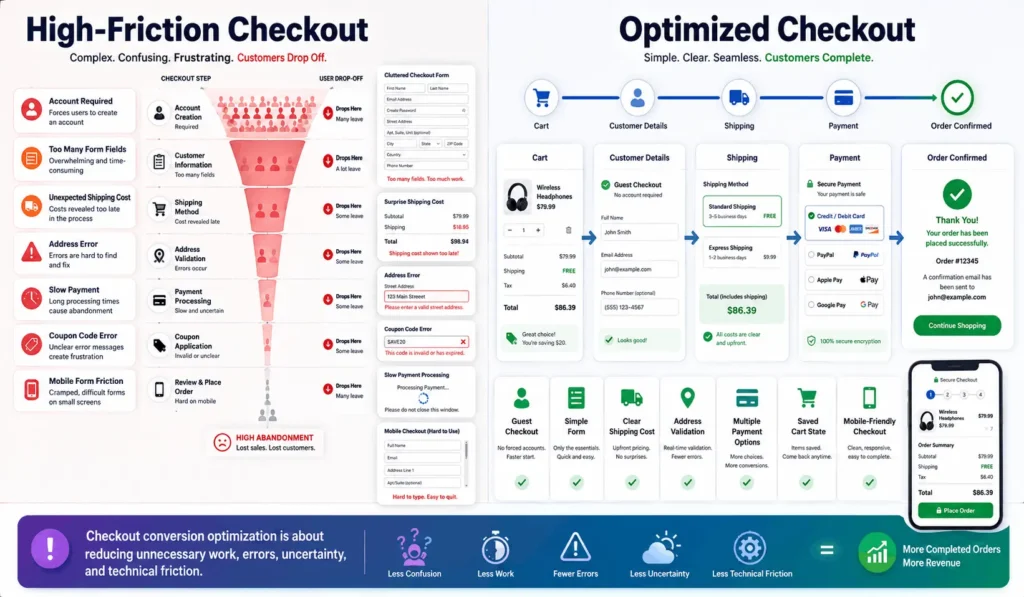
- 3. Reduce Checkout Work, Not Just Checkout Fields
- 4. Make Mobile Performance an Architecture Concern
- 5. Personalize With Stable Data and Clear Fallbacks
- 6. Run Tests Against Business Outcomes
- 7. Connect CRO With Acquisition and Unit Economics
- WooCommerce Architecture and Ecommerce Conversion Rate Optimization
- Platform Trade-Offs: What Works in Production?
- When Off-the-Shelf CRO Tools Stop Being Enough
- Ecommerce Conversion Rate Optimization FAQ
- How much do ecommerce conversion rate optimization services cost?
- How long does ecommerce conversion rate optimization take?
- Can CRO work on a store with complex API integrations?
- Is migration required before improving conversion rate?
- What maintenance does a CRO program require?
- When should a company hire an ecommerce conversion rate optimization consultant?
- Conclusion: Optimize the System, Not One Screen
A store can keep adding traffic while revenue barely moves. In production, the cause is often not one weak headline or button color. Slow product queries, inconsistent analytics events, failed payment callbacks, mobile friction, and accumulated checkout logic often combine into one revenue problem.
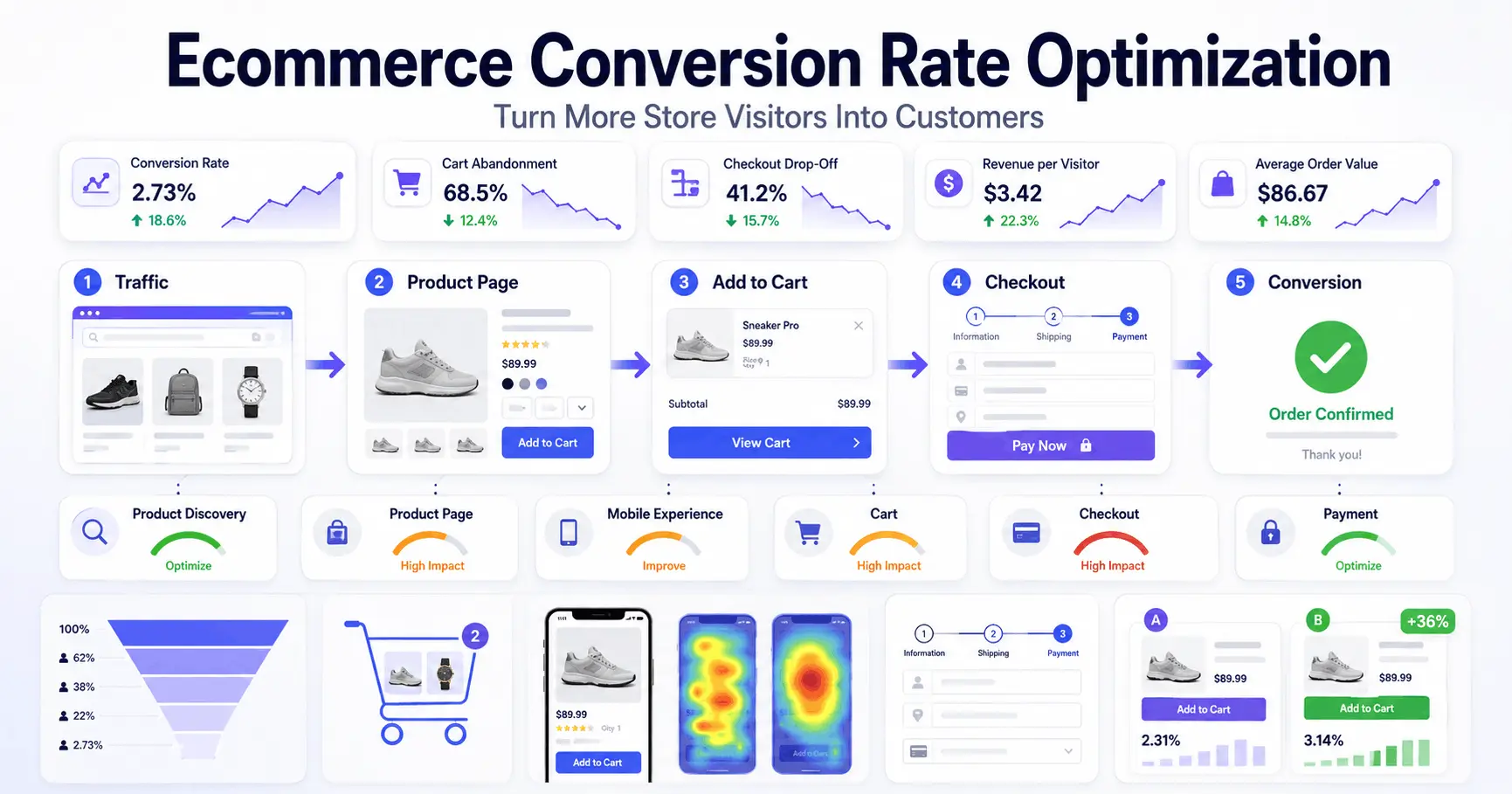
Ecommerce conversion rate optimization is the systematic improvement of the buying journey using behavioral data, technical analysis, controlled testing, and operational fixes. A mature program improves revenue per visitor, checkout reliability, average order value, acquisition efficiency, and platform maintainability.
The useful question is: where does intent break down, what technical or commercial condition causes it, and how can that condition be changed without creating a new failure elsewhere?
Quick Summary: What Decision-Makers Should Know
- Ecommerce conversion rate optimization works best when analytics, UX, performance, merchandising, payments, and operations are treated as one connected system.
- A faster checkout cannot compensate for incorrect pricing, unavailable inventory, or failed payment synchronization.
- Measure the funnel at event and business-outcome level before testing; poor instrumentation can make a losing experiment look successful.
- WooCommerce stores often need database, caching, cron, plugin, and integration work before front-end experiments become reliable.
- Track revenue per visitor, margin, refund rate, and customer lifetime value alongside conversion rate.
What Is Ecommerce Conversion Rate Optimization?
Ecommerce conversion rate optimization is the process of identifying friction in a commerce journey, forming evidence-based hypotheses, implementing changes, and measuring whether they improve valuable customer actions.
A purchase may touch search, catalog, promotions, tax, shipping, payments, fraud checks, orders, CRM, and analytics. Conversion funnel optimization has to account for the behavior of that chain.
Google Analytics 4 uses an event-based measurement model, so ecommerce analytics should validate events and parameters instead of assuming pageviews describe the funnel correctly. A purchase event that fires twice, misses currency, or records before payment confirmation can distort decisions. Google’s GA4 measurement overview explains the model.
A technically capable conversion rate optimisation agency should investigate analytics, code paths, integrations, performance, and user behavior together. A design-only audit is not enough when the constraint sits in backend execution.
Build a Baseline Before Choosing Ecommerce Conversion Rate Optimization Strategies
Start with a measurement map, not a list of CRO tips. Define the path from product discovery to repeat purchase, then identify where each state is recorded and which system owns it.
Measure the Funnel as a State Machine
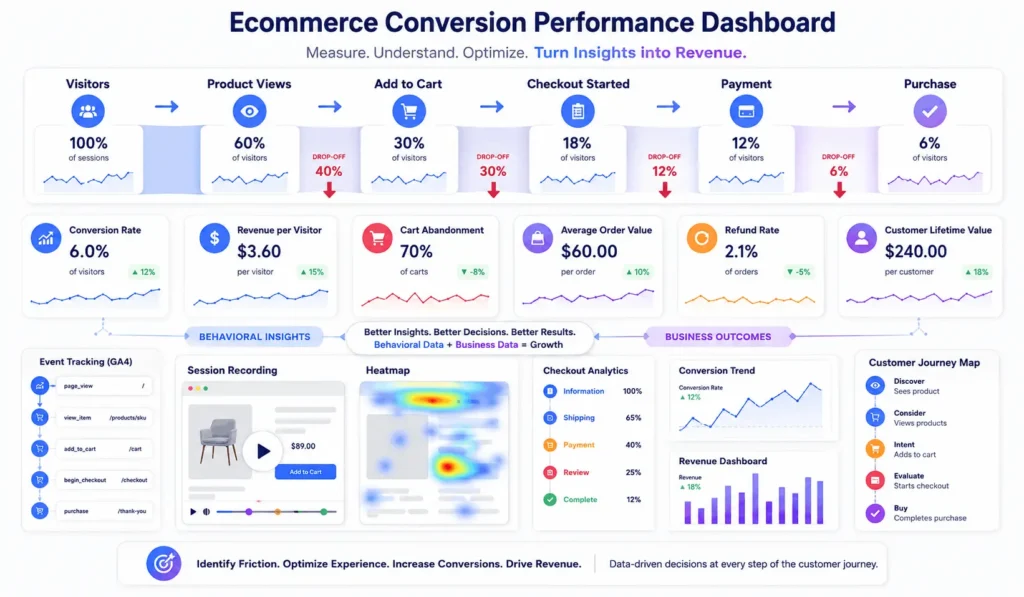
A production funnel is better modeled as states and transitions: product viewed, variant selected, cart updated, checkout started, address validated, shipping selected, payment authorized, order created, payment captured, fulfilled, and refunded.
The browser may emit a checkout event, while the payment gateway later confirms the transaction through a webhook. Those events are related but not interchangeable. Business truth should come from reconciled transaction states, while analytics explains behavior around them.
| Metric | What It Reveals | Common Misread |
|---|---|---|
| Conversion rate | Share of sessions or users completing a defined action | Ignoring traffic quality and repeat visitors |
| Revenue per visitor | Combined effect of conversion and order value | Optimizing purchase count while AOV falls |
| Checkout abandonment rate | Loss after checkout intent is explicit | Blaming UX when payment or shipping logic fails |
| Refund rate | Quality of purchase intent and fulfillment outcome | Counting low-quality orders as CRO wins |
| Customer lifetime value | Long-term value of acquired customers | Over-rewarding discounts that attract one-time buyers |
A CRO dashboard should connect behavioral signals with operational data. GA4, server logs, session recordings, heatmaps, search logs, support tickets, payment failures, and inventory errors answer different questions. No single CRO tool provides the whole diagnosis.
How the Production Workflow Affects Conversion
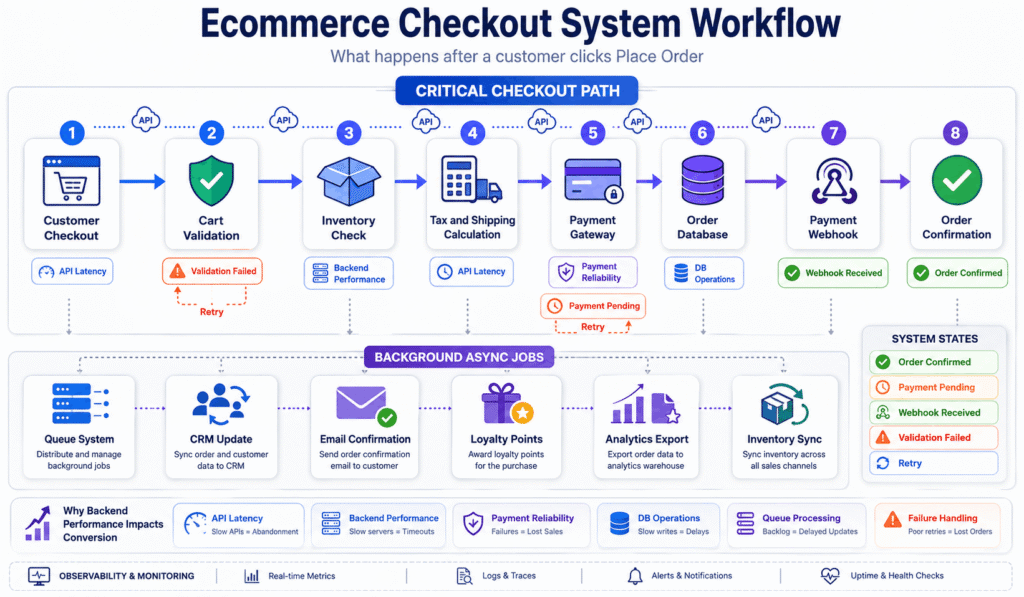
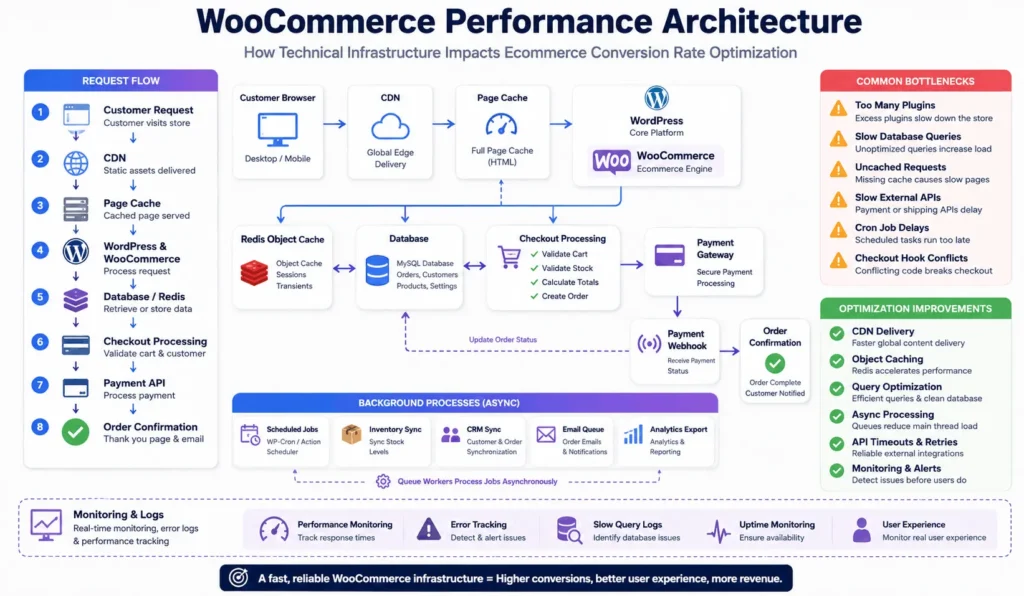
A customer clicks “Place order,” but several systems may execute before confirmation appears. The backend validates the cart, recalculates tax and shipping, checks inventory, sends a payment request, stores transaction metadata, and waits for a response or webhook.
Under load, database locks, slow APIs, cache misses, and synchronous CRM tasks can extend response time. A practical CRO program separates customer-critical work from non-critical work. Order confirmation belongs on the critical path; loyalty updates, CRM enrichment, and analytics exports usually do not.
Ecommerce Conversion Rate Optimization Needs Failure Handling
Queues and async jobs help only when they are observable. A job needs idempotency, retries, a failure state, alerting, and safe replay. Otherwise, moving work to a queue simply hides failures from checkout.
Payment webhooks deserve special treatment. Verify signatures, store event identifiers, make handlers idempotent, log state transitions, and reconcile gateway records against internal orders. Stripe documents webhook retries when endpoints fail, so duplicate-safe handlers are a production requirement.
7 Ecommerce Conversion Rate Optimization Moves That Scale
1. Fix Product Discovery Before Rewriting Product Pages
Zero-result searches, poor filtering, duplicate categories, and misleading availability can suppress product page conversion before a visitor reaches the page. Review search terms, filter usage, category exits, inventory coverage, and mobile navigation.
For larger catalogs, the ecommerce website structure also affects crawlability, merchandising control, and how quickly customers can narrow a broad catalog into a purchase decision.
2. Treat Product Page Optimization as Decision Support
Product pages should reduce uncertainty. The content depends on buying risk: dimensions and compatibility for technical products, delivery and returns for time-sensitive purchases, materials where suitability matters, and structured comparison for complex B2B ecommerce conversion rate optimization.
Trust signals work when they resolve real doubt. Product reviews, user-generated content, warranty terms, stock status, delivery estimates, and payment options should be placed near the decision they support. Random trust badges in the footer rarely solve a specific objection.
3. Reduce Checkout Work, Not Just Checkout Fields
Checkout optimization should remove unnecessary decisions and repeated effort. Guest checkout, address lookup, clear validation, retained cart state, transparent shipping costs, and sensible payment options usually matter more than cosmetic changes.
Instrument validation errors by field and device. A mobile keyboard mismatch, strict phone format, address timeout, or coupon bug can produce a visible abandonment pattern. Session replay and rage click data help, but confirm the behavior against application logs before assigning a cause.
4. Make Mobile Performance an Architecture Concern
Mobile-first design is not only responsive CSS. It includes image payloads, JavaScript execution, tag-manager load, API latency, cache behavior, and third-party widgets. A fast category page that triggers uncached cart work and remote checkout calls still has a conversion problem.
On WooCommerce, performance work may include safe page caching, persistent object caching such as Redis, CDN delivery, query analysis, image optimization, and removal of unnecessary plugin work. The WooCommerce speed optimization guide covers a focused performance path.
5. Personalize With Stable Data and Clear Fallbacks
A personalized shopping experience can improve relevance, but it adds data dependencies. Recommendation services need event quality, catalog freshness, availability checks, consent handling, and fallback logic when the model or API fails.
Start with deterministic segments before complex prediction: new versus returning customer, delivery constraints, account role, product compatibility, or category affinity. Add more complex automation only when data pipelines and monitoring can support it.
6. Run Tests Against Business Outcomes
A/B testing is useful when traffic, implementation quality, and the decision window support a meaningful result. Rank hypotheses with ICE or another transparent model, but include engineering effort and operational risk.
The best CRO tools cannot rescue a flawed experiment. Check assignment logic, sample ratio mismatch, device differences, campaign mix, seasonality, test interference, and whether the change affected margin, returns, or support contacts.
7. Connect CRO With Acquisition and Unit Economics
A store can improve conversion while acquiring less valuable traffic, overusing discounts, or increasing refunds. Review changes alongside acquisition cost, margin, AOV, repeat purchase behavior, and CLTV.
Technical SEO and CRO interact. Better intent matching can improve qualified traffic and conversion efficiency. For a broader acquisition perspective, see these ecommerce SEO growth strategies.
WooCommerce Architecture and Ecommerce Conversion Rate Optimization
WooCommerce can support substantial commerce workloads, but architecture matters. Plugin-heavy stores often accumulate duplicate scripts, repeated API calls, scheduled tasks, checkout hooks, and synchronization jobs that were never designed as one system.
WP-Cron checks scheduled work during page loads, so time-sensitive background processing needs careful review. WordPress documents this request-driven behavior directly. Critical workloads often use a system scheduler, queue, or managed job infrastructure instead of relying on traffic patterns.
For order-heavy stores, database design matters. WooCommerce describes High-Performance Order Storage as a scalable and reliable order-storage approach and enables it by default for new installations. Check extension and custom-code compatibility before migration.
Custom hooks should remain narrow and observable. REST API integrations need timeouts, authentication controls, logging, and retries. Plugin conflicts should be reproduced in staging with production-like data volume. Security hardening, RBAC, audit logs, and restricted admin permissions matter because CRO tools may access customer and order data.
Platform Trade-Offs: What Works in Production?
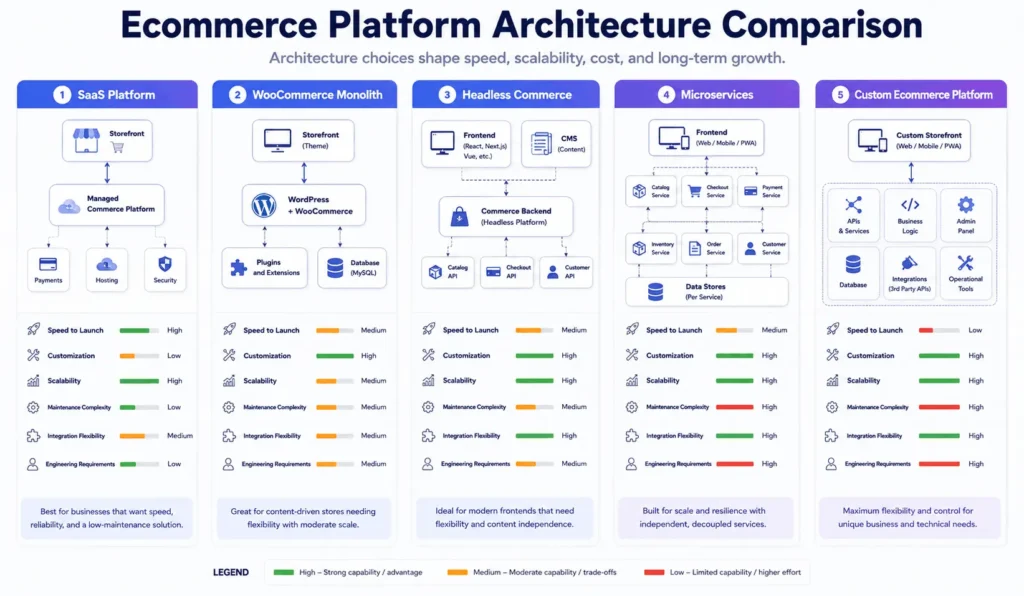
| Choice | Where It Works | Operational Trade-Off |
|---|---|---|
| SaaS platform | Standard catalog and checkout requirements | Lower infrastructure burden, less control over deep workflow changes |
| WooCommerce monolith | Content-rich stores with moderate integration complexity | Fast iteration, but plugin and database discipline are essential |
| Headless commerce | Multi-channel experiences with dedicated engineering teams | More front-end freedom, higher integration and observability overhead |
| Microservices | Clear domain boundaries and independent scaling needs | Deployment, networking, tracing, and data consistency become harder |
| Custom platform | Unique workflows, pricing, permissions, or marketplace operations | Maximum control, but requires long-term engineering ownership |
The common mistake is choosing architecture for prestige. A well-maintained monolith is often safer than premature microservices. Headless WordPress is valuable when channels need independent delivery, but it adds authentication, preview, cache invalidation, API, deployment, and observability work.
Cost decisions should include ownership, not only build price. The ecommerce website development cost breakdown explains how integrations, catalog complexity, custom workflows, and maintenance change the real budget.
In multi-tenant SaaS commerce, ecommerce conversion rate optimization must also respect tenant isolation, subscription and billing states, RBAC, admin tooling, audit logs, and real-time synchronization. A conversion experiment that bypasses account permissions or creates inconsistent billing state is not a valid win. Instrumentation and feature flags should preserve tenant boundaries and provide rollback paths.
When Off-the-Shelf CRO Tools Stop Being Enough
CRO software is useful for experiments, analytics, heatmaps, session recordings, surveys, personalization, and reporting. The boundary appears when diagnosis points to platform behavior the tool cannot change.
Examples include marketplace pricing, multi-warehouse inventory, account-specific catalogs, complex RBAC, subscription synchronization, approval workflows, payment reconciliation, or unreliable supplier APIs. At that point, CRO consulting has to include architecture and engineering.
Filicode works across custom software development, WordPress and WooCommerce development, AI automation, API integrations, SaaS development, system architecture, and performance optimization. The goal is to fix the constraint at the correct layer without creating a new maintenance burden.
For smaller teams, platform selection can prevent avoidable complexity. This comparison of the best ecommerce platforms for small businesses is useful while the operating model is flexible.
Ecommerce Conversion Rate Optimization FAQ
How much do ecommerce conversion rate optimization services cost?
Ecommerce conversion rate optimization services can range from a focused audit or experiment sprint to an ongoing program that includes analytics engineering, UX, development, QA, and reporting. Cost depends on traffic volume, platform complexity, integrations, test velocity, and whether backend changes are required.
How long does ecommerce conversion rate optimization take?
A useful initial diagnostic can often be completed within weeks, but optimization is an ongoing operating process. Timelines depend on data quality, traffic, release cycles, experiment complexity, and whether the bottleneck is UX, performance, payments, or architecture.
Can CRO work on a store with complex API integrations?
Yes. CRO on integration-heavy stores should include API latency, timeout handling, cache strategy, stale data rules, webhook reliability, retries, and reconciliation. Front-end testing alone can miss conversion losses caused by supplier, payment, tax, shipping, or inventory services.
Is migration required before improving conversion rate?
No. Many stores can improve conversion through measurement fixes, performance work, checkout changes, merchandising, and targeted development on the existing platform. Migration should be considered when platform constraints repeatedly block necessary workflows or create unacceptable operational risk.
What maintenance does a CRO program require?
A sustainable CRO program requires analytics validation, experiment QA, performance and integration monitoring, release coordination, documentation, and periodic review. Retire tests and personalization rules when they no longer match current products, traffic, or priorities.
When should a company hire an ecommerce conversion rate optimization consultant?
A company should consider an ecommerce conversion rate optimization consultant when traffic is meaningful but revenue efficiency is weak, funnel data is unreliable, checkout errors are recurring, experiments are inconclusive, or multiple teams disagree about the real source of conversion loss.
Conclusion: Optimize the System, Not One Screen
Ecommerce conversion rate optimization becomes a systems problem as a store grows. Warning signs include checkout errors, slow releases, conflicting analytics, plugin conflicts, manual reconciliation, inventory mismatches, failed jobs, and support teams compensating for workflow defects.
Custom development should be considered when off-the-shelf tools can identify a bottleneck but cannot remove it, or when the platform forces repetitive manual work. The next step is not automatically a rebuild. Diagnose the technical and behavioral constraints, rank them by impact and risk, then fix the smallest layer that solves the problem cleanly.
That is the difference between isolated ecommerce conversion rate optimization techniques and a maintainable growth system: one changes a page, while the other improves how data, software, operations, and customer decisions work together.