








Contents
- Quick Summary: for Decision Makers
- What Is Headless Magento Development?
- How Headless Magento Development Works in Production
- Headless Magento Development Workflow Example
- Magento Headless Architecture vs Traditional Magento
- Benefits of Headless Magento Development for Scaling Teams
- Where the Business Value Usually Appears
- Technical Architecture Behind Headless Magento Development
- Production Bottlenecks Most Teams Underestimate
- Magento 2 Headless Frontends: PWA Studio, React, Vue, and Next.js
- WordPress, WooCommerce, AI Automation, and Magento Headless Commerce
- When a Headless Magento Development Company Makes Sense
- Cost, Timeline, and Maintenance Reality
- Is Headless Magento Development Right for Your Store?
- Frequently Asked Questions
- How much does Headless Magento development cost?
- How long does a headless Magento project take?
- Is headless Magento better for SEO?
- What are the biggest risks in migration?
- Does every Magento store need headless architecture?
- Conclusion: Treat Headless as an Architecture Decision, Not a Trend
Checkout delays, slow category pages, fragile extensions, and overloaded admin workflows usually appear before an ecommerce platform visibly breaks. A store can still take orders while its architecture is quietly limiting growth. Headless Magento development addresses that problem through a Magento headless architecture that separates the customer-facing frontend from Magento’s backend commerce engine, giving teams more control over performance, integrations, content delivery, and multi-channel operations.
This is not just a design decision. It affects deployment pipelines, API reliability, caching, checkout logic, inventory synchronization, payment workflows, SEO rendering, and long-term maintenance. For founders, CTOs, and product managers, the real question is not whether headless sounds modern. The question is whether the business has reached the point where Magento’s traditional frontend is slowing down execution.
Quick Summary: for Decision Makers
- Headless Magento development works best when frontend speed, UX flexibility, or omnichannel commerce has become a business constraint.
- A decoupled architecture improves frontend freedom, but it increases API, caching, monitoring, and deployment responsibilities.
- Magento remains the backend commerce engine for catalog, customers, orders, pricing, inventory, and checkout logic.
- Production success depends on GraphQL planning, checkout reliability, CDN strategy, observability, and clean integration boundaries.
- Headless is not always cheaper. It is usually chosen for maintainability, performance, and scalable ecommerce operations.
What Is Headless Magento Development?
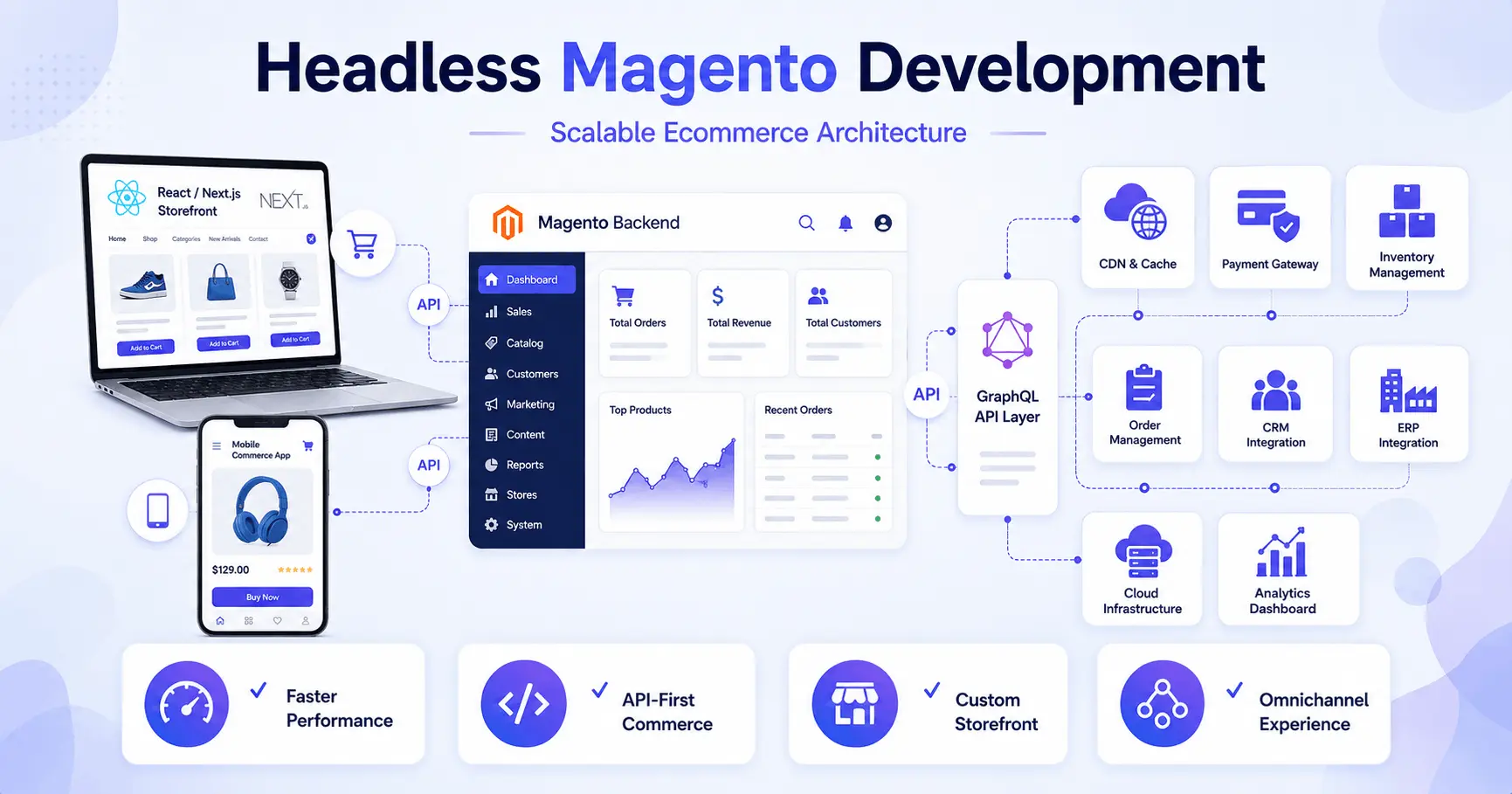
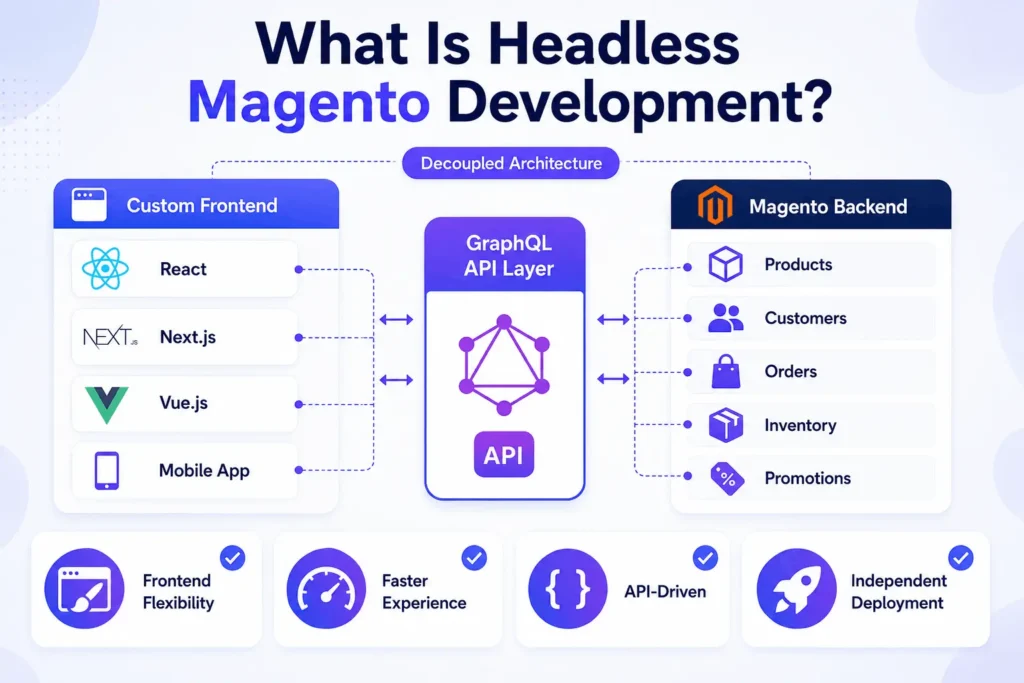
Headless Magento development means Magento handles backend commerce operations while a separate frontend application handles the storefront experience. The frontend may use React.js, Next.js, Vue.js, Nuxt.js, PWA Studio, Vue Storefront, or another modern framework.
Magento still manages products, categories, customer accounts, pricing rules, promotions, orders, payments, shipping logic, and admin workflows. The frontend communicates with Magento through GraphQL API, REST API, custom middleware, or service layers.
This approach is useful when a business needs a custom storefront, faster page rendering, mobile-first commerce, content-rich landing pages, or multiple frontends connected to one backend. Magento is an established open-source ecommerce platform, but its traditional theme layer can become restrictive when teams want complex frontend control.
If your ecommerce platform still needs strong Magento backend capability but better frontend flexibility, working with a technically grounded Magento development company can help define whether headless is appropriate or whether a more focused Magento 2 optimization is enough.
How Headless Magento Development Works in Production
In a traditional Magento store, the backend and frontend are tightly connected. Magento renders pages, loads theme assets, handles frontend templates, processes checkout, and manages admin operations in one system. That model is simpler to maintain at small scale, but it can become rigid under heavy traffic or frequent design changes.
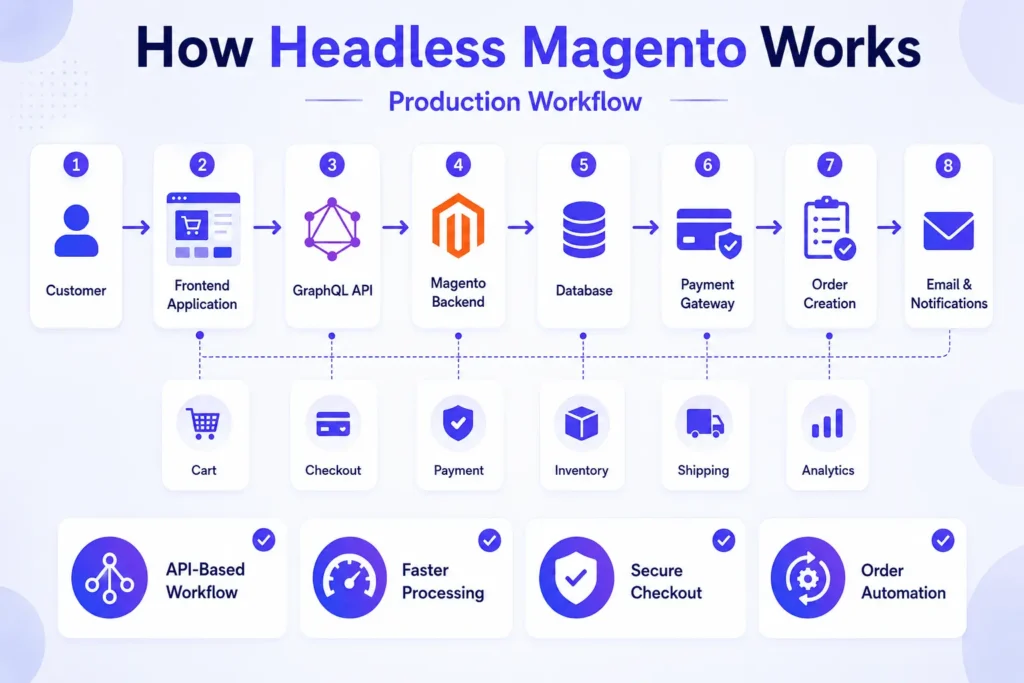
In a headless ecommerce architecture, the frontend becomes an independent application. A customer opens a product page. The frontend requests product data, pricing, stock status, media, and customer-specific rules from Magento or a middleware layer. Cached data may come from a CDN, edge cache, Redis, or frontend data store.
When the customer adds an item to cart, the storefront validates the cart through Magento APIs. Checkout then involves payment gateway calls, address validation, shipping rates, coupon logic, fraud checks, tax rules, and order creation. Some processes happen synchronously. Others should run through queues, retries, and background workers.
Headless Magento Development Workflow Example
A reliable Headless Magento development workflow usually includes these layers:
- Frontend application for product browsing, cart, checkout, account pages, and content sections.
- Magento backend for catalog, inventory, customer data, orders, promotions, and admin management.
- API layer using Magento GraphQL, REST API, or custom endpoints for business-specific operations.
- Cache layer using CDN, Redis, full-page caching strategy, and edge rendering where suitable.
- Queue system for emails, inventory sync, ERP updates, CRM pushes, invoice generation, and webhook retries.
- Monitoring layer for API latency, checkout failures, payment states, logs, and queue health.
The architecture looks clean on a diagram. Production is messier. APIs fail, stock data changes during checkout, payment callbacks arrive late, third-party systems throttle requests, and customers retry orders. Good architecture plans for this behavior instead of assuming every request succeeds.
Magento Headless Architecture vs Traditional Magento
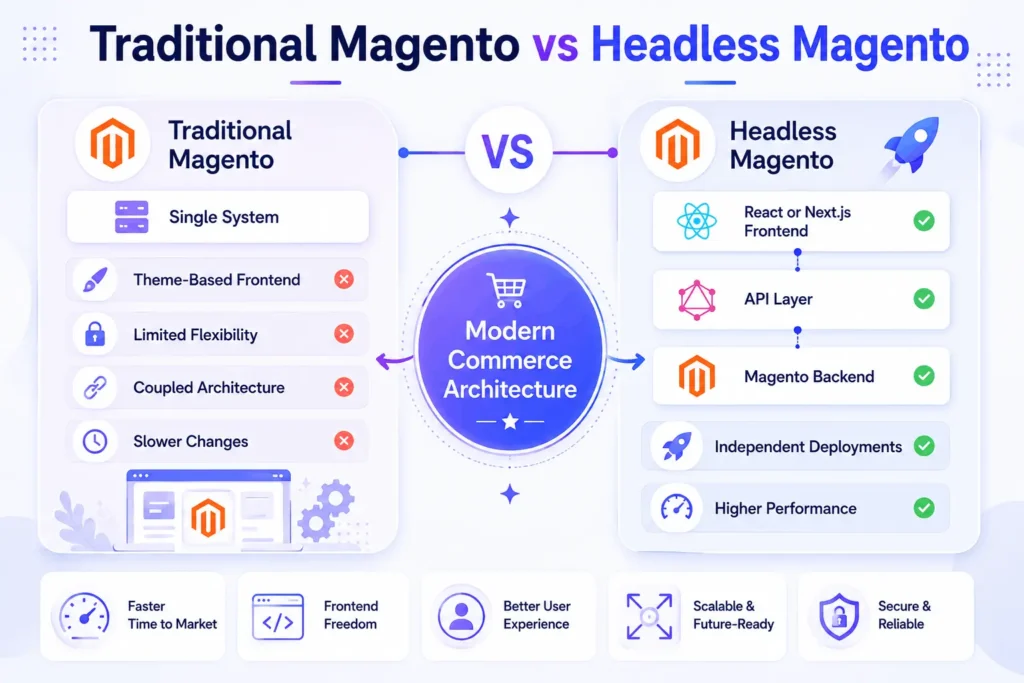
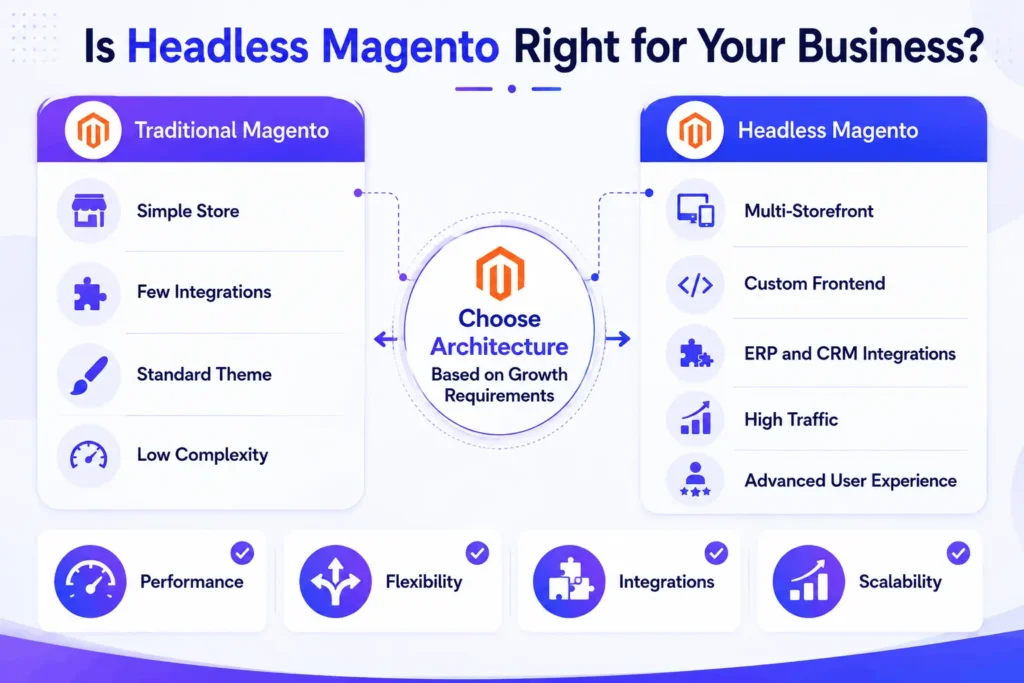
Traditional Magento is not wrong. It is often the better choice for smaller stores, simpler catalogs, limited custom UX, and teams that want fewer moving parts. A Magento headless architecture becomes more attractive when the frontend needs to move faster than the backend release cycle. Headless Magento development is the technical process used to plan, build, test, and maintain that architectural separation.
| Area | Traditional Magento | Headless Magento |
|---|---|---|
| Frontend control | Magento theme-based templates | Custom React, Vue, Next.js, Nuxt.js, or PWA frontend |
| Performance strategy | Magento caching and theme optimization | CDN, SSR, edge caching, API optimization, frontend performance control |
| Deployment | Frontend and backend often released together | Frontend and backend can be deployed separately |
| Complexity | Lower architectural complexity | Higher integration and monitoring responsibility |
| Best fit | Stable stores with standard ecommerce flows | Growing stores needing custom UX, speed, and multi-channel commerce |
The mistake many companies make is choosing headless only because competitors mention it. Architecture should follow operational pressure. If page speed, frontend experimentation, mobile conversion, API integrations, or multi-storefront control are bottlenecks, headless has a practical case.
Benefits of Headless Magento Development for Scaling Teams
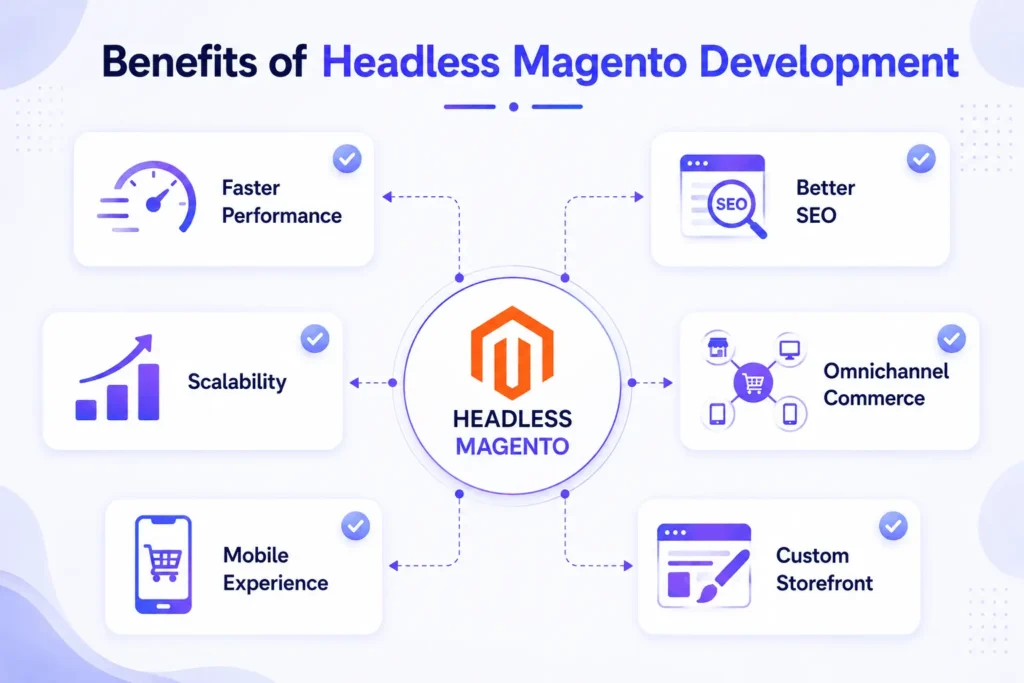
The main benefit is separation of responsibility. Frontend teams can improve the user experience without constantly fighting backend templates. Backend teams can focus on commerce logic, API stability, inventory rules, and operational workflows.
Headless Magento development can improve Core Web Vitals, especially when the frontend is built with server-side rendering, static generation, optimized media delivery, and CDN caching. This matters for SEO because ecommerce pages often carry heavy product images, filters, scripts, reviews, and personalization logic.
It also helps multi-channel commerce. A single Magento backend can serve a web storefront, mobile app, B2B portal, marketplace interface, kiosk, or custom sales dashboard. This is where Magento headless commerce becomes more than a frontend rebuild. It becomes a platform strategy.
Where the Business Value Usually Appears
The strongest commercial gains usually come from:
- Faster landing pages and product pages.
- Better checkout control and fewer frontend limitations.
- Custom ecommerce experiences for B2B, subscriptions, marketplaces, or regional storefronts.
- Cleaner integrations with ERP, CRM, warehouse, payment, and marketing systems.
- Reduced frontend release friction for product and marketing teams.
For teams still deciding between standard Magento work and a headless rebuild, reviewing Magento 2 development for scalable ecommerce operations can clarify whether the current bottleneck is frontend architecture or backend implementation quality.
Technical Architecture Behind Headless Magento Development
A serious Headless Magento development project needs more than a frontend framework. It needs clear boundaries between the storefront, Magento, third-party services, and operational tooling.
Authentication is one early decision. Customer login, token refresh, session expiration, guest carts, saved addresses, and account permissions must be handled carefully. B2B stores may also need RBAC systems for company accounts, buyer roles, approval workflows, quote permissions, and order limits.
API design matters. Magento GraphQL is useful for storefront data, but not every business workflow should be pushed directly into frontend calls. Complex pricing, ERP availability, warehouse logic, loyalty rules, and subscription states often need a middleware layer. That layer protects the frontend from backend complexity and prevents sensitive logic from leaking into the client.
Caching is another hard area. Product detail pages can be cached aggressively. Customer-specific pricing cannot. Cart and checkout data must be fresh. Inventory data may need short TTL caching or real-time validation before payment. A careless cache strategy can show wrong prices or sell unavailable stock.
Production Bottlenecks Most Teams Underestimate
Headless Magento development does not remove complexity. It moves complexity into APIs, infrastructure, observability, and release management.
Checkout is the most sensitive workflow. A customer may create a cart, apply a coupon, change address, calculate shipping, move to payment, abandon, return, and complete later. During that flow, inventory can change, promotions can expire, payment authorization can fail, and the order may remain in an intermediate state.
Payment gateways need webhook verification, clear transaction states, refund handling, and reconciliation.
Queues are also critical. ERP sync, CRM updates, email notifications, search indexing, product imports, and webhook retries should not block customer-facing requests. If queues fail silently, admin users eventually discover missing orders, stale stock, or incomplete customer data.
| Operational Area | Common Mistake | Production-Ready Approach |
|---|---|---|
| Checkout | Trusting frontend state too much | Validate cart, pricing, shipping, tax, and stock server-side |
| Payments | Depending only on redirect success | Use webhook verification, transaction states, and reconciliation |
| Integrations | Calling ERP or CRM directly from checkout | Use async jobs, retries, logs, and failure alerts |
| Caching | Caching customer-specific data incorrectly | Separate public, session, and customer-specific cache layers |
| Monitoring | Checking only uptime | Track API latency, queue failures, checkout errors, and payment gaps |
Magento 2 Headless Frontends: PWA Studio, React, Vue, and Next.js
A Magento 2 headless frontend is not a traditional Magento theme. It is a separate storefront application designed around Magento APIs. A headless PWA for Magento 2 may use PWA Studio, React, Next.js, Vue Storefront, Nuxt.js, or another frontend framework based on the project’s SEO, performance, content, and operational requirements.
Next.js is strong when SEO, server-side rendering, and performance control matter. Vue Storefront can reduce some implementation effort for commerce use cases. PWA Studio stays closer to the Magento ecosystem but may still require customization for serious business workflows.
WordPress, WooCommerce, AI Automation, and Magento Headless Commerce
Some ecommerce businesses do not run only Magento. They also use WordPress for content, WooCommerce for smaller product lines, SaaS tools for subscriptions, CRM platforms for sales, and AI automation for support or operations.
Headless ecommerce with Magento becomes useful when a business needs separate web, mobile, B2B, content, or regional storefront experiences connected to one central commerce backend.
A headless CMS such as Contentful, Strapi, Storyblok, Sanity, or headless WordPress can manage editorial content while Magento manages commerce. WordPress is often useful for blogs, landing pages, Gutenberg customization, multilingual content, and SEO workflows. The risk appears when plugins become operational dependencies without proper testing.
This is where a broader engineering partner matters. Filicode works across custom software development, WordPress development, WooCommerce development, API integrations, SaaS development, AI automation, and performance optimization. That mix helps when ecommerce architecture touches more than Magento alone. For complex platform requirements, custom ecommerce development services may be more appropriate than forcing every workflow into a standard plugin or theme model.
When a Headless Magento Development Company Makes Sense
A headless Magento development company makes sense when the project involves more than frontend redesign. Professional headless Magento development services should cover storefront architecture, checkout customization, ERP integration, multi-storefront planning, performance optimization, payment workflows, customer segmentation, backend scaling, testing, deployment, and ongoing monitoring.
A headless Magento development agency should be able to discuss API limits, cache strategy, deployment risks, data ownership, rollback plans, monitoring, and support workflows. If the conversation stays only around design screens, the project is under-scoped.
Companies searching for a headless Magento development company in India often want cost efficiency, but the cheaper option is not always the lower-cost outcome. Poor architecture creates expensive rework: broken checkout flows, unstable integrations, slow APIs, weak logging, and frontend rebuilds that do not improve operations.
If your internal team needs focused Magento engineering rather than a full platform rebuild, you can also hire Magento developers for targeted development, integration, migration, or performance work.
Cost, Timeline, and Maintenance Reality
Headless Magento development cost depends on frontend complexity, API customization, checkout requirements, third-party integrations, content architecture, hosting, QA coverage, and ongoing support. A basic headless storefront is very different from a multi-region ecommerce platform with ERP sync, custom pricing, advanced search, subscriptions, and role-based purchasing.
Maintenance must be planned from the beginning. Separate frontend and backend applications mean separate deployments, dependencies, security updates, monitoring dashboards, regression testing, and incident handling. That is acceptable when the business gains speed and control. It is wasteful when the store has simple requirements.
Is Headless Magento Development Right for Your Store?
Headless Magento development is worth considering when your store has real architecture pressure. Common signs include slow mobile pages, frontend limitations, frequent theme conflicts, international storefront needs, complex integrations, high checkout abandonment caused by UX friction, or marketing teams waiting too long for storefront changes.
It may not be the right move if the current problem is poor hosting, unoptimized images, bad extensions, weak caching, or bloated third-party scripts. Those issues should be fixed before a headless rebuild is approved.
The practical approach is to assess the current platform first: frontend performance, API readiness, checkout reliability, database load, admin workflows, extension quality, search behavior, deployment process, and monitoring maturity. Only then should the business choose between optimization, Magento 2 refactoring, PWA development, or a full headless build.
For teams comparing broader ecommerce options, Filicode’s ecommerce solutions page can help frame platform, integration, and growth requirements before committing to a specific technical path.
Frequently Asked Questions
How much does Headless Magento development cost?
Headless Magento development cost depends on frontend scope, API customization, checkout complexity, integrations, hosting, QA, and migration work. A simple storefront costs less than a multi-storefront platform with ERP, CRM, payment, and inventory automation.
How long does a headless Magento project take?
A focused implementation may take a few months. Larger builds with custom frontend design, GraphQL development, checkout changes, data migration, and integration testing take longer. The safest estimate comes after technical discovery.
Is headless Magento better for SEO?
It can be better when implemented with server-side rendering, clean URLs, structured data, fast page loads, optimized media, and stable internal linking. A poorly built headless frontend can damage SEO, especially if rendering and indexing are mishandled.
What are the biggest risks in migration?
The main risks are checkout failure, missing redirects, analytics loss, API performance issues, broken integrations, inaccurate inventory, and weak rollback planning. Migration should include SEO mapping, data validation, QA, and monitoring.
Does every Magento store need headless architecture?
No. Many stores perform well with traditional Magento when hosting, caching, theme quality, and extensions are managed properly. Headless is justified when frontend flexibility, speed, integrations, or multi-channel requirements outweigh added complexity.
Conclusion: Treat Headless as an Architecture Decision, Not a Trend
Headless Magento development can improve speed, frontend flexibility, and operational scalability, but only when treated as an architecture decision.
The warning signs are usually clear: slow storefront changes, fragile checkout, overloaded admin processes, unreliable integrations, poor mobile performance, duplicated work across systems, and missing visibility into failures. When those issues start affecting revenue, support workload, or product execution, custom development becomes a practical business decision.
Filicode helps teams assess Magento architecture, ecommerce workflows, custom integrations, WordPress and WooCommerce systems, SaaS requirements, AI automation, and performance bottlenecks before recommending a build path. If your store is reaching system limits and you want a technical review before committing to headless, you can discuss your project with the team.