







Contents
- Local SEO Checklist for Small Business: Quick Summary
- 1. Start the Local SEO Checklist With a Real Audit
- 2. Google Business Profile Local SEO Checklist
- Google Business Profile Checklist
- 3. Keep NAP Consistency Across Listings
- 4. Build Local Landing Pages With Real Service Context
- Local Landing Page Requirements
- 5. Use Technical SEO to Support Local Rankings
- 6. Add Structured Data Without Treating It as Magic
- 7. Create a Review Workflow, Not Random Review Requests
- 8. Build Citations and Local Links Carefully
- 9. Track Local SEO Performance by Action, Not Only Ranking
- 10. Update the Local SEO Checklist for AI Search Visibility
- 11. Use Local Content to Support Real Buying Decisions
- 12. Make Local SEO a Monthly Operating System
- Local SEO Checklist PDF Planning: What to Include
- FAQs
- What is a local SEO checklist?
- How long does local SEO take to show results?
- How much does local SEO cost?
- Is Google Business Profile enough for local SEO?
- Should I create separate pages for every city?
- Conclusion: Use This Local SEO Checklist as a System
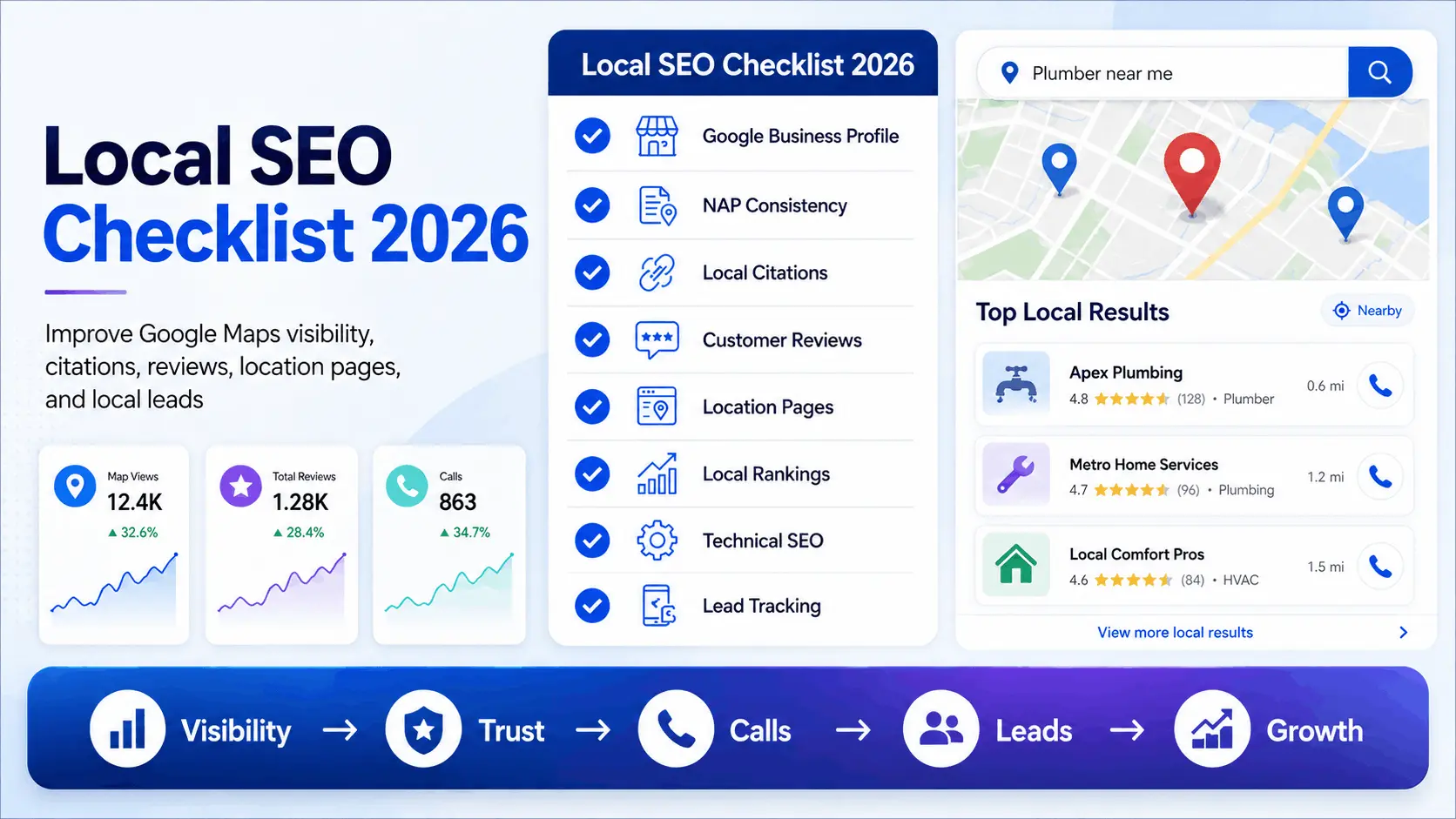
Use this 12-step local SEO checklist to improve Google Business Profile visibility, local rankings, citations, reviews, location pages, technical SEO, and lead tracking. It is designed for small businesses that need a practical system for improving local search visibility and generating more qualified leads in 2026.
Most small business local SEO problems do not come from one missing keyword. They come from weak Google Business Profile data, inconsistent NAP details, thin local pages, slow mobile performance, unmanaged reviews, poor tracking, and scattered citations. This local SEO checklist helps small businesses improve local rankings, map visibility, and lead quality by fixing the system behind local search.
For founders, operations teams, and technical decision-makers, local SEO is closer to data governance than simple content publishing. Business information must stay accurate. Pages must load fast. Reviews need a process. Citations need cleanup. Analytics must show which actions create calls, quote requests, bookings, and visits.
Local SEO Checklist for Small Business: Quick Summary
- Start with a local SEO audit before changing pages, categories, or citations.
- Keep name, address, phone number, hours, services, and locations consistent everywhere.
- Optimize Google Business Profile with accurate categories, services, photos, posts, and review workflows.
- Create useful local landing pages instead of duplicated city-name content.
1. Start the Local SEO Checklist With a Real Audit
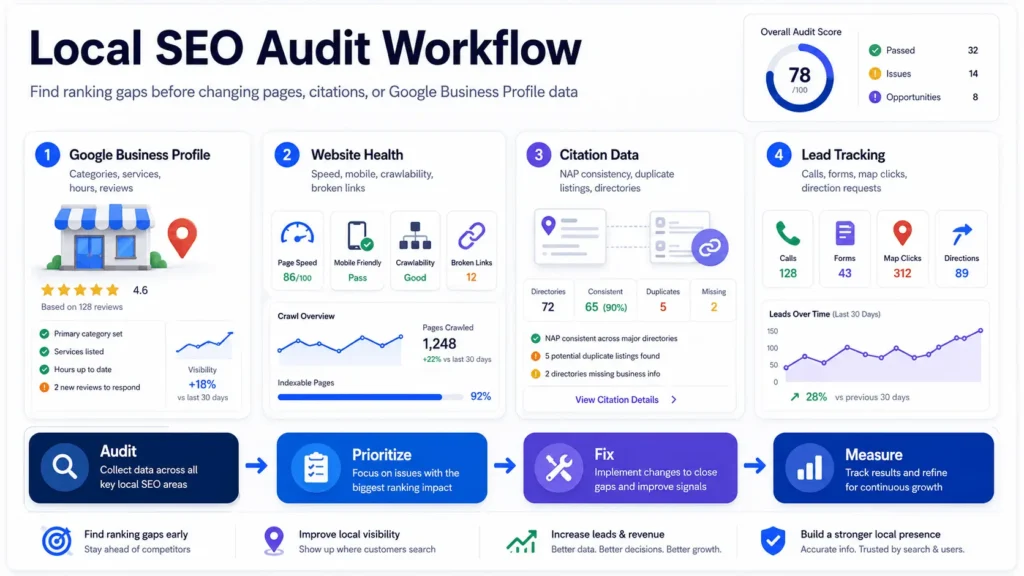
A useful local SEO checklist starts with an audit. Random edits usually create more noise than progress. Before writing new pages, changing categories, or building citations, check how the current system behaves.
Review Google Business Profile visibility, map pack rankings, organic local rankings, indexed location pages, duplicate listings, review velocity, technical errors, mobile speed, broken links, redirects, and conversion paths. The purpose is not to collect screenshots. The purpose is to find bottlenecks that block visibility or leads.
A local SEO audit should answer practical questions. Are customers finding the right location? Are service pages indexed? Is the primary category correct? Do citations match the website? Are phone calls tracked? Are reviews recent enough to support trust?
If your business needs a deeper review across rankings, pages, speed, and search visibility, this technical SEO audit checklist is a useful next layer after the local audit.
2. Google Business Profile Local SEO Checklist
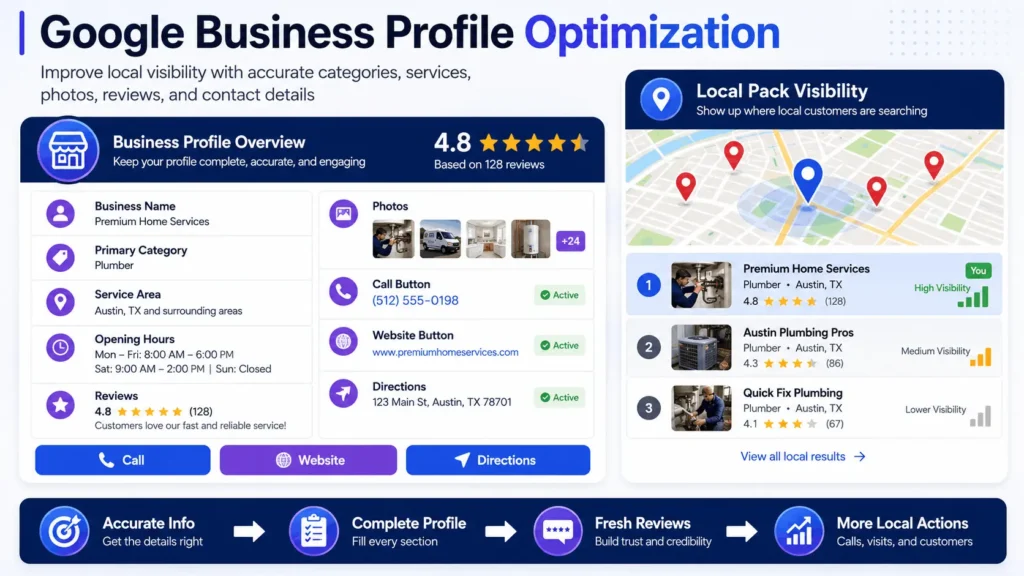
Google Business Profile is the operational center of local search. A website can be well built and still underperform if the profile is incomplete, inaccurate, or inactive. This is why every local SEO checklist needs a dedicated Google Business Profile section.
Start with the basics: business name, primary category, secondary categories, address, service area, phone number, website link, opening hours, holiday hours, business description, services, photos, and appointment links.
Google Business Profile Checklist
- Use the real business name without keyword stuffing.
- Select the most accurate primary category.
- Add secondary categories only when they reflect real services.
- Write service descriptions that match website pages.
- Add appointment, quote, booking, or contact links where relevant.
For a location-focused campaign, Google Business Profile should connect cleanly with the website. FiliCode’s Hawaii SEO specialist service page shows how local SEO can be positioned around visibility, trust, and practical lead generation.
3. Keep NAP Consistency Across Listings
NAP means name, address, and phone number. It sounds basic, but inconsistent business data is one of the most common local SEO problems.
A business may have one phone number on its website, another on Facebook, an old address on Yelp, and a previous business name in a directory listing. Search engines and customers both read those inconsistencies as risk.
For multi-location businesses, the problem gets bigger. Each location needs a clean data model: location name, address, local phone number, opening hours, services, service area, and URL. This should be stored centrally so updates are not handled manually across random spreadsheets.
Build a citation inventory. Include Google Business Profile, Bing Places, Apple Maps, Yelp, Facebook, Yellow Pages, chamber of commerce listings, industry directories, and local business associations. Then clean duplicates, outdated records, wrong categories, and inconsistent phone numbers.
A strong local SEO checklist should treat citations like operational data, not link building only.
4. Build Local Landing Pages With Real Service Context
Location pages are often built badly. Many businesses create ten pages with the same paragraph and replace the city name. That may create pages, but it does not create useful local relevance.
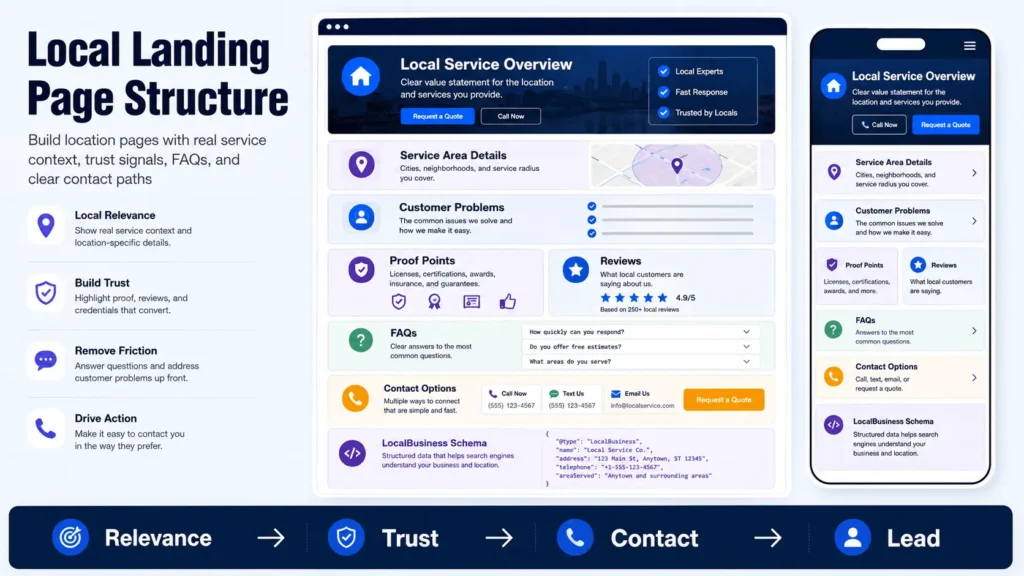
A good local landing page should explain what the business does in that location, which services are available, who the service is for, what problems customers usually have, what proof exists, and how people can take the next step.
Local Landing Page Requirements
- Service overview for that location.
- Local customer problems and decision factors.
- Internal links to core service pages.
- FAQs based on local buying intent.
- Clear contact options.
- LocalBusiness schema where appropriate.
For small businesses building local search foundations, this guide on local SEO for small business growth can support the broader planning process.
5. Use Technical SEO to Support Local Rankings
Local SEO is not separate from technical SEO. A slow, unstable, poorly structured website creates ranking and conversion problems even when the business has good reviews.
Mobile performance is especially important because many local searches happen on phones. A customer searching for a nearby service is often comparing quickly. If the page loads slowly, hides the phone number, breaks the form, or creates layout shifts, the ranking improvement does not turn into revenue.
Technical checks should include Core Web Vitals, page speed, crawlability, redirects, broken links, structured data, mobile layout, and index coverage.
This is where engineering discipline helps. Test changes on staging, monitor Search Console, check logs when traffic drops, and avoid installing plugins for every small feature.
6. Add Structured Data Without Treating It as Magic
Structured data helps search engines understand business information, but it will not rescue weak content or inaccurate business details. Use it to reinforce facts already visible on the page.
For local businesses, LocalBusiness schema can describe the business name, address, phone number, opening hours, website URL, service area, and business type. FAQ schema may be useful where the page contains real FAQs. Review schema should be handled carefully and only used where it follows search engine guidelines.
Google’s official LocalBusiness structured data guidance is a useful reference for implementation.
In WordPress, schema can be added through SEO plugins, custom theme code, or JSON-LD blocks. For larger websites, custom implementation is often cleaner because the data can be pulled from a structured location model instead of manually edited page by page.
7. Create a Review Workflow, Not Random Review Requests
Reviews influence trust, conversion, and local visibility. The mistake is treating reviews as something customers will remember to leave on their own.
A practical review workflow includes timing, request method, follow-up logic, staff ownership, response templates, and monitoring. For service businesses, the best time to request a review is usually after delivery, approval, repair completion, project launch, or customer support resolution.
The workflow can be simple. Send a direct review link. Use email or SMS where appropriate. Add a QR code for in-person teams. Train staff to ask at the right moment. Respond to both positive and negative reviews professionally.
Review quality matters too. Generic reviews help less than detailed reviews that mention the service, location, problem solved, and customer experience. Do not script fake reviews. Instead, ask customers to describe what was useful.
For businesses managing local SEO at scale, reviews should be tracked monthly by volume, recency, average rating, response rate, and competitor comparison.
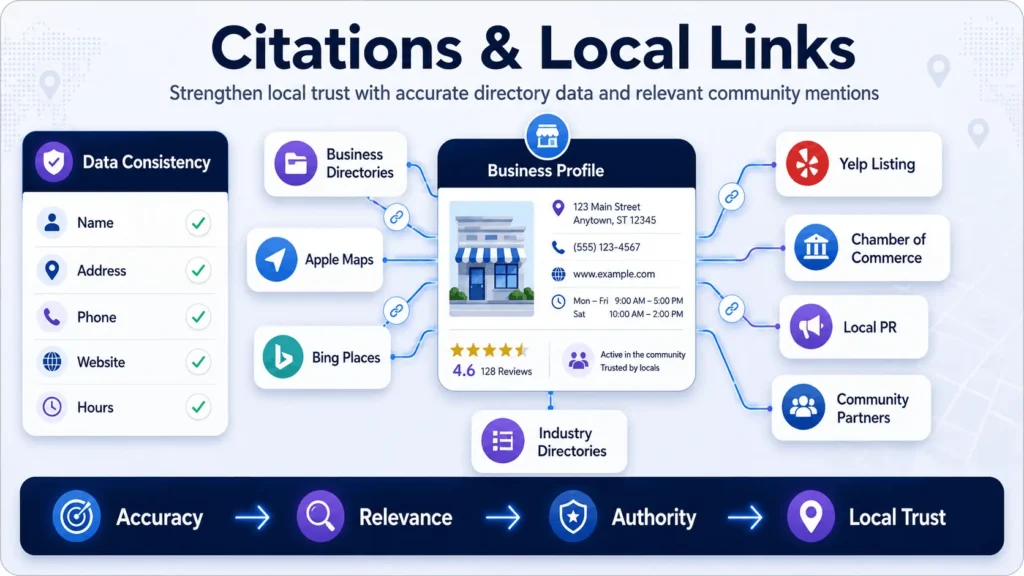
8. Build Citations and Local Links Carefully
Citations and local backlinks are not the same thing. Citations confirm business data. Backlinks support authority. Both can help, but both can also become messy if handled without standards.
Start with authoritative directories and industry-specific listings. Then look for local organizations: business associations, chambers of commerce, sponsorship pages, local news, supplier directories, partner pages, community events, and relevant local blogs.
Avoid low-quality directory blasts. They often create duplicate listings, wrong categories, and future cleanup work. A smaller number of accurate, relevant listings is better than hundreds of weak ones.
Local link building should reflect real business activity. If the company sponsors an event, partners with a local organization, publishes useful local resources, or contributes expert commentary, those mentions can become durable authority signals.
| Approach | Benefit | Risk |
|---|---|---|
| Manual citation cleanup | Accurate data and fewer duplicates | Takes time to document properly |
| Bulk directory submission | Fast coverage | Can create low-quality listings |
| Local partnerships | Strong relevance and trust | Requires real relationship building |
| Local PR | Builds authority and third-party mentions | Harder to control and repeat |
9. Track Local SEO Performance by Action, Not Only Ranking
Rank tracking matters, but it is not enough. A business can improve rankings and still get poor leads if the page does not match search intent or the conversion path is weak.
Track map pack rankings, organic local rankings, Google Business Profile calls, website clicks, direction requests, form submissions, booking actions, quote requests, and assisted conversions.
Use Google Search Console to review local queries and page performance. Use Google Analytics to separate traffic by landing page and conversion action. Use call tracking carefully so it does not break NAP consistency.
For local businesses running campaigns across SEO, content, and paid media, reporting should connect search visibility with operational outcomes. More impressions are useful only if they support calls, visits, inquiries, bookings, or qualified leads.
If you need broader local and organic search support, FiliCode’s SEO services for small business page explains how technical SEO, content planning, local visibility, and reporting can work together.
10. Update the Local SEO Checklist for AI Search Visibility
The local SEO checklist for 2026 needs to account for AI search, answer engines, and generated summaries. AI systems depend heavily on clear, consistent, well-supported business information.
This does not mean replacing normal SEO. It means improving how factual and citable your business information is across the web.
Your website should clearly explain services, locations, pricing factors, process, industries served, FAQs, credentials, and contact options. Third-party mentions, reviews, business directories, local articles, and structured data all support entity clarity.
AI-ready local content should answer specific questions. What areas do you serve? What service types do you handle? What makes a customer a good fit? How long does implementation take? What does pricing depend on?
11. Use Local Content to Support Real Buying Decisions
Local content should not exist only to target keywords. It should reduce uncertainty for buyers.
A local SEO checklist for businesses may include neighborhood guides, service-area pages, local project examples, comparison pages, maintenance guides, seasonal service content, and FAQ pages. For pool companies, this could include pool maintenance schedules, repair warning signs, local permit considerations, and seasonal service checklists. For a WordPress agency, it could include website maintenance, SEO checklists, cost guides, platform comparisons, and migration planning.
Content should connect to services naturally. A blog about local SEO should support SEO services. A WordPress website cost guide should support development services. A maintenance checklist should support long-term support plans.
For businesses using WordPress, content structure matters. Categories, tags, internal links, reusable blocks, custom post types, and Gutenberg patterns should be planned. Otherwise, the blog becomes a pile of disconnected articles with no clear topical authority.
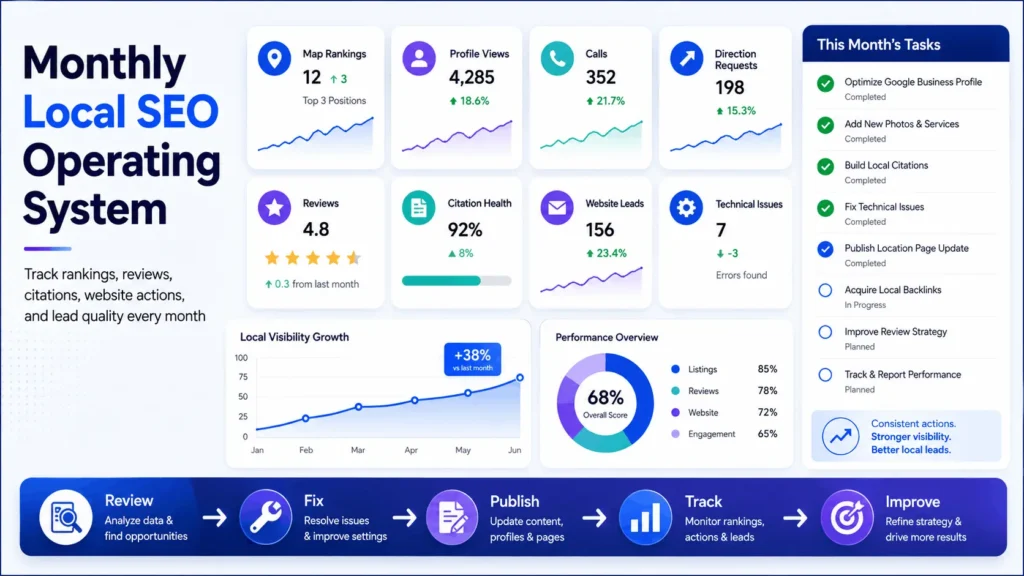
12. Make Local SEO a Monthly Operating System
Local SEO is not finished after setup. Competitors update profiles. Reviews change. Google tests layouts. Directories scrape old data. Websites break after plugin updates. New service areas open. Staff forget to update holiday hours.
A monthly process keeps the system healthy.
Review profile performance, calls, direction requests, reviews, citations, local rankings, page speed, Search Console queries, broken pages, form tracking, and competitor movement. Then decide what needs action.
FiliCode supports businesses that need SEO, WordPress development, WooCommerce improvements, API integrations, AI automation, and maintainable website systems. Local SEO works better when the website, tracking, content workflow, and technical architecture are built to support ongoing improvement, not one-time edits.
For businesses with technical growth needs, FiliCode’s digital marketing services can connect local SEO with website performance, content planning, analytics, and conversion strategy.
Local SEO Checklist PDF Planning: What to Include
Many teams search for a local SEO checklist PDF because they want something practical to follow. A PDF is useful only if it becomes part of a workflow.
A strong checklist document should include Google Business Profile fields, citation inventory, review workflow, location page requirements, technical SEO checks, schema requirements, tracking setup, monthly reporting, competitor monitoring, and a content update schedule.
The PDF should be assigned to someone. Otherwise, it becomes another file in a shared folder. For growing teams, convert the checklist into tasks inside Trello, Asana, ClickUp, Notion, or a CRM workflow.
FAQs
What is a local SEO checklist?
A local SEO checklist is a practical list of actions used to improve local search visibility. It usually covers Google Business Profile, citations, reviews, local keywords, location pages, technical SEO, tracking, and ongoing optimization.
How long does local SEO take to show results?
Most businesses need 3 to 6 months to see meaningful movement, depending on competition, website quality, reviews, citations, and current visibility.
How much does local SEO cost?
Local SEO pricing depends on the number of locations, website condition, citation cleanup, content needs, review management, and reporting depth.
Is Google Business Profile enough for local SEO?
No. Google Business Profile is important, but it works better when supported by accurate citations, strong reviews, optimized location pages, fast mobile performance, structured data, and clear service content.
Should I create separate pages for every city?
Only when each page can provide useful, specific information. Do not create copied pages with changed city names. Good location pages should include real service context, local proof, FAQs, contact options, and relevant internal links.
Conclusion: Use This Local SEO Checklist as a System
The warning signs are easy to spot. Calls are inconsistent. Rankings move but leads do not improve. Reviews are old. Location pages are thin. Business listings show different phone numbers. Forms break after updates. Nobody knows which channel produced the lead.
That is when local SEO needs structure.
This local SEO checklist gives you the operating model: audit first, fix business data, optimize Google Business Profile, clean citations, improve location pages, strengthen reviews, add technical SEO, track real actions, and maintain the system monthly.
If your website, local visibility, analytics, or content workflow has become difficult to manage, custom support may be worth considering. FiliCode can help review the current setup, identify practical bottlenecks, and plan the next steps without unnecessary complexity. You can contact FiliCode to discuss the right next step.