




Contents
- Quick Summary: for Founders, CTOs, and Operators
- What Does PPC Management Include?
- How Does PPC Management Work?
- The Architecture Behind PPC Campaign Management
- How PPC Management Changes as Campaigns Scale
- Paid Search, Paid Social, and Retargeting
- Landing Pages, WordPress, and Website Bottlenecks
- PPC Management, Data, Tracking, and Automation
- Common PPC Management Bottlenecks in Production
- SaaS Tools, No-Code Setups, and Custom Systems
- When PPC and SEO Should Work Together
- When Filicode Fits Into PPC and Growth Systems
- Frequently Asked Questions About PPC Management Services
- What is PPC management services in simple terms?
- How much do PPC management services cost?
- How long does PPC implementation take?
- Can PPC management scale with WordPress or WooCommerce?
- Do PPC campaigns need CRM and API integrations?
- Is AI useful in PPC management?
- Conclusion: What PPC Management Services Really Solve
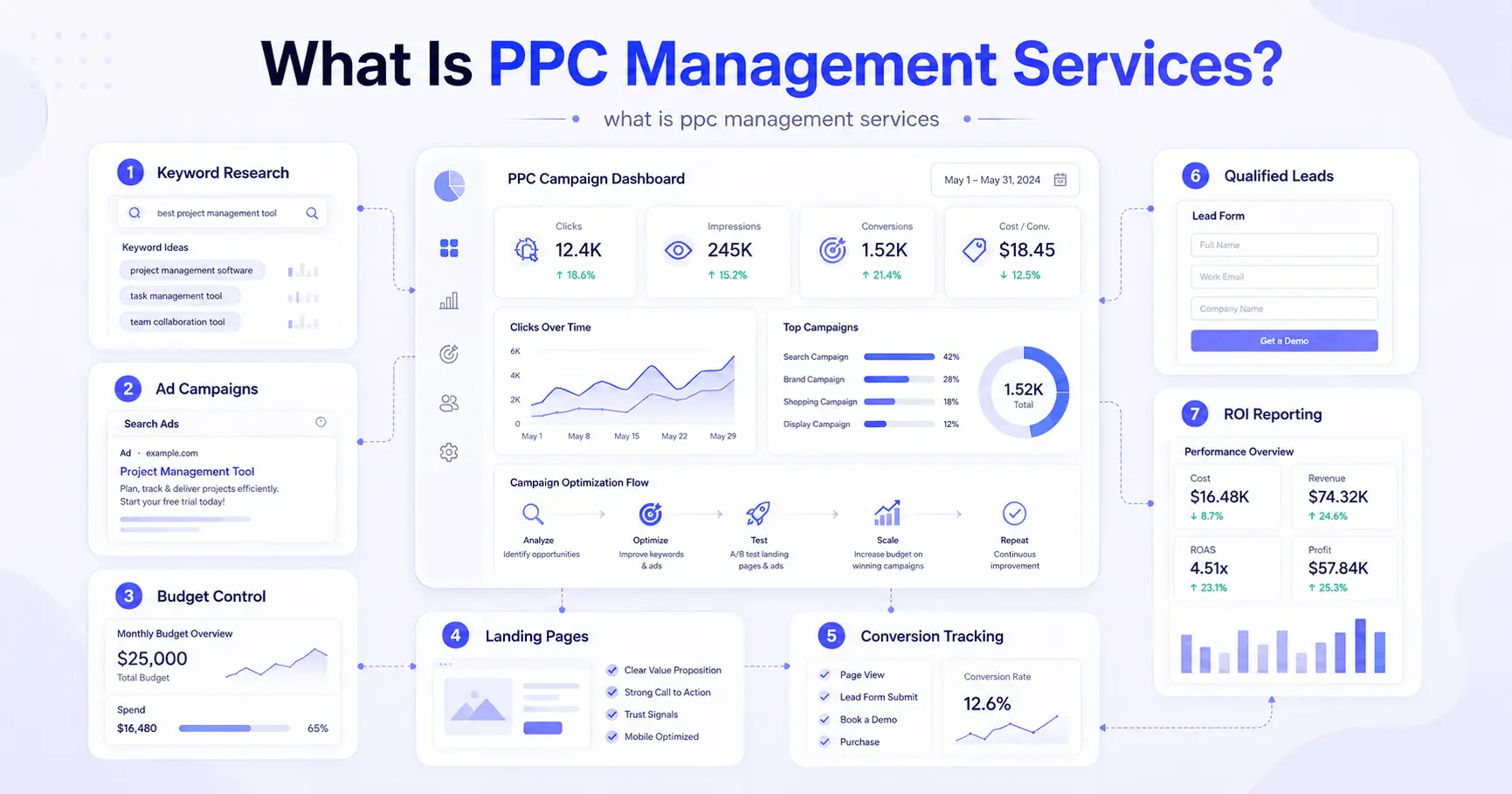
What is PPC management services? PPC management services involve planning, setting up, monitoring, and optimizing paid advertising campaigns to generate better leads or sales while controlling ad spend. This includes keyword research, bidding, campaign structure, ad creation, landing pages, conversion tracking, reporting, and ongoing optimization.
PPC stands for pay per click, and the pay per click advertising model charges advertisers when users click an ad. Management is the discipline around that model. It connects ad strategy, account setup, keyword research, bidding, budgets, landing pages, tracking, reporting, and ongoing optimization into one operating system.
Quick Summary: for Founders, CTOs, and Operators
- PPC management is campaign architecture, budget control, data quality, and performance refinement.
- Bad conversion data trains campaigns toward the wrong outcomes.
- Scaling PPC requires landing page performance, CRM integration, event tracking, and clean reporting.
- WordPress and WooCommerce campaigns need speed, checkout reliability, product feed health, and plugin conflict control.
- AI automation can support reporting and lead routing, but it needs validation, fallback logic, and human review.
What Does PPC Management Include?
At a basic level, what is PPC management services means the professional planning, setup, monitoring, and improvement of paid advertising campaigns across platforms like Google Ads, Bing Ads, LinkedIn, Facebook, Instagram, YouTube, TikTok, and retargeting networks. At an operational level, it controls how advertising dollars move through the business system.
A PPC management company or specialist should manage search intent, account structure, audience targeting, bidding strategy, negative keyword research, ad creative, landing page quality, conversion tracking, cost per lead, ROAS, and reporting. The objective is not cheaper clicks. The objective is qualified traffic that can turn into pipeline, booked calls, ecommerce sales, or high value conversions.
This is where paid media management becomes closer to systems work than campaign work. A click triggers a landing page visit. The page loads scripts, forms, call tracking, analytics tags, consent tools, and sometimes personalization logic. A form submission may push data into a CRM, send a webhook, create a lead record, start an email sequence, notify sales, and update attribution reports.
For businesses looking for managed PPC services, Filicode’s PPC management team supports campaign structure, tracking, landing pages, budget control, and ongoing performance improvement.
How Does PPC Management Work?
In production, what is PPC management services is the workflow that keeps paid traffic connected to business outcomes. It starts with campaign goals and buyer intent, then maps those goals to keyword groups, audiences, ad messaging, landing pages, tracking events, CRM fields, and revenue reports.
For local services, that may mean call tracking, quote forms, service-area targeting, and lead quality review. For SaaS, it may mean trial signups, demo requests, subscription events, lifecycle automation, and sales pipeline attribution. For WooCommerce, it may include shopping ads, product feed health, cart events, checkout conversion rate, refunds, and repeat purchase reporting.
The Architecture Behind PPC Campaign Management
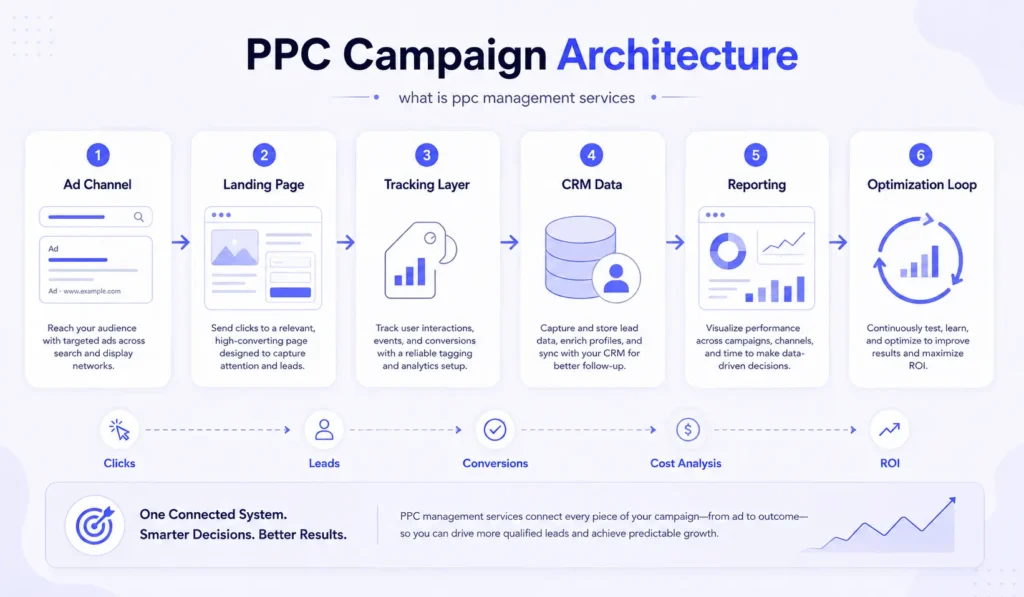
Strong PPC management uses a simple architecture: channel, landing experience, tracking layer, data storage, reporting, optimization loop, and governance. The channel brings traffic. The page handles conversion. Tracking records clicks, conversions, and user behaviour. The CRM or ecommerce database stores commercial truth.
When this architecture is weak, teams make expensive decisions from incomplete signals. A campaign may show conversions while sales receives low-quality leads. A paid social campaign may generate cheap form fills that never answer the phone. A Google Search campaign may look expensive, but produce the highest close rate.
PPC also connects to broader digital acquisition. Paid search can reveal high-intent queries before SEO rankings mature. Retargeting can support visitors who first arrived through content. Landing page testing can improve both organic and paid conversion rates. This is why digital marketing services work better when paid media, SEO, analytics, and website performance are not managed in separate silos.
How PPC Management Changes as Campaigns Scale
When accounts are small, manual management can work. A specialist can review search terms, adjust bids, pause weak ads, and improve landing pages. The pressure changes when spend increases, locations expand, product catalogs grow, or campaigns connect to multiple sales teams. At that stage, what is PPC management services becomes a question of operational control.
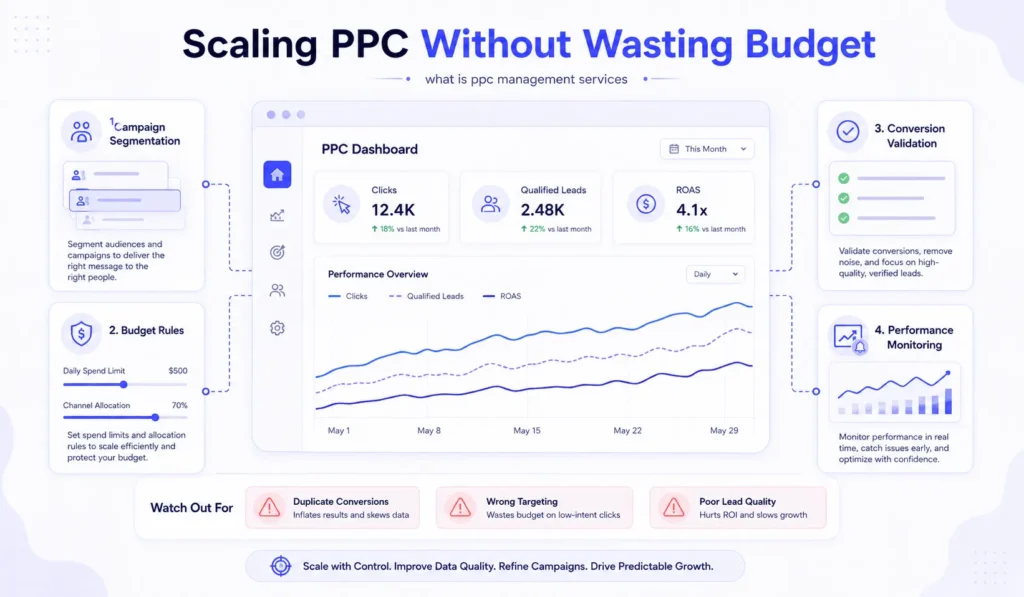
Scaling requires naming conventions, campaign segmentation, budget rules, approval workflows, tracking validation, dashboard consistency, and change logs. These prevent mistakes such as sending traffic to retired landing pages, optimizing for duplicate conversions, targeting the wrong location, or spending budget on outdated offers.
Enterprise PPC accounts often need queue-based processing and async jobs. Product feeds need scheduled updates. CRM events need webhook retries. Offline conversion imports need validation. Reporting jobs need to run without blocking the website. If a webhook fails, the system should retry and log the issue instead of silently losing attribution.
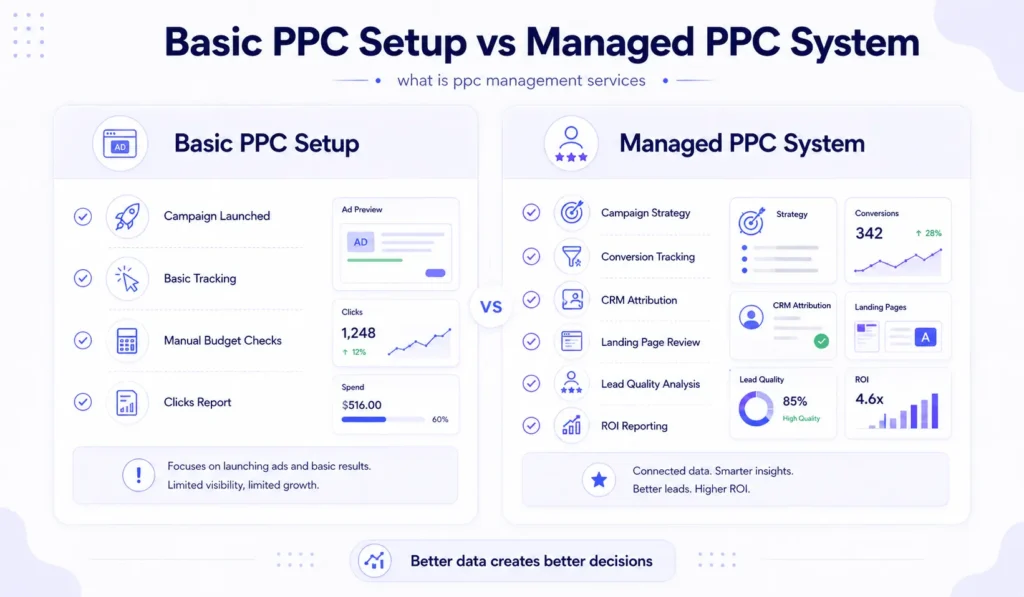
| Area | Basic Campaign Setup | Managed PPC Operating System |
|---|---|---|
| Tracking | Single form conversion | Validated events, CRM attribution, call tracking, offline imports |
| Budgeting | Manual daily budget changes | Budget rules based on performance, seasonality, and lead quality |
| Landing pages | One generic page | Segmented pages for intent, location, offer, and funnel stage |
| Reporting | Clicks, impressions, conversions | Cost per qualified lead, ROAS, pipeline, close rate |
| Governance | Ad hoc edits | Change history, naming rules, approvals, monitoring, rollback plan |
Paid Search, Paid Social, and Retargeting
Paid search ads capture demand. Paid social ads shape demand. Remarketing and retargeting bring back users who already showed intent. A serious paid media strategy maps each platform to a buyer stage and measures the role it plays in conversion.
Google Search ads work best when users already have a problem and use relevant searches. LinkedIn can support B2B lead generation where role or industry matters. Facebook, Instagram, YouTube, and Bing can each support different stages. The technical mistake is treating every channel with the same conversion target. Good PPC management services define conversion stages from engaged visits to qualified leads, purchases, and revenue.
For B2B companies, the paid media model also depends on funnel length. A demo request, whitepaper download, webinar signup, and sales-qualified opportunity should not be treated equally. Filicode’s B2B digital marketing strategy guide explains why scalable growth needs clearer segmentation, pipeline visibility, and operational feedback loops.
Landing Pages, WordPress, and Website Bottlenecks
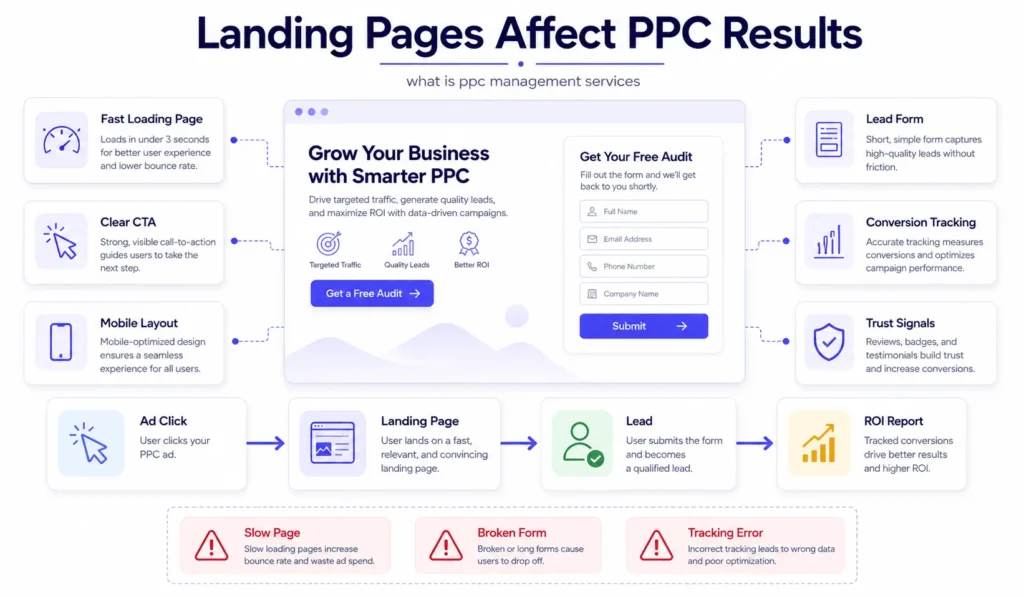
Many paid campaigns lose money after the click. The ad account may be organized well, but the website is slow, the form plugin conflicts with caching, the tracking script fires twice, or the checkout adds friction on mobile. PPC exposes these weaknesses because paid traffic arrives immediately.
For WordPress, strong landing page work includes custom Gutenberg sections, lean templates, object caching, Redis where appropriate, CDN optimization, plugin conflict management, security hardening, and clean REST API integrations. If a business is paying for traffic, the page should not rely on fragile tracking snippets pasted across multiple templates.
Website design also affects paid traffic quality. Clear page hierarchy, fast-loading sections, focused CTAs, trust signals, accessible forms, and mobile-first layouts reduce wasted clicks. When a campaign depends on high-intent visitors, website design and development becomes part of the PPC performance system, not a separate design task.
WooCommerce adds product feeds, cart events, checkout scripts, payment gateways, fraud checks, coupons, shipping rules, refunds, and inventory sync. A shopping ad campaign can look broken when the real issue is feed accuracy, checkout latency, or missing purchase events.
PPC Management, Data, Tracking, and Automation
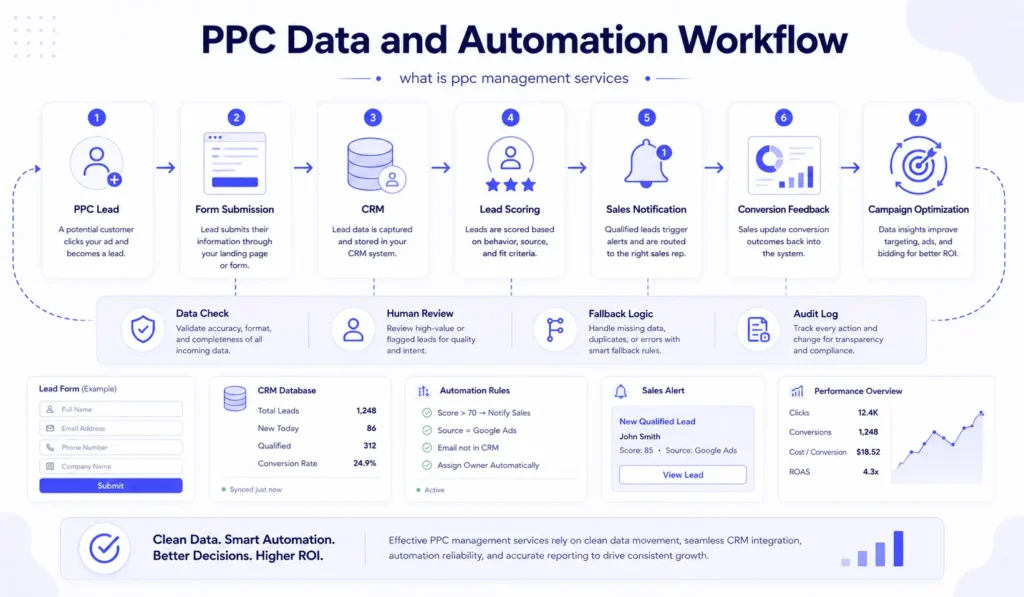
This is another reason what is PPC management services should be defined beyond ad clicks. Modern campaigns depend on data movement. When someone asks what is PPC management services, the answer should include tracking pipelines, API integrations, webhook reliability, CRM automation, and reporting workflows. Otherwise the business sees ad platform numbers but not operational truth.
A stable setup may push leads from landing pages into HubSpot, Salesforce, Zoho, or a custom CRM. It may assign leads by territory, score them by intent, notify the right sales rep, create tasks, sync conversion quality back to Google Ads, and exclude poor-fit audiences from future campaigns.
AI automation can help, but only when the workflow has guardrails. AI agents can summarize campaign performance, classify lead quality, draft ad variants, analyze search terms, or flag conversion tracking anomalies. They need validation systems, human-in-the-loop review, fallback logic, audit logs, and monitoring of AI outputs.
Common PPC Management Bottlenecks in Production
The most expensive PPC failures are quiet. A thank-you page changes and conversion tracking breaks. A CRM field is renamed and lead source data disappears. A developer deploys a cookie banner that blocks analytics. A page speed issue increases cost per conversion. A campaign keeps spending because nobody reviews search terms with sales feedback.
- Duplicate conversion events that inflate results.
- No negative keyword management, so budgets leak into irrelevant searches.
- Landing pages disconnected from ad messaging and buyer intent.
- No offline conversion import, so platforms cannot learn which leads became revenue.
- Reports focused on clicks instead of cost per qualified opportunity.
Good what is PPC management services content should be honest about this: PPC is easy to start and difficult to operate well. The hard part is keeping data, landing pages, budgets, people, platforms, and revenue feedback aligned while the business changes.
SaaS Tools, No-Code Setups, and Custom Systems
Small teams can start with SaaS tools, templates, Google Tag Manager, ad platform dashboards, and no-code CRM automations. That is often correct. The mistake is assuming the same stack will stay reliable after spend increases, teams grow, products expand, and reporting requirements become more specific.
| Option | Works Best When | Limitations |
|---|---|---|
| No-code PPC stack | Budgets are modest and workflows are simple | Can become fragile with many forms, tags, and CRM branches |
| SaaS marketing platform | Teams need fast deployment and standard reporting | May restrict custom attribution, permissions, or data ownership |
| WordPress landing system | Content, SEO, and PPC need shared page infrastructure | Needs disciplined plugin, caching, and deployment management |
| Custom integration layer | Lead routing, billing, CRM sync, or reporting needs precision | Requires architecture planning, maintenance, logging, and support |
| Headless or microservice approach | High traffic or complex user journeys exist | More expensive to build and operate than a simple monolith |
There is no universal best architecture. A monolith can be efficient when one team owns the system. Microservices help separate domains scale, but they add deployment, monitoring, authentication, and data consistency overhead.
When PPC and SEO Should Work Together
PPC and SEO are often treated as separate budget lines, but the data overlaps. PPC search term reports show active buyer language. SEO content can lower dependency on paid traffic over time. Landing page testing can improve both paid and organic conversion rates.
Small businesses need this connection because every channel has budget pressure. Paid traffic can create fast learning, while SEO builds longer-term visibility. A business that cannot afford waste should connect PPC learnings with SEO services for small business, content planning, local landing pages, and conversion tracking.
When Filicode Fits Into PPC and Growth Systems
Filicode is not useful when a business only needs someone to switch on a small campaign and check it once a month. The work becomes valuable when paid traffic exposes deeper system problems: weak landing pages, slow website performance, broken ecommerce tracking, disconnected APIs, CRM gaps, or manual workflows.
That is where custom software development, WordPress development, WooCommerce development, AI automation, API integrations, SaaS development, and performance optimization matter. A company may begin with PPC marketing services, then realize the real bottleneck is lead processing, checkout reliability, data visibility, or admin tooling. Architecture-focused execution reduces future maintenance cost because the system is designed around the workflow.
Filicode’s PPC management services are built around practical campaign oversight, tracking quality, landing page performance, and growth systems that can be maintained as campaigns expand.
Frequently Asked Questions About PPC Management Services
What is PPC management services in simple terms?
what is PPC management services refers to the planning, setup, monitoring, and improvement of paid ad campaigns so clicks can become measurable business outcomes. It includes keyword research, bidding, ad copy, landing pages, conversion tracking, reporting, and ongoing optimization.
How much do PPC management services cost?
Pricing depends on ad spend, account complexity, platforms, landing page needs, reporting depth, and integration requirements. Models often include a flat fee, percentage of spend, or hybrid setup.
How long does PPC implementation take?
A simple campaign can launch in days, but a reliable setup takes longer because tracking, landing pages, CRM fields, and reporting need validation. Complex campaigns need staged rollout and testing.
Can PPC management scale with WordPress or WooCommerce?
Yes, but the site must be technically prepared. Page speed, caching, checkout stability, product feeds, tracking scripts, plugin conflicts, and mobile usability all affect campaign performance.
Do PPC campaigns need CRM and API integrations?
They do when the business cares about lead quality, sales outcomes, or revenue attribution. CRM and API integrations connect ad clicks to qualified leads, opportunities, purchases, refunds, and long-term customer value.
Is AI useful in PPC management?
AI can support analysis, reporting, search term review, lead classification, and ad variant creation. It still needs human review, validation rules, and monitoring because campaign data can be noisy or incomplete.
Conclusion: What PPC Management Services Really Solve
The best answer to what is PPC management services is not “running ads.” It is building a controlled paid acquisition workflow where traffic, landing pages, tracking, automation, CRM data, and reporting support business decisions. The work becomes valuable when a company needs more than clicks. It needs predictable learning, cleaner lead quality, and fewer blind spots.
Warning signs are easy to spot: campaign reports do not match sales feedback, lead quality is unclear, conversion tracking breaks often, landing pages are slow, budgets scale without better pipeline, or the team depends on manual spreadsheets to understand performance. Those are system limitations, not only marketing issues.
When those signs appear, custom development should be considered carefully. Not every business needs a complex platform, but every growing business needs reliable infrastructure around acquisition. If paid traffic is exposing website, CRM, automation, or reporting gaps, it may be time to discuss your project with a team that understands both technical systems and growth operations.