








Contents
- Quick Summary: 7 Ecommerce SEO Chicago Strategies at a Glance
- Why Chicago Ecommerce SEO Requires a Different Strategy
- Ecommerce SEO Chicago Starts With Site Architecture
- Common Ecommerce Architecture Problems
- Category Page SEO Matters More Than Most Teams Expect
- Technical SEO for Ecommerce Websites
- Crawlability and Indexability
- Ecommerce Site Speed and Core Web Vitals
- How Chicago SEO for Ecommerce Websites Works Under Production Conditions
- Backend Systems That Influence SEO
- Ecommerce Platform SEO Comparison
- Product Page Optimization vs Category Page Optimization
- Ecommerce SEO Chicago for Product Pages
- Ecommerce Keyword Research and Mapping
- Local SEO Support for Ecommerce Businesses
- Ecommerce Analytics Tracking and Reporting Systems
- Ecommerce Reporting Workflow
- Ecommerce SEO Chicago and Conversion Rate Optimization
- Checkout Flow Optimization
- Ecommerce SEO Chicago and Modern Technical Architecture
- Monolith vs Headless Commerce
- API Integrations, Automation, and Ecommerce SEO
- Operational Reliability Matters
- AI Search and the Future of Ecommerce SEO Chicago
- Enterprise Ecommerce SEO and Operational Complexity
- When Custom Ecommerce Development Becomes Necessary
- How Filicode Approaches Ecommerce SEO Projects
- Frequently Asked Questions
- How much do ecommerce SEO services in Chicago typically cost?
- How long does ecommerce SEO Chicago take to produce results?
- Which ecommerce platform is best for SEO?
- Does ecommerce SEO Chicago help increase sales or only traffic?
- Is ecommerce website migration risky for SEO?
- Do ecommerce stores require ongoing SEO maintenance?
- Conclusion
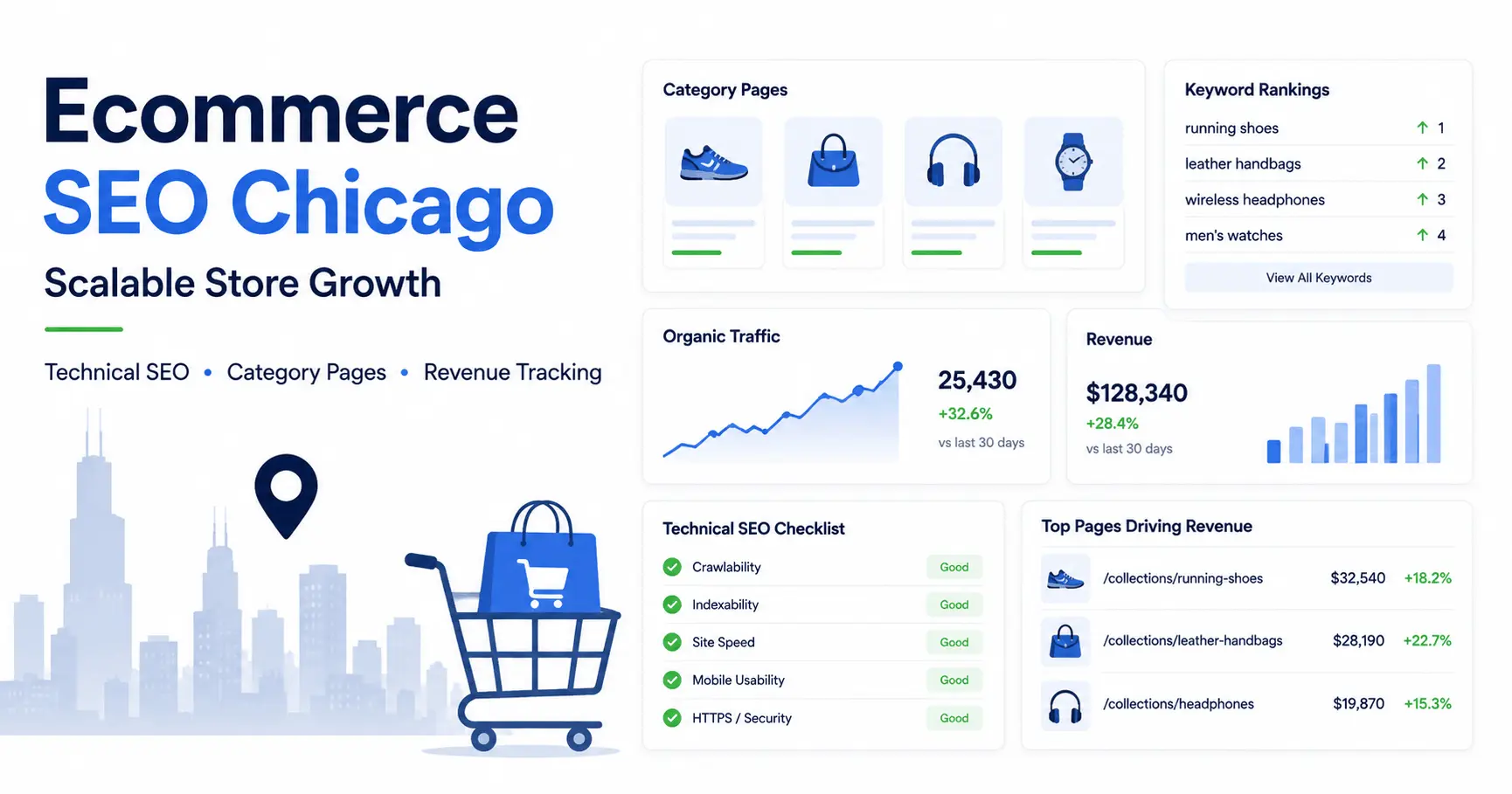
Ecommerce SEO Chicago requires more than publishing product content. Growing stores need clean architecture, crawlable category pages, fast performance, reliable tracking, and stable integrations to protect rankings and revenue.
A strong Chicago ecommerce SEO strategy connects technical SEO, category and product optimization, analytics, conversion improvement, and operational reliability so the store can scale without creating thousands of low-value URLs or long-term maintenance problems.
Quick Summary: 7 Ecommerce SEO Chicago Strategies at a Glance
- Ecommerce SEO failures often originate from architecture and technical debt rather than content quality.
- Category structure and internal linking influence rankings more than many businesses realize.
- Site speed, crawlability, and indexability directly affect revenue generation.
- WooCommerce, Shopify, Magento, and BigCommerce require different SEO approaches.
- Analytics, conversion tracking, and operational reporting should guide optimization priorities.
- Sustainable growth comes from maintainable systems rather than short-term ranking tactics.
- Chicago-based stores should combine local trust signals with broader ecommerce SEO when serving both regional and national customers.
Why Chicago Ecommerce SEO Requires a Different Strategy
A service business website may contain a few dozen pages. An ecommerce store often contains hundreds or thousands.
Search engines must understand product relationships, category hierarchies, internal linking structures, inventory changes, product variations, and seasonal landing pages. As a store grows, search complexity grows with it.
Many businesses invest heavily in content production before addressing underlying architecture problems. This creates situations where new pages are published continuously while existing pages struggle to rank.
Strong ecommerce SEO Chicago campaigns start by identifying structural bottlenecks before expanding content efforts.
For businesses evaluating broader search visibility opportunities, understanding how ecommerce SEO fits into a wider Chicago SEO growth strategy can help align technical and commercial objectives.
Ecommerce SEO Chicago Starts With Site Architecture
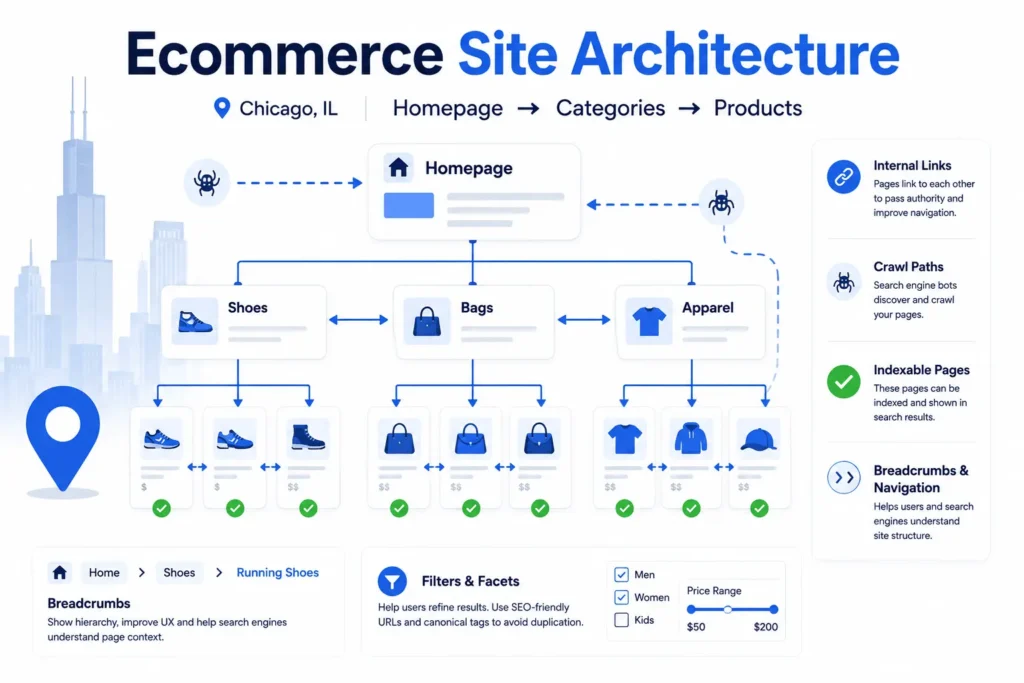
Site architecture determines how easily users and search engines navigate a store. A poor structure creates long-term limitations because crawl paths, category logic, and internal links affect how authority flows across the website.
Common Ecommerce Architecture Problems
Large stores frequently suffer from duplicate category paths, orphan product pages, excessive URL parameters, weak internal linking, inconsistent navigation, and deep category structures.
Search engines spend resources crawling low-value pages instead of prioritizing important revenue-generating assets. This weakens organic rankings and makes ecommerce search engine optimization harder to maintain.
Category Page SEO Matters More Than Most Teams Expect
Category pages often become the strongest ranking assets in an ecommerce website. Unlike product pages, category pages target broader commercial intent and support product discovery at scale.
Examples include men’s running shoes, industrial safety equipment, organic skincare products, and office furniture collections. These pages support ecommerce keyword strategy, internal linking, product discovery, user engagement, and revenue growth.
Many stores focus heavily on product page SEO while neglecting category page SEO. That imbalance limits scalability.
Technical SEO for Ecommerce Websites
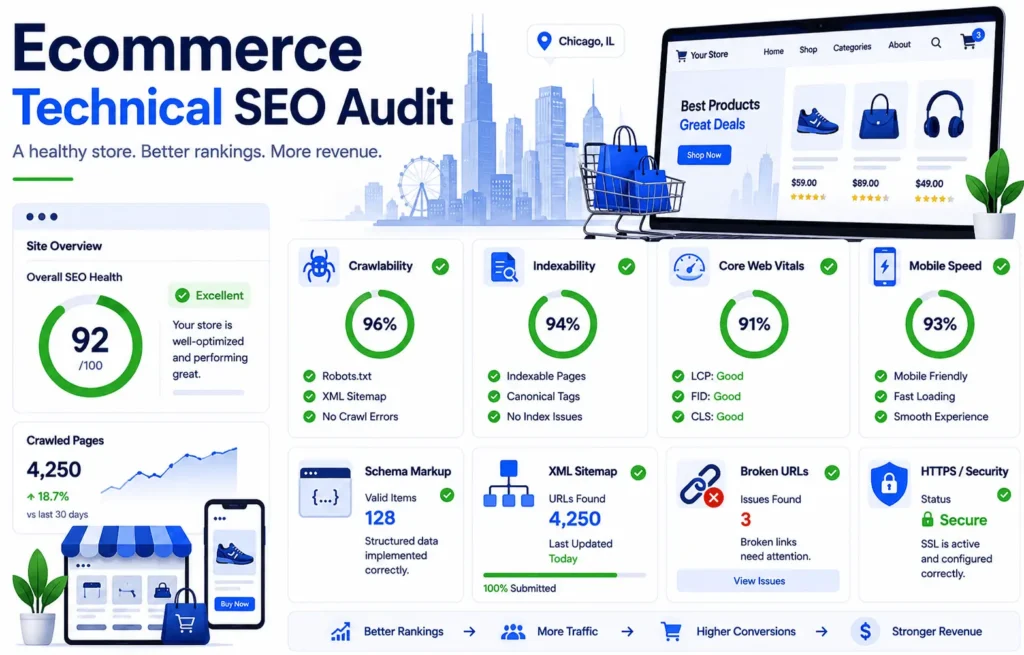
Chicago website optimization for ecommerce stores should prioritize crawlability, indexation, Core Web Vitals, structured data, mobile usability, and performance across conversion-critical pages.
Crawlability and Indexability
Search engines allocate finite crawl resources. When ecommerce platforms generate excessive URLs through filtering and sorting systems, crawl efficiency decreases.
Common issues include search result indexing, parameter URLs, session-generated URLs, duplicate collections, and pagination problems. Strong ecommerce SEO Chicago implementation focuses on controlling what search engines can access and index.
Ecommerce Site Speed and Core Web Vitals
Site performance directly affects both rankings and conversions. Performance bottlenecks commonly originate from large images, third-party scripts, excessive plugins, unoptimized themes, and poor caching policies.
WooCommerce stores often experience performance degradation as functionality expands. Optimization usually includes CDN implementation, Redis object caching, image compression, query optimization, and asset reduction.
Businesses reviewing technical improvements often begin with a structured technical SEO framework for scalable websites before investing in additional traffic acquisition.
How Chicago SEO for Ecommerce Websites Works Under Production Conditions
Many SEO discussions focus only on rankings. Production environments require a broader perspective because every system connected to the store can influence user experience, crawlability, and revenue tracking.
A typical ecommerce workflow looks like this:
- User discovers a category page through search.
- Frontend loads product data.
- Database queries retrieve inventory information.
- Search filters update dynamically.
- Analytics events capture behavior.
- CRM or marketing automation systems process user actions.
- Conversion data returns to reporting systems.
Every step introduces potential bottlenecks. When traffic increases, weaknesses become more visible.
Backend Systems That Influence SEO
Several backend systems indirectly affect organic performance, including inventory databases, product information management systems, CRM platforms, search engines, API integrations, and caching layers.
A slow inventory API can increase page load times. A broken product feed can create indexing issues. Operational reliability influences search performance more than many organizations realize.
Ecommerce Platform SEO Comparison
Different ecommerce platforms create different SEO opportunities and constraints. The best choice depends on catalog size, operational requirements, integration complexity, and internal technical resources.
| Feature | WooCommerce | Shopify | Magento |
|---|---|---|---|
| SEO Flexibility | High | Moderate | Very High |
| Customization | Extensive | Limited | Extensive |
| Technical Control | High | Moderate | Very High |
| Maintenance Effort | Moderate | Low | High |
| Enterprise Scalability | Moderate | Good | Excellent |
WooCommerce provides strong flexibility for businesses already using WordPress. Shopify simplifies operations but limits some advanced customization opportunities. Magento supports enterprise requirements but introduces additional infrastructure complexity.
Organizations evaluating platform scalability often review the underlying Magento ecommerce platform architecture because it demonstrates how enterprise commerce systems are structured.
Product Page Optimization vs Category Page Optimization
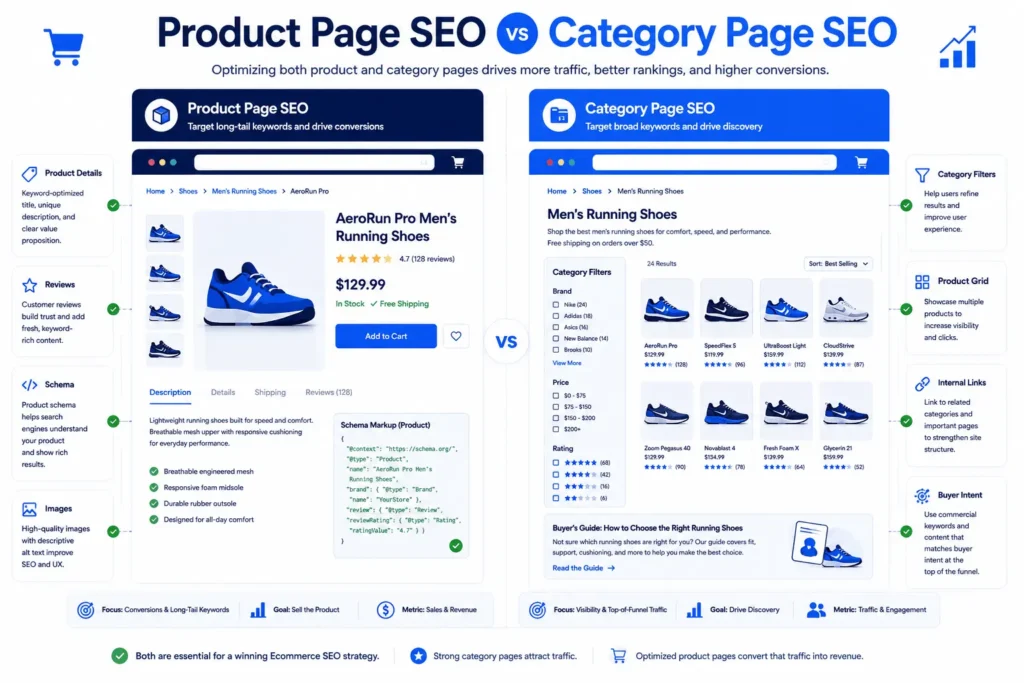
Both page types serve different purposes. Product pages target highly specific intent, while category pages target broader commercial intent.
| Product Pages | Category Pages |
|---|---|
| Specific searches | Commercial searches |
| Individual products | Product collections |
| Detailed specifications | Discovery experience |
| Purchase-focused | Research and comparison |
| Lower scalability | Higher scalability |
Stores that balance both approaches typically achieve stronger organic ecommerce rankings.
Ecommerce SEO Chicago for Product Pages
Effective product page optimization includes unique descriptions, structured data, optimized images, internal links, product reviews, and customer FAQs.
Product descriptions copied from manufacturers rarely perform well. Search engines reward differentiated content that helps users make purchasing decisions.
Ecommerce Keyword Research and Mapping
Keyword research is not simply collecting search terms. It is the process of assigning intent to the correct page type.
Poor keyword mapping creates cannibalization. For example, a category page, product page, and blog post may all target the same keyword without a clear ranking purpose.
Strong ecommerce SEO Chicago strategies assign clear responsibilities to each page type. This improves relevance, crawl efficiency, and ranking stability.
Local SEO Support for Ecommerce Businesses
Many ecommerce businesses overlook local visibility opportunities. Chicago-based brands can strengthen authority through Google Business Profile optimization, local citations, regional landing pages, local customer reviews, and local content assets.
Even stores selling nationally can benefit from local trust signals. Local SEO support often complements broader ecommerce SEO services rather than replacing them.
Ecommerce Analytics Tracking and Reporting Systems
SEO decisions become expensive when teams operate without reliable data. Traffic alone does not measure business performance. Revenue, customer acquisition cost, conversion rate, and customer lifetime value provide a more accurate picture of ecommerce success.
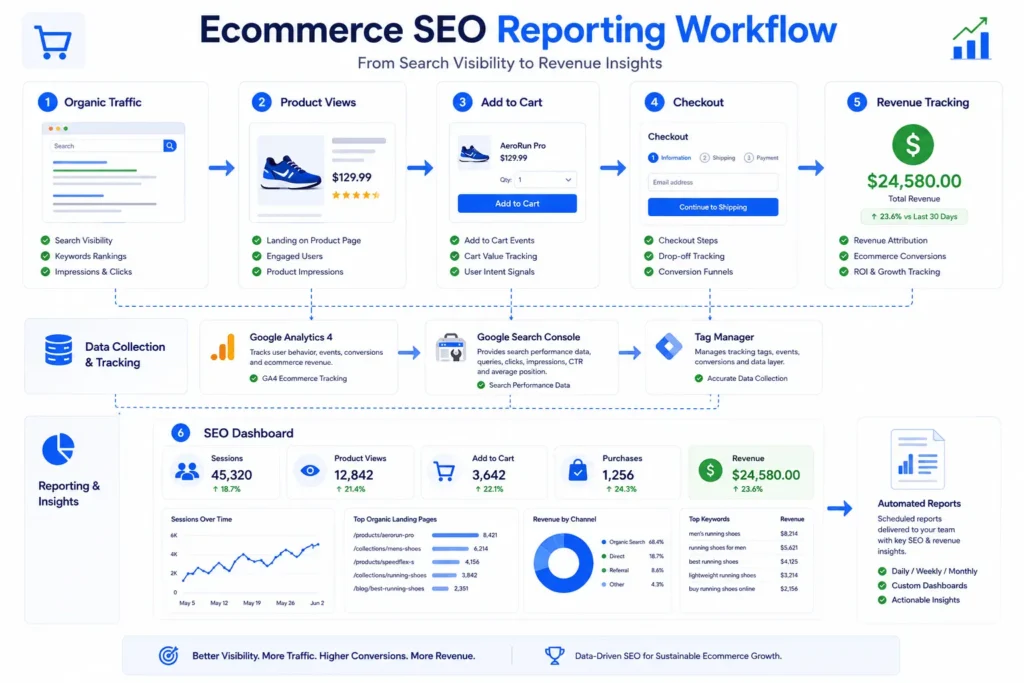
A mature ecommerce SEO Chicago strategy should include GA4 ecommerce tracking, Google Search Console management, Looker Studio dashboards, revenue attribution reporting, conversion funnel analysis, and product performance reporting.
Without proper measurement, businesses often invest in pages and keywords that generate visits but contribute little to revenue.
Ecommerce Reporting Workflow
A practical reporting workflow typically follows this sequence:
- Search Console identifies ranking and visibility changes.
- GA4 tracks engagement and conversions.
- Revenue attribution connects organic traffic to sales.
- Dashboards highlight trends and anomalies.
- SEO priorities are adjusted based on business outcomes
This approach keeps optimization aligned with commercial objectives rather than vanity metrics.
Ecommerce SEO Chicago and Conversion Rate Optimization
Traffic growth without conversion improvement creates diminishing returns. Many ecommerce stores increase organic traffic while revenue growth remains stagnant. The issue is usually found within the conversion funnel rather than search visibility.
Common bottlenecks include slow checkout processes, weak mobile experiences, poor product presentation, lack of trust indicators, and cart abandonment issues.
SEO and CRO should work together. Search visibility brings visitors into the store. Conversion optimization helps those visitors become customers.
Checkout Flow Optimization
Checkout systems frequently become performance bottlenecks. Common operational issues include multi-step checkout friction, slow payment processing, excessive form fields, mobile usability problems, and third-party script conflicts.
When traffic increases significantly, these issues become more expensive because more potential revenue is lost.
Ecommerce SEO Chicago and Modern Technical Architecture
As stores scale, architecture decisions begin affecting search performance. A small catalog can function effectively within a traditional monolithic system. Larger stores often encounter challenges involving inventory synchronization, multi-channel selling, real-time pricing, personalized experiences, and API integrations.
Monolith vs Headless Commerce
Many ecommerce businesses eventually evaluate headless architecture. Traditional ecommerce systems combine frontend, backend, database, and business logic within a single application.
Headless commerce separates frontend presentation from backend commerce operations.
| Traditional Commerce | Headless Commerce |
|---|---|
| Faster deployment | Greater flexibility |
| Lower complexity | Higher scalability |
| Easier management | Better frontend performance |
| Lower development cost | More development effort |
| Suitable for smaller stores | Suitable for larger operations |
Headless architecture can improve performance but introduces operational complexity. The decision should be based on business requirements rather than industry trends.
Businesses evaluating future growth often review their ecommerce website structure and scalability before considering major architectural changes.
API Integrations, Automation, and Ecommerce SEO
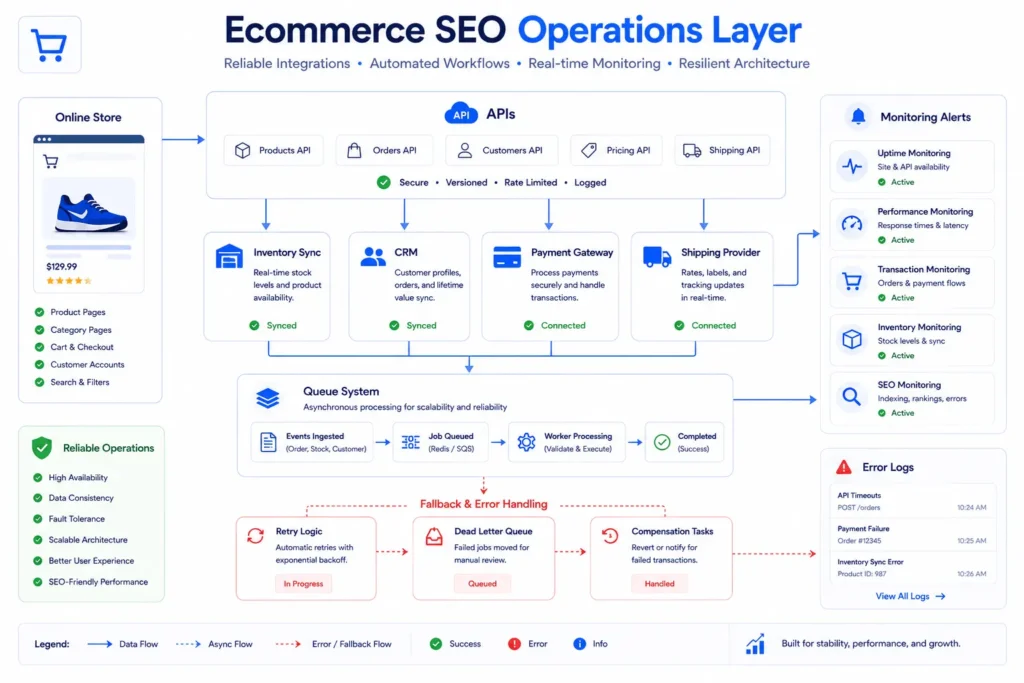
Modern ecommerce stores depend heavily on integrations. Search visibility can be affected by systems that seem unrelated to SEO.
Examples include inventory APIs, shipping providers, payment gateways, CRM systems, ERP platforms, and product feed syndication.
When integrations fail, search performance often suffers indirectly. Out-of-stock pages may remain indexed. Product data may become inaccurate. Category pages may display incomplete inventory.
Operational Reliability Matters
High-performing stores typically implement error logging, queue systems, retry mechanisms, monitoring dashboards, and automated alerts. These systems help detect issues before customers and search engines experience them.
Reliable operations support reliable rankings.
AI Search and the Future of Ecommerce SEO Chicago
Search engines continue evolving toward AI-generated answers and search experiences. This does not eliminate SEO. It changes how information should be structured.
Successful stores increasingly focus on entity-based content, product comparison content, structured data implementation, product guides, buyer education resources, and helpful category content.
Search engines can better understand stores that provide clear context around products, categories, and customer intent. AI-powered search optimization is becoming an extension of traditional ecommerce search engine optimization rather than a replacement.
Enterprise Ecommerce SEO and Operational Complexity
Enterprise ecommerce SEO introduces challenges that smaller stores rarely encounter. These often include multi-location SEO, international ecommerce SEO, multi-language content, multiple inventory systems, large product catalogs, and governance workflows.
At scale, technical debt becomes expensive. A minor indexing issue affecting 20 pages may be manageable. The same issue affecting 20,000 pages becomes a major operational problem.
This is why enterprise ecommerce SEO depends heavily on process, governance, monitoring, and observability.
When Custom Ecommerce Development Becomes Necessary
Off-the-shelf platforms solve many problems efficiently. However, businesses eventually reach points where standard functionality creates limitations.
- Complex pricing rules
- Advanced inventory workflows
- Marketplace integrations
- Custom fulfillment requirements
- B2B ecommerce requirements
- Multi-tenant commerce models
At that stage, maintaining workarounds often becomes more expensive than implementing a purpose-built solution.
Organizations facing these challenges frequently explore custom ecommerce development services to reduce operational friction and support long-term scalability.
Similarly, stores redesigning customer acquisition and conversion journeys often benefit from a stronger ecommerce store design strategy that aligns UX, SEO, and business goals.
How Filicode Approaches Ecommerce SEO Projects
By the time a business begins experiencing crawl inefficiencies, performance degradation, reporting gaps, or integration failures, the challenge is usually larger than keyword optimization.
Filicode approaches ecommerce SEO from a systems perspective. Projects often involve WordPress development, WooCommerce optimization, API integrations, technical SEO implementation, performance engineering, analytics infrastructure, automation workflows, and custom software development.
The objective is not simply improving rankings. The objective is building maintainable ecommerce systems that continue performing as traffic, product catalogs, and operational complexity grow.
For organizations expanding beyond local markets, our SEO services for competitive regional markets provide additional insight into scaling organic acquisition strategies.
Frequently Asked Questions
How much do ecommerce SEO services in Chicago typically cost?
Costs vary depending on catalog size, technical complexity, and competition. Small stores may invest a few hundred dollars monthly, while enterprise ecommerce SEO projects often require significantly larger budgets.
How long does ecommerce SEO Chicago take to produce results?
Technical improvements can generate measurable gains within weeks. Competitive category rankings and broader ecommerce organic traffic growth generally require three to six months or longer.
Which ecommerce platform is best for SEO?
WooCommerce, Shopify, Magento, and BigCommerce can all perform well. The best platform depends on operational requirements, customization needs, scalability goals, and technical resources.
Does ecommerce SEO Chicago help increase sales or only traffic?
When implemented correctly, ecommerce SEO Chicago improves qualified traffic, conversion opportunities, and revenue generation. Rankings alone are not the primary objective.
Is ecommerce website migration risky for SEO?
Yes. Poorly executed migrations can cause ranking losses, indexing issues, and traffic declines. Redirect planning, URL mapping, structured data validation, and technical testing reduce migration risk.
Do ecommerce stores require ongoing SEO maintenance?
Absolutely. Inventory changes, platform updates, new competitors, algorithm changes, and evolving customer behavior require continuous monitoring and optimization.
Conclusion
The strongest ecommerce SEO Chicago strategies are built on architecture, technical reliability, operational visibility, and long-term maintainability.
When category pages become difficult to manage, reporting systems fail to connect traffic with revenue, site performance continues declining, or integrations create recurring operational problems, those are often signs that the underlying ecommerce system is reaching its limits.
Businesses frequently attempt to solve these issues by publishing more content or increasing advertising spend. In practice, structural improvements often create a larger impact.
A well-designed ecommerce platform should support growth without creating excessive maintenance overhead, technical debt, or operational complexity.
If your store is experiencing scaling bottlenecks, architecture limitations, or persistent technical SEO challenges, it may be time to evaluate the underlying systems rather than continuing to optimize around them.
For businesses seeking practical guidance on ecommerce growth, technical architecture, and search visibility, discuss your project with the Filicode team and identify where the next meaningful improvements can be made.