








Contents
- Quick Summary: The Operating Model
- How Service Area Business SEO Actually Works
- Why proximity cannot be engineered away
- Build Geographic Relevance Without Doorway Pages
- Service area pages vs location pages
- Design the Website as a Local Lead System
- Service Area Business SEO Measurement Stack
- Technical Architecture for Maintainable Local Growth
- Reviews, Citations, and Local Authority Signals
- Scaling Service Area Business SEO Across Multiple Regions
- When Off-the-Shelf SEO Operations Stop Scaling
- FAQs About Service Area Business SEO
- How much does service area business SEO cost?
- How long does implementation usually take?
- Can one website scale to many service areas?
- What integrations are useful for a service-area SEO system?
- Is migration to a new local SEO architecture risky?
- Conclusion: Build Coverage Around Operational Reality
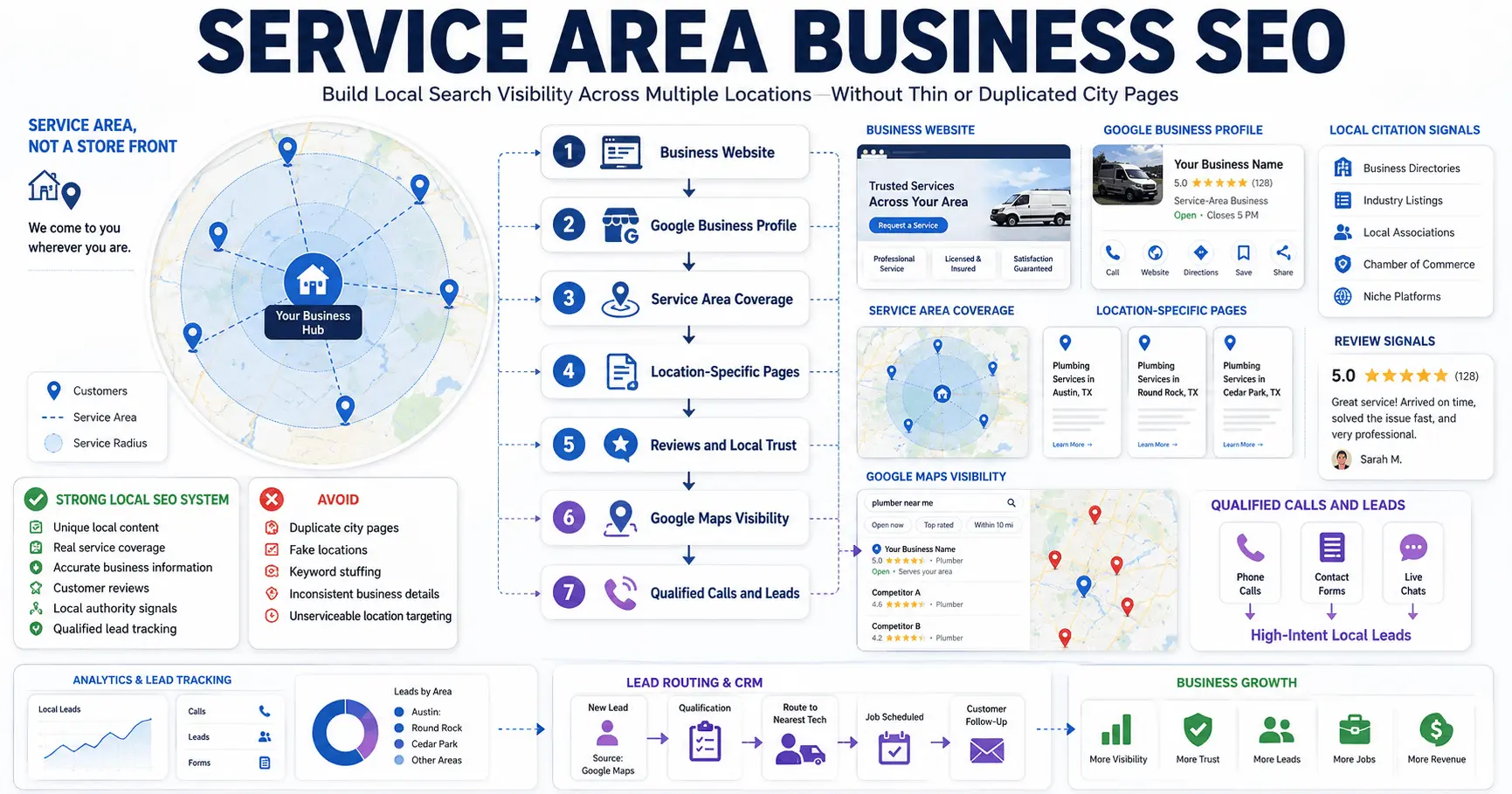
A service business can rank in one neighbourhood, disappear two towns away, and still receive leads from areas it cannot serve profitably. That mismatch is the core problem service area business SEO must solve. The objective is to align Google Business Profile configuration, geographic content, authority signals, technical delivery, and lead operations with places the company can actually support.
Service area business SEO improves local search visibility for a company that travels to customers rather than serving everyone at a public storefront. A sound strategy connects geographic relevance with operational capacity, so rankings, enquiries, dispatch coverage, and customer experience support the same service model.
Quick Summary: The Operating Model
- A service-area business should configure its Google Business Profile around real operating coverage, not an aspirational list of distant cities.
- Location pages create value only when they contain distinct service, proof, logistics, and customer information for that area.
- Local rankings are influenced by relevance, distance, and prominence, so no website architecture can completely remove the effect of geography.
- Reviews, citations, local links, website content, and Business Profile data should describe the same real-world business entity.
- Lead generation is incomplete without routing, validation, attribution, retry handling, and reporting that show which locations produce profitable work.
How Service Area Business SEO Actually Works
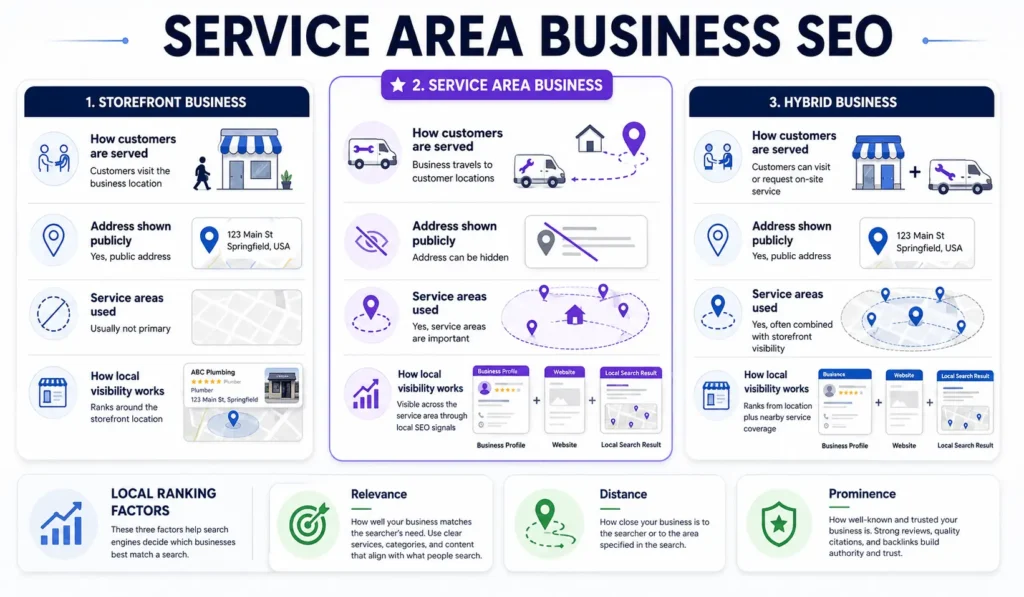
Google distinguishes storefront, service-area, and hybrid businesses. A service-area business visits customers; a hybrid business serves customers at its address and travels to them. Google allows up to 20 service areas based on cities, postal codes, or other supported areas, and says the overall area should generally remain within about two hours of driving time from the business base.
If customers are not served at the business address, the address should not be shown publicly. Google states that hiding the address is appropriate for a service-area business, while the profile displays the service area instead.
This matters because service area business SEO is not a workaround for proximity. Google explains that local results are mainly based on relevance, distance, and popularity or prominence. Complete business information improves relevance, the searcher’s position affects distance, and links plus review signals contribute to prominence.
| Business model | Customer interaction | GBP location setup | Website priority |
|---|---|---|---|
| Storefront | Customers visit the premises | Public address | Location authority around the physical site |
| Service-area business | Team travels to customers | Service area with address hidden when customers are not served there | Service coverage, local proof, and realistic dispatch geography |
| Hybrid business | Customers visit and the team travels | Public address plus service areas | Balance storefront relevance with off-site service coverage |
Why proximity cannot be engineered away
A plumbing company based in one city may have a strong website and excellent reviews, yet still lose map visibility to a credible competitor closer to the searcher. The correct response is not to create a fake office or publish fifty near-duplicate city pages. The response is to strengthen relevance and prominence where the company genuinely operates, while accepting that map visibility varies by search location.
Regional strategy changes with geography. Sparse territories require a different page and proof structure from dense metropolitan markets. An Alaska SEO company strategy should not be copied mechanically into London or Virginia, where travel times, competition density, and search behaviour differ.
Build Geographic Relevance Without Doorway Pages
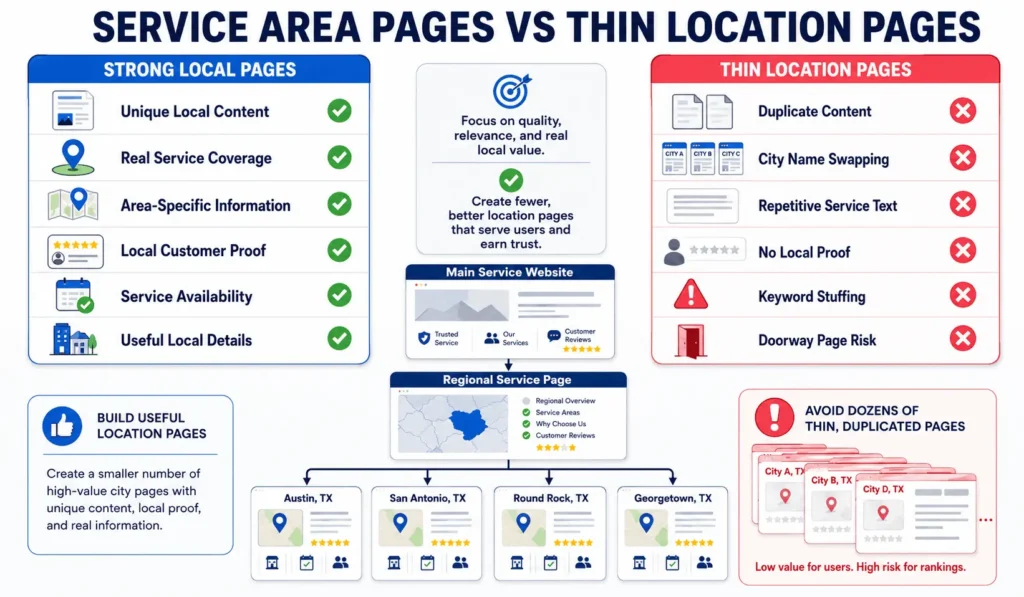
The fastest way to create maintenance debt in service area business SEO is to generate a page for every city, replace the place name, and publish. Users gain nothing from dozens of pages that hide the same service description behind different headings.
Google’s spam policies warn against doorway abuse and pages created primarily to rank for similar queries while funnelling users toward substantially the same destination. A location architecture should therefore be based on useful differences, not a city-name substitution process. Google Search spam policies provide the policy context for that distinction.
Service area pages vs location pages
A service-area page explains coverage across a meaningful region. A location page focuses on one city where demand, proof, and operational differences justify dedicated content. Both can work. The mistake is assuming every town in a CRM dropdown deserves an indexable URL.
For each city page, check whether you can provide distinct information about service availability, response expectations, local constraints, customer evidence, pricing variables, or scheduling. A local SEO checklist for small-business rankings can help teams audit these signals before expanding the page set.
| Architecture choice | When it works | Operational risk | Recommended control |
|---|---|---|---|
| One regional service page | Coverage is compact and services are consistent | Weak relevance for distinct high-value cities | Add local proof and clear coverage information |
| Selected city pages | Demand and content differences are real | Content drift and inconsistent updates | Use a shared content model with required unique fields |
| Large programmatic location set | Only when data and local utility are genuinely unique at scale | Thin content, index bloat, QA failures | Validation rules, canonical controls, and publishing thresholds |
| Multiple microsites | Rare cases with separate brands or legal operations | Authority dilution and duplicated maintenance | Central governance and clear brand boundaries |
Design the Website as a Local Lead System
A ranking is not the final output. The useful output is a qualified job the operation can fulfil. That means service area business SEO should connect search acquisition to the website, CRM, dispatch process, and reporting layer.
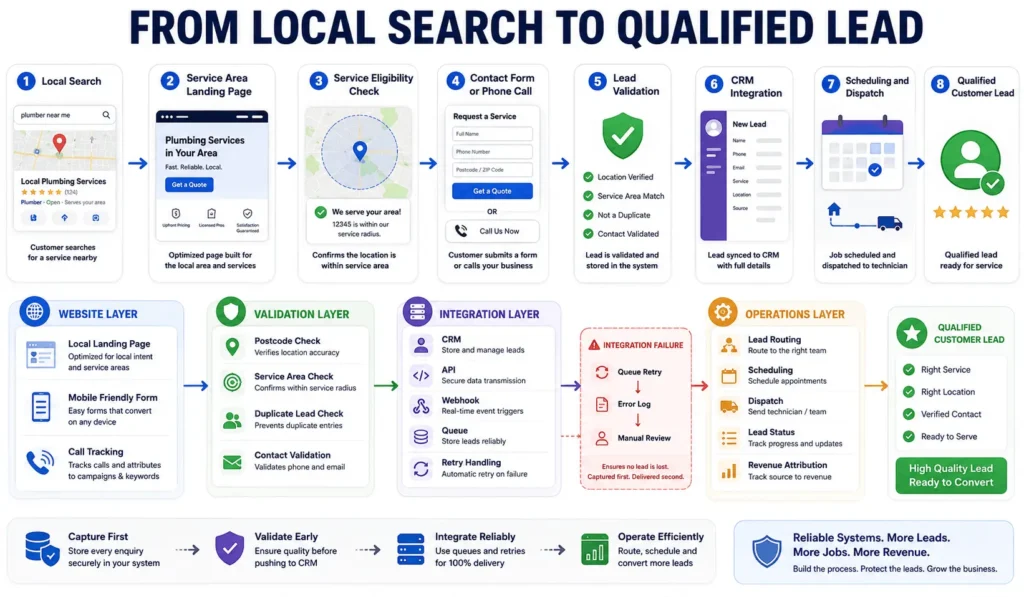
A typical production workflow looks like this: a visitor lands on a cached local page through organic search or Maps, the page confirms service eligibility, the form validates contact and postcode data, and the backend records the enquiry before attempting external integrations. The system then sends the lead to a CRM or scheduling platform through an API or webhook.
External systems fail. Tokens expire, CRM APIs time out, webhooks return errors, and users submit forms twice. A robust workflow stores the lead first, assigns an idempotency key, pushes integration work to a queue, retries transient failures, and logs permanent failures for review. Store attribution with the lead instead of reconstructing it later.
Service Area Business SEO Measurement Stack
For service area business SEO, reporting should connect query visibility to operational outcomes. At minimum, track landing page, geographic intent, form or call source, qualified status, booked status, revenue range, and serviceability outcome. Otherwise a city can look successful in Search Console while producing low-margin work or enquiries outside the dispatch radius.
This operating view is especially useful for london service area business seo, where short physical distances can still produce very different travel times. Straight-line radius can create poor scheduling assumptions. Use actual serviceability rules from operations, then let the content architecture reflect them.
Technical Architecture for Maintainable Local Growth
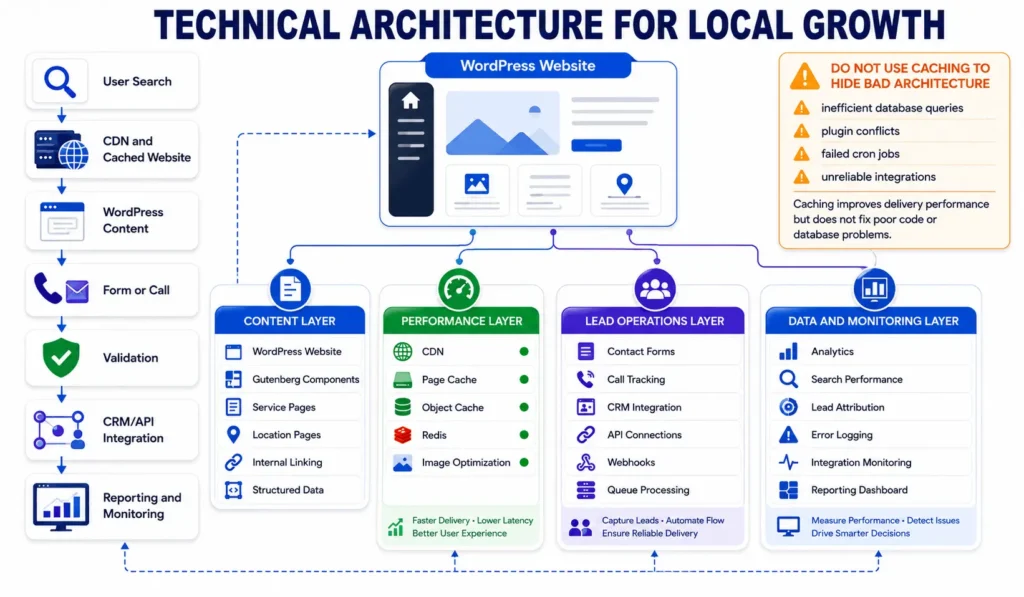
Most local service sites do not need microservices. A well-engineered WordPress monolith is often better because editorial workflow, templates, structured data, forms, and governance stay in one maintainable system. Splitting a modest site into many services adds deployment and observability overhead without solving a real bottleneck.
The architecture should still be disciplined. Use reusable Gutenberg patterns or custom blocks for proof, coverage, FAQs, testimonials, and calls to action. Store location data consistently, limit plugins, test custom hooks, and avoid page-builder logic that creates different markup rules on every city page.
A CDN can cache public assets and suitable HTML responses, while exclusions protect forms and admin sessions. Redis object caching can help database-heavy WordPress installations, but it does not fix inefficient queries or plugin conflicts. Monitor cron tasks; business-critical synchronisation is safer on a system scheduler or managed queue than traffic-triggered WP-Cron alone.
Schema markup can describe the business entity and local properties, but it must match visible, accurate content. Google documents LocalBusiness structured data for details such as hours and other entity information. Use it to support a coherent entity model, not to compensate for weak pages or inconsistent data.
A periodic technical, on-page, and local SEO audit should also check indexability, canonical tags, sitemap quality, broken internal links, duplicate templates, Core Web Vitals, form failures, and structured data errors.
Reviews, Citations, and Local Authority Signals
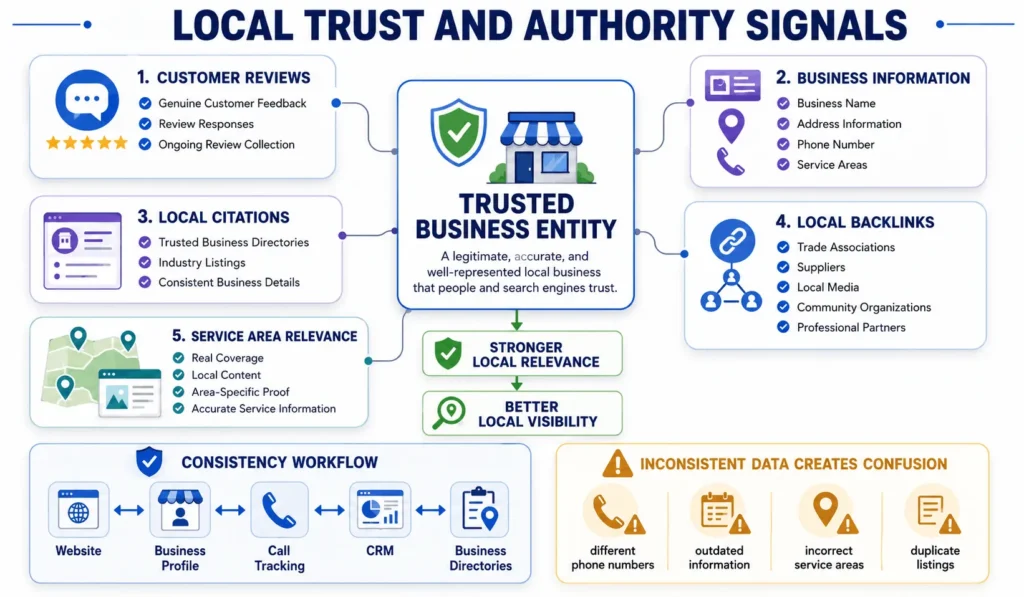
Reviews are not a one-time campaign. In a mature service area business SEO programme, review requests are part of job completion. The CRM should trigger requests after completed service, suppress duplicates, record delivery status, and stop reminders after a review or opt-out.
Do not script customer language or pressure customers to mention a city. Genuine reviews naturally contain service and location context when the experience is specific. Google states that review quantity and positive ratings can contribute to local ranking, while helpful responses also help the business stand out.
Local citations reduce entity ambiguity. NAP consistency means the business name, address handling, and phone details remain coherent across authoritative directories and platforms. When a phone number changes, one owner should manage updates across the website, Business Profile, call tracking, major citations, and CRM rules.
Local backlinks should also be earned from real relationships where possible: trade bodies, suppliers, community organisations, local media, sponsorships, and professional partners. A broader local SEO growth framework can help connect these authority signals with content and conversion work.
Scaling Service Area Business SEO Across Multiple Regions
Expansion creates a governance problem before a content problem. Service area business SEO becomes difficult when regions are added faster than the website, reporting, and review systems can represent them accurately.
Start with a location data model. Define area name, parent region, services, dispatch base, service hours, proof assets, phone routing, page status, canonical URL, and review date. Structured custom fields or a database-backed model are easier to govern than copying old pages and editing them manually.
For WordPress, a custom post type works well when enough legitimate locations justify structured management. A REST API can expose approved location data to other systems, while role-based access control limits publishing and tracking changes. Multisite may suit separated brands, but its deployment, plugin compatibility, and governance overhead need real organisational justification.
Regional comparisons should be used to understand architecture, not to clone content. For example, sustainable local SEO in Virginia can inform how regional proof and service coverage are presented.
A broader scalable search growth approach also shows why technical structure and market strategy need to develop together as regional competition increases.
When Off-the-Shelf SEO Operations Stop Scaling
Spreadsheets, form plugins, and standard CRM automations are sufficient for many companies. Custom development becomes reasonable when teams repeatedly reconcile lead sources, serviceability, dispatch rules, duplicate contacts, and reporting across systems.
Filicode works across custom software, WordPress and WooCommerce development, API integrations, system architecture, SaaS development, automation, and performance optimisation. The role of engineering is not to replace every off-the-shelf tool. It is to remove integration and data problems that create support burden, reporting gaps, and repeated manual work.
Keep the architecture as simple as the operation allows. Use a monolith when one deployable application is easier to maintain. Add asynchronous queues when unreliable integrations affect user requests, and event-driven workflows when several systems must react independently to a verified event. Adopt microservices only when ownership, scale, or deployment requirements justify the cost.
FAQs About Service Area Business SEO
How much does service area business SEO cost?
Service area business SEO pricing depends on market competition, number of genuine service regions, website condition, content requirements, Business Profile complexity, and reporting needs. A small single-region campaign costs less than a multi-location programme that requires technical development, content governance, CRM integration, and call attribution.
How long does implementation usually take?
Initial implementation usually requires several weeks for auditing, Business Profile corrections, technical fixes, page architecture, tracking, and content improvements. Ranking changes can take longer because competition, distance, site authority, crawl cycles, reviews, and local prominence develop at different speeds.
Can one website scale to many service areas?
Yes. One well-structured website can support many service areas when each indexable page has a clear purpose, unique local value, consistent templates, strong internal linking, and reliable content governance. Scale becomes risky when page creation outruns operational proof and quality control.
What integrations are useful for a service-area SEO system?
Useful integrations include CRM lead capture, call tracking, scheduling, postcode or serviceability validation, analytics, review-request automation, and revenue attribution. Integrations should include validation, logging, retry handling, and fallback processes so a third-party outage does not lose enquiries.
Is migration to a new local SEO architecture risky?
Migration carries risk when URLs, redirects, internal links, canonicals, tracking, forms, schema, and Business Profile landing-page links are changed without a controlled plan. Reduce risk with a URL inventory, redirect map, staging QA, analytics validation, crawl comparison, and post-launch monitoring.
Conclusion: Build Coverage Around Operational Reality
Service area business SEO starts failing when the map, the website, and the operation describe different businesses. Warning signs include leads from unserviceable areas, duplicated city pages, inconsistent phone routing, stale location facts, failed CRM handoffs, unexplained ranking gaps, and reporting that stops at form submissions.
The next step is not automatically more content. Audit service coverage, Business Profile configuration, page quality, review workflows, technical health, and lead routing as one system. Consider custom development when manual reconciliation and integration failures become recurring operating costs.
A maintainable service area business SEO programme grows from accurate data, controlled publishing, credible local evidence, resilient lead workflows, and measurement tied to qualified business outcomes. That foundation is slower to fake and easier to scale.