








Contents
- Quick Summary: The Operating View
- How to Improve ROI in Digital Marketing Starts With Measurement Architecture
- How to Improve ROI in Digital Marketing With a Reliable Event Pipeline
- Fix Attribution Before Moving the Budget
- Improve Funnel Economics Before Buying More Traffic
- How to Improve ROI in Digital Marketing Through Channel Economics
- How to Improve ROI in Digital Marketing With Controlled Automation
- Technology Architecture Trade-offs That Affect ROI
- Operational Bottlenecks That Quietly Reduce Digital Marketing ROI
- How to Improve ROI in Digital Marketing Before Scaling Budget
- When Technical Delivery Becomes Part of Marketing Performance
- Frequently Asked Questions
- How is digital marketing ROI calculated?
- How long does it take to improve digital marketing ROI?
- Can a small business improve ROI without replacing its marketing stack?
- What integrations matter most for digital marketing ROI?
- How can AI automation improve marketing ROI safely?
- Conclusion: Build a Better Feedback System Before Spending More
A common ROI problem is not weak creative. It is a broken operating system behind the campaign. Ads generate clicks, forms submit, CRM records arrive late, sales teams update stages inconsistently, and finance data never closes the loop. That makes optimization noisy and budget decisions political.
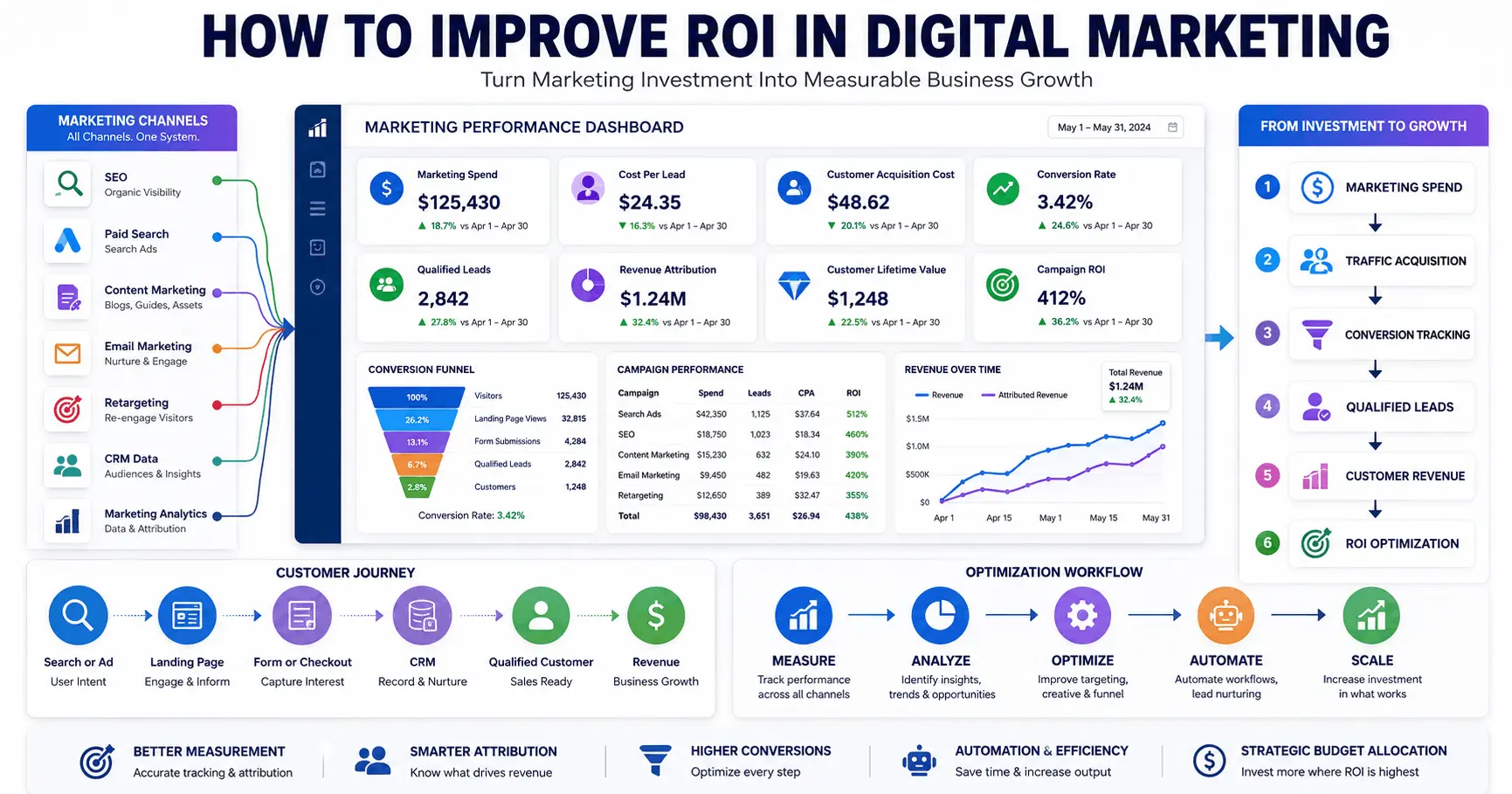
The practical answer to how to improve ROI in digital marketing is to connect spend, user behavior, lead quality, sales outcomes, and revenue in one measurable workflow. Improve the measurement architecture first, then reduce conversion friction, automate repetitive decisions, and move budget toward channels that produce profitable customers rather than cheap activity.
Quick Summary: The Operating View
- How to improve ROI in digital marketing starts with using revenue, not platform-reported conversions, as the final optimization signal.
- A reliable measurement stack needs consistent event definitions, server-side validation, CRM stage discipline, and revenue reconciliation.
- Increasing traffic before fixing funnel leakage usually increases waste faster than it increases growth.
- Automation creates value when it shortens response times, improves segmentation, or reduces manual work without removing validation and fallback controls.
- Channel budgets should be managed by marginal return, customer lifetime value, payback period, and lead quality, not by average cost per lead alone.
How to Improve ROI in Digital Marketing Starts With Measurement Architecture
Most teams can calculate a simple return on investment formula: attributable revenue minus marketing cost, divided by marketing cost. The harder problem is deciding which revenue is genuinely attributable and how shared costs should be allocated.
A useful measurement framework has four layers: acquisition data, behavioral events, commercial stages, and financial outcomes. Ad platforms, analytics, CRM, billing, and reporting should share consistent identifiers and explicit event ownership.
For teams evaluating regional campaign execution and technical delivery together, a structured digital marketing agency approach should connect campaign planning with analytics, landing-page performance, CRM integration, and revenue reporting rather than treat them as isolated services.
How to Improve ROI in Digital Marketing With a Reliable Event Pipeline
The production workflow should be simple enough to explain and resilient enough to survive failures.
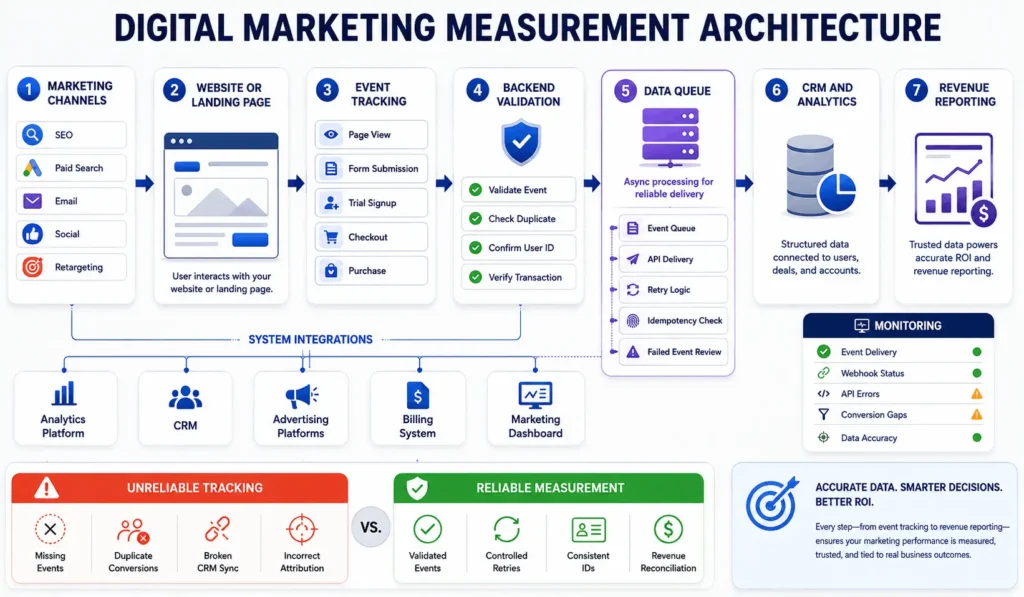
A visitor lands with campaign parameters and a first-party identifier. The frontend records permitted interaction events. The backend validates critical actions such as forms, trials, checkout completion, or subscription activation, then writes valid events to a durable database or queue before downstream delivery.
Async workers send events to analytics, ad platforms, CRM systems, and reporting stores. API timeouts should trigger controlled retries with idempotency keys so purchases or leads are not counted twice. Failed payloads need a review path, and monitoring should flag event drops, schema errors, webhook failures, and unusual differences between platform and finance totals.
This is where how to improve ROI in digital marketing becomes an engineering problem. If paid leads disappear during a CRM outage, reporting may incorrectly reduce spend on a profitable campaign. A reliable system preserves the event, retries delivery, records failure state, and exposes the exception.
Fix Attribution Before Moving the Budget
Attribution modeling is not a search for one perfect model. It is a way to understand how credit changes when different touchpoints are recognized. For implementation context, review the Google Analytics attribution documentation before selecting a reporting model.
Last-click reporting is easy to operate but can over-credit closing channels. Multi-touch attribution adds journey context but depends on identity resolution and clean data. Marketing mix modeling supports broader budget planning, not daily campaign-level conversion tracking.
| Attribution Method | Best Use | Main Limitation | Operational Requirement |
|---|---|---|---|
| Last click | Simple channel reporting | Understates assisting touchpoints | Consistent conversion definitions |
| Data-driven attribution | Accounts with sufficient journey data | Model logic is less transparent | Clean event and path data |
| Multi-touch attribution | Longer B2B or SaaS journeys | Identity stitching can be incomplete | CRM and web identity alignment |
| Marketing mix modeling | Strategic budget allocation | Less useful for daily optimization | Sufficient historical spend and outcome data |
Use attribution as a decision aid, then validate the result against pipeline value, closed revenue, gross margin, and sales feedback. That discipline is central to how to improve ROI in digital marketing because platform-visible conversions are not always equal to business profitability.
Improve Funnel Economics Before Buying More Traffic
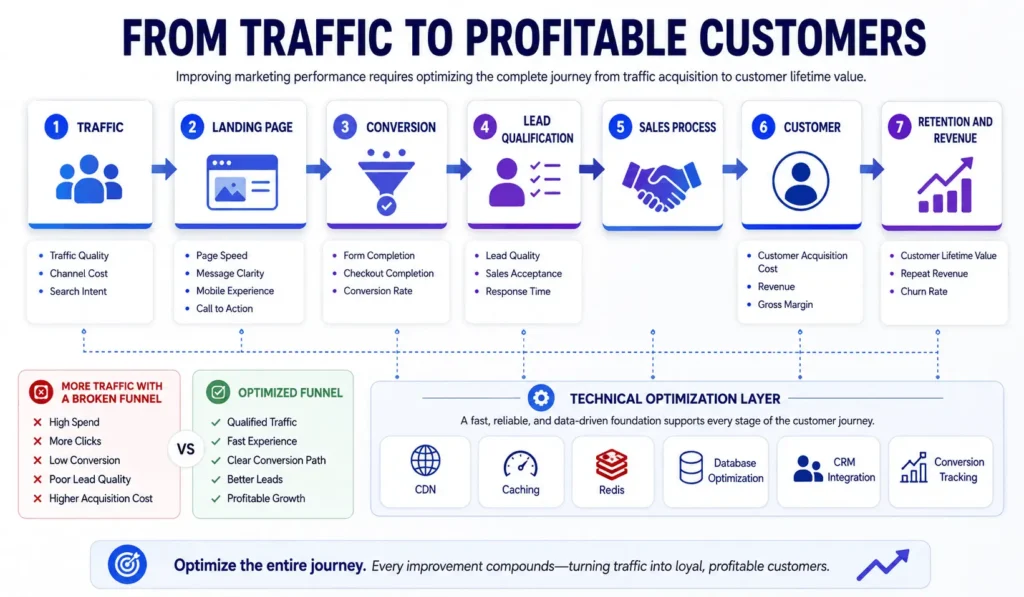
A campaign can have a good click-through rate and still produce poor economics. Cost per lead becomes misleading when lead quality varies, while customer acquisition cost becomes misleading when onboarding, support, refunds, payment failures, or relevant sales labor are excluded.
Start with the funnel as an operating model:
- Traffic quality affects landing-page engagement.
- Landing-page clarity affects form completion or checkout progression.
- Backend reliability affects whether the conversion is recorded and routed.
- CRM response time affects qualification and close rate.
- Product fit and onboarding affect retention and customer lifetime value.
For B2B teams, the broader B2B digital marketing strategy should connect demand generation with qualification rules, sales capacity, buying-cycle length, and account economics. More leads can reduce revenue efficiency when sales cannot process them well.
WordPress and WooCommerce need operational checks. Plugin conflicts can break tracking hooks, slow checkout queries reduce conversion rate, uncached personalization raises server load, and WordPress cron or overloaded queues can delay background work during campaign peaks.
Object caching, Redis, CDN configuration, database indexing, controlled plugins, and tested REST API integrations can improve performance and measurement reliability. Headless WordPress can help when multi-channel delivery justifies extra integration and deployment complexity, not simply because the architecture is fashionable.
How to Improve ROI in Digital Marketing Through Channel Economics
Channel optimization should compare the economics of the next unit of spend, not only historical averages. Ask whether the next budget increment is likely to produce acceptable payback and customer lifetime value.
Paid search is strongest when demand already exists. Organic search can compound over time but requires realistic expectations about indexing, authority, competition, content quality, and the economics of SEO investment.
Comparing paid and organic search should account for timing as well as cost because SEO results usually accumulate over time.
For teams managing paid acquisition, the operational structure behind PPC management matters as much as bid changes. Search-term control, negative keywords, conversion value rules, landing-page alignment, experiment design, and budget pacing should work as one system.
Email marketing ROI often improves through segmentation, lifecycle triggers, and deliverability discipline. Social supports discovery and retargeting, while programmatic buying can scale reach but also amplify waste when inventory controls and conversion validation are weak.
To understand how to improve ROI in digital marketing across channels, establish a common reporting layer. Use the same revenue definition, customer window, refund treatment, and margin assumptions. Otherwise, each channel appears to win under its own accounting rules.
How to Improve ROI in Digital Marketing With Controlled Automation
Automation should remove delay or repetitive work. It should not hide bad decisions behind more software.
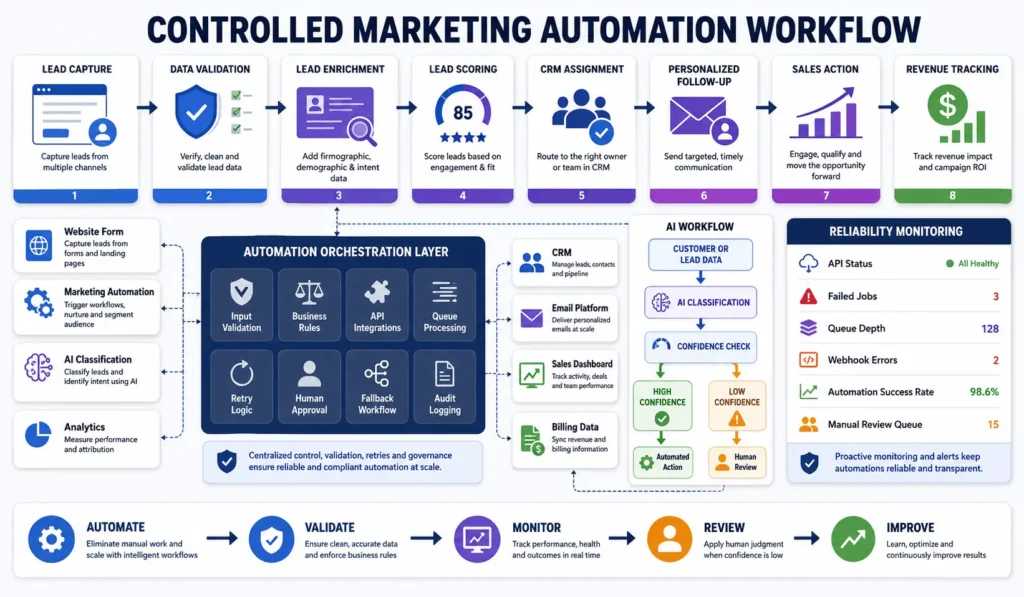
A marketing automation workflow might score a lead, enrich company data through an API, assign an owner, trigger a relevant sequence, schedule follow-up, and update reporting. Each step needs validation, timeout handling, and an audit record.
AI agents can classify inbound requests, summarize sales calls, prioritize support queues, or recommend campaign actions. Production use needs an orchestration layer: validate inputs, restrict tool permissions, require human approval for high-impact actions, monitor outputs, and provide fallback rules for failure or low confidence.
The same principles apply to CRM automation and data pipelines. Failed webhooks must not drop qualified leads, retries must not create duplicate contacts, and schema changes must not corrupt reporting. Reliable automation is visible, testable, and reversible.
Teams exploring these patterns can review how enterprise AI automation workflows are designed around orchestration, validation, integration, and operational control.
Technology Architecture Trade-offs That Affect ROI
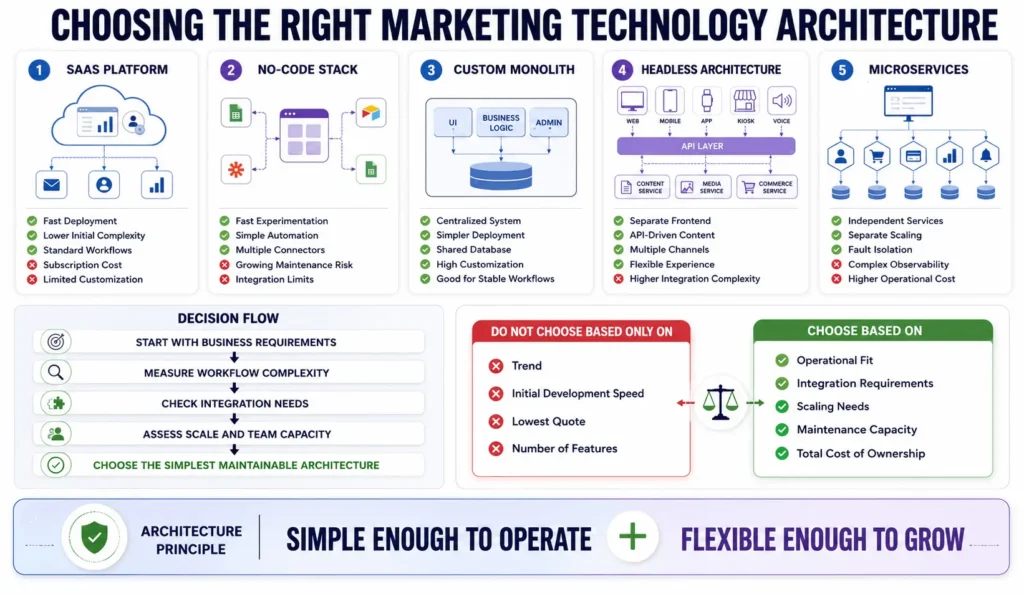
Marketing stacks become expensive when every team buys a local solution to a local problem. Data duplicates, permissions drift, subscription costs rise, and reporting becomes manual.
| Approach | Speed to Launch | Flexibility | Maintenance Load | Best Fit |
|---|---|---|---|---|
| SaaS platform | Fast | Moderate | Low to moderate | Standard workflows with limited customization |
| No-code stack | Fast | Moderate at small scale | Can rise quickly | Early experimentation and simple automation |
| Custom monolith | Moderate | High | Moderate | Stable domain with integrated workflows |
| Headless architecture | Moderate | High | High | Multiple frontends and complex content delivery |
| Microservices | Slow | Very high | Very high | Large systems with clear service boundaries and scaling needs |
A monolith is often the right starting point because deployment, observability, and transactions stay simpler. Microservices become valuable when independent scaling, team ownership, fault isolation, or deployment boundaries justify their operational cost.
Off-the-shelf SaaS is efficient when the workflow fits. Custom software becomes rational when licensing cost, reconciliation work, integration limits, or process exceptions create recurring expense.
Operational Bottlenecks That Quietly Reduce Digital Marketing ROI
Many teams ask how to improve ROI in digital marketing while ignoring technical debt that directly affects conversion and reporting.
A slow landing page reduces the value of every paid visit. Database contention delays checkout. Broken webhooks disconnect payment events from CRM records. Weak RBAC permits uncontrolled changes, while poor audit logging makes performance shifts difficult to explain.
Observability should cover technical and commercial signals. Track application errors, queue depth, API latency, webhook failures, cache hit rates, database load, checkout completion, lead routing delay, and CRM stage movement.
Payment workflows need similar discipline. Webhook verification, transaction states, refunds, subscription changes, invoice generation, fraud review, and reconciliation all affect true campaign profitability.
How to Improve ROI in Digital Marketing Before Scaling Budget
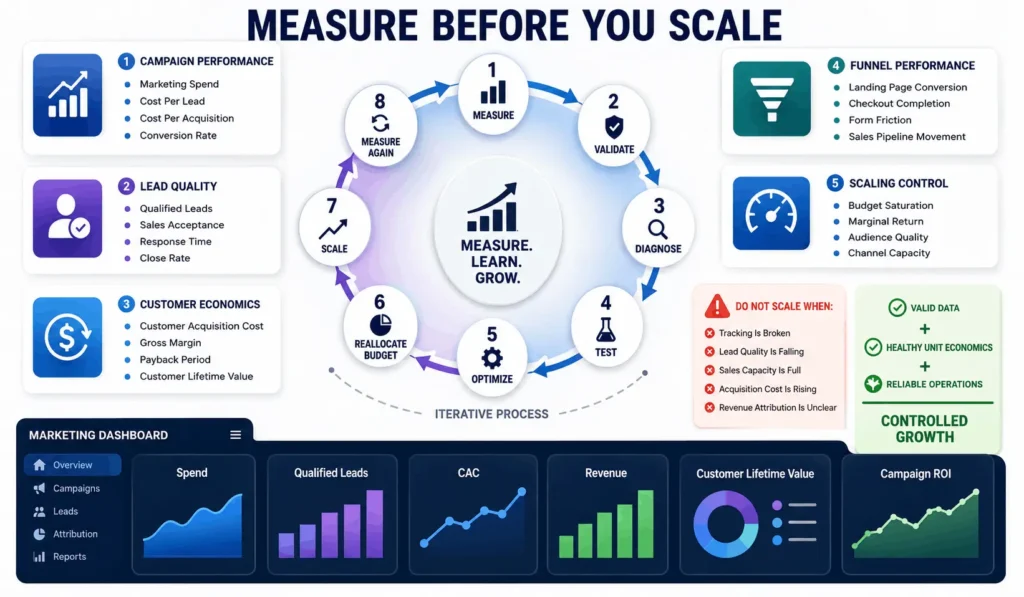
The safest way to scale is to increase budget behind a system that already explains where value is created and where it is lost.
Use SMART goals at the operating level. Instead of “increase conversions,” define the target segment, qualified pipeline value, acceptable acquisition cost, payback window, measurement period, and owner.
A/B testing should focus on economically meaningful decisions such as offer structure, message clarity, form friction, pricing presentation, checkout steps, onboarding prompts, or audience segmentation.
Budget allocation should consider saturation. Strong historical return can fall as spend rises. Review cohorts, lead quality, sales acceptance, close rate, retention, and refund behavior.
This approach to how to improve ROI in digital marketing treats campaign optimization as a feedback system: measure, validate, diagnose, change one controlled variable, observe downstream impact, and update allocation.
When Technical Delivery Becomes Part of Marketing Performance
There is a point where marketing optimization cannot be separated from the systems carrying the customer journey.
Filicode works across custom software, WordPress and WooCommerce development, API integrations, AI automation, SaaS development, system architecture, and performance optimization. For how to improve ROI in digital marketing at this stage, the question is whether current tools and workflows create measurable operational friction.
Warning signs include spreadsheet reconciliation, duplicate records, fragile plugin chains, untraceable webhook failures, slow releases, unreliable dashboards, manual lead routing, and support burden growing faster than revenue.
When those conditions appear, start with architecture review, not a rewrite. Map critical workflows, identify data ownership, measure failure points, simplify unnecessary integrations, and decide what should remain SaaS, what should be consolidated, and what genuinely requires custom engineering.
Frequently Asked Questions
How is digital marketing ROI calculated?
Digital marketing ROI is commonly calculated by subtracting marketing cost from attributable revenue, then dividing by marketing cost. Include media spend, agency fees, software, creative production, relevant sales labor, refunds, and margin assumptions so the result reflects business economics rather than media efficiency alone.
How long does it take to improve digital marketing ROI?
The timeline depends on the bottleneck. Tracking fixes and budget reallocation can affect decisions within days or weeks, while SEO, lifecycle automation, CRM cleanup, and architecture changes may take months to show full impact. Tie the timeline to the sales cycle and measurement window.
Can a small business improve ROI without replacing its marketing stack?
Yes. A small business deciding how to improve ROI in digital marketing can start by fixing conversion tracking, simplifying campaigns, improving landing pages, tightening targeting, connecting forms to the CRM, and removing reporting errors. Replacement becomes justified when integration failures, subscription overlap, or maintenance work cost more than a better architecture.
What integrations matter most for digital marketing ROI?
The highest-value integrations connect ad platforms, web analytics, forms or checkout, CRM stages, billing data, and customer support outcomes. The goal is a traceable path from spend to revenue with reliable identifiers, validation, retries, and reconciliation.
How can AI automation improve marketing ROI safely?
AI automation can improve marketing ROI by reducing response time, classifying leads, summarizing interactions, supporting segmentation, and assisting repetitive campaign work. Safe implementation requires restricted permissions, validated inputs, monitored outputs, human approval for high-impact actions, audit logging, and fallback procedures.
Conclusion: Build a Better Feedback System Before Spending More
The clearest warning signs are inconsistent reports, conversion gaps, slow lead response, duplicate data, fragile integrations, queue failures, checkout latency, and teams spending hours reconciling systems that should agree.
The practical path for how to improve ROI in digital marketing is to strengthen the feedback loop between marketing spend and real business outcomes. Fix measurement, validate attribution, remove funnel friction, automate controlled workflows, monitor production systems, and scale only where marginal economics remain healthy.
Consider custom development when off-the-shelf tools create recurring manual work, block necessary integrations, or cannot support required workflows reliably. Start with a technical and commercial review of the current stack. For how to improve ROI in digital marketing sustainably, the objective is lower operational friction, clearer decisions, and maintainable growth.