








Contents
- Quick Summary: The Practical Decision
- How Many Keywords for SEO Should One Page Target?
- Why Fixed Advice on How Many Keywords for SEO Fails
- One Keyword, Many Keywords, or a Keyword Cluster?
- How Many Keywords for SEO in a Service Page?
- How to Build the Keyword-to-Page Architecture
- Production Workflow: From Research to Published Page
- How Many Keywords for SEO by Content Type?
- Keyword Placement Without Keyword Stuffing
- Common Bottlenecks and Their Operational Impact
- When Filicode Supports the Wider System
- Frequently Asked Questions
- How many keywords for SEO should I use on one page?
- Can a page rank for more keywords than it targets?
- What keyword density percentage should I use?
- How long does keyword optimization take to show results?
- When should similar keywords use separate pages?
- Can automated keyword clustering replace human review?
- Conclusion: Use Intent as the Control System
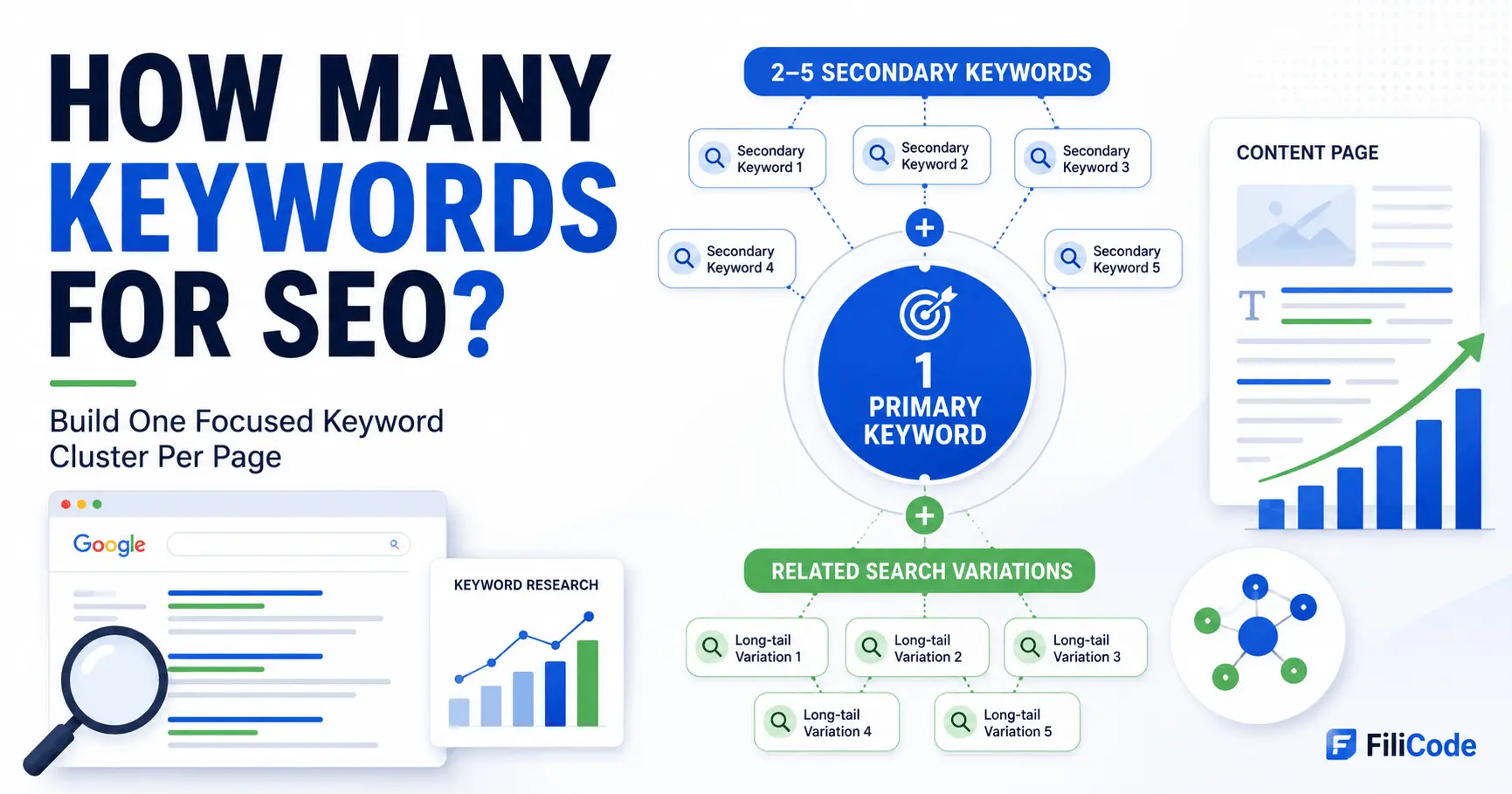
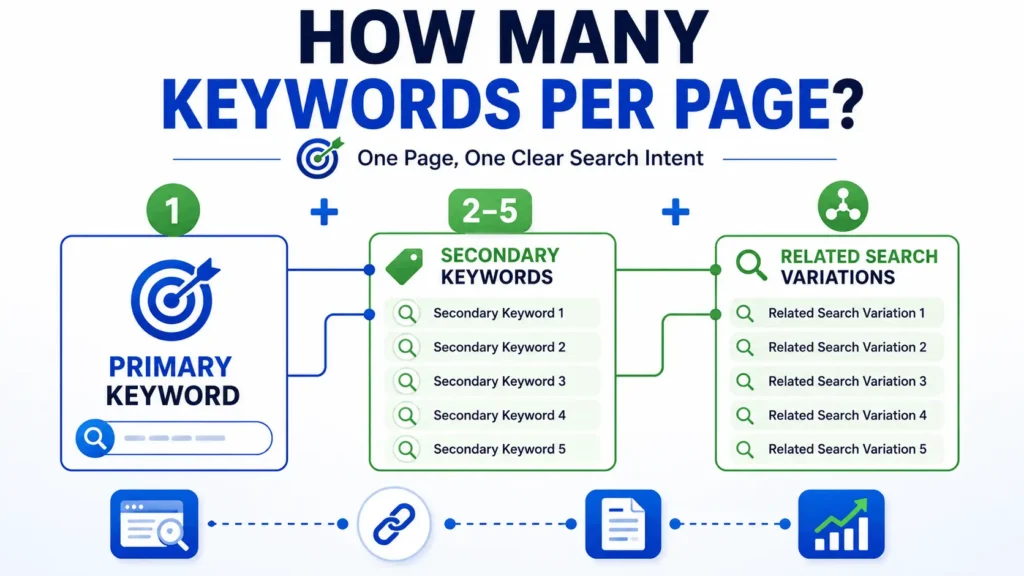
Publishing teams often start with a spreadsheet containing 30, 50, or 100 phrases and then try to force all of them into one page. That creates unclear intent, repetitive copy, and pages that compete with each other. The practical answer to how many keywords for SEO is usually one primary keyword, two to five closely related secondary keywords, and additional natural variations that support the same search intent.
When deciding how many keywords for SEO, the count is not the real control point. Intent alignment is. A page can rank for hundreds of queries while being deliberately optimized around one focused keyword cluster. The objective is to build one clear answer for one search problem, not to make every phrase in a keyword research tool appear in the copy.
Quick Summary: The Practical Decision
- Use one primary keyword to define the page’s main search intent and content promise.
- Add two to five secondary keywords only when they can be answered by the same page without changing its purpose.
- Treat long-tail keywords, synonyms, entities, and question phrases as supporting coverage rather than separate density targets.
- Create another page when keywords show different intent, different buyers, or weak SERP overlap.
- Measure rankings, impressions, conversions, and cannibalization after publishing; do not optimize by keyword count alone.
How Many Keywords for SEO Should One Page Target?
For most pages, the answer to how many keywords for SEO is one primary term plus a small cluster of related phrases. A 1,500-word guide may naturally cover more variations than a 500-word service page, but content length should follow the subject rather than an arbitrary keyword quota.
A useful page-level model is:
- One primary keyword: the phrase that best represents the page’s intent.
- Two to five secondary keywords: close variations, subtopics, or supporting questions.
- Natural semantic coverage: entities, synonyms, examples, and terminology required to explain the subject properly.
This is not a ranking formula. It is a governance model that keeps briefs, title tags, H1 headings, internal links, and reporting aligned. Google advises site owners to use the words people search for in prominent locations such as the title and main heading, while its spam policies define excessive unnatural repetition as keyword stuffing. Google Search Essentials supports clear placement, not mechanical repetition.
Why Fixed Advice on How Many Keywords for SEO Fails
Teams asking how many keywords for SEO often assume each keyword needs its own paragraph or a fixed frequency. That approach fails because keywords are not independent database records. Search engines interpret language, entities, page structure, links, and intent together.
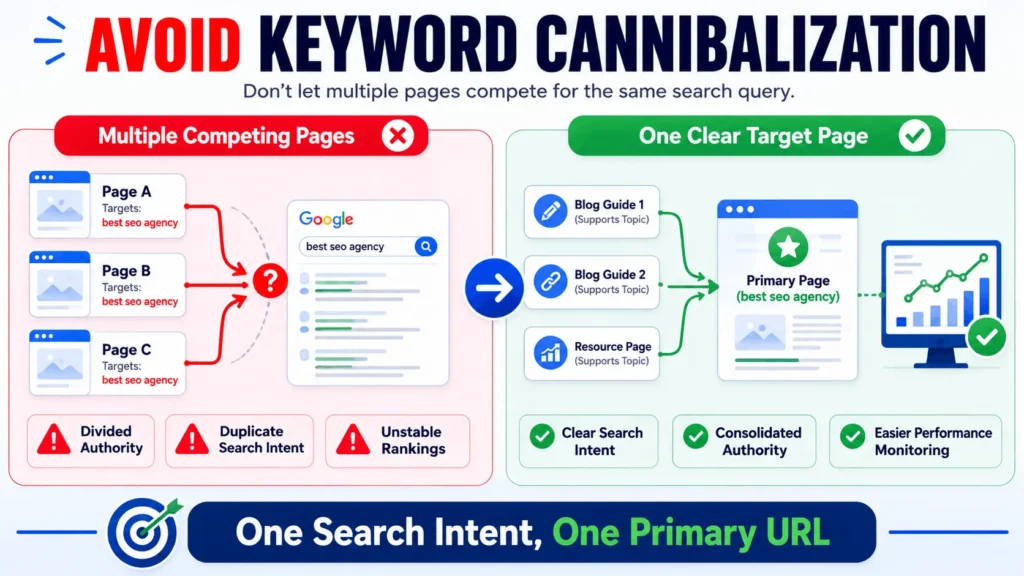
In production, the problem appears when a content calendar is managed as a list instead of an architecture. Writers create separate pages for small wording changes, developers add near-identical templates, and internal links point to multiple URLs for the same topic. The result is keyword cannibalization, weak authority signals, higher maintenance overhead, and unstable Google ranking performance.
Keyword density also becomes misleading at this stage. A keyword density percentage can identify obvious underuse or stuffing, but it cannot tell whether the page answers user intent, contains reliable information, or deserves to rank. A readable page with strong topical depth will normally use exact-match keywords less rigidly than a page written to satisfy a plugin score.
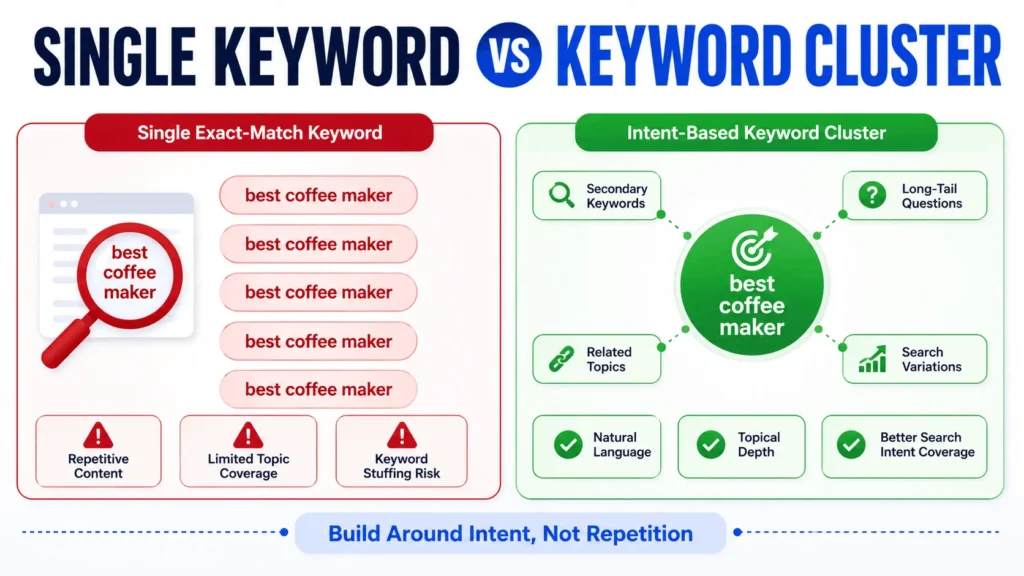
One Keyword, Many Keywords, or a Keyword Cluster?
| Feature | Single Exact-Match Focus | Intent-Based Keyword Cluster |
|---|---|---|
| Page purpose | Often too narrow | One clear intent with supporting depth |
| Keyword coverage | One repeated phrase | Primary, secondary, long-tail, and semantic terms |
| Readability | Can sound repetitive | Uses natural language and useful examples |
| Scaling risk | Creates many thin pages | Reduces overlap and cannibalization |
| Best use | Very specific landing pages | Most service pages, guides, and category content |
The cluster model is normally the better answer to how many keywords for SEO. It recognizes that one page can satisfy several closely connected queries. The constraint is SERP overlap: if the same types of pages rank for two keywords and the intent is equivalent, those terms usually belong together. If the results show different page types, offers, or buyer stages, separate pages are safer.
How Many Keywords for SEO in a Service Page?
A service page should usually target one commercial phrase and a small set of service variations. For example, an Alabama SEO company page can cover related terms about local strategy, technical SEO, content, reporting, and business outcomes without creating a different page for every wording change.
Do not combine unrelated services simply because they share search volume. SEO consulting, WordPress development, paid advertising, and AI automation may support one buyer journey, but they are different primary intents. Each deserves a clear page when the offering, evidence, conversion action, and competitive SERP are different.
How to Build the Keyword-to-Page Architecture
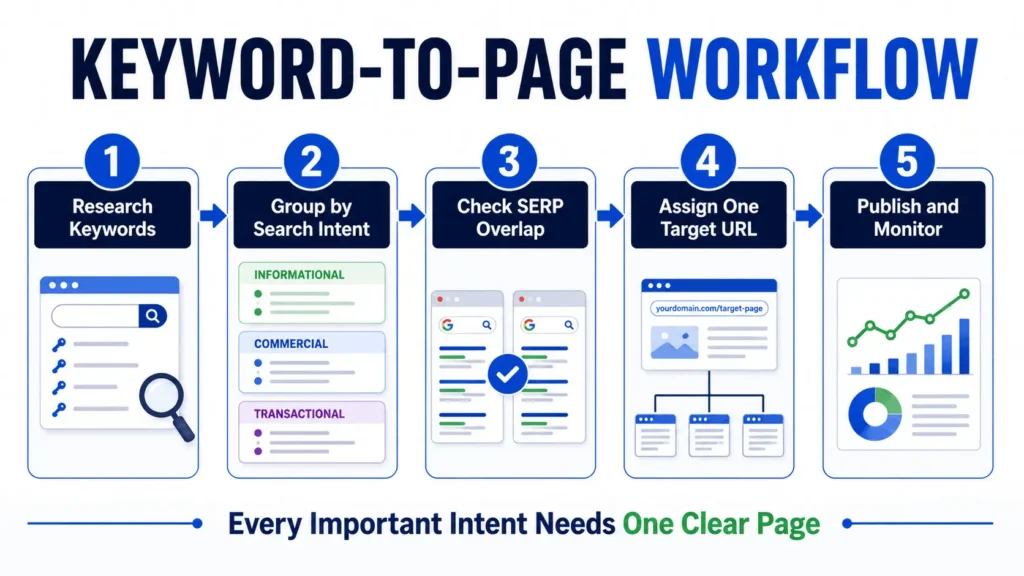
The scalable answer to how many keywords for SEO starts before writing. Build a keyword-to-page map that assigns each important intent to one canonical URL. The map should include the primary keyword, secondary keywords, target page type, funnel stage, internal links, owner, publication status, and validation date.
Use the following workflow:
- Collect candidate keywords from Search Console, competitor pages, customer questions, sales calls, and a keyword research tool.
- Group phrases by meaning and user intent, not only by shared words.
- Check SERP overlap to decide whether terms belong on one page.
- Choose one primary keyword for each URL and document its supporting cluster.
- Review existing content before approving a new page.
- Publish, measure query coverage, and consolidate pages when overlap appears.
A structured SEO audit checklist helps validate whether the problem is content coverage, internal linking, indexation, or template quality. This matters because adding keywords cannot repair a page blocked by a noindex tag, weakened by the wrong canonical, or buried too deep in the site architecture.
Production Workflow: From Research to Published Page
At small scale, deciding how many keywords for SEO can live in a spreadsheet. At larger scale, the workflow behaves like a content system. The frontend exposes the published page. WordPress stores content, metadata, taxonomies, links, and revision history in the backend database. SEO plugins generate title tags, meta descriptions, canonicals, and schema. Crawlers and APIs return performance data for the next optimization cycle.
When content is created through imports, AI automation, or a headless CMS, validation becomes critical. API authentication should restrict who can publish. RBAC should separate writers, reviewers, developers, and administrators. Webhooks can trigger cache invalidation, sitemap updates, or indexing checks after publication. Queues are useful for large audits, link checks, and content scoring because these jobs should not block a user request.
In production, this fails when scheduled jobs depend entirely on low-traffic WordPress cron, an API rate limit stops halfway through an import, or a retry creates duplicate posts. Reliable systems use idempotent job identifiers, bounded retries, failure logs, alerts, and human review before high-impact changes go live.
Caching also affects validation. A writer may update the H1 while a CDN, page cache, or Redis object cache continues serving the old version. Deployment checks should inspect rendered HTML, not only the WordPress editor. The technical SEO checklist for scalable sites covers these crawlability, rendering, caching, and monitoring dependencies.
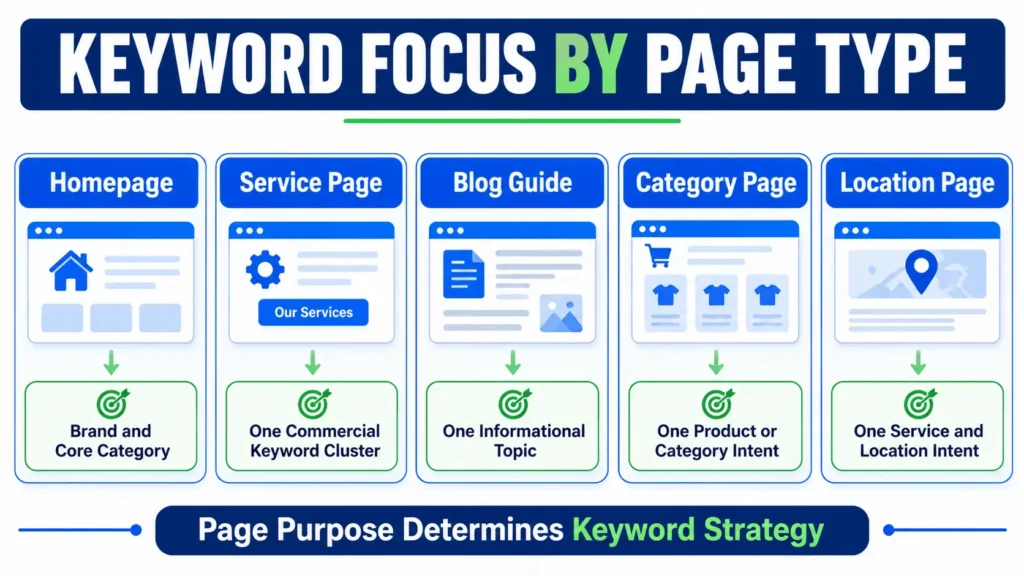
How Many Keywords for SEO by Content Type?
| Content Type | Recommended Focus | Main Risk |
|---|---|---|
| Homepage | Brand, category, and core value proposition | Trying to target every service |
| Service page | One commercial keyword cluster | Mixing unrelated services or locations |
| Blog guide | One informational topic with multiple subquestions | Adding sections that do not match intent |
| Product or category page | One product or category intent with attributes | Duplicate filters and thin variants |
| Location page | One service-location combination | Doorway-style duplication |
| Comparison page | One decision query with clear criteria | Biased or unsupported claims |
These are planning ranges, not rules enforced by Google. The right answer to how many keywords for SEO changes with page purpose, content depth, competition, and how people search. A detailed guide may rank for many long-tail questions, while a transactional page should remain tightly focused on the action users want to take.
Keyword Placement Without Keyword Stuffing
After deciding how many keywords for SEO belong on the page, place the primary keyword where it clarifies the topic: the meta title, H1 heading, introduction, a relevant H2, body copy, image alt text when descriptive, and possibly the conclusion. Secondary keywords fit naturally in subheadings, examples, definitions, FAQs, and internal anchor text.
The question how many keywords for SEO should never become a reason to repeat the exact phrase every few lines. Read the page aloud. If the wording sounds designed for a checker rather than a person, replace repetitions with specific explanations, examples, and semantic variations.
Keyword stuffing is not only a copy problem. It can also appear in title templates, location blocks, product attributes, footer links, tags, and auto-generated archives. On WordPress and WooCommerce, plugin settings can accidentally index hundreds of weak taxonomy pages. A practical small business SEO checklist helps teams review content, local signals, technical health, and conversion paths as one operating system.
Common Bottlenecks and Their Operational Impact
A reliable process for how many keywords for SEO also needs ownership. Writers optimize for volume, developers optimize for templates, and leadership tracks traffic without agreeing on the page’s commercial purpose. A keyword map needs a named owner and a review process.
The second bottleneck is stale data. Search demand, SERP composition, products, and customer language change. Recheck priority clusters quarterly and after major ranking shifts, migrations, or service changes. Monitoring should alert the team when two URLs begin receiving impressions for the same core query.
The third bottleneck is premature scaling. Microservices, event buses, and separate content services can improve isolation for large platforms, but they also add authentication, observability, deployment, and synchronization overhead. A well-maintained WordPress monolith is often the more reliable choice for a normal B2B site. Headless architecture becomes useful when multiple channels, complex permissions, or independent release cycles justify the operational cost.
This trade-off applies to SEO automation as well. Automated clustering and metadata generation reduce repetitive work, but false grouping can merge different intents. Human review remains necessary for money pages, regulated topics, migration decisions, and pages with significant revenue impact.
When Filicode Supports the Wider System
Sometimes the answer to how many keywords for SEO exposes a larger platform problem. The team may have duplicate templates, weak internal linking, slow WordPress queries, WooCommerce archive sprawl, disconnected CRM data, unreliable API integrations, or no content governance.
Filicode works across custom software development, WordPress and WooCommerce development, SaaS architecture, API integrations, AI automation, and performance optimization. The practical value is not adding more technology. It is choosing the smallest maintainable system that can support reliable publishing, measurement, permissions, integrations, and future growth.
Custom development becomes reasonable when off-the-shelf tools create repeated manual work, plugin conflicts, data inconsistency, slow deployments, or reporting gaps. The limitation is that custom systems require discovery, testing, documentation, monitoring, and ongoing ownership. They reduce long-term operational friction only when the architecture matches the team and business model.
Frequently Asked Questions
How many keywords for SEO should I use on one page?
The practical answer to how many keywords for SEO is one primary keyword and usually two to five closely related secondary keywords. Add natural long-tail variations and entities only when they support the same search intent.
Can a page rank for more keywords than it targets?
Yes. A well-structured page can rank for dozens or hundreds of related queries because search engines match meaning, entities, and intent, not only exact-match keywords.
What keyword density percentage should I use?
There is no universal ideal percentage. Use density as a quality-control signal, then prioritize natural language, complete topic coverage, and clear placement in the title, H1, introduction, and relevant subheadings.
How long does keyword optimization take to show results?
Initial query impressions may appear within days or weeks after crawling, but meaningful ranking and conversion trends often need three to six months, depending on competition, authority, technical health, and content quality.
When should similar keywords use separate pages?
Create separate pages when the keywords show different search intent, different SERP page types, different offers, or different conversion actions. Weak SERP overlap is a strong signal to separate them.
Can automated keyword clustering replace human review?
No. Automation can group thousands of phrases quickly, but a reviewer should validate commercial intent, SERP overlap, brand fit, legal sensitivity, and cannibalization risk before publishing.
Conclusion: Use Intent as the Control System
The reliable answer to how many keywords for SEO is not a universal number. Use one primary keyword, a focused set of secondary keywords, and enough semantic depth to solve one search intent completely. Create another page when the intent, audience, offer, or SERP clearly changes.
Warning signs include several URLs ranking for the same query, pages with repetitive exact-match copy, content briefs containing dozens of unrelated terms, rising impressions without conversions, and publishing workflows nobody can audit. These are architecture and governance problems, not density problems.
Start with a keyword-to-page map, consolidate overlap, confirm technical indexability, and monitor results after publication. SEO also needs time to compound; this guide on how long SEO takes to start working explains the practical timeline. When content growth is exposing CMS, integration, performance, or reporting limitations, review the wider system before commissioning more pages.