








Contents
- Quick Summary: Website Pricing for Decision-Makers
- How Much Do Web Designers Charge for a Website?
- What Changes How Much Do Web Designers Charge?
- Project Scope and Content Complexity
- Architecture, Integrations, and Data Workflows
- WordPress and WooCommerce Engineering
- How Pricing Models Work in Practice
- How Much Do Web Designers Charge Per Hour?
- How Much Do Web Designers Charge Per Page?
- How Much Do Web Designers Charge Per Month?
- Freelancer, Agency, or Engineering Partner?
- Why Cheap Website Estimates Fail in Production
- How Much Do Web Designers Charge in the UK?
- How to Evaluate a Web Design Proposal
- When Custom Development Becomes Necessary
- Frequently Asked Questions
- How much do web designers charge for a website?
- How much do web designers charge per hour?
- How much do web designers charge per page?
- How much do web designers charge per website?
- How much do web designers charge per month?
- How long does a custom website take to build?
- Is WordPress cheaper than custom software?
- Conclusion: Price the Operating System, Not Just the Pages
A website quote can look simple until the project reaches production. A five-page brochure site may only need a theme, content entry, and a contact form; another five-page site may require CRM synchronization, role-based access, multilingual content, payment workflows, analytics, and strict performance targets. So, how much do web designers charge? Typical small-business projects often range from $1,500 to $8,000 for a freelancer-led build, $6,000 to $25,000 for custom WordPress work, and $20,000 or more for ecommerce, SaaS, or integration-heavy platforms. Hourly rates commonly sit between $40 and $150, while established agencies may charge $100 to $250 per hour.
Quick Summary: Website Pricing for Decision-Makers
- Basic marketing sites cost less because they have fewer integrations, permissions, and failure scenarios.
- Custom WordPress pricing rises with bespoke Gutenberg blocks, APIs, WooCommerce, multilingual workflows, and performance engineering.
- Project pricing suits stable requirements; hourly pricing is safer for discovery, repair, migration, and unknown technical debt.
- Low proposals become expensive when they exclude testing, accessibility, security, analytics, deployment, and support.
- A reliable quote separates design, engineering, content, infrastructure, and maintenance.
How Much Do Web Designers Charge for a Website?
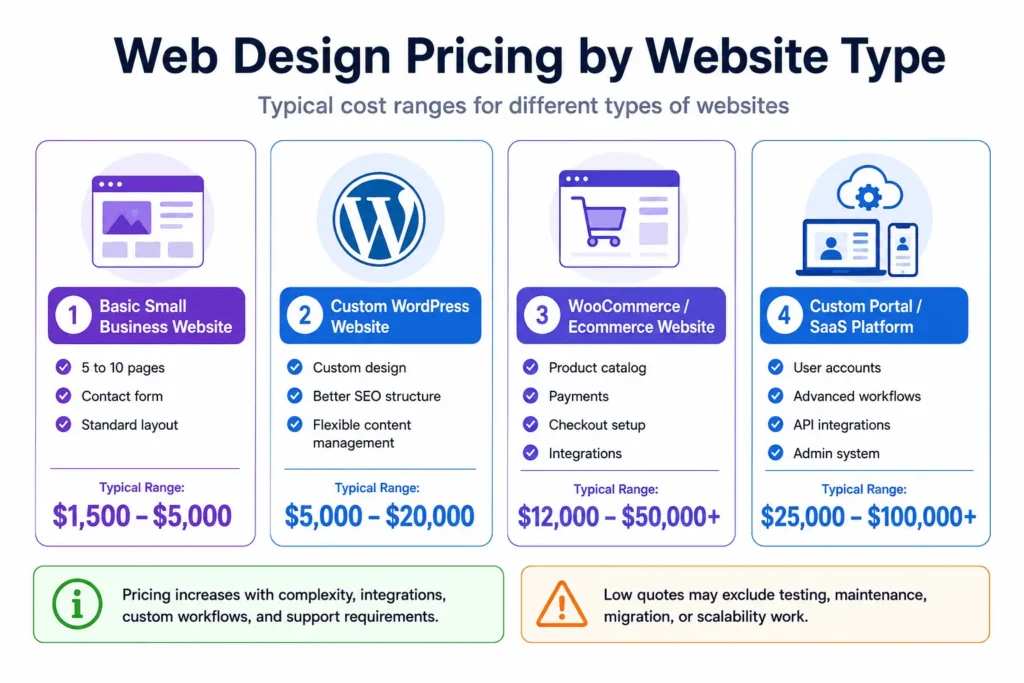
For most commercial projects, how much do web designers charge depends on the delivery model. A template-based site may cost $1,500 to $5,000. A professionally designed WordPress site commonly falls between $5,000 and $20,000. Ecommerce, membership, portal, and integration-heavy builds often start around $15,000 and can exceed $75,000 when they include custom workflows, data migration, automation, or high-availability requirements.
These are planning ranges, not fixed market prices. Geography, experience, business risk, content readiness, and the quality of the existing system can move the final number significantly. For a more focused WordPress breakdown, review this guide to what a WordPress website costs.
| Project Type | Typical Planning Range | What Usually Drives the Cost |
|---|---|---|
| Template-based small-business site | $1,500-$5,000 | Theme setup, limited pages, basic forms, content entry |
| Custom WordPress marketing site | $5,000-$20,000 | Custom design system, Gutenberg blocks, SEO structure, performance work |
| WooCommerce store | $12,000-$50,000+ | Catalog rules, checkout, payments, shipping, tax, integrations |
| Portal or SaaS-style platform | $25,000-$100,000+ | Authentication, RBAC, subscriptions, APIs, audit logs, admin tooling |
When founders ask how much do web designers charge per website, the hidden question is usually whether the quote covers only visible pages or the complete operating system behind them. The distinction matters. A polished interface without reliable backend processing, monitoring, and maintenance is not a finished business platform.
What Changes How Much Do Web Designers Charge?
Project Scope and Content Complexity
Page type matters more than page count. Ten reusable service pages can cost less than three pages containing a calculator, booking flow, gated content, and account data. Copywriting, localization, and migration also affect web design project pricing.
A common pricing mistake is treating every page as equal. In production, one checkout page can carry more engineering risk than fifty informational pages because it touches session state, payments, tax, inventory, validation, error recovery, and customer notifications.
Architecture, Integrations, and Data Workflows
The frontend is only the interaction layer. A serious website may validate data, write database records, call a CRM or payment API, enqueue jobs, update caches, and trigger webhooks. The estimate must cover retries, timeouts, duplicate events, failed payments, and partial updates.
Integration costs are often underestimated because the happy path works in a demo. Production failures appear when an API rate-limits requests, a webhook arrives twice, or a scheduled task stops. Reliable systems need idempotency, logging, reconciliation, and manual recovery.
This is one reason how much do web designers charge varies so widely between a visual designer and an engineering-led team. The first may price screens. The second prices the workflow, data integrity, deployment, and operational consequences of failure.
In SaaS work, multi-tenant isolation, subscription state, RBAC, audit logs, billing reconciliation, and admin tooling add separate test cases. AI automation also needs output validation, human review, fallback handling, and monitoring. Payment workflows need transaction states, idempotent webhooks, refunds, reconciliation, and fraud review.
WordPress and WooCommerce Engineering
WordPress is economical when its plugin architecture fits the requirement. Cost rises with custom hooks, plugins, REST APIs, Gutenberg components, multisite, headless delivery, or strict permissions. WooCommerce adds checkout scaling, payment webhooks, refunds, invoices, and inventory synchronization.
Performance work may include a CDN, full-page caching, Redis object caching, database indexing, and background-job control. WordPress cron is traffic-dependent by default, so critical tasks may need a server scheduler or queue worker. Plugin conflicts and security hardening also belong in the estimate.
For store-specific budgeting, the ecommerce website development cost guide explains why catalog size, checkout logic, integrations, and operational rules matter more than the number of templates.
For location-specific projects, a team familiar with business requirements and technical delivery can provide more useful estimates than a generic package. Filicode’s St. Louis web design services are structured around scope, maintainability, performance, and measurable operating needs rather than page count alone.
How Pricing Models Work in Practice
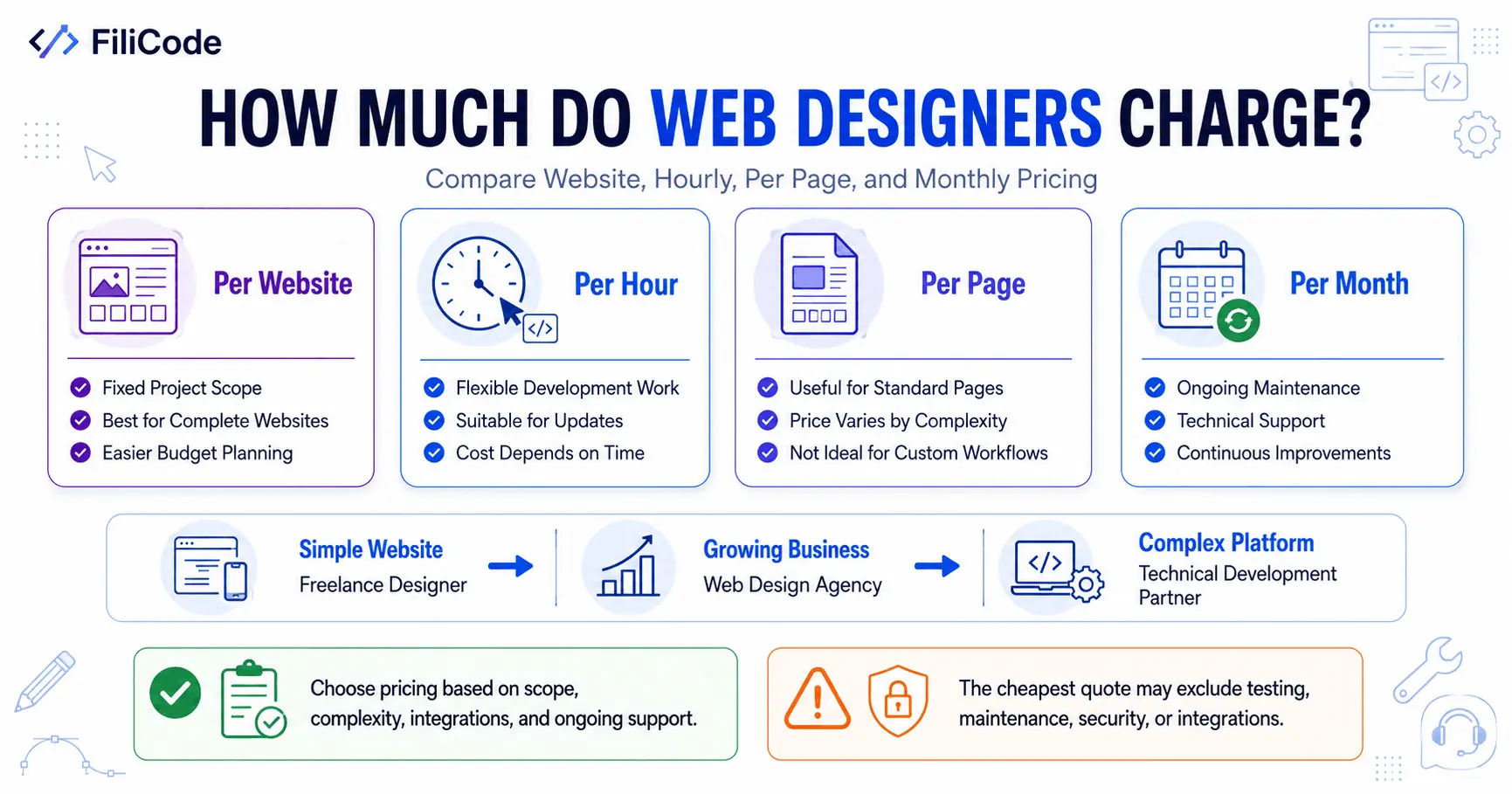
How Much Do Web Designers Charge Per Hour?
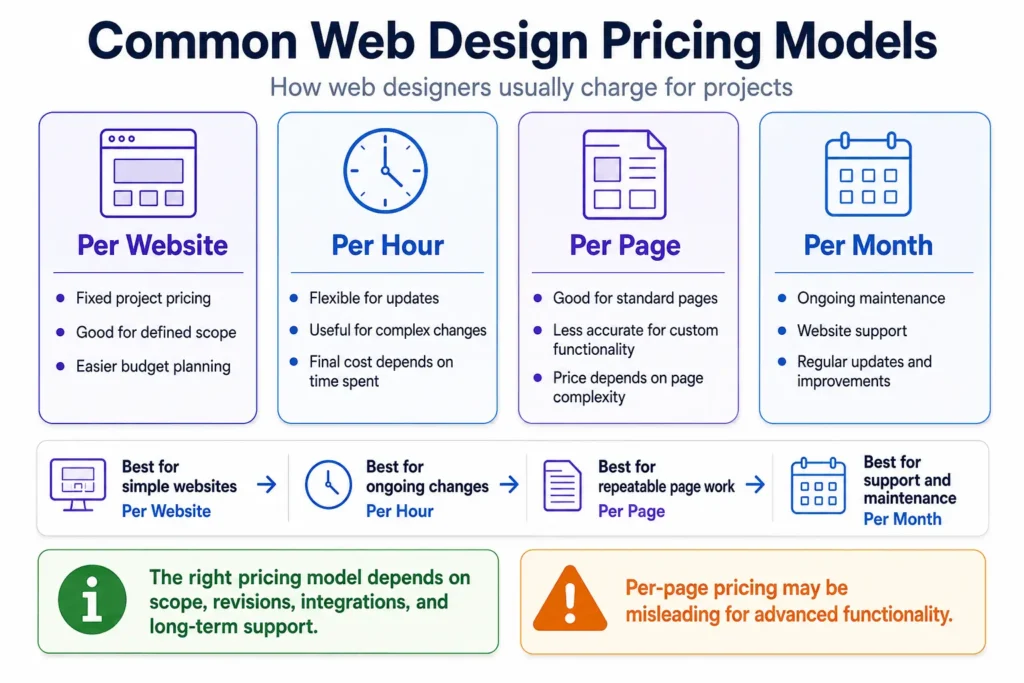
Freelance web designer rates often range from $40 to $150 per hour. Senior specialists and agencies may charge $100 to $250 per hour, especially for architecture, performance, security, or complex integrations. Hourly pricing works best for discovery, troubleshooting, legacy migrations, and evolving requirements where a fixed estimate would require a large risk buffer.
When evaluating how much do web designers charge per hour, compare capability rather than the rate alone. A senior engineer who resolves a database bottleneck in six hours may cost less than a cheaper contractor who spends forty hours testing unrelated plugins.
How Much Do Web Designers Charge Per Page?
Per-page pricing can range from $100 for simple content assembly to $1,500 or more for a custom, conversion-focused page with original design, responsive states, structured data, analytics events, and accessibility work. It is suitable only when pages share a predictable system. It becomes misleading when pages contain unique applications, dashboards, forms, or integrations.
Ask what how much do web designers charge per page actually includes: design, copy, mobile behavior, revisions, development, image preparation, SEO fields, testing, and publishing. Without that definition, two per-page quotes are not comparable.
How Much Do Web Designers Charge Per Month?
Monthly retainers commonly range from $300 to $3,000 for updates, support, reporting, backups, and small improvements. Higher retainers may include dedicated development capacity, conversion testing, content operations, infrastructure monitoring, or ongoing integration maintenance. Retainer pricing should define response times, included hours, rollover rules, exclusions, and ownership of unused capacity.
The answer to how much do web designers charge per month should be tied to service levels. Hosting alone is not maintenance. Proper recurring support covers patching, regression checks, uptime monitoring, backups, security review, and a process for handling failed deployments or third-party changes.
Freelancer, Agency, or Engineering Partner?
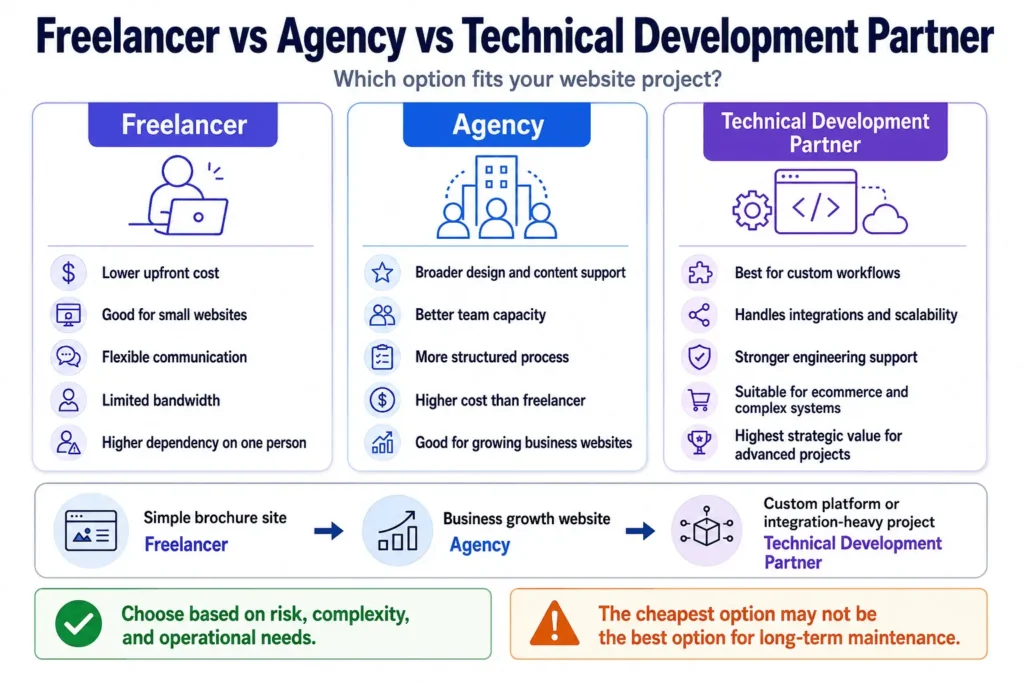
The right option depends on risk and complexity. A freelancer can suit a focused site with limited integrations. An agency adds design, content, and project-management capacity. An engineering partner fits systems connected to revenue, customer data, subscriptions, or internal tools.
| Decision Area | Freelancer or Small Studio | Architecture-Led Agency |
|---|---|---|
| Best fit | Focused marketing sites and defined redesigns | Complex WordPress, ecommerce, SaaS, and integrations |
| Cost structure | Lower overhead and narrower scope | Higher rate with multidisciplinary coverage |
| Operational resilience | Often dependent on one person | Shared ownership, QA, documentation, and support processes |
| Trade-off | Limited capacity during peaks or absence | More discovery, governance, and coordination overhead |
A larger team is not automatically better. Architecture-led delivery costs more and can introduce process overhead that is unnecessary for a simple brochure site. The value appears when failures affect leads, transactions, staff workflows, compliance, or customer trust.
Why Cheap Website Estimates Fail in Production
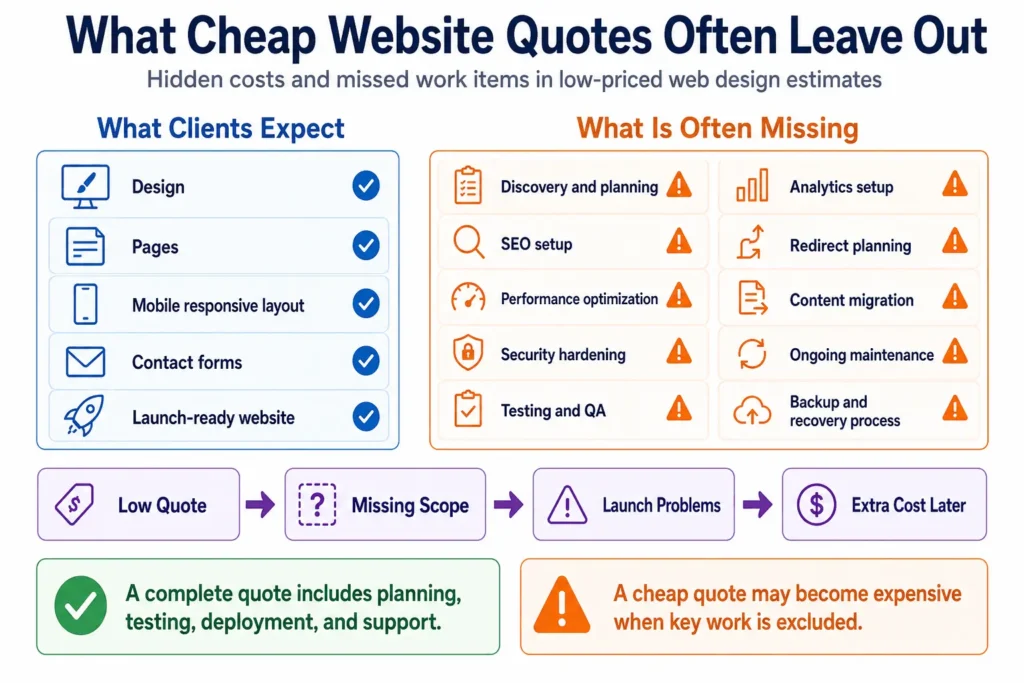
Low quotes often omit discovery, browser testing, accessibility, migration, analytics, redirects, security, deployment planning, and documentation. The site may launch, but the support burden moves to the client.
Choosing microservices or headless WordPress too early is another failure point. A structured monolith is often cheaper and easier to operate. Microservices help when domains need independent scaling, but add network failures, distributed logging, authentication, queues, and infrastructure cost.
No-code platforms are fast for standard workflows. They become expensive with custom permissions, complex data, unusual billing, real-time synchronization, or portability requirements. Ignored platform limits can force a costly rebuild.
Before selecting a low-cost package, compare it with this practical framework for choosing an affordable website design company. Affordable should mean controlled scope and sensible architecture, not omitted engineering.
How Much Do Web Designers Charge in the UK?
For buyers researching how much do web designers charge UK, freelancers often quote roughly £35 to £100 per hour, while specialist agencies may charge £80 to £180 or more. Small business websites frequently fall between £1,500 and £8,000, with custom ecommerce and integration-heavy projects ranging from £10,000 to £50,000 or beyond.
UK pricing is affected by VAT status, accessibility obligations, content scope, hosting responsibility, and whether the supplier provides ongoing support. Requirements should also reference recognized standards such as WCAG accessibility guidance when accessibility is part of procurement.
Currency does not change the underlying cost model. Whether a proposal is in pounds or dollars, how much do web designers charge still depends on risk, specialization, workflow complexity, and the expected standard of delivery.
How to Evaluate a Web Design Proposal
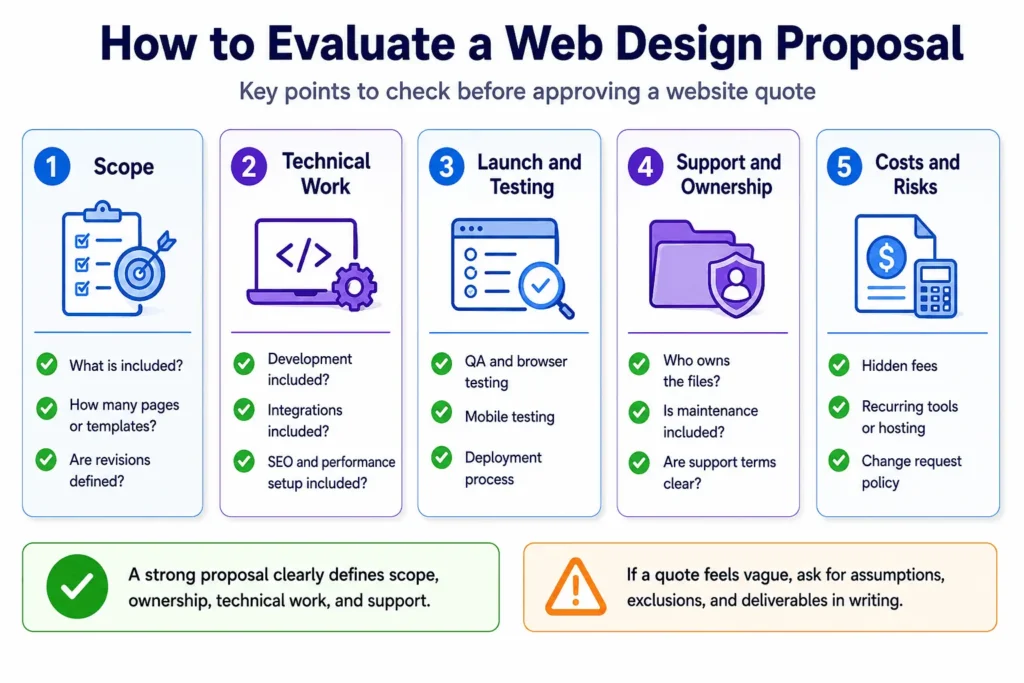
A credible proposal should show assumptions, exclusions, milestones, acceptance criteria, and ownership. It should state whether content, licenses, hosting, migration, training, and maintenance are included. For uncertain work, paid discovery is safer than a fictional fixed scope.
- Confirm ownership of design files, source code, licenses, domains, and infrastructure.
- Ask how changes are tested and failed releases are rolled back.
- List third-party services, recurring fees, data flows, and dependencies.
- Check monitoring for failed jobs, forms, payments, and APIs, not uptime alone.
- Define response times for production incidents.
Good business website design also considers editorial workflow, conversion tracking, and future page creation. These business website design principles help teams assess whether the proposed system will remain usable after the original developer leaves.
When Custom Development Becomes Necessary
Custom development becomes reasonable when staff duplicate data, plugins conflict, checkout changes require risky workarounds, reporting is unreliable, or the platform cannot represent business rules. Those are architecture problems, not design polish problems.
Filicode works across custom software development, WordPress, WooCommerce, API integrations, SaaS systems, AI automation, and performance optimization. The practical starting point is usually a system review: identify the bottleneck, map data ownership, measure failure points, and decide whether configuration, refactoring, or a custom component is justified.
That approach is not always cheapest upfront. Discovery, testing, observability, and maintainable architecture add cost, but can reduce future expense when the website is revenue-critical or integration-heavy. Teams can also review Filicode’s web design services in California for the same architecture-focused approach.
Frequently Asked Questions
How much do web designers charge for a website?
The answer to how much do web designers charge depends on scope and technical complexity. A small-business website often costs $1,500 to $8,000, while custom WordPress projects commonly range from $6,000 to $25,000. Ecommerce, portals, and integration-heavy systems can start around $15,000 and exceed $75,000.
How much do web designers charge per hour?
Freelancers commonly charge $40 to $150 per hour. Senior specialists and agencies may charge $100 to $250 per hour for architecture, security, performance, ecommerce, or complex API work.
How much do web designers charge per page?
Simple content pages may cost $100 to $500 each, while custom landing pages can cost $500 to $1,500 or more. Per-page pricing is unreliable for dashboards, checkout flows, calculators, and other pages with unique functionality.
How much do web designers charge per website?
Project pricing ranges from a few thousand dollars for a basic site to $100,000 or more for a complex platform. The quote should define design, development, content, integrations, testing, deployment, and post-launch support.
How much do web designers charge per month?
Monthly website retainers often range from $300 to $3,000. Higher retainers may include dedicated development hours, security monitoring, conversion work, infrastructure support, and integration maintenance.
How long does a custom website take to build?
A focused marketing website may take 6 to 10 weeks. A custom WordPress, ecommerce, or portal project often takes 12 to 24 weeks, depending on content readiness, integrations, feedback speed, and migration complexity.
Is WordPress cheaper than custom software?
WordPress is usually cheaper when its content model and plugin ecosystem fit the requirement. It becomes less economical when the project needs extensive plugin overrides, unusual permissions, complex real-time workflows, or deep product logic.
Conclusion: Price the Operating System, Not Just the Pages
When deciding how much do web designers charge, look beyond visual layouts. Warning signs include manual data re-entry, unreliable forms, slow checkout, repeated plugin conflicts, missing logs, unclear ownership, failed integrations, and a backlog of changes nobody wants to deploy.
Custom development should be considered when those limitations are constraining revenue, staff efficiency, reporting, or customer service. Start by documenting the current workflow, identifying failure points, separating essential requirements from preferences, and requesting a proposal that exposes assumptions and recurring costs. That gives you a price you can evaluate as an operating investment rather than a vague design expense.