








Contents
- Quick Summary: What Decision-Makers Should Prioritize
- What Should Internet Marketing Kansas Fix Before More Ad Spend?
- How Does Internet Marketing Kansas Work as a Production System?
- Internet Marketing Kansas Workflow Under Production Load
- Architecture Choices: WordPress, Headless, SaaS, or Custom?
- Local Demand Architecture for Kansas and Kansas City
- Paid Acquisition Needs a Revenue Data Pipeline
- Where Automation Helps, and Where It Creates New Risk
- How to Evaluate a Top-Rated Internet Marketing Kansas City Partner
- When Off-the-Shelf Marketing Tools Stop Being Enough
- Operational Metrics That Matter More Than Vanity Traffic
- Frequently Asked Questions
- How much does internet marketing in Kansas cost?
- How long does an internet marketing Kansas strategy take to show results?
- Can internet marketing systems scale without custom software?
- What integrations matter most for local and B2B lead generation?
- How risky is migrating a marketing website or CRM workflow?
- What maintenance does a scalable marketing platform require?
- Conclusion: Internet Marketing Kansas Should Reduce Operational Friction
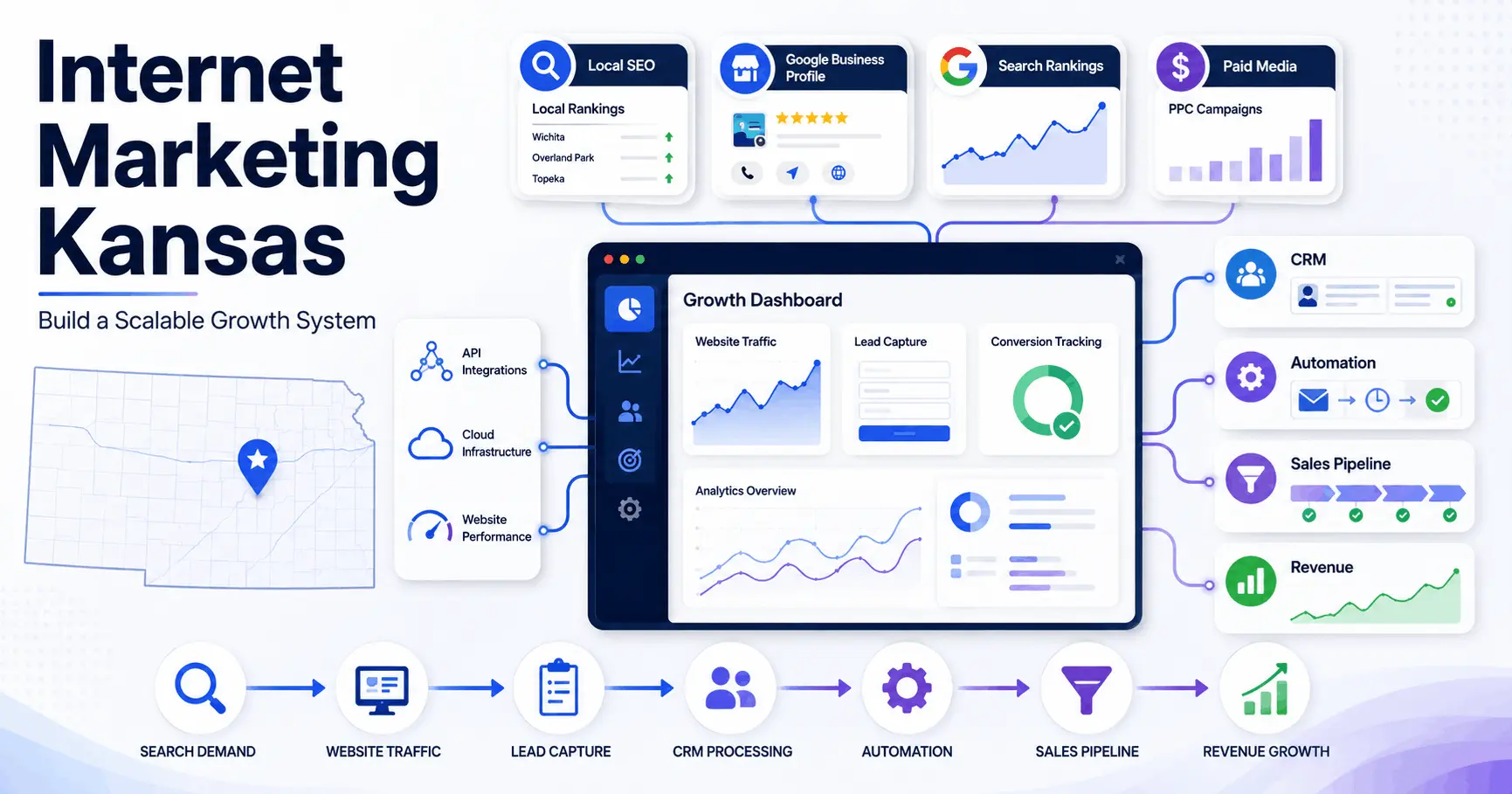
A paid campaign can generate clicks while the business still loses revenue through slow pages, broken form tracking, duplicate CRM records, delayed lead routing, and weak local visibility. Effective internet marketing Kansas connects acquisition, website performance, analytics, CRM workflows, follow-up, and sales outcomes. The goal is a measurable path from search demand to qualified leads, reliable attribution, and repeatable growth.
Internet marketing for a Kansas business coordinates local SEO, content, paid media, conversion optimization, analytics, and automation to create and measure demand. A strong program treats the website and marketing stack as production infrastructure, with clear data ownership, validated events, failure handling, and reporting tied to revenue.
Quick Summary: What Decision-Makers Should Prioritize
- Marketing scale fails when lead capture, analytics, CRM ownership, and sales follow-up are designed as separate systems instead of one measurable workflow.
- Local SEO and PPC perform better when location intent, service relevance, landing-page speed, and conversion tracking are managed together.
- WordPress can support serious growth when plugin boundaries, caching, database load, cron jobs, integrations, and deployment practices are controlled deliberately.
- Automation should use validation, retry logic, observability, and human review for high-impact decisions rather than relying on unmonitored workflows.
- Custom development becomes justified when off-the-shelf tools create repeated data loss, manual reconciliation, permission gaps, integration failures, or rising support overhead.
What Should Internet Marketing Kansas Fix Before More Ad Spend?
The first question is not which channel deserves more budget. It is whether the current system can capture demand without losing context between the click, page session, form submission, CRM record, sales response, and closed deal.
A common failure pattern is PPC traffic landing on generic pages, local pages competing for the same intent, call tracking disconnected from CRM data, and analytics conversions the sales team cannot reconcile. Marketing reports activity while operations cannot explain lead quality or return on investment (ROI).
The practical priority order is measurement integrity, conversion path quality, search visibility, paid acquisition efficiency, and then automation. Scaling a broken funnel multiplies waste. Strong Kansas SEO strategy and technical search execution should support the same revenue workflow used by paid media and sales operations.
How Does Internet Marketing Kansas Work as a Production System?
The production workflow starts before a form is submitted. A visitor arrives from organic search, online advertising, email marketing, social media marketing, or a referral. The frontend captures campaign context and consent state, the application validates the request, and the backend writes the lead to a durable system of record.
Reliable systems use queues or asynchronous jobs for CRM synchronization, email delivery, enrichment, lead scoring, and notifications. External APIs and webhooks can fail or rate-limit, so retries need backoff rules, idempotency keys, and dead-letter handling rather than blind repetition.
Internet Marketing Kansas Workflow Under Production Load
Under production load, the correct flow is: browser request, CDN and edge cache, application response, event capture, server-side validation, database write, queue dispatch, CRM update, attribution processing, and reporting. Monitoring should detect delayed jobs, webhook failures, duplicate submissions, unusual conversion drops, and mismatches between ad-platform conversions and CRM outcomes.
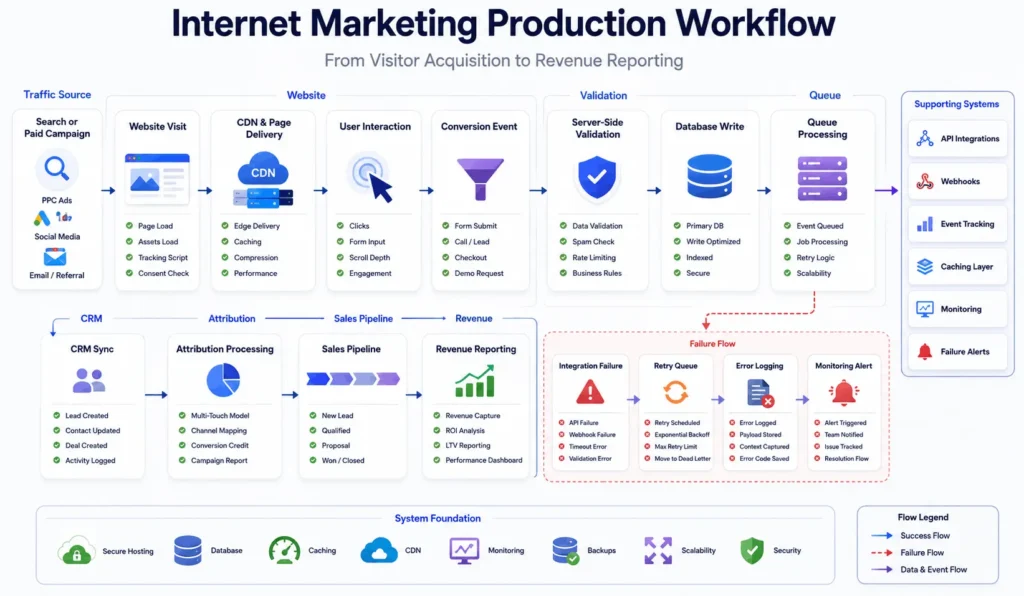
Caching is useful for content delivery but dangerous when applied carelessly to personalized forms, checkout steps, account pages, or dynamic pricing. The same principle applies to databases. Read-heavy reporting queries should not compete indefinitely with transactional writes on the same hot tables as volume grows.
| Feature | Option A | Option B |
|---|---|---|
| Lead routing | Direct plugin-to-CRM request that can block or fail silently | Validated write plus queued synchronization and retry handling |
| Attribution | Channel dashboards viewed separately | Shared campaign taxonomy connected to CRM and revenue states |
| Failure handling | Manual checks after complaints | Logging, alerts, retry policies, and reconciliation reports |
| Scaling behavior | More traffic creates more operational noise | Capacity, data ownership, and bottlenecks are measured explicitly |
Architecture Choices: WordPress, Headless, SaaS, or Custom?
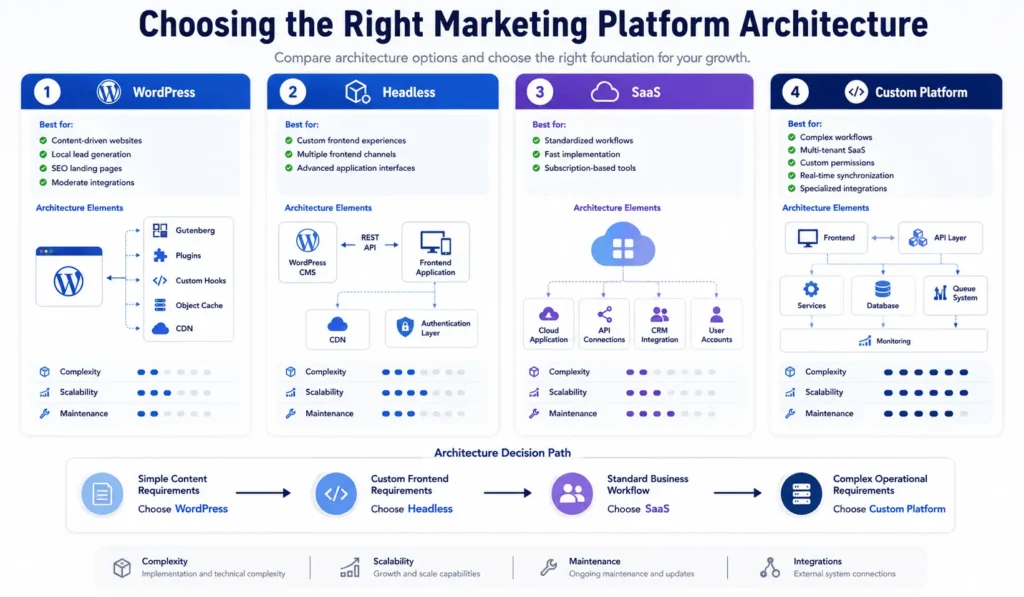
Architecture should follow operational requirements. A service business with editorial content, location pages, and straightforward lead capture may be well served by WordPress. A marketplace with real-time inventory, complex permissions, subscription billing, or high-frequency synchronization may need a custom application layer or SaaS platform architecture.
WordPress websites become fragile when every requirement is solved with another plugin. Mature implementations define plugin responsibilities, use custom hooks carefully, isolate integrations, control database queries, test upgrades, and maintain staging environments. Redis object caching reduces repeated database work, while a CDN lowers origin load for cacheable assets.
WooCommerce introduces additional concerns around checkout performance, inventory synchronization, payment states, and plugin conflicts. For businesses using ecommerce as part of their marketing system, failed payments and transaction states should be tracked reliably rather than relying only on browser redirects.
Headless WordPress separates content management from the frontend but increases deployment, preview, caching, authentication, and integration complexity. Gutenberg customization can be simpler for teams that need controlled publishing without maintaining two application stacks. The choice should follow the actual bottleneck.
| Feature | Option A | Option B |
|---|---|---|
| Platform model | Integrated WordPress or modular monolith | Headless frontend or distributed services |
| Best fit | Content-led growth, local lead generation, moderate commerce | Complex products, multiple clients, real-time data, specialized scaling |
| Operational cost | Lower when boundaries and plugins are controlled | Higher due to more deployments, APIs, monitoring, and failure modes |
| Scaling approach | Cache, optimize queries, isolate heavy jobs, scale infrastructure | Scale services independently where domain boundaries justify it |
Microservices are not an automatic upgrade from a monolith. A modular monolith is often easier to deploy, test, and observe. Distributed services make sense when scaling profiles, security boundaries, team ownership, or domain isolation justify the added network complexity.
Local Demand Architecture for Kansas and Kansas City
Local demand is shaped by geography, service intent, proximity, reputation, and page relevance. Internet marketing Kansas City and internet marketing Kansas City MO queries may overlap, but landing pages should reflect the actual service area rather than create thin pages for every nearby location.
A practical local SEO system aligns the Google Business Profile, service categories, location information, review acquisition, landing pages, internal links, structured data, and conversion tracking. Teams managing broader territories should understand service-area business SEO architecture before duplicating city pages that offer little unique value.
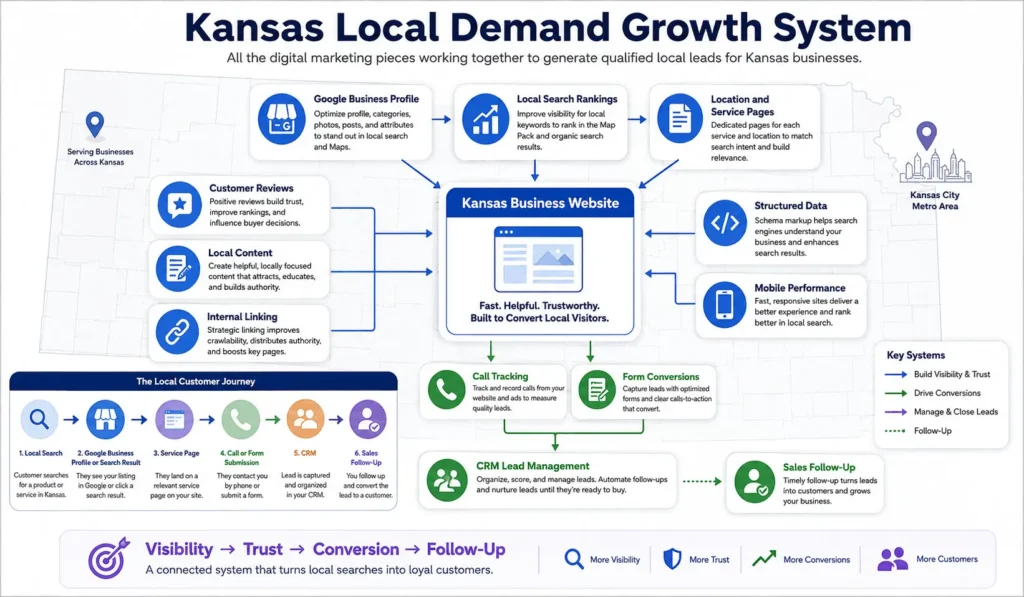
Content should answer commercial questions before consultation: service scope, pricing, integration capability, and migration risk. A useful local SEO checklist for small businesses keeps foundational work tied to measurable outcomes.
For planning, a local SEO growth strategy for small businesses connects visibility, conversion paths, and ongoing lead generation.
Technical compliance still matters. Google Search Essentials provides baseline guidance for search-friendly implementation. Rankings also depend on intent satisfaction, reliable performance, crawlable content, and trust.
Paid Acquisition Needs a Revenue Data Pipeline
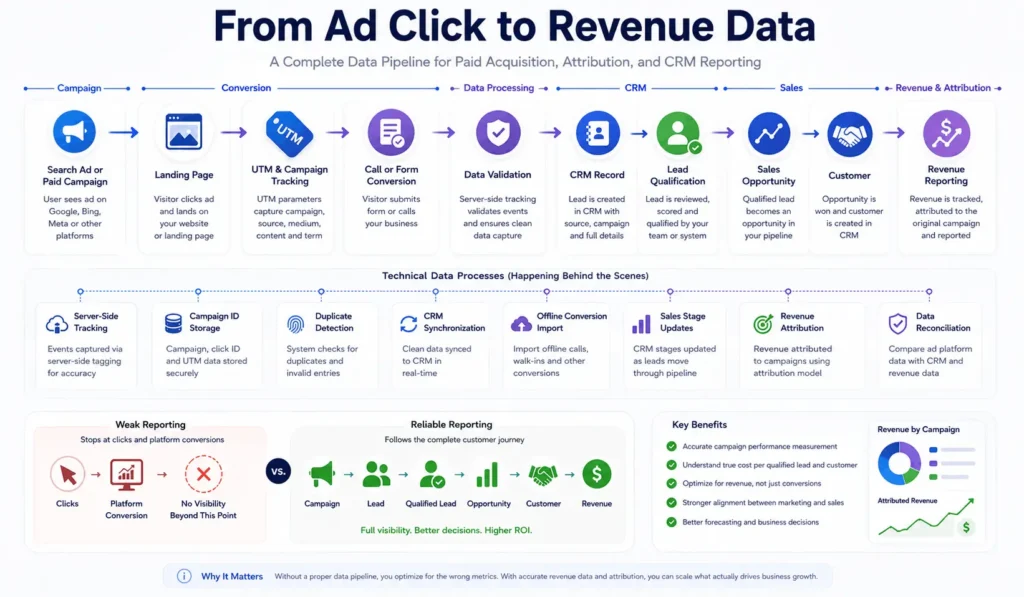
PPC ads management should not stop at click cost and platform conversion counts. A production-grade workflow preserves campaign identifiers, standardizes UTM parameters, records form and call events, validates lead records, and synchronizes meaningful lifecycle stages back to reporting systems.
The useful question is which combination of query, page, audience, offer, response time, and sales process produced qualified leads and profitable customers. That requires shared definitions between marketing and sales.
Attribution will never be perfect, especially across devices, privacy controls, offline interactions, and long B2B buying cycles. The goal is consistent decision-quality data. Teams can improve budget decisions by connecting campaign cost to CRM stages and following a disciplined framework for improving ROI in digital marketing.
Where Automation Helps, and Where It Creates New Risk
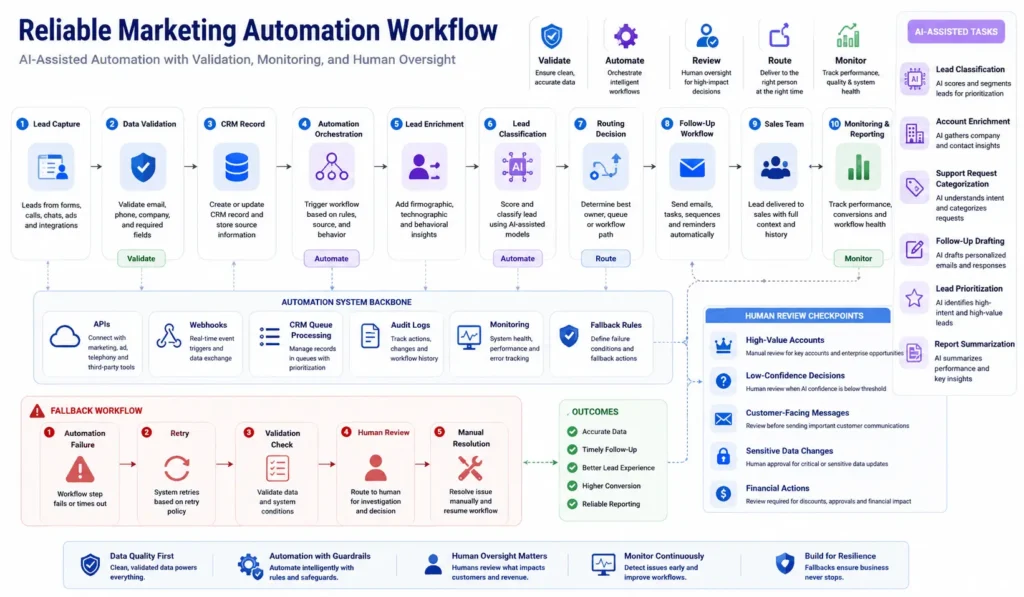
Automation is useful for lead enrichment, routing, follow-up reminders, support classification, reporting preparation, and CRM hygiene. Risk rises when a workflow can change customer data, send public messages, or trigger financial actions without validation and rollback paths.
Reliable AI automation needs orchestration, structured inputs, output validation, permission boundaries, audit logs, fallbacks, and human review for high-impact cases. LLM workflows should be monitored by failure category, not only average success rate. Even a small error rate can create serious support burden when valuable accounts are affected.
For B2B operations, automation should also respect long sales cycles and account context. A scalable B2B digital marketing strategy connects content, demand generation, CRM stages, account ownership, and reporting rather than automating isolated messages.
How to Evaluate a Top-Rated Internet Marketing Kansas City Partner
A top-rated internet marketing Kansas City provider should be evaluated on operating discipline, not just testimonials or channel lists. Ask how the team handles tracking design, data validation, technical SEO, page performance, CRM integration, deployment safety, reporting definitions, and ownership when an integration fails.
Commercial terms do not replace architecture quality. Buyers should confirm ownership of the data model, landing pages, analytics configuration, creative assets, and integration code.
- Request a clear measurement plan that connects website traffic to qualified leads and revenue stages.
- Ask for examples of failure handling, migration planning, and performance troubleshooting, not only campaign screenshots.
- Confirm how local SEO, content marketing, web design and development, conversion rate optimization, and paid media share data.
- Check whether reporting distinguishes leads, sales-qualified opportunities, customers, and repeat revenue.
When Off-the-Shelf Marketing Tools Stop Being Enough
Off-the-shelf SaaS tools are usually the right starting point because they reduce development cost. Custom systems become reasonable when teams repeatedly work around limitations through spreadsheets, manual exports, duplicate entry, fragile connectors, or unsuitable permission models.
Filicode works across custom software development, WordPress development, WooCommerce development, AI automation, API integrations, system architecture, SaaS development, and performance optimization. The useful role of engineering in marketing is not to rebuild every SaaS tool. It is to remove the bottlenecks that directly affect conversion, data quality, reliability, and operating cost.
For SaaS platforms, bottlenecks often involve multi-tenant architecture, tenant isolation, subscription billing, RBAC, audit logging, real-time synchronization, and admin tooling. Ecommerce pain may involve checkout contention, inventory synchronization, payment reconciliation, refunds, or slow reporting. Each case needs a different architecture response.
Cheap development often looks efficient until maintenance begins. Unversioned integrations, direct production edits, undocumented cron jobs, and shared administrator credentials reduce initial cost but increase deployment risk and support burden. Maintainability is an operating expense decision, not merely a code-quality preference.
Operational Metrics That Matter More Than Vanity Traffic
A reliable dashboard should distinguish acquisition, conversion quality, sales response, pipeline movement, and revenue. It should also expose form errors, queue delays, webhook failures, page latency, and integration backlogs.
For local lead generation, monitor search visibility by service intent, Google Business Profile actions, landing-page conversion rate, call quality, lead-to-opportunity rate, and response time. For ecommerce, track checkout completion, payment failures, refunds, repeat purchase behavior, and gross margin contribution.
Observability closes the gap between marketing and engineering. Logs explain failures, metrics expose trends, and traces identify latency across services. Without these signals, teams may change campaigns when the real fault is a form endpoint, slow query, broken webhook, or delayed sales workflow.
Frequently Asked Questions
How much does internet marketing in Kansas cost?
Pricing depends on channel mix, competitive demand, media spend, content requirements, tracking complexity, and integration work. A small local program may focus on technical SEO, Google Business Profile optimization, content, and limited PPC, while a larger B2B or ecommerce operation may require CRM integration, attribution, automation, and ongoing development.
How long does an internet marketing Kansas strategy take to show results?
An internet marketing Kansas strategy can generate paid traffic quickly, but reliable optimization requires enough conversion and sales data to make sound decisions. Local SEO and content usually require a longer horizon because indexing, relevance, authority, competition, and review growth develop over time. Technical fixes can improve performance sooner when clear bottlenecks already exist.
Can internet marketing systems scale without custom software?
Yes. Many businesses can scale with well-configured SaaS tools, WordPress, analytics, and CRM platforms. Custom software becomes useful when integration limits, data duplication, manual reconciliation, permission gaps, or performance constraints create recurring operational cost that exceeds the value of staying entirely off the shelf.
What integrations matter most for local and B2B lead generation?
The most useful integrations connect forms and calls to a CRM, preserve campaign attribution, route leads to the correct owner, trigger follow-up workflows, and return sales outcomes to reporting. Additional integrations should be added only when they improve decision quality, response speed, or operational consistency.
How risky is migrating a marketing website or CRM workflow?
Migration risk depends on URL changes, tracking changes, data mapping, integration dependencies, redirect coverage, testing quality, and rollback planning. A safe migration uses inventory, staging validation, controlled cutover, monitoring, and post-launch reconciliation rather than moving every component at once without verification.
What maintenance does a scalable marketing platform require?
Ongoing maintenance includes dependency updates, security review, backups, performance monitoring, integration testing, webhook reconciliation, analytics validation, access review, and documentation. The exact workload depends on platform complexity, traffic, transaction volume, and how many external systems exchange data.
Conclusion: Internet Marketing Kansas Should Reduce Operational Friction
The warning signs are operational first: leads arrive without source data, teams reconcile reports manually, sales cannot trust attribution, page changes break tracking, integrations fail silently, and support staff become the glue between systems. Those are signs that internet marketing Kansas has become a systems problem, not just a campaign problem.
Custom development should be considered when repeated workarounds, data inconsistencies, platform limits, or performance issues create measurable cost. The next step is to map the acquisition-to-revenue workflow, identify where data or responsibility is lost, and prioritize fixes by business impact. A marketing system should make growth easier to operate, not harder to explain.