








Contents
- Quick Summary: for Founders and Technical Decision-Makers
- What Are Marketing Attribution Models?
- Why Marketing Attribution Models Fail in Production
- Types of Marketing Attribution Models and Their Trade-Offs
- First-Touch and Last-Touch Marketing Attribution Models
- Linear, Time Decay, U-Shaped, and W-Shaped Models
- How Does a Production Attribution Workflow Work?
- Data Architecture: Monolith, Warehouse, or Event-Driven Pipeline?
- Marketing Attribution Models, Machine Learning, and Data-Driven Logic
- B2B, E-Commerce, Mobile, and Influencer Attribution Need Different Designs
- HubSpot Marketing Attribution Models and Platform Limits
- How to Choose Marketing Attribution Models and Tools
- How to Build an Attribution Model Without Creating Reporting Debt
- Operational Indicators That Custom Engineering Is Becoming Necessary
- Frequently Asked Questions
- How much does a marketing attribution system cost?
- How long does attribution implementation take?
- Which marketing attribution models are best for B2B?
- Can attribution models scale across multiple products and regions?
- What is the biggest migration risk when changing attribution platforms?
- Do machine learning attribution models remove the need for manual analysis?
- Conclusion: Choose Marketing Attribution Models Based on Operational Reality
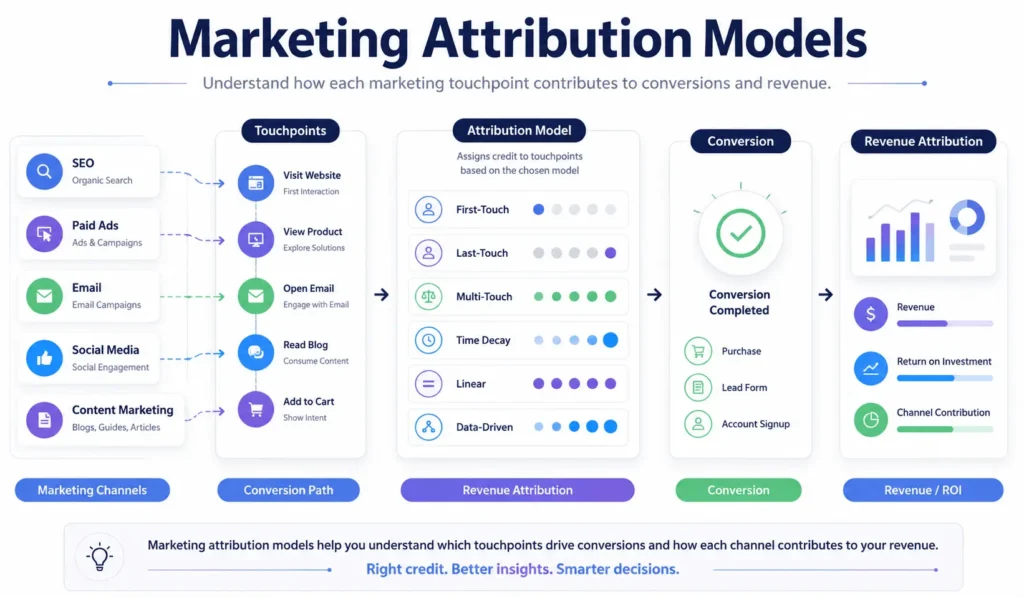
A campaign can look profitable in an ad platform while finance sees weak margin, sales credits outbound activity, and the CRM shows another source. That conflict is an attribution architecture problem. Marketing attribution models assign conversion credit across customer touchpoints, but any model is only as reliable as the tracking, identity resolution, data quality, and business rules underneath it.
The goal is not one universally correct model. It is a measurement system that explains how channels contribute to pipeline, revenue, retention, or another agreed outcome. First-touch answers acquisition questions, while multi-touch or data-driven attribution supports budget allocation when journey data is complete.
Quick Summary: for Founders and Technical Decision-Makers
- An attribution model cannot repair missing campaign parameters, broken identity stitching, duplicate conversions, or lifecycle gaps.
- Single-touch models are easy to audit but oversimplify long journeys; multi-touch models require stronger data engineering.
- B2B attribution should connect anonymous sessions, known contacts, account activity, deal stages, and revenue, not stop at lead creation.
- E-commerce attribution must reconcile browser events with orders, refunds, payment states, and server records before ROAS can be trusted.
- Machine learning attribution is useful only when event definitions, conversion windows, and training data are stable enough for repeatable signals.
What Are Marketing Attribution Models?
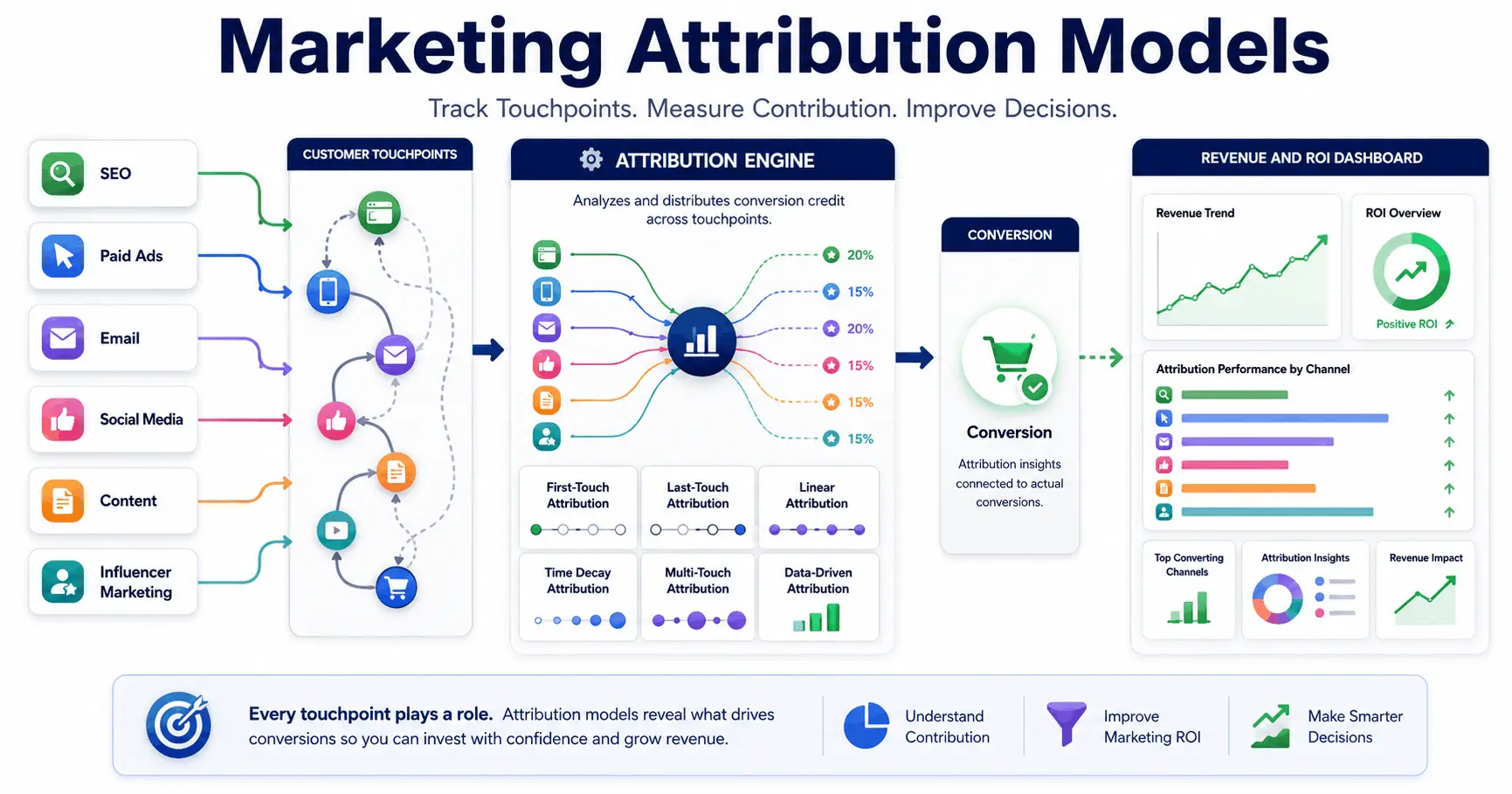
Marketing attribution models define how conversion credit is distributed across marketing interactions before an outcome. A model may assign all credit to one touchpoint, divide it across several, weight interactions by position or time, or use observed data to estimate contribution.
The model is the rule. The infrastructure is the pipeline capturing UTM parameters, sessions, forms, CRM activity, product events, calls, payments, and offline outcomes. Official Google Analytics attribution guidance defines attribution through rules or data-driven logic that assigns credit along a conversion path.
For companies comparing SEO, paid media, content, email, and social, attribution should sit inside the wider measurement design. A technical digital marketing strategy works better when campaign execution, analytics, CRM data, and conversion systems operate as one measurement layer rather than separate dashboards.
Why Marketing Attribution Models Fail in Production
Most failures begin before the model runs. A visitor clicks a campaign, changes device, submits a form, talks to sales, returns directly, and converts later. Every transition can break the chain.
Forms may process synchronously while CRM updates run as asynchronous jobs. Payments arrive through webhooks, call tracking through APIs, and ad conversions may retry after failures. Inconsistent identifiers leave partial journeys instead of one usable path.
A production pipeline validates events, deduplicates conversion IDs, normalizes campaign fields, retries failures, and monitors lag. Caching reduces dashboard load, while queues protect ingestion during spikes. Observability should expose failed webhooks, API limits, dropped jobs, and attribution lag.
Types of Marketing Attribution Models and Their Trade-Offs
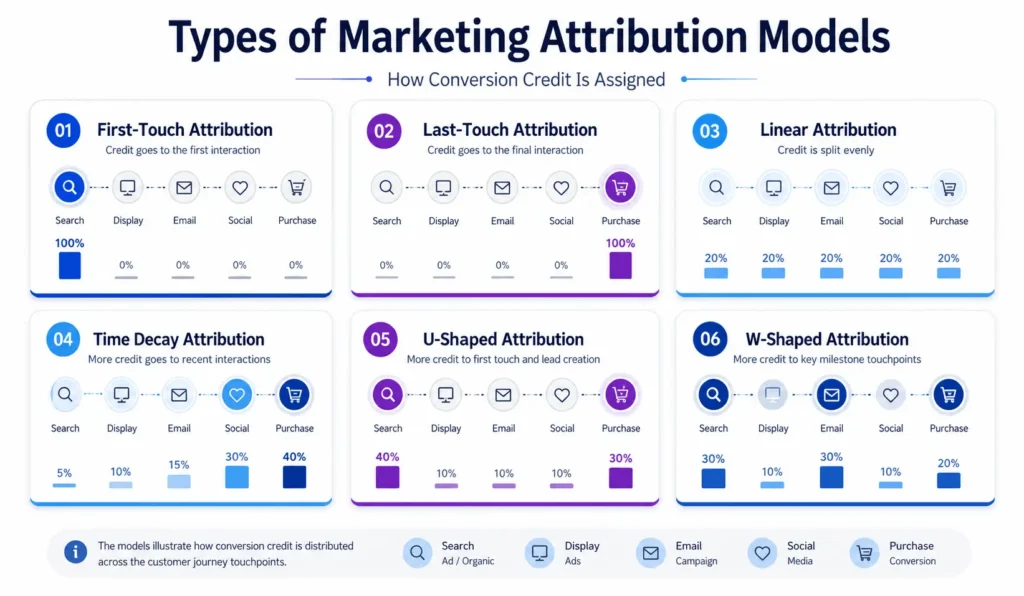
The best marketing attribution models are selected by the business question, not the most sophisticated dashboard. The seven practical models covered here are first-touch, last-touch, linear, time decay, U-shaped, W-shaped, and data-driven attribution. Each answers a different acquisition, journey, pipeline, or revenue question.
First-Touch and Last-Touch Marketing Attribution Models
First-touch attribution gives full credit to the first known interaction. It is useful when the business wants to compare which sources introduce new prospects.
Last-touch attribution gives full credit to the final eligible interaction before conversion. It is simple for short purchase cycles. In longer journeys, branded search, direct traffic, or retargeting may receive credit after earlier channels created demand.
Linear, Time Decay, U-Shaped, and W-Shaped Models
Linear attribution distributes credit evenly. Time decay favors interactions nearer conversion. U-shaped attribution emphasizes first touch and lead creation, while W-shaped attribution adds opportunity milestones.
These models provide transparent rules, but their weighting remains a policy choice rather than objective truth.
| Model | Credit Method | Best Fit | Main Limitation |
|---|---|---|---|
| First-Touch | First interaction gets all credit | Demand discovery | Ignores later influence |
| Last-Touch | Final interaction gets all credit | Short journeys | Overvalues closing channels |
| Linear | Credit split equally | Basic multi-touch analysis | Treats all touches equally |
| Time Decay | Recent interactions get more credit | Long journeys | Can undervalue discovery |
| U-Shaped | Weights first touch and lead creation | Lead generation | Weak for complex B2B journeys |
| W-Shaped | Weights key funnel milestones | B2B pipelines | Needs clean CRM stages |
| Data-Driven | Contribution estimated from data | Mature datasets | Needs stable, reliable data |
A useful digital marketing ROI framework should compare attributed revenue with margin, customer acquisition cost, sales capacity, and retention. Attribution is one decision input, not the finance ledger.
How Does a Production Attribution Workflow Work?
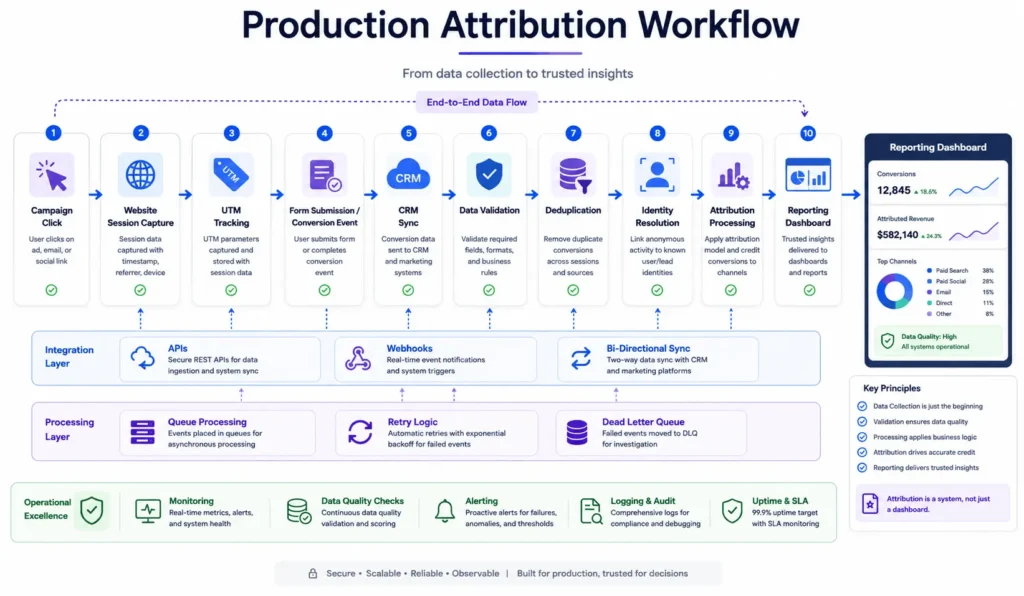
A reliable workflow starts with consistent event contracts. The frontend captures campaign and session context, while backend services attach stable identifiers. APIs and webhooks bring in ad, CRM, billing, and support events. Cross-channel marketing attribution models become more reliable when systems use consistent identifiers and controlled event definitions.
Processing follows a sequence: ingest, validate, normalize, deduplicate, resolve identity, order touchpoints, apply attribution windows, calculate output, and publish reporting views. Expensive transformations should run as scheduled or event-driven jobs, not block customer requests.
Failure handling matters. Webhooks should be idempotent so retries cannot create duplicate conversions. Queue workers need bounded retries and dead-letter handling. API credentials should be scoped and rotated. RBAC should protect revenue data, while model changes remain controlled and logged.
For complex channel and revenue operations, a broader scalable B2B digital marketing strategy should define lifecycle stages and ownership before attribution dashboards become a source of truth.
Data Architecture: Monolith, Warehouse, or Event-Driven Pipeline?
Small teams can start with website analytics, ad platforms, and a CRM connected through standard integrations. This monolithic setup is cheaper to maintain, but limitations appear when offline activity, multiple products, business units, or custom revenue rules must be joined consistently.
A warehouse-centered architecture gives SQL-based control over identity mapping, attribution windows, refunds, taxonomy, and historical recalculation. It also creates responsibility for schemas, jobs, access control, data quality, and cost monitoring.
Microservices are rarely justified just for attribution. Event-driven systems become useful when many applications publish events such as trial_started, invoice_paid, refund_completed, or account_churned. A message broker can decouple producers from consumers, but distributed systems increase logging, tracing, deployment, and incident-response overhead.
Marketing Attribution Models, Machine Learning, and Data-Driven Logic
Marketing attribution models using machine learning estimate contribution from observed journey data rather than fixed weights. Approaches may include data-driven platform models, probabilistic methods, or path-based techniques such as Markov chain attribution.
The caveat is data stability. Models learn from recorded data. If campaign naming changes, CRM stages are skipped, or conversions are duplicated, complexity can produce convincing errors.
AI agents can classify campaign naming errors, summarize anomalies, route broken tracking issues, or draft analyst notes. They should not become the attribution authority. Production workflows still need validation rules, human review for material budget changes, fallback logic, and output monitoring. The same reliability principles apply to broader AI agent workflow automation.
B2B, E-Commerce, Mobile, and Influencer Attribution Need Different Designs
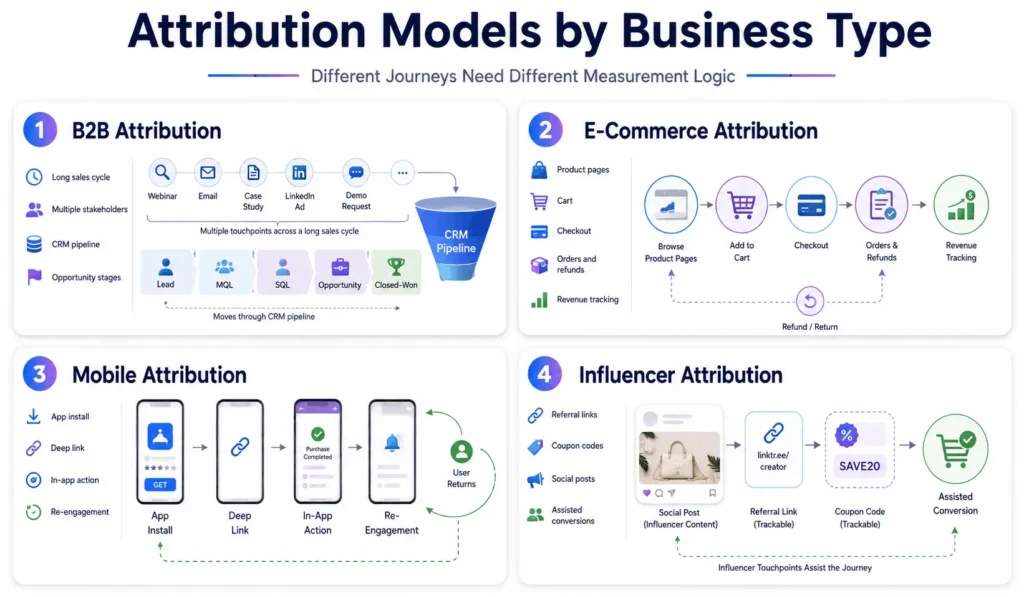
B2B marketing attribution models must account for long sales cycles and several people from one account. Contact-level attribution can miss the buying committee. A useful model connects anonymous activity, known contacts, CRM interactions, opportunity stages, and closed revenue.
E-commerce attribution is transaction-heavy. Browser events should reconcile with orders, payment states, refunds, chargebacks, discounts, and tax treatment. In WooCommerce, attribution code must not slow checkout. Custom hooks and REST integrations need testing, while object caching, Redis, CDN configuration, and conflict management protect performance.
WordPress cron is convenient but weak for time-sensitive, high-volume processing without a real scheduler. Large stores should move attribution imports, API synchronization, and reporting to controlled background jobs.
Mobile marketing attribution models deal with app installs, deep links, re-engagement, device identifiers, privacy controls, and attribution windows. Influencer programs often need coupon codes, referral links, campaign IDs, and assisted-conversion analysis because view-through influence may not produce an immediate click.
HubSpot Marketing Attribution Models and Platform Limits
HubSpot marketing attribution models can support contact, deal, and revenue workflows, depending on configuration and product access. Models available in HubSpot should be selected by reporting question, data completeness, and lifecycle configuration, not availability alone.
No SaaS platform can infer a missing meeting, untracked call, edited deal, or payment event that never synchronized. SaaS tools reduce implementation effort, while custom pipelines provide control. The choice depends on data complexity, engineering capacity, audit requirements, and external business logic.
| Feature | SaaS Attribution Stack | Custom Attribution System |
|---|---|---|
| Deployment speed | Faster with standard connectors | Slower due to engineering validation |
| Business rules | Limited to platform capabilities | Can model custom lifecycle and revenue logic |
| Maintenance | Vendor handles core operations | Internal or partner team owns the pipeline |
| Data control | Depends on export and API capabilities | Higher control over raw and modeled data |
| Best fit | Standard journeys and lean teams | Complex products, channels, or compliance needs |
How to Choose Marketing Attribution Models and Tools
Choose attribution tools by the data and decisions they must support. Check CRM and ad-platform integrations, offline conversion support, attribution-window control, raw data export, warehouse compatibility, historical recalculation, and revenue reconciliation before dashboard features.
For simpler journeys, a SaaS platform with reliable connectors may be enough. Complex businesses should evaluate identity resolution, multi-product reporting, currency handling, RBAC, audit logs, API limits, data latency, and raw-event retention. Tool selection should reduce reporting debt, not hide it behind another dashboard.
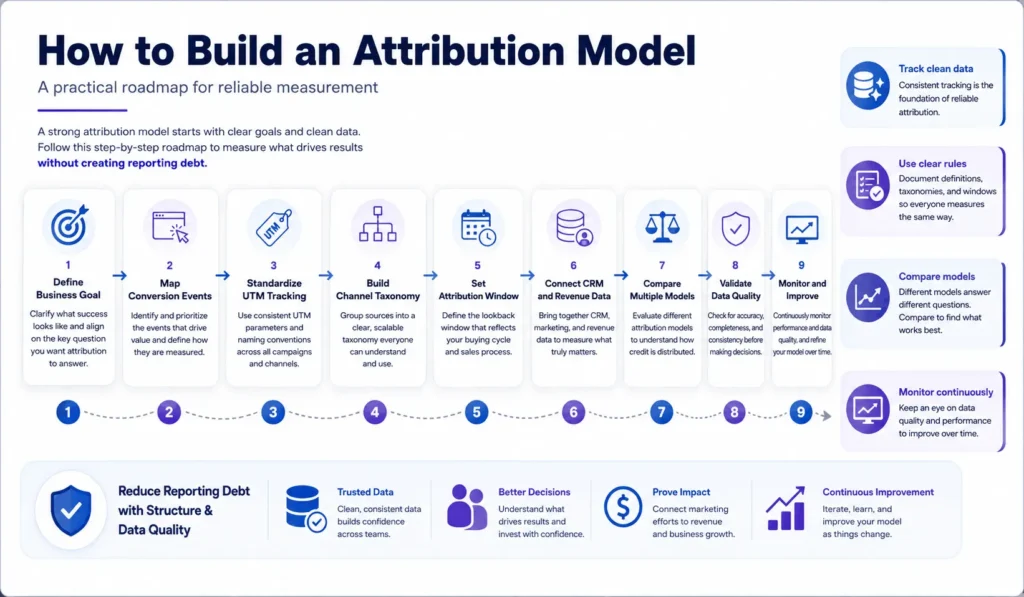
How to Build an Attribution Model Without Creating Reporting Debt
Start with the business decision. If the question is which channels create qualified pipeline, define that outcome precisely. Then map required events, source systems, identifiers, ownership, retention, and acceptable latency.
Next, establish a channel taxonomy and UTM tracking standard. Preserve raw values while mapping them into governed reporting categories. Define lookback and attribution windows, then decide how direct traffic, cross-device activity, view-through attribution, assisted conversions, and offline events are handled.
Run more than one model during evaluation. A marketing attribution models comparison is useful when the same conversions are tested under first-touch, last-touch, linear, time decay, and multi-touch approaches. Large differences can reveal journey complexity or tracking gaps.
Finally, add automated tests. Validate unique order IDs, revenue reconciliation, required campaign fields, correct model totals, and data freshness against an agreed service level. Reporting without monitoring quietly degrades.
Operational Indicators That Custom Engineering Is Becoming Necessary
Off-the-shelf tools are often the right starting point. Custom engineering becomes reasonable when teams spend more time fixing connectors, reconciling revenue, or rebuilding account journeys than using reports.
Filicode works across custom software, WordPress and WooCommerce engineering, API integrations, SaaS architecture, AI automation, and performance optimization. Attribution work often starts by stabilizing data contracts, integrations, jobs, permissions, and monitoring so reporting becomes trustworthy.
Automation should be treated as infrastructure, not isolated scripts. Reliable enterprise automation workflows need ownership, validation, retries, audit logging, and fallback paths. Attribution pipelines need the same discipline.
Paid media teams should connect attribution findings with campaign operations. A strong channel still depends on bidding, landing pages, conversion tracking, and lead quality. That operational layer is explained in this guide to PPC management and paid advertising operations.
Frequently Asked Questions
How much does a marketing attribution system cost?
Cost depends on data sources, journey complexity, reporting requirements, and whether standard SaaS connectors are sufficient. A simple analytics and CRM setup costs less than a custom warehouse pipeline with identity resolution, offline conversions, revenue reconciliation, and monitored jobs.
How long does attribution implementation take?
A basic single-touch setup can be configured quickly when tracking and CRM data are clean. Multi-touch or custom attribution takes longer because teams must define events, repair data gaps, validate integrations, reconcile revenue, and test outputs before budget decisions.
Which marketing attribution models are best for B2B?
B2B marketing attribution models should reflect the sales cycle. First-touch is useful for demand discovery, while U-shaped, W-shaped, or custom multi-touch models fit journeys where lead creation, opportunity creation, and revenue are distinct milestones.
Can attribution models scale across multiple products and regions?
Yes, but scalability depends on governed event schemas, consistent channel taxonomy, business-unit isolation, reliable identity rules, and a data model that separates product, region, currency, and revenue logic without duplicate pipelines.
What is the biggest migration risk when changing attribution platforms?
The biggest risk is losing comparability between historical and new reporting. Preserve raw events, document model rules, run both systems in parallel, reconcile totals, and avoid changing tracking taxonomy and model logic simultaneously.
Do machine learning attribution models remove the need for manual analysis?
No. Machine learning attribution models can estimate contribution from observed journey data, but they still depend on accurate events, stable conversion definitions, appropriate windows, and human review of anomalies and budget implications.
Conclusion: Choose Marketing Attribution Models Based on Operational Reality
The warning signs are consistent: channel reports disagree, revenue does not reconcile, CRM sources are overwritten, offline activity disappears, refunds remain counted as success, or analysts rebuild joins. Changing the chart will not solve that problem.
Marketing attribution models become useful when collection, identity rules, revenue logic, and purpose are explicit. Start with the decision, repair the data path, compare models against the same conversion set, and monitor the system after deployment.
Custom development should be considered when platform limits create manual work, integration failures affect reporting, or the business needs logic that standard tools cannot express safely. The next step is an architecture review of data sources, event flows, CRM stages, payment records, and reporting dependencies before adopting a more complex model.