








Contents
- Quick Summary: What founders should evaluate first
- Choosing a digital marketing agency for startups: agency vs in-house
- What architecture should a digital marketing agency for startups understand?
- How a digital marketing agency for startups should design tracking
- How the production marketing workflow should operate
- Where startup marketing systems bottleneck under load
- Scaling a digital marketing agency for startups engagement
- Technical trade-offs that affect marketing performance
- How much does a digital marketing agency for startups cost?
- How to identify the best digital marketing agency for startups
- When Filicode fits the operating problem
- Frequently asked questions
- What does a digital marketing agency for startups actually do?
- How long should startup marketing implementation take?
- Can a startup marketing system scale without microservices?
- What integration risks should founders check before hiring an agency?
- How should maintenance work after launch?
- When should a startup replace off-the-shelf marketing tools with custom development?
- Conclusion: choose for operational fit, not service count
A startup can buy traffic long before it can measure whether that traffic produces durable revenue. The failure usually appears between systems: ad platforms report conversions, the website records forms, the CRM creates contacts, billing confirms customers, and nobody can reconcile the full path. A digital marketing agency for startups should solve that operating problem, not merely run campaigns.
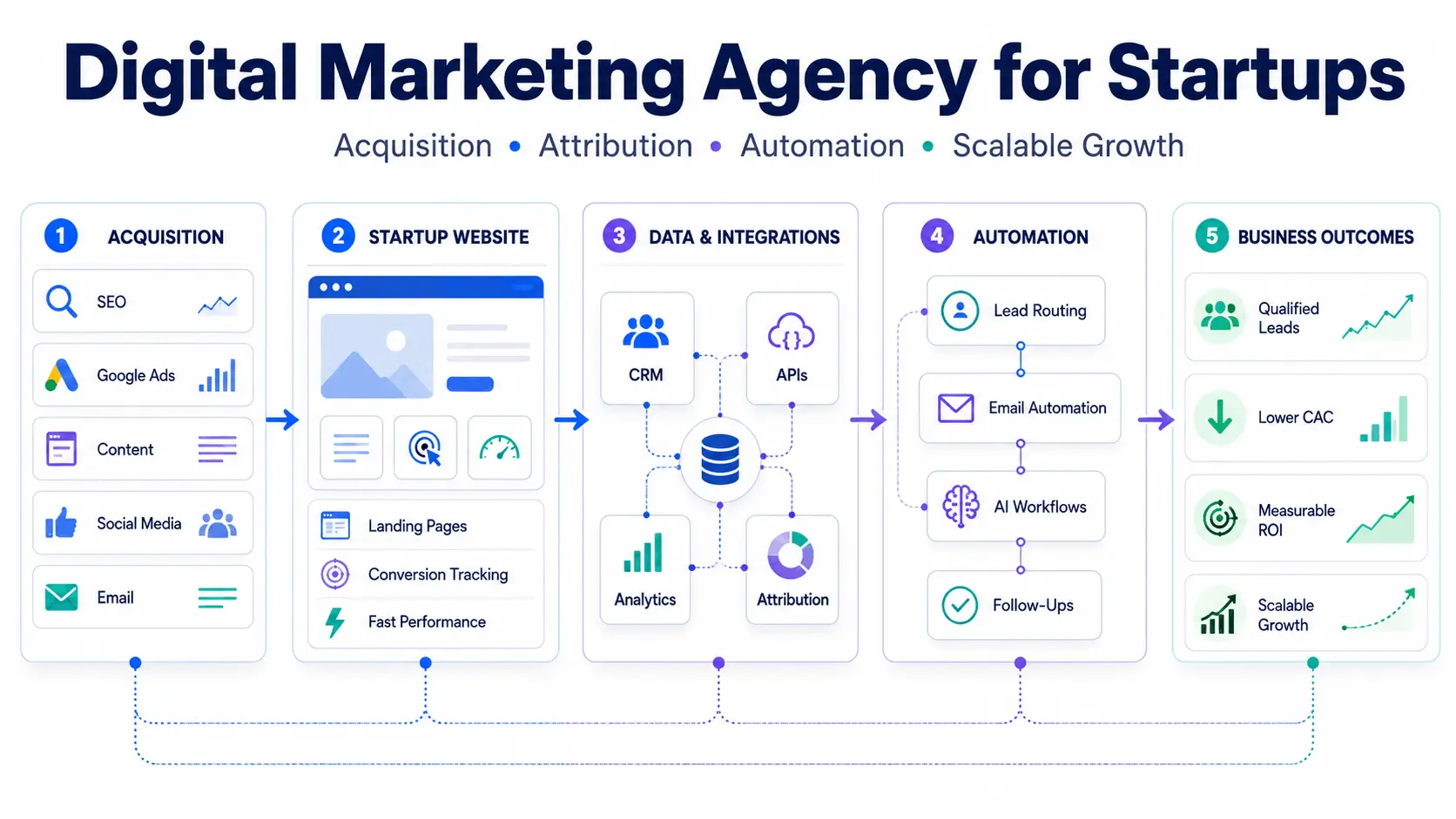
A digital marketing agency for startups is a partner that combines acquisition, analytics, conversion, content, automation, and the technical integrations required to connect marketing activity to revenue. The right agency should help a lean team test demand quickly while keeping tracking, infrastructure, data quality, and campaign operations maintainable as volume grows.
Quick Summary: What founders should evaluate first
- A digital marketing agency for startups should be judged on revenue instrumentation, not channel activity alone; clicks, impressions, and leads are weak substitutes for attributable pipeline and retained customers.
- The marketing stack must scale with the product stack, including CRM integration, analytics events, webhook reliability, consent handling, landing-page performance, and automation failure recovery.
- Startups should avoid locking into a large monthly retainer before product-market fit signals, channel economics, and reporting quality are understood.
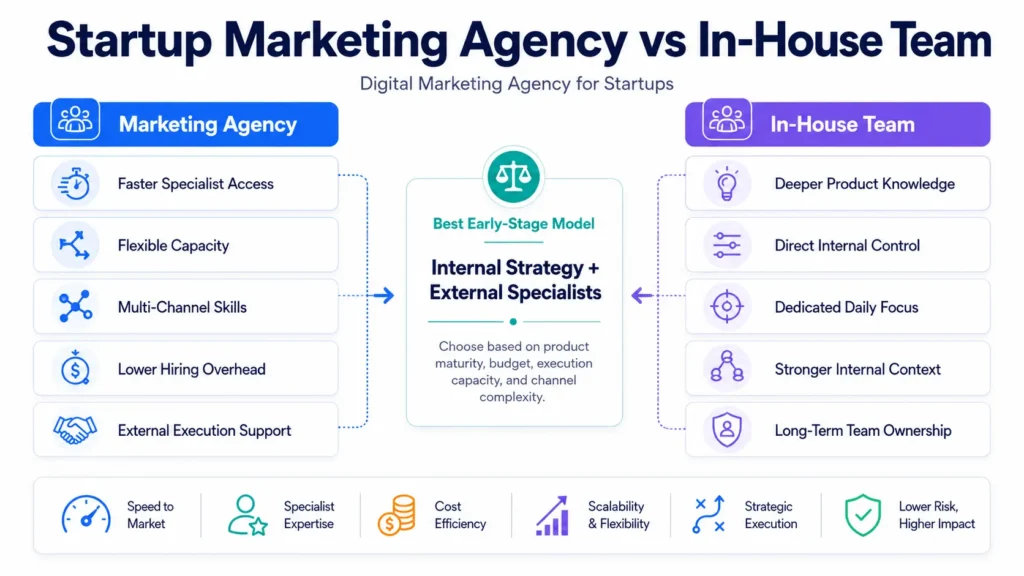
- Agency versus in-house is not a binary decision: a strong early model is often internal ownership of strategy and product knowledge with external specialists handling execution, experimentation, and technical marketing operations.
- The best digital marketing agency for startups documents what it changes, exposes performance data, and leaves the startup with systems that remain understandable if the engagement ends.
Choosing a digital marketing agency for startups: agency vs in-house
Start with operating constraints. An early-stage startup has limited budget, lean teams, incomplete messaging, and little tolerance for months of activity before learning whether a channel works. A mature in-house department can be superior later, but building one too early creates fixed cost before acquisition is proven.
A capable digital marketing agency for startups can provide SEO, paid media, conversion rate optimization, analytics, content, email marketing, and automation without seven separate hires. That breadth matters only when every discipline shares one measurement model; otherwise, teams optimize isolated metrics.
| Feature | Startup Marketing Agency | In-House Team |
|---|---|---|
| Speed to capability | Fast access to specialists and existing workflows | Slower because hiring and onboarding take time |
| Product knowledge | Must be deliberately transferred through briefs, calls, and data | Usually deeper through daily product exposure |
| Cost structure | Retainer, project, or month-to-month engagement | Fixed salaries, management overhead, and tooling |
| Experiment capacity | Can scale channel expertise up or down quickly | Limited by headcount and current skill mix |
| Long-term ownership | Requires documentation and access discipline | Knowledge remains internally if staff retention is strong |
Location is usually secondary to operating fit. A digital marketing agency for startups USA team can help with US media buying and time-zone coverage, while a digital marketing agency for startups UK may bring stronger UK market context. A Los Angeles digital marketing agency for startups can add local network value, but geography should not outweigh attribution discipline or technical competence.
As a regional comparison point, this digital marketing agency in Florida overview is useful for evaluating integrated execution rather than isolated channel services.
What architecture should a digital marketing agency for startups understand?
Marketing sits on top of application architecture. A campaign may touch WordPress, a SaaS product, payments, CRM, email, analytics, and a warehouse. If an agency cannot reason about APIs, authentication, event delivery, data ownership, and failure states, reporting will drift from reality.
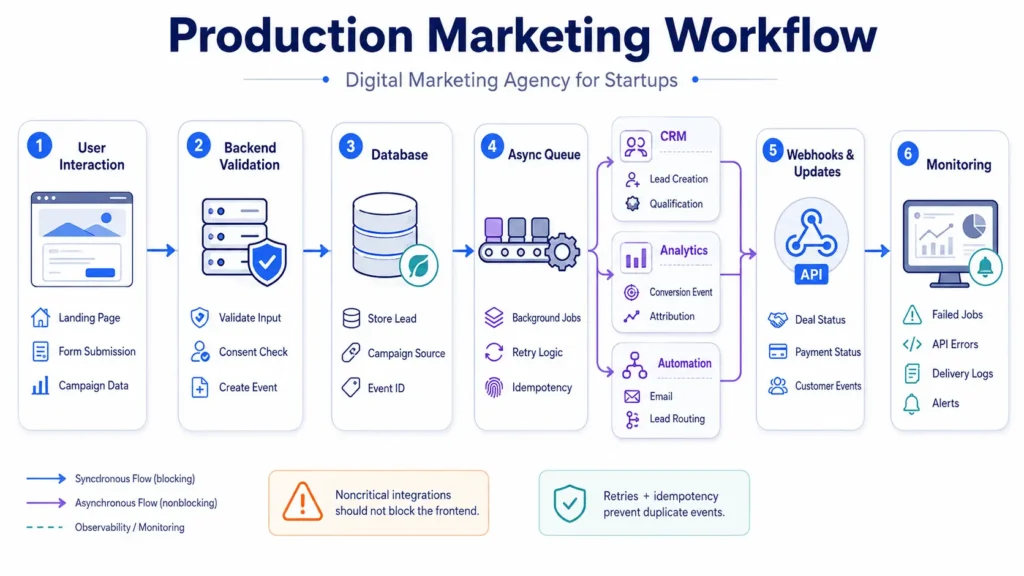
A digital marketing agency for startups should distinguish synchronous API calls from asynchronous work. Form validation may run immediately, while enrichment, lifecycle email, attribution updates, and CRM side effects often belong in queues or background jobs so slow vendors cannot block the frontend.
How a digital marketing agency for startups should design tracking
A practical event model uses stable identifiers and explicit states: visitor, lead, qualified opportunity, customer, renewal, or churn. Events should carry source, timestamp, consent, campaign, and product context. Collect enough trustworthy data to explain acquisition cost, funnel loss, and revenue contribution.
In production, this fails when every tool becomes a source of truth. Ad-platform conversions, CRM deals, and billing records rarely share identical definitions. A documented marketing attribution model keeps reporting from becoming a weekly reconciliation exercise.
The same thinking applies to WordPress. Plugin architecture, custom hooks, REST integrations, Redis object caching, CDN configuration, cron limitations, security hardening, Gutenberg customization, multisite design, and plugin conflicts can affect acquisition. A slow landing page or unreliable form is a marketing problem with an engineering cause. Google’s SEO Starter Guide provides a useful crawlability baseline.
How the production marketing workflow should operate
A well-run digital marketing agency for startups should map a campaign from frontend interaction to booked revenue: paid visit, landing page, demo request, CRM qualification, contract, and renewal.
The browser records campaign and consent data; the backend validates the form and writes it durably. A queue dispatches CRM creation, enrichment, notifications, and analytics. CRM or billing webhooks return later state changes. Retries need idempotency keys so delayed events do not create duplicate contacts, invoices, or conversions.
Authentication and permissions matter. API credentials should be scoped, rotated, and kept outside page code. Role-based access control should separate campaign operators from users who can change billing, domains, integrations, or production tracking. Audit logs should record changes to conversion definitions.
A common mistake is automating before the data contract is stable. AI agents can classify leads, summarize calls, draft nurture messages, or route support, but orchestration needs validation, confidence thresholds, human-in-the-loop rules, fallbacks, prompt operations, and output monitoring. A bad LLM write to the CRM can contaminate downstream automation quickly.
Where startup marketing systems bottleneck under load
The first bottleneck is often coupling, not traffic. If a landing page, form, or checkout waits on third-party marketing calls, one slow vendor can degrade conversion. Move noncritical work to asynchronous jobs.
For WooCommerce or subscription commerce, checkout needs isolation. Payment authorization must not depend on analytics. Gateway webhooks should handle retries and out-of-order events; reconciliation jobs should verify transaction states, refunds, invoices, fraud flags, and reporting. Marketing automation should consume confirmed payment states, not thank-you-page views.
Database contention appears when every event writes to the transactional database. High-volume analytics belongs in an analytical store. Caching, CDN delivery, object caches, and indexes can improve response time, but none fixes a poor data model.
Observability is commonly missing. The agency should know when webhooks fail, queues back up, CRM writes are rejected, pages slow down, or conversion tracking drops. Logs, alerts, queue depth, API latency, and event-delivery success rates are operational metrics.
Scaling a digital marketing agency for startups engagement
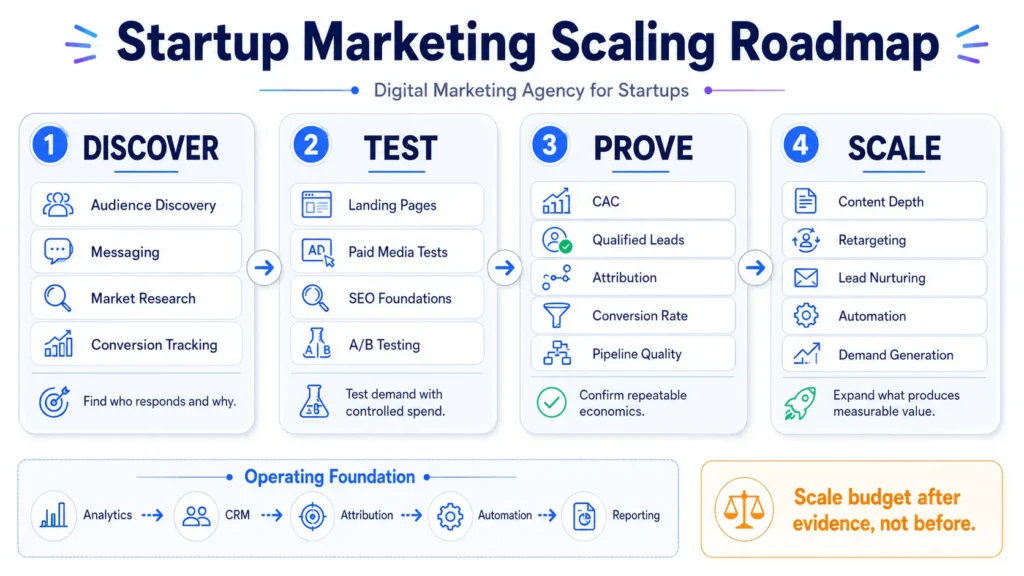
Scale the engagement by evidence. Before product-market fit, prioritize audience discovery, messaging, small paid-media tests, technical SEO, conversion tracking, and landing-page iteration. Once acquisition becomes repeatable, expand budget, content depth, lead nurturing, retargeting, and demand generation.
Marketing budget allocation should then become explicit. Track customer acquisition cost, payback assumptions, stage conversion, and the difference between ROAS and actual ROI. Filicode’s guide to improving digital marketing ROI explains why revenue quality matters more than surface campaign efficiency.
SEO should scale similarly: remove technical blockers first, then build commercially relevant topic clusters, comparison pages, case studies, and digital PR. For smaller teams, cost-conscious SEO programs work best when they preserve technical quality instead of buying low-cost article volume.
AI SEO and generative engine optimization add another requirement: pages need clear entities, self-contained answers, verifiable claims, and crawlable structure so AI Overviews and LLM-based search systems can cite them confidently.
Technical trade-offs that affect marketing performance
No platform wins universally. Choose based on traffic, release frequency, team capability, integration count, compliance needs, and how tightly marketing interacts with the product.
| Feature | Simpler Approach | Engineered Approach |
|---|---|---|
| Website platform | WordPress monolith is fast to launch and easy for content teams | Headless WordPress can separate content from frontend delivery but adds deployment and integration complexity |
| Automation | No-code tools are quick for low-volume workflows | Custom event-driven services offer stronger validation, retries, observability, and control |
| Application architecture | Monolith reduces early operational overhead | Microservices improve independent scaling only when service boundaries and DevOps maturity justify the cost |
| Analytics | Vendor dashboards are fast to adopt | Warehouse-backed reporting creates stronger cross-channel truth but requires data engineering |
| Development cost | Cheap implementation lowers initial spend | Maintainable systems cost more upfront but reduce rework, outage risk, and integration debt |
The engineered approach has a real limitation: premature complexity. A seed-stage company with modest traffic rarely needs microservices. A structured monolith with queues, caching, clear APIs, and observability is often cheaper to operate. Headless WordPress has the same trade-off; use it only when frontend requirements justify extra deployment and integration overhead.
For web foundations, scalable website design principles matter more than visual polish alone. Conversion depends on speed, maintainability, accessibility, analytics integrity, and how safely teams can ship new pages.
How much does a digital marketing agency for startups cost?
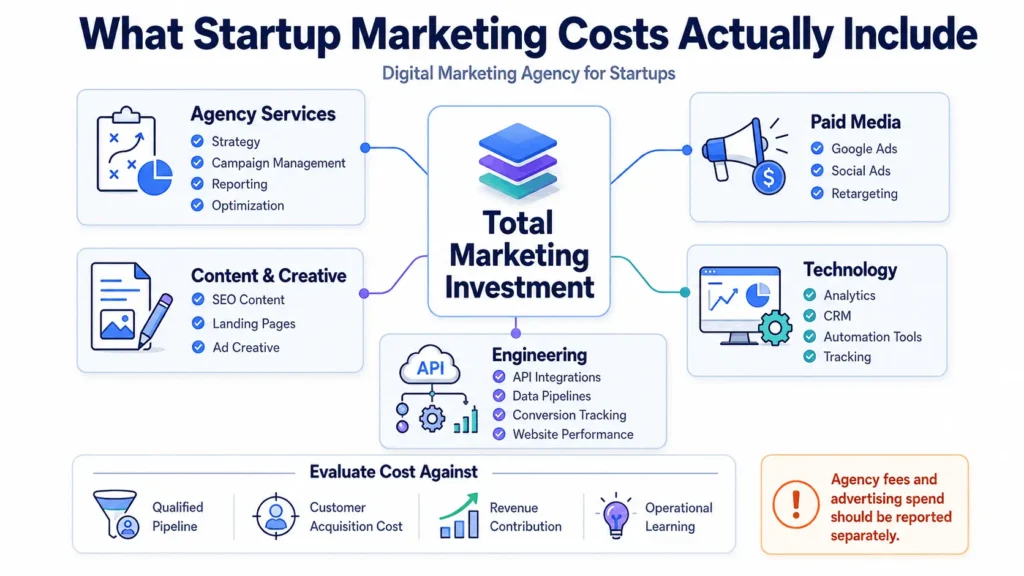
Pricing depends on scope, channel count, creative volume, integration work, and reporting depth. Projects may be fixed-scope; ongoing work often uses a monthly retainer or month-to-month contract. Judge cost by whether the engagement produces measurable learning or revenue faster than equivalent internal hiring.
Ask what is included in strategy, media management, content, engineering, analytics, reporting, account management, and tools. Separate paid media spend from agency fees. Scope CRM integration, data pipelines, and conversion tracking explicitly because they can require more engineering than campaign setup.
How to identify the best digital marketing agency for startups
The best digital marketing agency for startups is not the one with the longest service list. Look for startup experience, measurable results, clear reporting cadence, account access, and the ability to explain why a campaign did or did not work.
Ask for examples involving limited budget, unclear positioning, integrations, and changing product priorities. Review case studies and client testimonials, then inspect the operating model: who owns the account, performs the work, prioritizes experiments, and documents changes.
When Filicode fits the operating problem
Filicode is most relevant when marketing performance depends on technical execution. That can include custom software development, WordPress development, WooCommerce development, SaaS development, AI automation, API integrations, system architecture, and performance optimization alongside acquisition work.
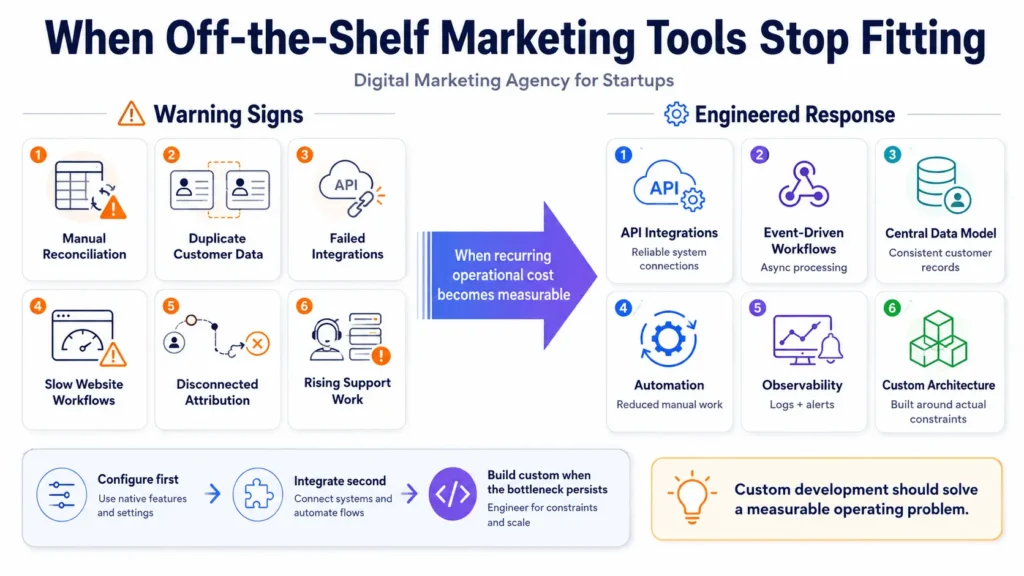
This matters when off-the-shelf tools stop fitting. A startup may need custom CRM integration, event-driven synchronization, tenant-isolated SaaS analytics, subscription automation, admin tooling, or a more reliable attribution pipeline. Custom systems should reduce operating cost and failure risk, not become a platform the team cannot maintain.
For B2B companies, the same principle applies to demand generation. A scalable B2B digital marketing strategy should connect positioning, content, paid acquisition, CRM stages, sales handoff, and reporting rather than treating lead generation as an isolated top-of-funnel task.
Frequently asked questions
What does a digital marketing agency for startups actually do?
A digital marketing agency for startups plans and operates acquisition, SEO, paid media, content, conversion, analytics, CRM workflows, and automation. A technically capable agency also manages API integrations, tracking validation, attribution, and reporting so campaign activity can be tied to pipeline or revenue.
How long should startup marketing implementation take?
A focused measurement and campaign foundation can often be implemented in 2 to 6 weeks when access, messaging, and systems are ready. Complex CRM migrations, website rebuilds, data pipelines, or multi-channel automation can take longer because testing and integration dependencies must be resolved before scale.
Can a startup marketing system scale without microservices?
Yes. Many startups can scale effectively with a well-structured monolith, CDN, object caching, background queues, indexed databases, and clear APIs. Microservices become useful when independent deployment, team boundaries, or workload isolation justify the additional operational complexity.
What integration risks should founders check before hiring an agency?
Check API ownership, credential storage, webhook retries, duplicate-event handling, CRM field mapping, consent data, and account permissions. A production integration should have logging and failure alerts because silent synchronization errors can corrupt attribution and lead-routing decisions.
How should maintenance work after launch?
Maintenance should include monthly or release-based checks for tracking accuracy, page performance, integration errors, automation failures, access permissions, and dependency updates. Higher-volume systems may need continuous alerts for queue depth, API errors, webhook delivery, and checkout failures.
When should a startup replace off-the-shelf marketing tools with custom development?
Custom development becomes reasonable when manual reconciliation, integration limits, data duplication, platform latency, or licensing constraints create recurring operational cost. The trigger should be a measurable bottleneck, not a preference for custom software.
Conclusion: choose for operational fit, not service count
A digital marketing agency for startups should make growth easier to measure and operate. Warning signs include manual reconciliation, inconsistent conversions, slow landing pages, brittle CRM automation, failed webhooks, rising support effort, duplicate customer records, and reporting that cannot connect spend to revenue.
Consider custom development when those problems recur often enough to justify engineering ownership. Before replacing tools, document the bottleneck, quantify its operating cost, and test whether configuration or integration can solve it first.
If your startup is evaluating a digital marketing agency for startups, focus the next conversation on architecture, attribution, ownership, reporting, and failure handling as much as channel tactics. That is where scalable growth stops being a campaign promise and becomes an operating system the team can maintain.