








Contents
- Quick Summary:
- Why SEO for Law Firms Works Differently Than Normal Local SEO
- Local SEO for Law Firms: Maps, Reviews, and Location Authority
- How Google Maps Visibility Usually Improves
- Technical SEO for Law Firms Starts With Website Architecture
- On-Page SEO for Law Firms: Intent, Content Depth, and Conversion
- SEO for Law Firms Content Workflow
- SEO for Law Firms Requires Better Measurement Than Traffic
- Production Workflow: From Search Query to Signed Case
- Architecture Choices: WordPress, Headless, SaaS Tools, or Custom Systems
- AI Search, Automation, and Legal SEO
- When Filicode Fits Into a Law Firm SEO System
- FAQs About SEO for Law Firms
- Why do SEO costs vary for law firms?
- How long does SEO take for law firms?
- What are the best SEO practices for law firms?
- How can I track SEO results for law firms?
- How can AI be used for law firm SEO?
- Conclusion:
A law firm website can rank for a few terms and still fail commercially. Pages load slowly on mobile. Practice area content overlaps. Google Business Profile data is inconsistent. Intake forms break after plugin updates. Call tracking is not connected to signed-case reporting. That is where seo for law firms becomes more than keyword placement. It becomes a technical and operational system for acquiring better cases with less waste.
Legal search is high-intent, competitive, and unforgiving. A personal injury query in Los Angeles, a family law search in Miami, or a criminal defense search in Houston can involve expensive clicks, strong local competitors, and strict trust signals. Good SEO has to connect content, local visibility, website architecture, analytics, reviews, schema, and conversion tracking.
This guide explains how law firms should approach SEO from a systems perspective: what to build, what to avoid, how technical decisions affect rankings, and how to measure the work beyond traffic.
Quick Summary:
- SEO is an acquisition system. Rankings matter, but signed cases, intake quality, and cost per acquisition matter more.
- Local visibility drives serious legal leads. Google Maps, reviews, NAP consistency, and location pages need ongoing governance.
- Technical SEO cannot be separated from WordPress maintenance. Plugin conflicts, slow templates, poor schema, and weak hosting create ranking and conversion drag.
- Content must match practice area intent. A “car accident lawyer” page, a blog post, and a city landing page should not compete with each other.
- AI can help workflows, not replace legal judgment. Human review, attorney validation, and compliance checks are non-negotiable.
- Cheap SEO usually becomes expensive later. Thin pages, duplicated city content, and bad backlinks create cleanup costs.
Why SEO for Law Firms Works Differently Than Normal Local SEO
Most local businesses compete on convenience, price, and proximity. Law firms compete on trust, urgency, legal expertise, jurisdiction, practice area relevance, and proof. That changes the architecture of the SEO campaign.
A plumber can rank with service pages, reviews, and citations. A law firm needs stronger topical authority, attorney credentials, local relevance, content accuracy, and ethical advertising discipline. Legal content sits close to YMYL territory, so weak claims, vague advice, or unsupported pages can reduce trust.
Effective seo for law firms usually includes:
- Practice area pages for high-intent services.
- Location pages for city and office-level relevance.
- Attorney bios with credentials, bar admissions, and experience.
- Review systems that support Google Business Profile growth.
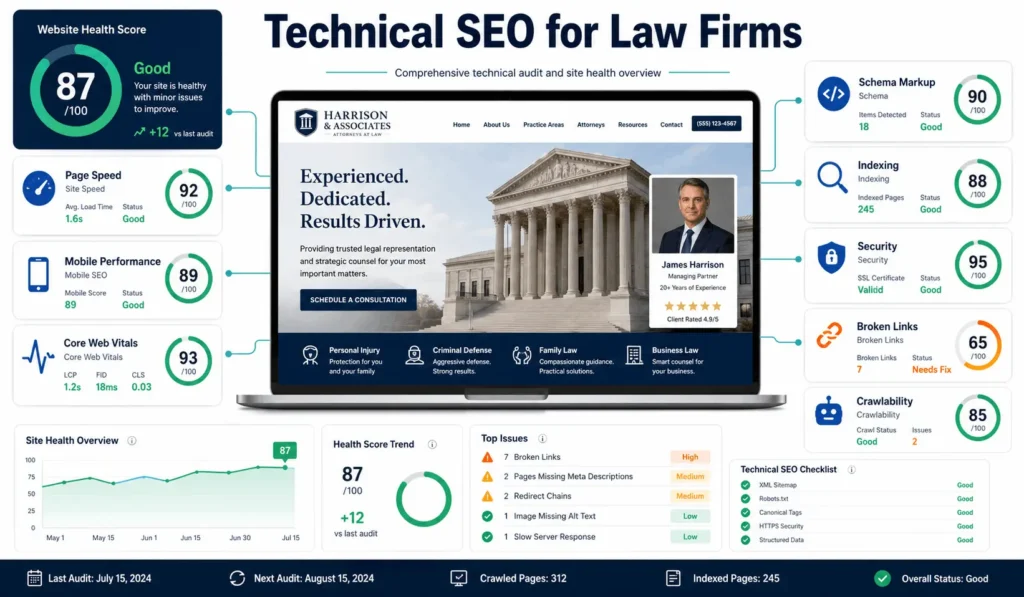
- Technical SEO audits for crawlability, indexation, speed, and schema.
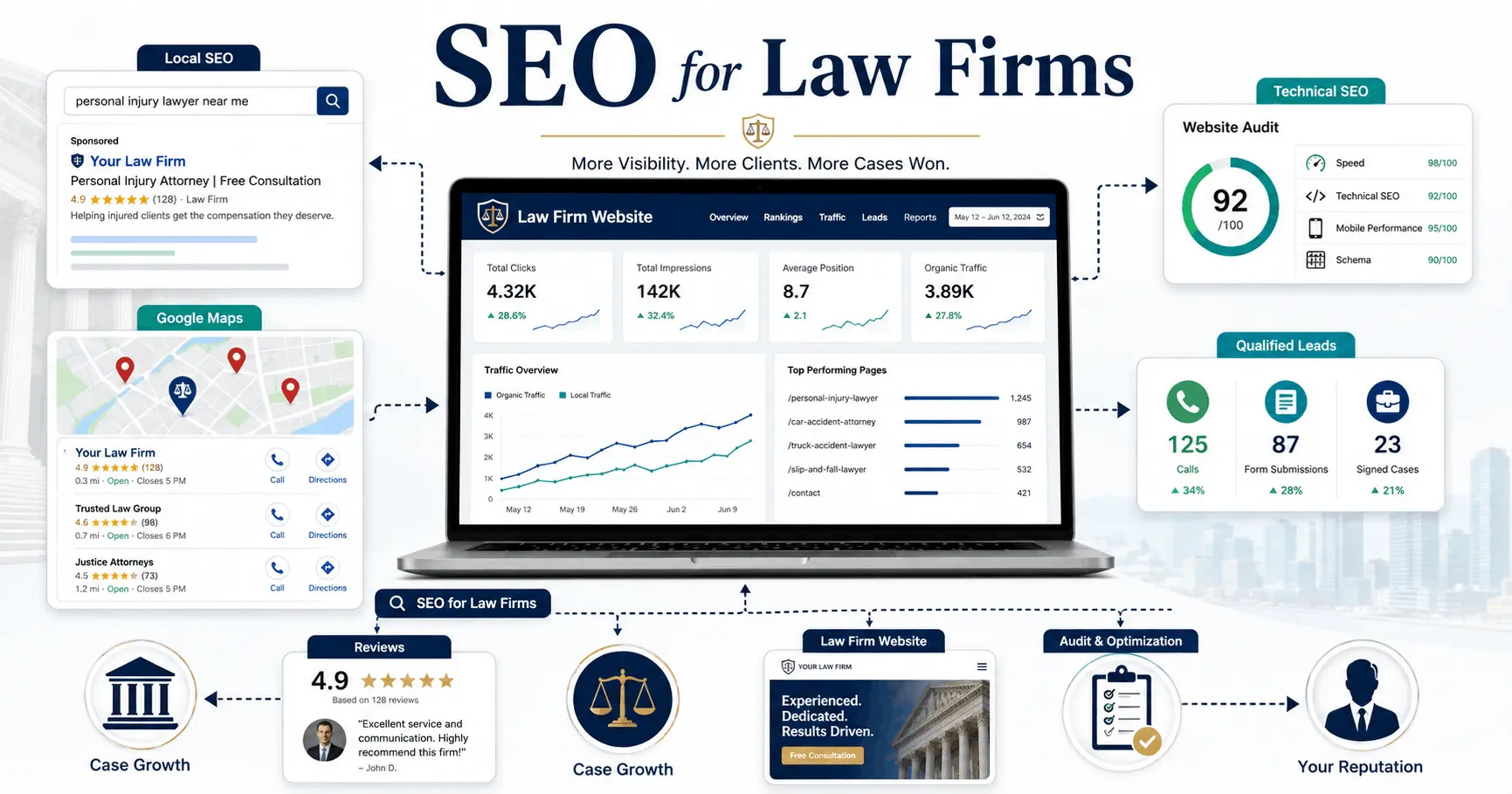
- Conversion tracking for calls, forms, chats, directions, and signed cases.
A law firm in Miami has different local ranking pressure than a firm in Cleveland, Houston, New York, Long Island, Baltimore, or Birmingham. For firms targeting Florida markets, a supporting local strategy around Miami SEO services can help connect city-level visibility with broader legal SEO execution.
Local SEO for Law Firms: Maps, Reviews, and Location Authority
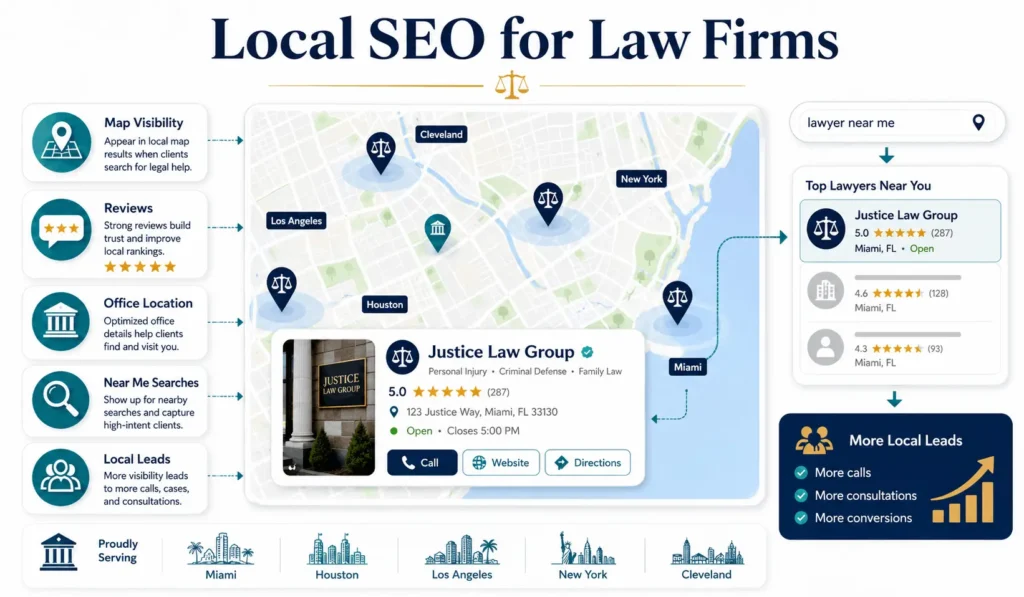
For many legal searches, the local 3-pack receives serious attention before organic listings. That makes local seo for law firms a core acquisition channel, not a side task.
A production-ready local SEO workflow should manage three layers: Google Business Profile, website location architecture, and external local consensus. The firm’s name, address, phone number, business hours, categories, services, office photos, review responses, and appointment links should stay consistent across the web.
Local SEO becomes harder when a firm has multiple offices or serves nearby cities without a physical office in each one. A page for “seo for law firms in Miami” or “seo for law firms in Houston TX” can be valid in a marketing context, but legal service pages need genuine relevance. Fake office locations, doorway pages, and duplicated city templates are risky.
How Google Maps Visibility Usually Improves
The practical workflow is simple, but the execution requires discipline:
- Clean NAP data across Google Business Profile, legal directories, and local citations.
- Build strong office-level landing pages with maps, staff, directions, parking details, and practice relevance.
- Request reviews ethically after appropriate client milestones.
- Respond to reviews without exposing confidential information.
- Earn local backlinks from bar associations, chambers of commerce, local media, sponsorships, and community organizations.
The local SEO checklist for small business rankings is useful here because many foundational local ranking signals apply to law firms too, though legal compliance needs extra care.
Technical SEO for Law Firms Starts With Website Architecture
Many legal websites are built on WordPress. That is fine when the stack is maintained properly. WordPress can support fast, structured, scalable websites, but poor theme decisions and plugin overload often create technical debt.
Technical seo for law firms should cover crawl paths, indexing rules, schema, Core Web Vitals, redirect logic, internal linking, canonical tags, sitemap hygiene, security, and hosting performance. A visually attractive site can still fail if Googlebot struggles to crawl it or users abandon it on mobile.
For a growing law firm, the architecture should separate:
- Practice area pages.
- Sub-practice pages.
- City and office pages.
- Attorney profiles.
- Case result pages where permitted.
- Blog and FAQ content.
- Conversion pages such as contact, consultation, and intake forms.
The goal is not more pages. The goal is fewer conflicts. If “car accident lawyer,” “personal injury lawyer,” and “truck accident attorney” pages all repeat the same copy, rankings become unstable. Search engines see weak differentiation, and users see generic content.
For deeper technical diagnostics, firms should run a structured technical SEO checklist for scalable website growth before investing heavily in content.
On-Page SEO for Law Firms: Intent, Content Depth, and Conversion
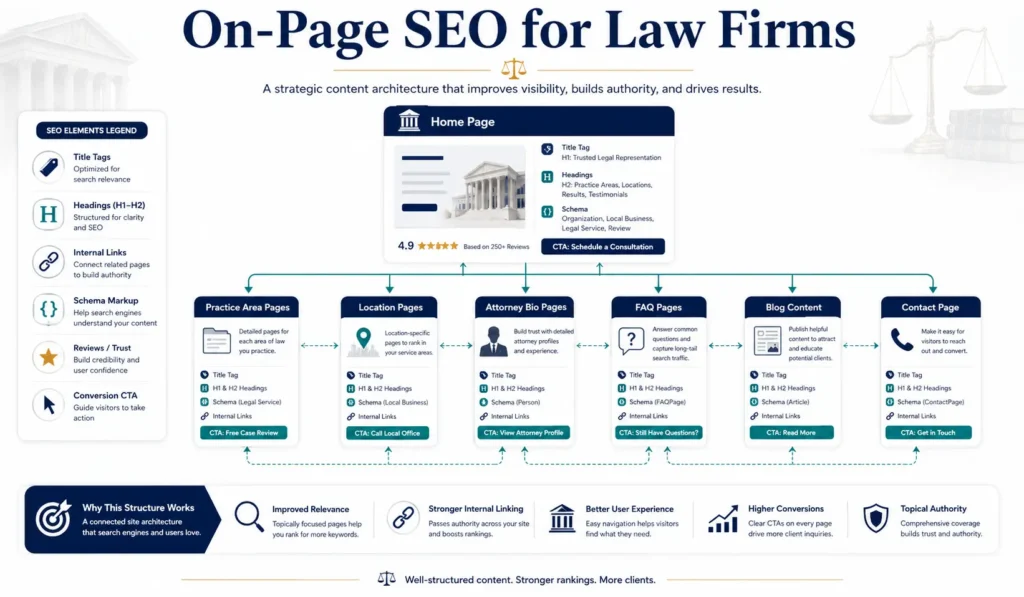
On-page seo for law firms is not just title tags and headings. It is the process of aligning a page with the user’s legal problem, local context, and decision stage.
A strong practice area page usually answers:
- What legal problem does the page solve?
- Who is the right client for this service?
- What jurisdiction or local process affects the case?
- What evidence, deadlines, or next steps matter?
- Why should the user trust this firm?
- How can the user contact the firm quickly?
For seo for law firms, the best content is practical, clear, and legally responsible. It should avoid exaggerated promises. It should not say “we guarantee compensation” or imply outcomes that depend on facts and law.
Attorney-reviewed content, author bios, citations to legal resources, updated FAQs, and accurate local court references all support trust. Search engines evaluate pages through many signals, but users make decisions faster. If the page feels vague, they leave.
SEO for Law Firms Content Workflow
A maintainable workflow looks like this:
- Map practice areas to commercial keywords and local modifiers.
- Identify search intent for each page before writing.
- Create an outline that avoids cannibalization with existing pages.
- Write with attorney input or attorney review.
- Add schema, internal links, FAQs, and conversion blocks.
- Track impressions, rankings, calls, forms, and signed cases.
- Update pages based on performance and legal changes.
The SEO audit checklist for technical, on-page, and local SEO can help teams find weak pages before launching a larger content campaign.
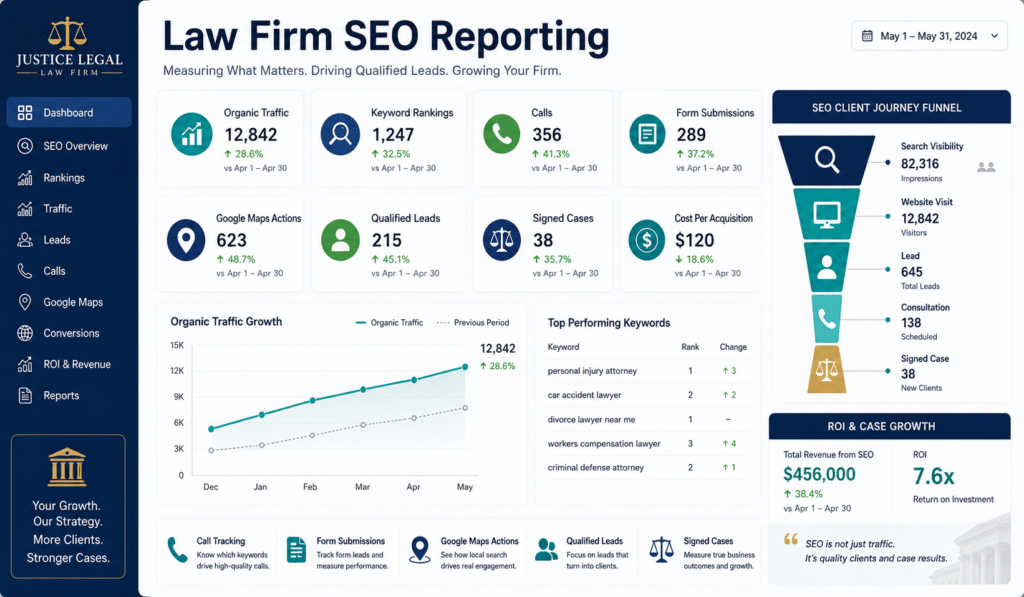
SEO for Law Firms Requires Better Measurement Than Traffic
Traffic can mislead law firms. A blog post about “what happens after a car accident” may attract visitors, but not every visitor is ready to hire an attorney. High traffic with low intake quality creates reporting noise.
The useful metrics are closer to operations:
| Metric | Why It Matters | Operational Risk If Ignored |
|---|---|---|
| Qualified calls | Shows whether rankings are producing real inquiries. | Traffic grows, but intake team receives poor-fit leads. |
| Form submissions | Measures conversion from service and location pages. | Broken forms or weak CTAs stay unnoticed. |
| Google Business Profile actions | Tracks calls, website clicks, and direction requests. | Map visibility cannot be tied to business impact. |
| Signed cases | Connects marketing to revenue. | Campaigns optimize for rankings instead of case value. |
| Cost per acquisition | Compares SEO against PPC, Local Service Ads, and referrals. | Budget decisions rely on incomplete data. |
A practical setup connects Google Search Console, Google Analytics, call tracking, CRM stages, and intake notes. Microsoft Clarity can also reveal friction in forms, mobile layouts, and CTA placement. For background on how search engines categorize and retrieve content, this overview of search engine optimization gives useful context.
Production Workflow: From Search Query to Signed Case
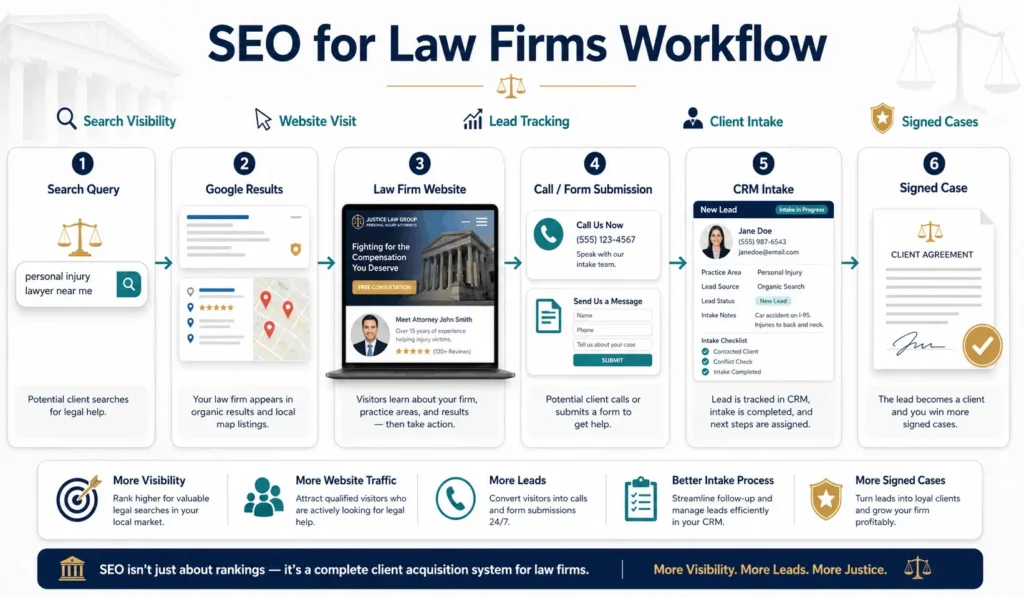
A real legal SEO system has several moving parts. The user searches. Google selects pages or map listings. The website loads. The user calls, submits a form, opens live chat, or requests directions. The intake team qualifies the lead. The CRM tracks the case. Reporting connects the original query to the business outcome.
From a technical perspective, the workflow often includes:
- Frontend pages built in WordPress or a headless frontend.
- Backend form processing with validation and spam protection.
- CRM API integrations for lead routing.
- Call tracking scripts with source attribution.
- Caching and CDN layers for speed.
- Schema markup for attorneys, legal services, local business data, and FAQs.
- Async jobs for email notifications, CRM sync, and reporting updates.
- Monitoring for failed submissions, slow pages, and broken tracking events.
This is where many firms lose leads without realizing it. A contact form may appear functional while silently failing on mobile Safari. A plugin update may remove tracking parameters. A caching rule may delay thank-you page events. A CRM webhook may timeout during peak traffic.
Reliable seo for law firms includes failure handling. Forms should log submissions before sending them to third-party systems. API calls should retry. Notifications should have fallbacks. Admin users should have audit logs. The marketing dashboard should show data quality issues, not only traffic charts.
Architecture Choices: WordPress, Headless, SaaS Tools, or Custom Systems
Law firms do not always need custom software. Many can grow with a well-built WordPress site, strong hosting, clean plugins, and disciplined content governance. Problems appear when the business model becomes more complex.
A multi-location firm may need advanced permissions, intake routing, content approvals, CRM integrations, attorney dashboards, lead scoring, and reporting by office or practice area. At that point, the website becomes part of the firm’s operating system.
| Approach | Best Fit | Trade-Off |
|---|---|---|
| Standard WordPress | Small to mid-sized firms with clear services and moderate content needs. | Needs careful plugin management, security hardening, and performance tuning. |
| Headless WordPress | Firms needing stronger frontend performance or custom user experiences. | Higher development cost and more deployment complexity. |
| SaaS landing page tools | Fast campaign launches and simple PPC support. | Limited architecture control and weaker long-term SEO ownership. |
| Custom platform | Multi-location firms with complex intake, reporting, automation, or integrations. | Requires architecture planning, maintenance budget, and experienced engineering. |
Cheap development often looks attractive at launch. The cost appears later: slow templates, duplicated blocks, fragile page builders, no staging workflow, weak backups, and plugin conflicts. Maintainability is not a luxury when your website drives consultations.
AI Search, Automation, and Legal SEO
AI Overviews, ChatGPT, Gemini, Copilot, and Perplexity are changing how users discover legal information. That does not remove the need for technical SEO. It raises the quality bar.
AI systems tend to surface content that is clear, structured, authoritative, and easy to extract. Question-based headings, concise answers, attorney-reviewed explanations, schema markup, and strong entity signals help. This overlaps with Answer Engine Optimization and Generative Engine Optimization.
AI can also improve internal workflows:
- Content briefs based on approved keyword maps.
- FAQ clustering for practice area pages.
- Review sentiment summaries.
- CRM lead classification.
- Call transcript tagging.
- Internal reporting summaries.
But legal AI workflows need validation. An AI agent should not publish legal advice without review. LLM outputs need human-in-the-loop checks, prompt governance, source validation, and monitoring. In law firm marketing, automation should reduce repetitive work, not introduce compliance risk.
When Filicode Fits Into a Law Firm SEO System
After the strategy is clear, implementation quality decides whether the plan survives production. Filicode works on the technical side of growth systems: custom software development, WordPress development, WooCommerce development, SaaS development, API integrations, AI automation, performance optimization, and system architecture.
For a law firm, that can mean improving WordPress performance, fixing technical SEO problems, integrating forms with a CRM, building custom intake workflows, creating reporting dashboards, or restructuring service and location pages. It can also mean helping a firm outgrow fragile plugins when custom development becomes more reliable than patching old tools.
Firms reviewing broader marketing infrastructure can also compare services through technical digital marketing services and SEO services for small business growth when planning budgets and execution models.
FAQs About SEO for Law Firms
Why do SEO costs vary for law firms?
Costs vary because competition, practice area value, location difficulty, website condition, content needs, and technical debt are different for every firm. Seo for law firms in New York, Los Angeles, Miami, or Houston usually requires more content depth, stronger backlinks, better local SEO, and tighter tracking than a low-competition market.
How long does SEO take for law firms?
Most firms should expect early technical and indexing improvements within weeks, but meaningful ranking and lead growth often takes 3 to 9 months. Competitive personal injury and criminal defense markets may take longer because authority, reviews, and content depth compound over time.
What are the best SEO practices for law firms?
The best practices include clean site architecture, strong practice area pages, ethical review generation, local SEO, attorney-reviewed content, schema markup, fast mobile performance, accurate tracking, and regular audits. The work should connect rankings to calls, forms, and signed cases.
How can I track SEO results for law firms?
Track Google Search Console impressions, keyword rankings, organic traffic, Google Business Profile actions, calls, forms, chat leads, CRM stages, and signed cases. Ranking reports alone are not enough. Intake quality and cost per acquisition show whether the campaign is commercially useful.
How can AI be used for law firm SEO?
AI can support keyword clustering, content outlines, internal linking audits, call summaries, FAQ generation, and reporting. It should not replace attorney review. Legal content needs accuracy, compliance checks, and clear responsibility before publication.
Conclusion:
The warning signs are easy to spot: rankings fluctuate without explanation, forms fail quietly, local pages compete with each other, reviews grow slowly, reports show traffic but not cases, and every plugin update creates risk. These are not just marketing problems. They are system problems.
Strong seo for law firms connects technical architecture, local visibility, content quality, analytics, automation, and intake operations. It respects legal compliance. It measures business outcomes. It avoids shortcuts that create cleanup work later.
Custom development should be considered when the firm has outgrown basic tools, needs CRM or intake automation, manages multiple offices, relies on complex reporting, or cannot trust its current website stack. The next practical step is a technical and local SEO audit, followed by a clear roadmap that separates quick fixes from architecture-level improvements.