








Contents
- Quick Summary: What Do Web Developers Do for a Business?
- What Do Web Developers Do at Work?
- What Do Web Developers Do Daily Before Writing Code?
- Frontend vs Backend vs Full-Stack Developer Responsibilities
- How Does a Production Web Development Workflow Operate?
- How Do Web Developers Design Technical Architecture?
- What Do Web Developers Do in WordPress and WooCommerce?
- Developer Responsibilities in SaaS, AI, and Payment Systems
- How Web Developers Respond When Systems Fail
- Which Web Development Skills Matter Most?
- What Do Web Developers Do Across Career Paths and Work Environments?
- Cheap Development, No-Code, or Maintainable Engineering?
- When Should a Business Bring in Experienced Web Developers?
- Frequently Asked Questions
- What do web developers do on a daily basis?
- What factors affect web development cost?
- How long does a web development project take?
- What do web developers do to scale an existing website?
- Do web developers need a degree?
- Are web developers in demand?
- What Do Web Developers Do When Growth Exposes System Limits?
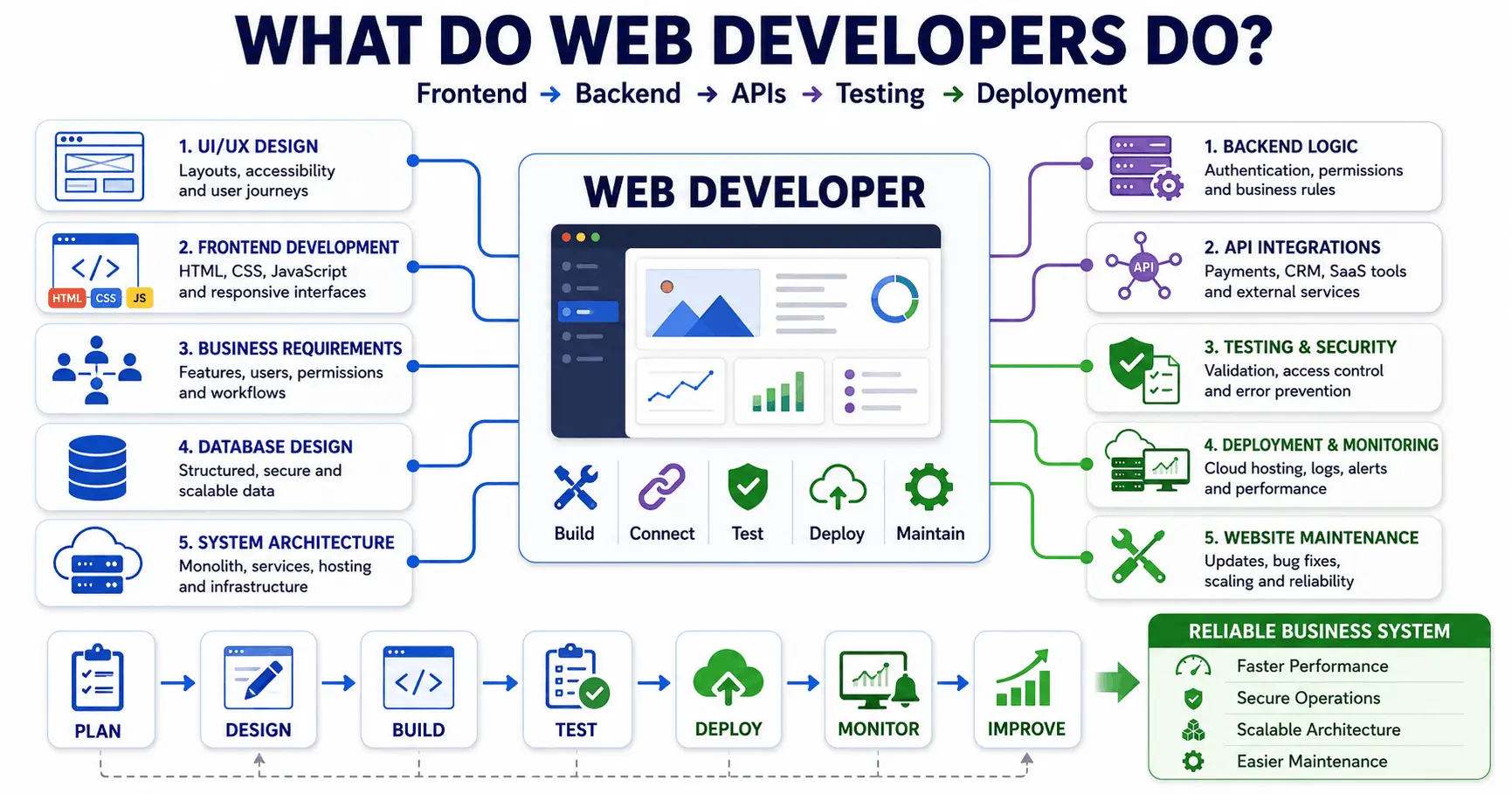
A slow checkout, failed API sync, broken deployment, or database bottleneck rarely has one obvious cause. Web developers investigate how the interface, application logic, infrastructure, third-party services, and data layer interact before changing code. So, what do web developers do? They design, build, test, deploy, monitor, and maintain websites and web applications so users can complete real business tasks reliably.
The job is not limited to HTML, CSS, and JavaScript. In production, developers validate data, secure authentication flows, manage integrations, improve performance, and reduce the support burden created by fragile systems.
Quick Summary: What Do Web Developers Do for a Business?
- Web developers turn product requirements into working interfaces, backend services, databases, integrations, and operational tools.
- Scalable development requires more than coding; it includes architecture, security, testing, monitoring, deployment, and failure recovery.
- A front-end developer controls browser behavior, while a back-end developer manages application logic, data, permissions, and integrations.
- Production reliability depends on validation, caching, queues, logs, retries, and clear ownership of failures.
- Technical debt becomes expensive when every new feature increases deployment risk, support tickets, or database contention.
What Do Web Developers Do at Work?
At work, web developers translate business requirements into dependable system behavior. A request such as “add subscription upgrades” may require user-interface changes, billing rules, payment gateway webhooks, database migrations, permission checks, emails, audit logs, and reporting updates. The visible screen is only one part of the delivery.
What do web developers do on a daily basis depends on the product stage. A new SaaS team may focus on features, while a mature marketplace team spends more time tracing failures, reviewing changes, and reducing operational risk.
What Do Web Developers Do Daily Before Writing Code?
Good developers clarify what the system must do, who can do it, which data changes, and what happens when an external service fails. They inspect code, database relationships, API contracts, and deployment constraints before implementation.
- Review requirements, acceptance criteria, analytics, support reports, or production logs.
- Break work into frontend, backend, database, integration, security, and testing tasks.
- Estimate risk around migrations, compatibility, performance, and rollback.
- Implement code, test edge cases, review changes, and document operational behavior.
- Deploy safely, monitor the release, and correct issues without corrupting data.
For companies evaluating regional delivery partners, the scope of Texas web development services should be assessed in these operational terms, not only by page design or hourly rate.
Frontend vs Backend vs Full-Stack Developer Responsibilities
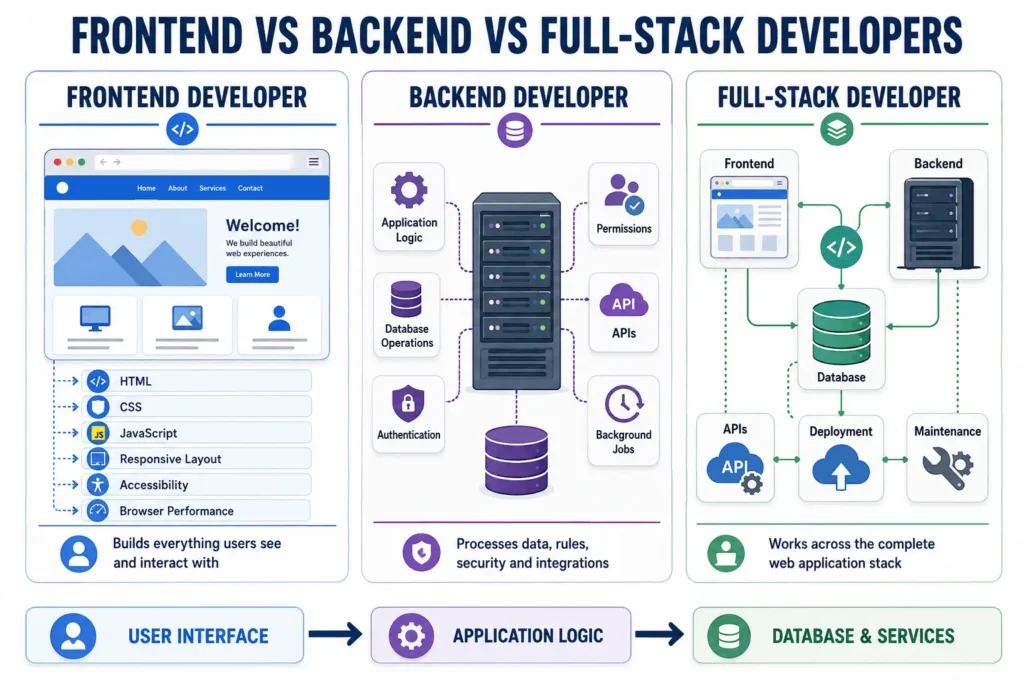
The web developer job description changes by specialization, but every role supports the same transaction: present the action clearly, process it correctly, store it safely, and make failures observable.
| Feature | Frontend Developer | Backend or Full-Stack Developer |
|---|---|---|
| Primary responsibility | Website layout, interaction, accessibility, and browser performance | Business logic, databases, APIs, permissions, and system reliability |
| Typical technologies | HTML, CSS, JavaScript, React, Vue, browser APIs | PHP, Node.js, Python, Java, SQL, queues, cloud services |
| Common risks | Layout shifts, slow rendering, accessibility gaps, cross-browser failures | Data corruption, security flaws, slow queries, integration failures |
| Operational focus | Usability, conversion flow, responsive behavior, Core Web Vitals | Scalability, validation, logging, retries, deployment, recovery |
A front-end developer converts UI/UX design into responsive interfaces and manages browser state. The work includes validation, component behavior, cross-browser testing, accessibility, and performance. A polished interface still fails if it hides errors or loses user input.
A back-end developer builds authentication, role-based access control, database integration, APIs, scheduled jobs, billing states, and admin workflows. A full-stack developer works across both layers, although infrastructure or security may still require specialists.
In WordPress projects, the difference between basic theme editing and engineering is substantial. Strong WordPress developer skills include hook design, query performance, plugin architecture, security, deployment discipline, and compatibility planning.
How Does a Production Web Development Workflow Operate?
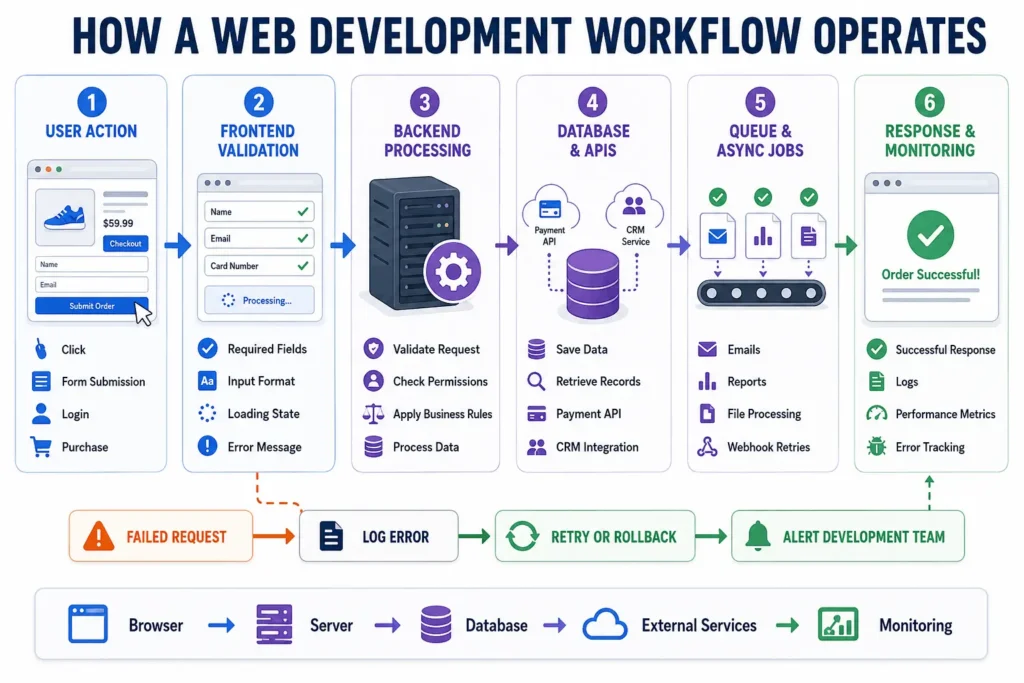
To understand what do web developers do at work, follow a typical transaction. A user submits a form. The frontend validates obvious errors, sends an authenticated request, and shows a stable loading state. The backend validates the payload again because browser-side validation cannot be trusted.
The application checks permissions, applies business rules, updates data, and may call an external API. Slow work such as email, imports, or document generation should usually move to a queue so the request can finish quickly.
Queues need retry limits, idempotency, and dead-letter handling. In production, a payment or CRM job that retries without an idempotency key can create duplicate charges, contacts, or notifications. Developers must design failure behavior before failures occur.
Caching reduces repeated work, but incorrect invalidation can show outdated prices, permissions, or inventory. Developers decide where browser, CDN, page, object, or Redis caching is safe and which data must remain current.
What do web developers do after deployment? They monitor structured logs, errors, performance metrics, queue dashboards, slow database queries, and uptime checks to identify whether a failure originated in code, infrastructure, or a third-party provider. This ownership extends the role beyond building pages into continuous operation and recovery.
How Do Web Developers Design Technical Architecture?
Architecture determines how safely a product can change. What do web developers do during architecture work? They define component boundaries, data ownership, API contracts, authentication, deployment units, caching, and monitoring.
A modular monolith is often the practical starting point because deployment and debugging remain simpler. Microservices help when teams or scaling patterns need independent services, but they add network failures, distributed tracing, versioned contracts, and infrastructure overhead.
Webhooks and event-driven systems synchronize payments, CRM records, inventory, and notifications. Because events can arrive late, twice, or out of order, reliable systems verify signatures, store event IDs, record status, and reconcile missed events.
Authentication confirms identity; authorization controls actions. RBAC must be enforced on the server, not by hiding buttons. SaaS tenant isolation must cover queries, files, caches, background jobs, and admin tools.
What Do Web Developers Do in WordPress and WooCommerce?
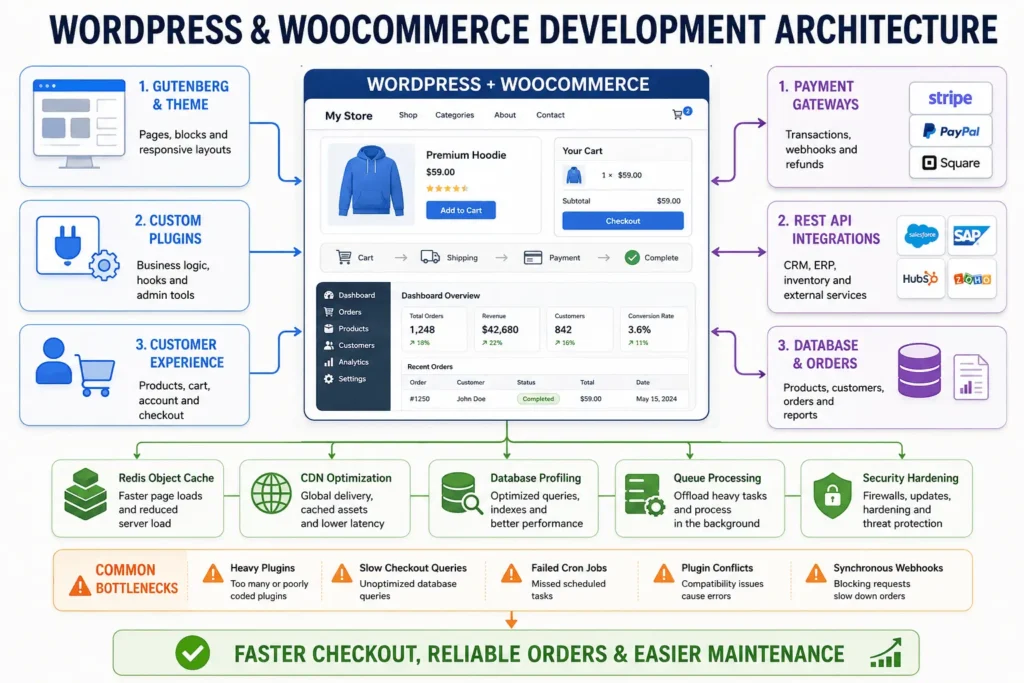
WordPress developers create Gutenberg blocks, plugins, post types, REST API integrations, multisite rules, admin workflows, and security controls. In custom WordPress development, maintainable teams keep business logic out of theme files and use documented hooks and data models.
WooCommerce adds cart, checkout, inventory, tax, payment, refund, and order-state complexity. Under load, uncached queries, synchronous webhooks, heavy plugins, and weak cron design create timeouts. Redis, CDN optimization, profiling, and queues help only after the real bottleneck is measured.
Headless WordPress improves frontend flexibility but adds API dependency, preview complexity, cache invalidation, and separate deployments. A conventional build is often easier to operate; the choice depends on traffic, editorial workflow, integrations, and team maturity.
Developer Responsibilities in SaaS, AI, and Payment Systems
In SaaS products, developers manage tenant isolation, subscriptions, permissions, audit logs, admin tools, and synchronization. AI automation adds orchestration, validation, bounded actions, fallbacks, and human review. In production, missed tenant filters or unvalidated agent actions can expose data or create incorrect updates, so deterministic checks and audit trails are essential.
Payment integrations require verified webhooks, transaction states, reconciliation, refunds, invoices, and fraud controls. A browser redirect is not proof of payment; the server must confirm the provider event and record every state change.
How Web Developers Respond When Systems Fail
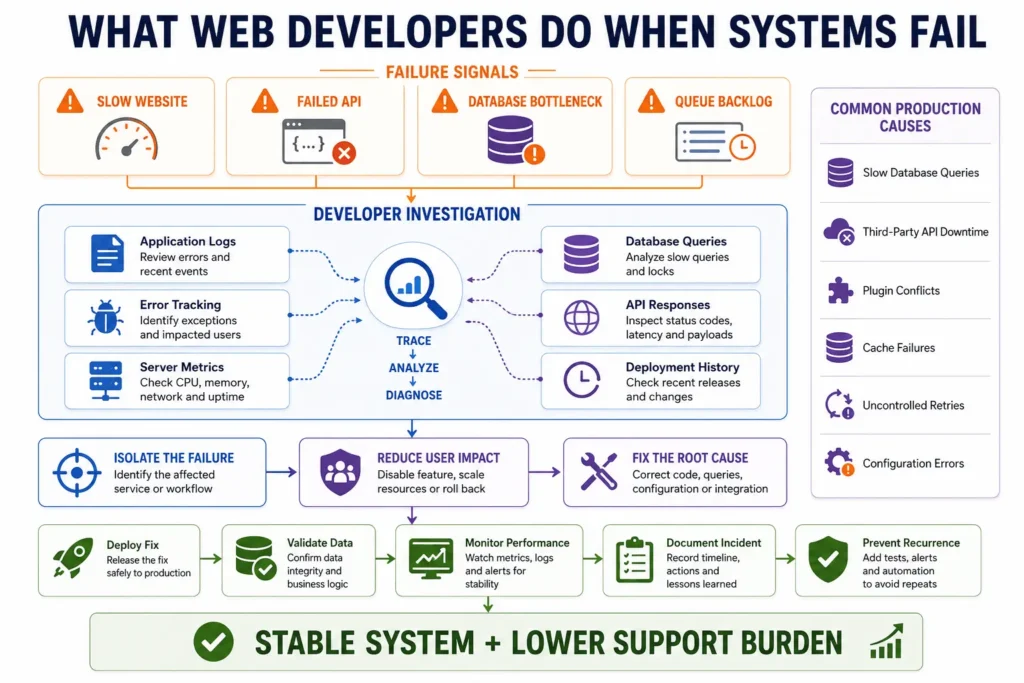
Production support is part of web developer daily tasks. Developers reproduce issues, correlate logs, inspect deployments, trace queries, and decide whether a failure is isolated or systemic. They may roll back or disable a feature before the permanent fix.
Common bottlenecks include database contention, unbounded API calls, heavy imports, plugin conflicts, cache stampedes, queue backlogs, and observability gaps. Scaling problems often appear first as rising support tickets, slow admin pages, missed jobs, and releases that need manual fixes.
Technical debt is any decision that makes the next safe change disproportionately expensive. Developers reduce it through tests, simpler dependencies, documented workflows, less duplicate logic, and controlled automation.
Which Web Development Skills Matter Most?
Programming languages matter, but production judgment matters more. What do web developers do well? They explain trade-offs, identify failure modes, read unfamiliar code, communicate risk, and match solutions to the business stage.
- Core coding and development skills across browser, server, database, and API layers.
- Testing discipline covering unit, integration, end-to-end, security, and regression risks.
- Performance analysis using real metrics rather than assumptions.
- Version control, code review, deployment, rollback, and environment management.
- Clear communication with product, design, operations, support, and leadership teams.
Employers often evaluate practical projects, debugging ability, systems understanding, and communication. For WordPress hiring, a good WordPress developer assessment is more useful than portfolio screenshots alone.
What Do Web Developers Do Across Career Paths and Work Environments?
Web developers work in software companies, agencies, consultancies, and product teams. Their work environment may combine feature delivery, meetings, code review, incident response, and website maintenance. Freelancers handle estimates, client communication, hosting, and support.
What do web developers do to progress? They deepen frontend, backend, full-stack, platform, security, or leadership skills. Education requirements vary by employer; projects, debugging, code quality, and communication also matter.
For U.S. context, the Bureau of Labor Statistics career data reports a median annual wage of $90,930 for web developers in May 2024 and projects combined employment of web developers and digital designers to grow 7 percent from 2024 to 2034. These figures are not global salary or demand benchmarks.
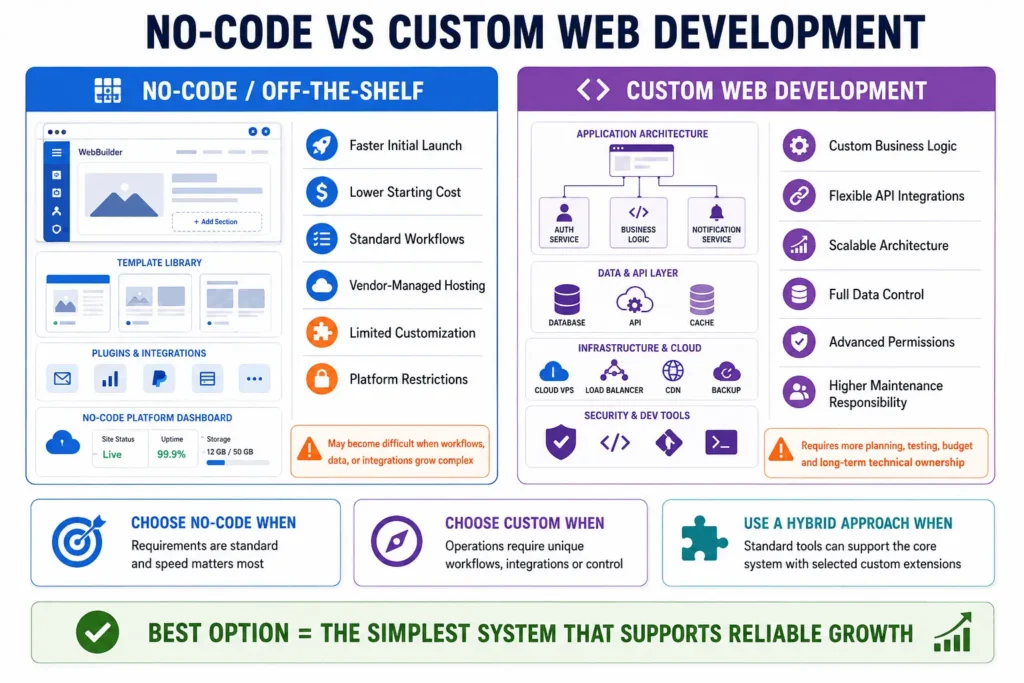
Cheap Development, No-Code, or Maintainable Engineering?
The cheapest launch option is not always the lowest-cost operating model. What do web developers do differently in maintainable projects? They create clear ownership, predictable data models, tests, logging, deployment controls, and extension points that reduce the cost of future changes.
| Feature | Fast or Off-the-Shelf Approach | Engineered Custom Approach |
|---|---|---|
| Initial delivery | Usually faster with templates, plugins, or no-code tools | Slower because workflows and architecture are designed explicitly |
| Flexibility | Limited by vendor rules and available extensions | High, but every custom feature adds ownership and maintenance |
| Scaling | Works well until traffic, data, or workflow complexity exceeds platform assumptions | Can scale deliberately when performance and data boundaries are designed well |
| Operational risk | Plugin conflicts, vendor lock-in, hidden limits, difficult debugging | Higher engineering responsibility, testing cost, and infrastructure complexity |
| Best fit | Validated workflows, smaller budgets, standard requirements | Differentiated operations, complex integrations, compliance, or sustained scale |
Custom engineering is not automatically better. It creates code that the business must fund, secure, document, and maintain. Off-the-shelf tools are often correct when the workflow is standard. Custom systems become justified when platform limitations repeatedly force manual work, unreliable integrations, or costly compromises.
When Should a Business Bring in Experienced Web Developers?
A business needs deeper engineering support when releases break existing features, integrations require manual reconciliation, checkout slows, permissions become inconsistent, or reporting cannot be trusted. These are system-design problems, not cosmetic issues.
Filicode works across custom software, WordPress, WooCommerce, AI automation, API integrations, SaaS architecture, and performance optimization. What do web developers do at Filicode? They map the operating workflow first, then select the smallest architecture that can meet reliability and growth requirements.
Some companies need a custom WordPress website build to control content, workflows, and integrations, while others need ongoing backend ownership from a dedicated PHP developer. The decision should follow the operational bottleneck, not a preferred technology.
Frequently Asked Questions
What do web developers do on a daily basis?
What do web developers do daily? They review requirements, write and test code, investigate bugs, manage databases and APIs, deploy releases, and monitor production behavior. The balance changes by product stage and team size.
What factors affect web development cost?
Web development cost depends on the number of workflows, design complexity, integrations, security requirements, data migration, testing, hosting, and ongoing support. A small marketing site may require tens of development hours, while a custom SaaS or marketplace can require several months.
How long does a web development project take?
A focused website can often be delivered in 4 to 8 weeks. Complex platforms commonly need 3 to 9 months because architecture, integrations, permissions, migration, testing, and phased deployment add real implementation work.
What do web developers do to scale an existing website?
Web developers begin scaling with measurement. They profile database queries, application code, API latency, cache behavior, queue throughput, and infrastructure limits before changing architecture or adding capacity.
Do web developers need a degree?
Web developers do not always need a degree. Education requirements vary by employer and role, while practical projects, coding ability, debugging skills, systems knowledge, and communication can also influence hiring decisions.
Are web developers in demand?
In the United States, the Bureau of Labor Statistics projects employment of web developers and digital designers to grow 7 percent from 2024 to 2034. Demand varies by location, specialization, industry, and economic conditions.
What Do Web Developers Do When Growth Exposes System Limits?
When traffic, data, integrations, or internal workflows outgrow the platform, developers identify the constraint creating operational cost. Warning signs include outages, slow admin tools, duplicate data, manual reconciliation, failed jobs, weak permission workarounds, and emergency fixes.
What do web developers do at that stage? They measure the bottleneck, stabilize critical workflows, remove unnecessary complexity, and create a phased improvement plan. Custom development should be considered when standard tools can no longer support reliable operations without repeated workarounds.
The practical next step is a technical review of architecture, code quality, database behavior, integrations, deployment, monitoring, and support history. It should show what must be fixed now, what can remain unchanged, and which investments reduce future operating cost.